All About Desert Life
Đọc · Nghe · Từ vựng · Bài tập · Dự án · Từ điển tranh
What Is a Desert?
1 Đọc trang sách
2 Đọc & Nghe
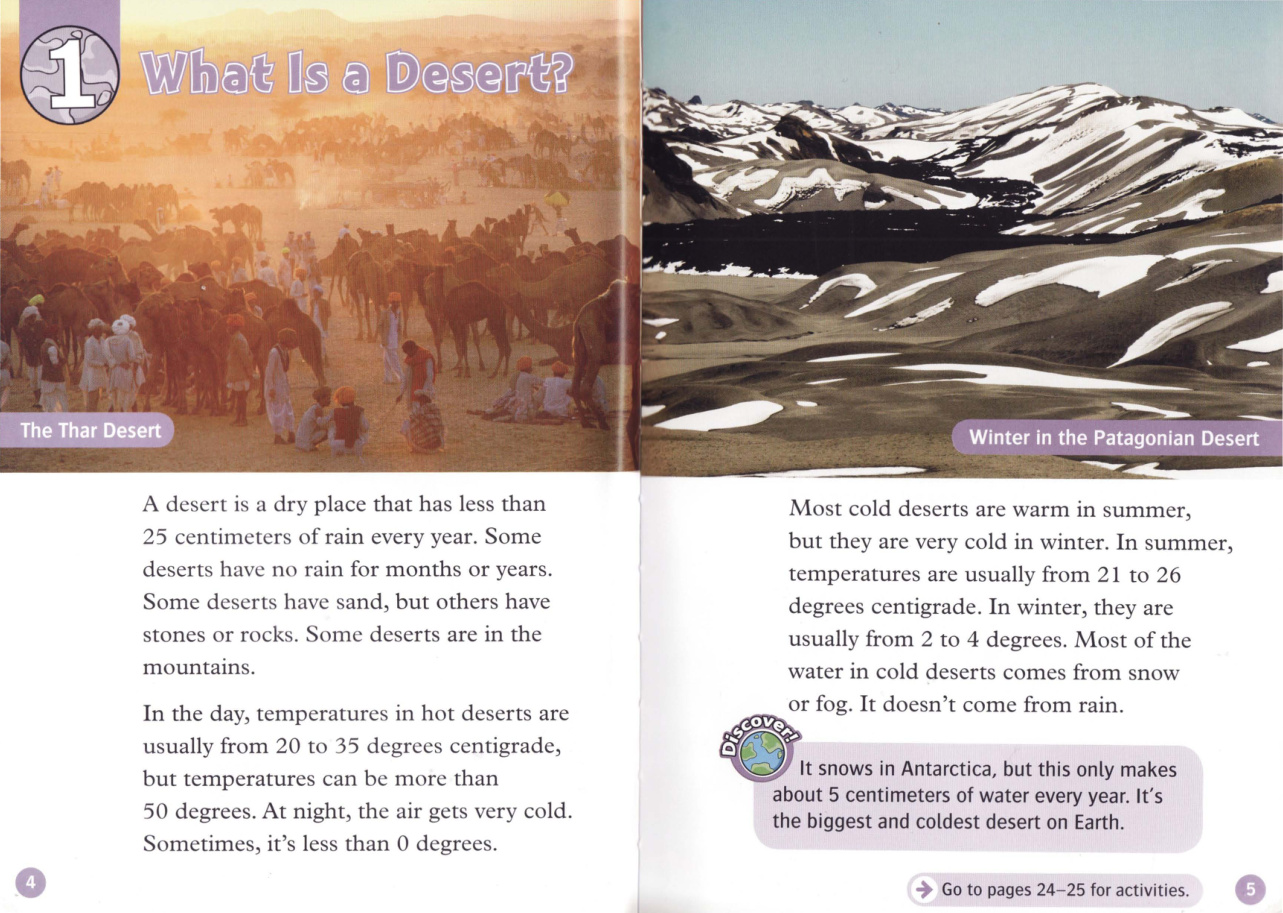
A desert is a dry place that has less than 25 centimeters of rain every year. Some deserts have no rain for months or years.
Some deserts have sand, but others have stones or rocks. Some deserts are in the mountains.
In the day, temperatures in hot deserts are usually from 20 to 35 degrees centigrade, but temperatures can be more than 50 degrees. At night, the air gets very cold. Sometimes, it's less than 0 degrees.
Most cold deserts are warm in summer, but they are very cold in winter. In summer, temperatures are usually from 21 to 26 degrees centigrade. In winter, they are usually from 2 to 4 degrees.
Most of the water in cold deserts comes from snow or fog. It doesn't come from rain.
It snows in Antarctica, but this only makes about 5 centimeters of water every year. It's the biggest and coldest desert on Earth.
Từ vựng
3 Xem trang bài tập
4 Bài tập tương tác
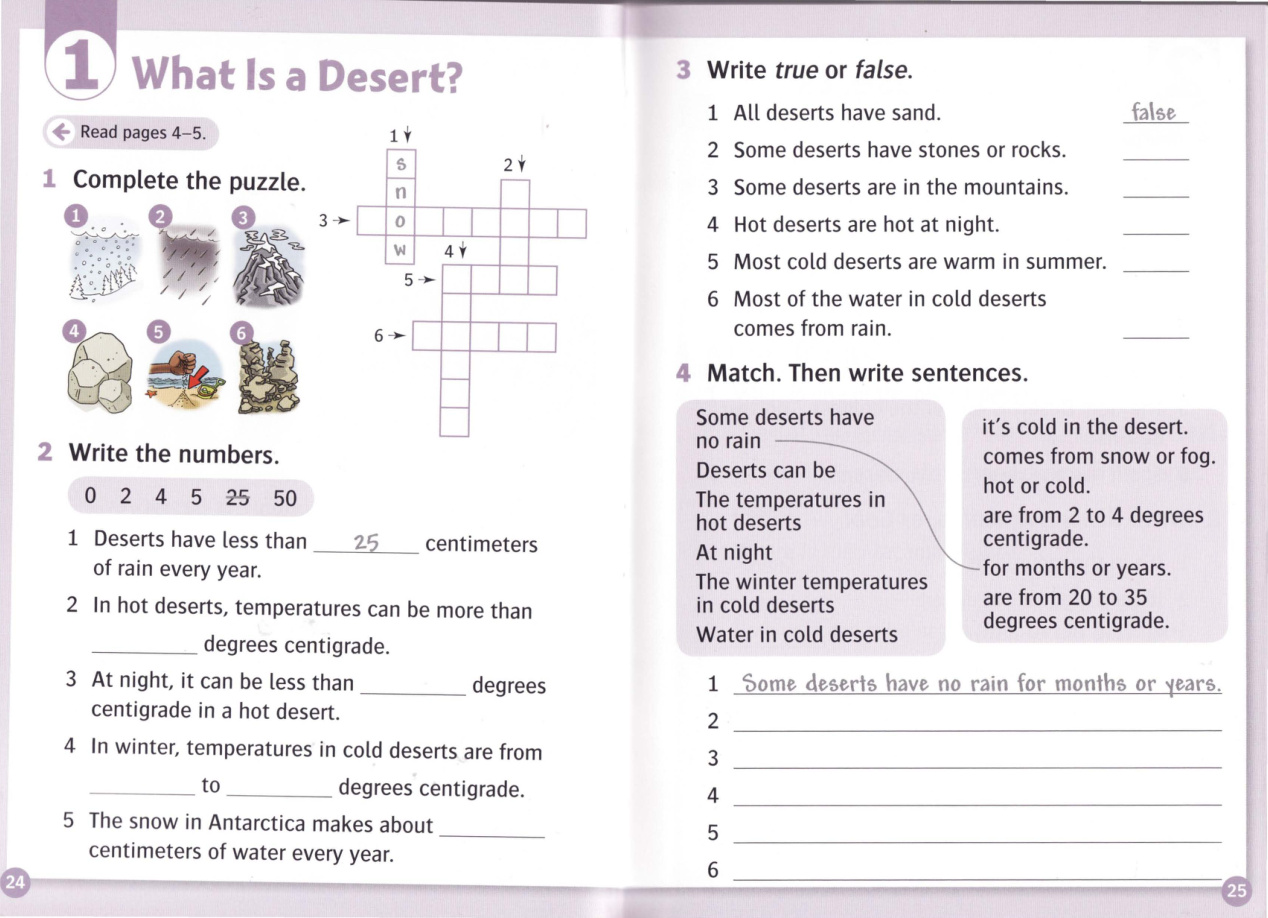
1. Puzzle picture 1: Write the word.
2. Puzzle picture 2: Write the word.
3. Puzzle picture 3: Write the word.
4. Puzzle picture 4: Write the word.
5. Puzzle picture 5: Write the word.
6. Puzzle picture 6: Write the word.
7. Deserts have less than ____ centimeters of rain every year.
8. In hot deserts, temperatures can be more than ____ degrees centigrade.
9. At night, it can be less than ____ degrees centigrade in a hot desert.
10. In winter, temperatures in cold deserts are from ____ to ____ degrees centigrade.
11. The snow in Antarctica makes about ____ centimeters of water every year.
12. All deserts have sand.
13. Some deserts have stones or rocks.
14. Some deserts are in the mountains.
15. Hot deserts are hot at night.
16. Most cold deserts are warm in summer.
17. Most of the water in cold deserts comes from rain.
18. Some deserts have no rain …
19. Deserts can be …
20. The temperatures in hot deserts …
21. At night …
22. The winter temperatures in cold deserts …
23. Water in cold deserts …
Different Deserts
1 Đọc trang sách
2 Đọc & Nghe
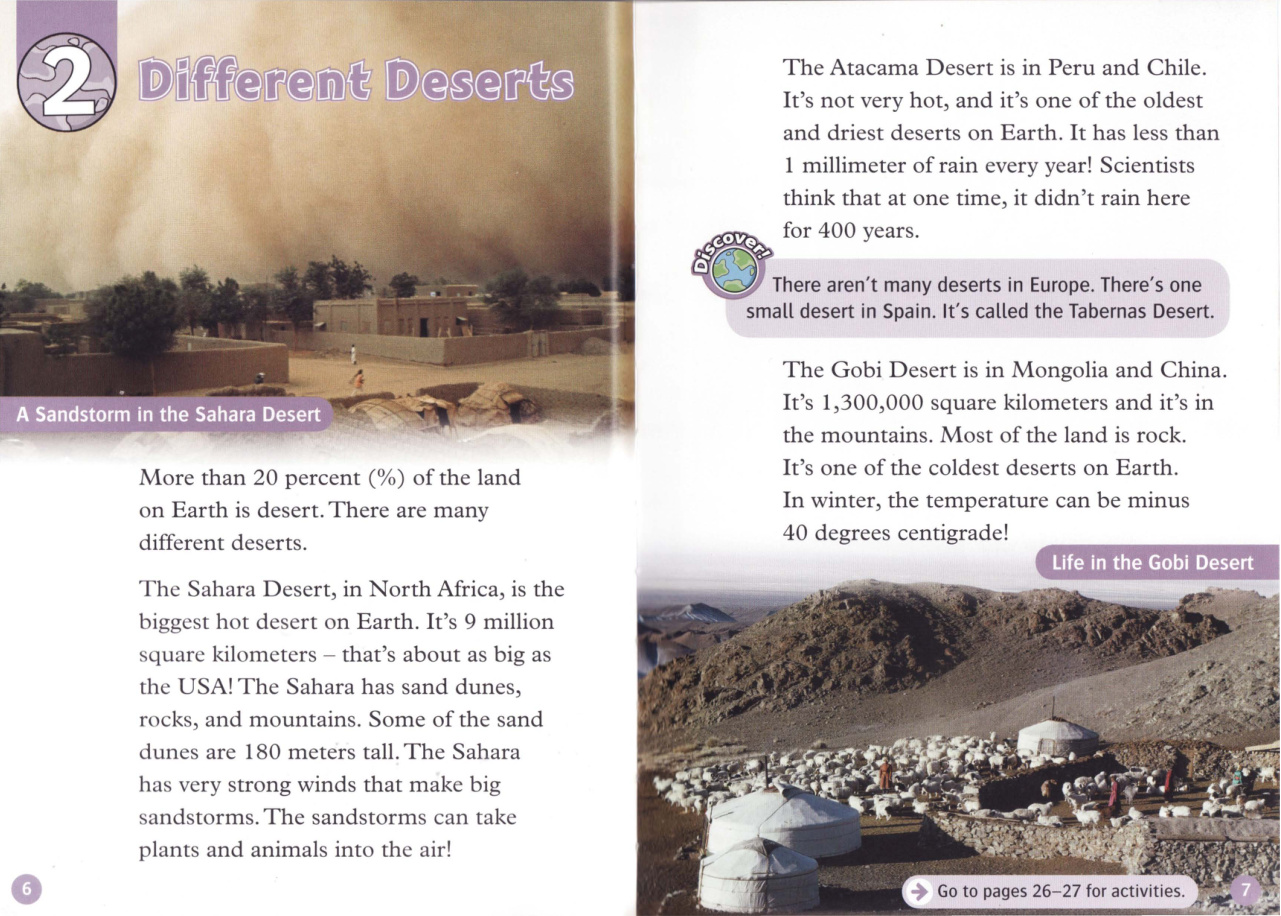
More than 20 percent of the land on Earth is desert. There are many different deserts.
The Sahara Desert, in North Africa, is the biggest hot desert on Earth. It's 9 million square kilometers – that's about as big as the USA!
The Sahara has sand dunes, rocks, and mountains. Some of the sand dunes are 180 meters tall. The Sahara has very strong winds that make big sandstorms.
The Atacama Desert is in Peru and Chile. It's not very hot, and it's one of the oldest and driest deserts on Earth. It has less than 1 millimeter of rain every year.
There aren't many deserts in Europe. There's one small desert in Spain. It's called the Tabernas Desert.
The Gobi Desert is in Mongolia and China. Most of the land is rock. It's one of the coldest deserts on Earth. In winter, the temperature can be minus 40 degrees centigrade.
Từ vựng
3 Xem trang bài tập
4 Bài tập tương tác
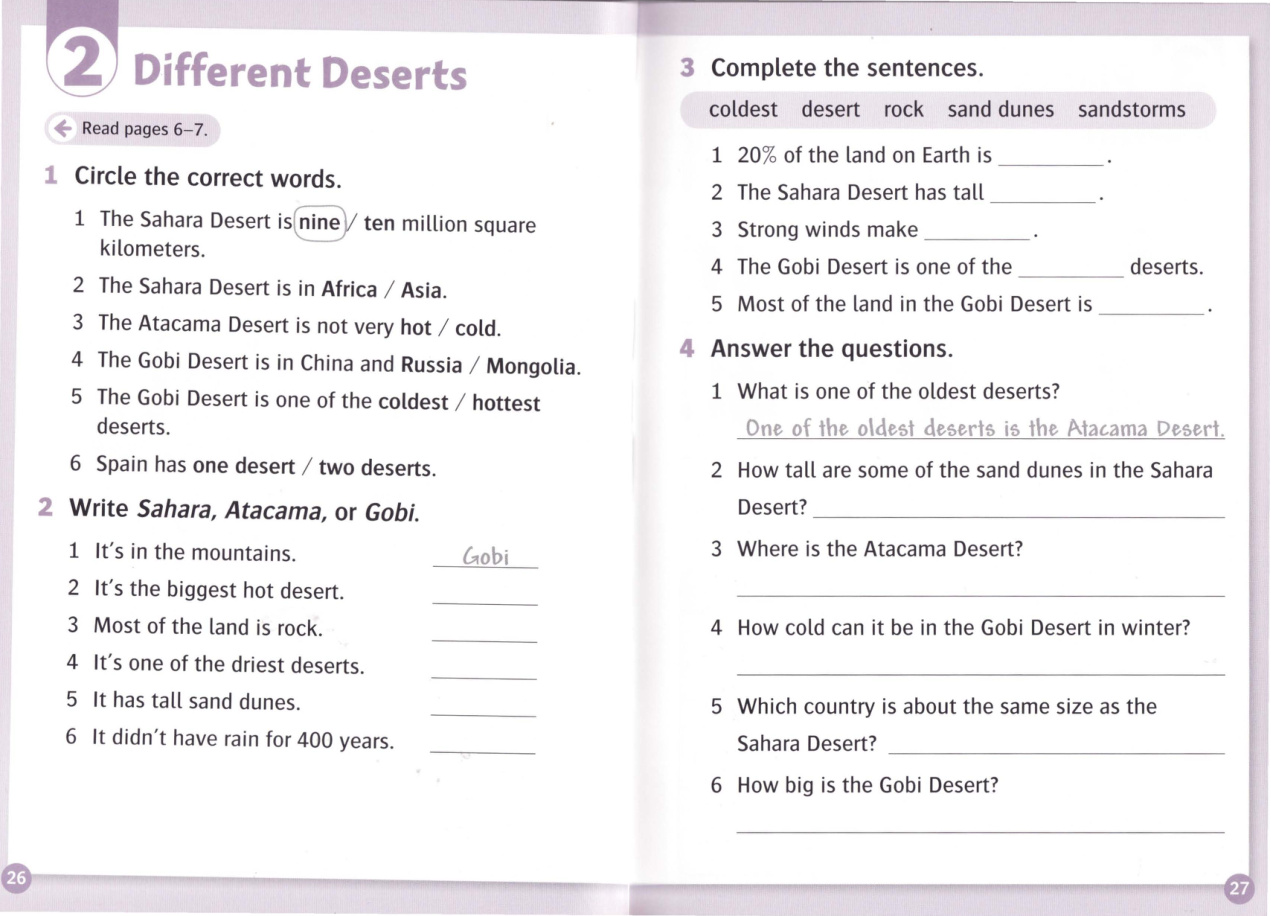
1. The Sahara Desert is nine / ten million square kilometers.
2. The Sahara Desert is in Africa / Asia.
3. The Atacama Desert is not very hot / cold.
4. The Gobi Desert is in China and Russia / Mongolia.
5. The Gobi Desert is one of the coldest / hottest deserts.
6. Spain has one desert / two deserts.
7. It's in the mountains.
8. It's the biggest hot desert.
9. Most of the land is rock.
10. It's one of the driest deserts.
11. It has tall sand dunes.
12. It didn't have rain for 400 years.
13. 20% of the land on Earth is ____.
14. The Sahara Desert has tall ____.
15. Strong winds make ____.
16. The Gobi Desert is one of the ____ deserts.
17. Most of the land in the Gobi Desert is ____.
18. What is one of the oldest deserts?
19. How tall are some of the sand dunes in the Sahara Desert?
20. Where is the Atacama Desert?
21. How cold can it be in the Gobi Desert in winter?
22. Which country is about the same size as the Sahara Desert?
23. How big is the Gobi Desert?
Plants
1 Đọc trang sách
2 Đọc & Nghe
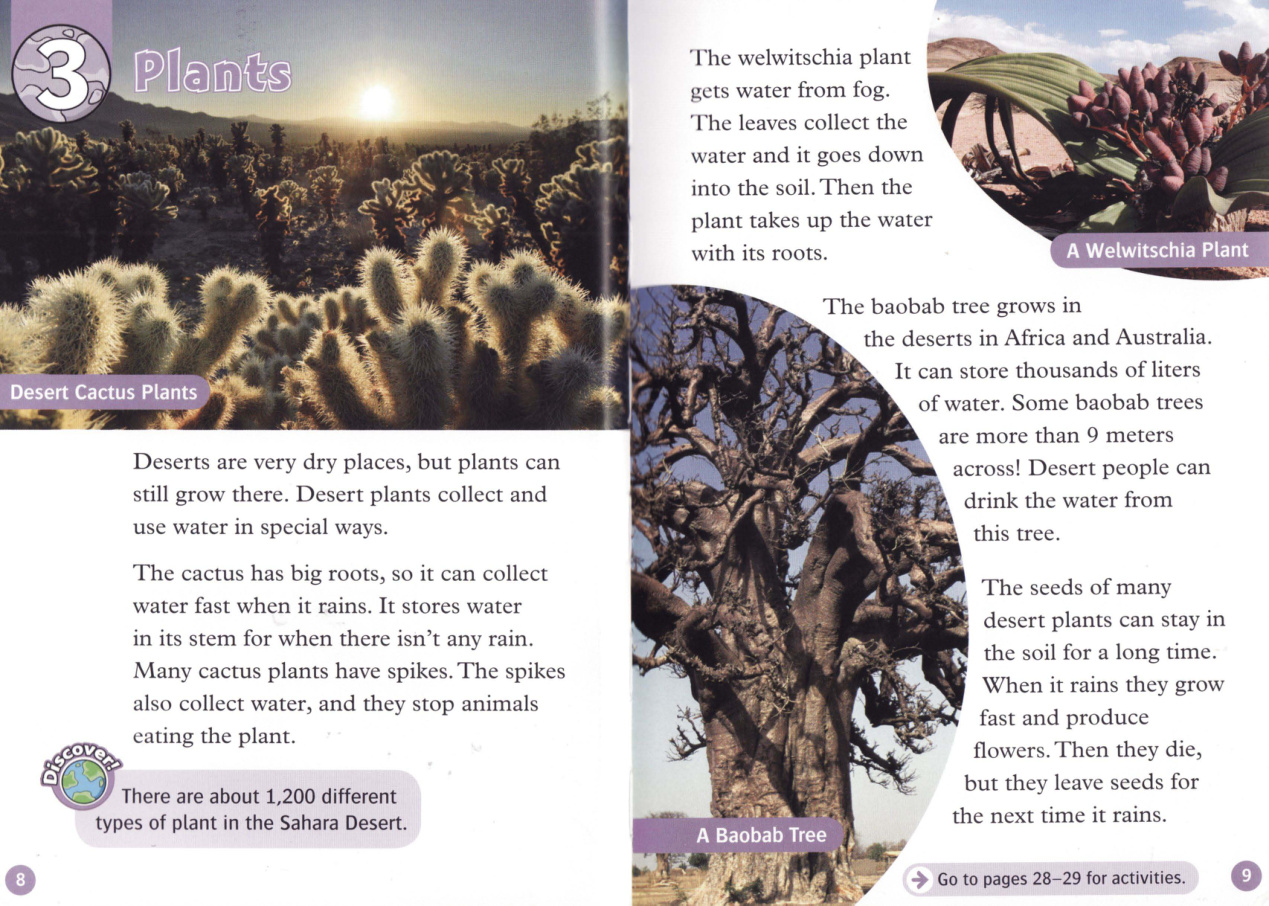
Deserts are very dry places, but plants can still grow there. Desert plants collect and use water in special ways.
The cactus has big roots, so it can collect water fast when it rains. It stores water in its stem for when there isn't any rain.
Many cactus plants have spikes. The spikes also collect water, and they stop animals eating the plant.
There are about 1,200 different types of plant in the Sahara Desert.
The welwitschia plant gets water from fog. The leaves collect the water and it goes down into the soil. Then the plant takes up the water with its roots.
The baobab tree grows in the deserts in Africa and Australia. It can store thousands of liters of water.
The seeds of many desert plants can stay in the soil for a long time. When it rains they grow fast and produce flowers. Then they die, but they leave seeds for the next time it rains.
Từ vựng
3 Xem trang bài tập

4 Bài tập tương tác
1. Picture 1: Write the word.
2. Picture 2: Write the word.
3. Picture 3: Write the word.
4. Picture 4: Write the word.
5. Picture 5: Write the word.
6. Picture 6: Write the word.
7. Cactus: It can have ____.
8. Cactus: It collects ____ fast.
9. Baobab: It's a ____ tree.
10. Baobab: It can be more than ____ across.
11. Welwitschia: It collects water on its ____.
12. Welwitschia: It can get water from ____.
13. Deserts are ____ places.
14. The cactus has ____ roots.
15. Some plants can ____ a lot of water.
16. Baobab trees ____ in Africa and Australia.
17. Plant seeds can stay in the ____ for a long time.
18. The welwitschia gets water from ____.
19. Why does the cactus have big roots?
20. What do the spikes on cactus plants do?
21. How much water can a baobab tree store?
22. How big are some baobab trees?
23. What part of the welwitschia plant collects water?
24. What do seeds do when it rains in the desert?
Animals
1 Đọc trang sách
2 Đọc & Nghe
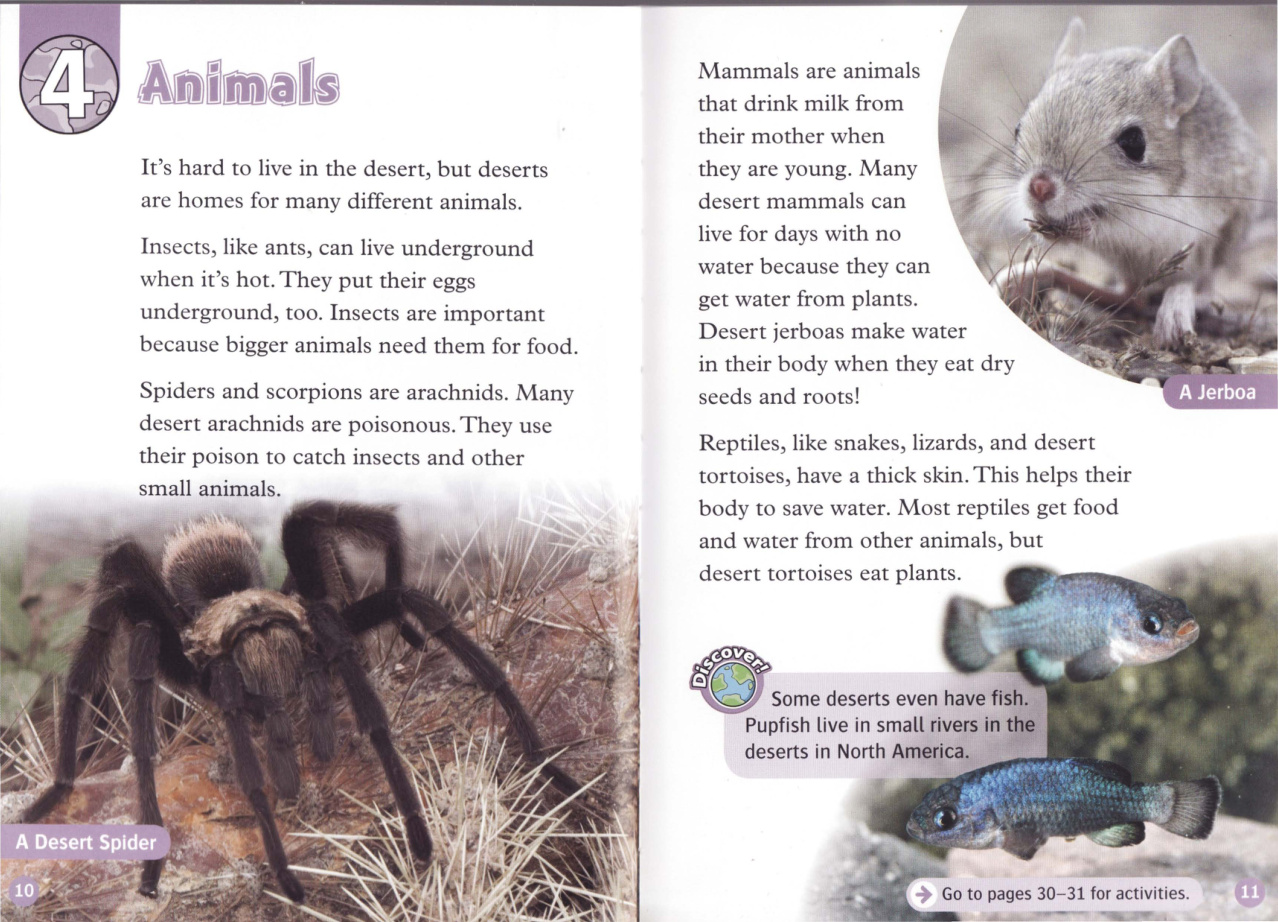
It's hard to live in the desert, but deserts are homes for many different animals.
Insects, like ants, can live underground when it's hot. They put their eggs underground, too. Insects are important because bigger animals need them for food.
Spiders and scorpions are arachnids. Many desert arachnids are poisonous. They use their poison to catch insects and other small animals.
Mammals are animals that drink milk from their mother when they are young. Many desert mammals can live for days with no water because they can get water from plants.
Desert jerboas make water in their body when they eat dry seeds and roots.
Reptiles, like snakes, lizards, and desert tortoises, have a thick skin. This helps their body to save water.
Most reptiles get food and water from other animals, but desert tortoises eat plants.
Từ vựng
3 Xem trang bài tập

4 Bài tập tương tác
1. Desert insects can live underground.
2. Other animals in the desert eat insects.
3. Scorpions and spiders are insects.
4. Some mammals get water from plants.
5. Desert jerboas make water in their body.
6. Snakes and lizards only eat plants.
7. Insects: ant
8. Mammals: jerboa
9. Arachnids: scorpion
10. Arachnids: spider
11. Reptiles: snake
12. Reptiles: lizard
13. Picture 1: Write the word.
14. Picture 2: Write the word.
15. Picture 3: Write the word.
16. Picture 4: Write the word.
17. Picture 5: Write the word.
18. Picture 6: Write the word.
19. Desert jerboas eat roots and dry ____.
20. Desert arachnids use ____ to catch other animals.
21. Many mammals get their water from ____.
22. Reptiles have a thick ____.
23. Insects are food for ____ animals.
24. Desert ____ don't eat other animals.
Day and Night
1 Đọc trang sách
2 Đọc & Nghe
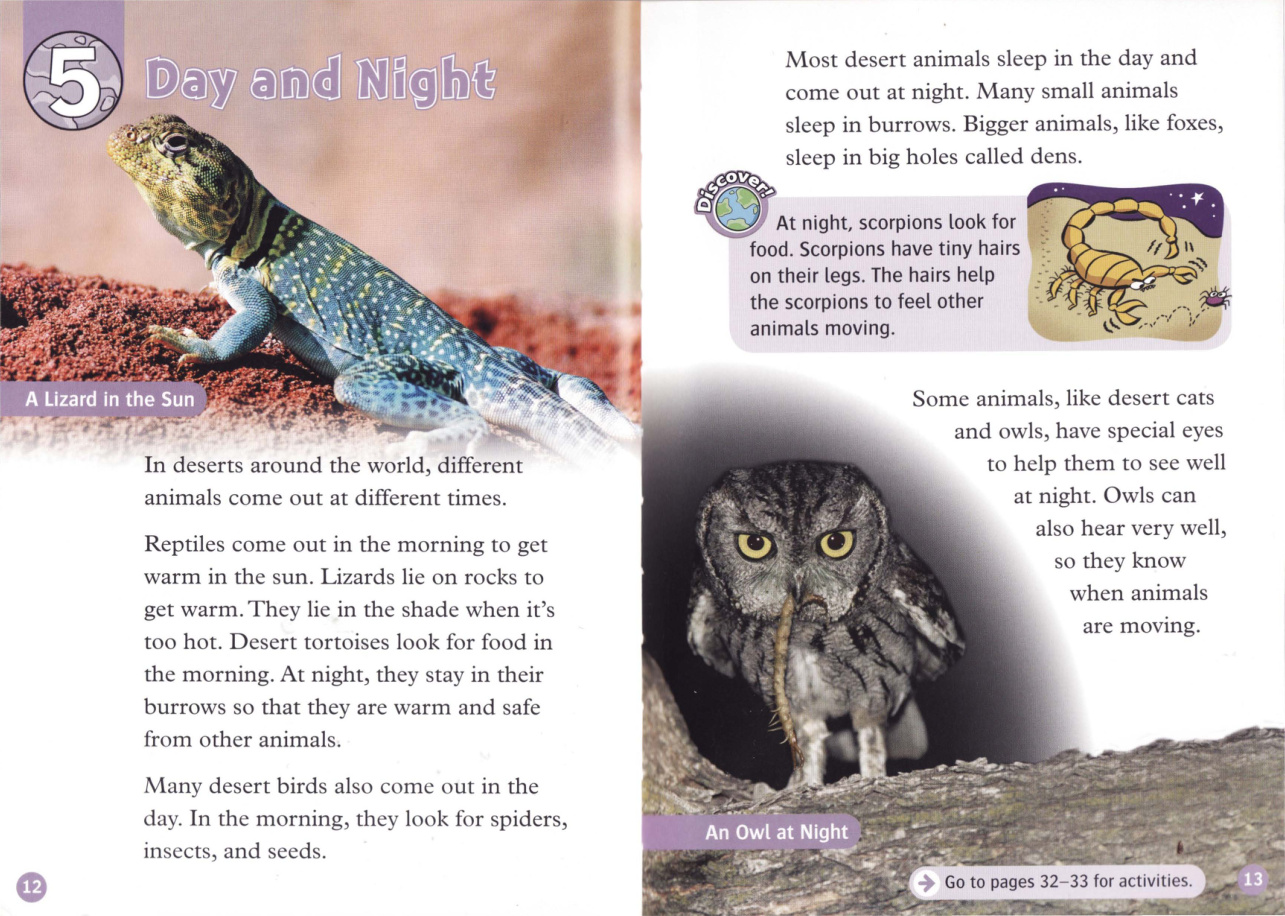
In deserts around the world, different animals come out at different times.
Reptiles come out in the morning to get warm in the sun. Lizards lie on rocks to get warm. They lie in the shade when it's too hot.
Desert tortoises look for food in the morning. At night, they stay in their burrows so that they are warm and safe from other animals.
Many desert birds also come out in the day. In the morning, they look for spiders, insects, and seeds.
Most desert animals sleep in the day and come out at night. Many small animals sleep in burrows. Bigger animals, like foxes, sleep in big holes called dens.
At night, scorpions look for food. Scorpions have tiny hairs on their legs. The hairs help the scorpions to feel other animals moving.
Some animals, like desert cats and owls, have special eyes to help them to see well at night. Owls can also hear very well.
Từ vựng
3 Xem trang bài tập

4 Bài tập tương tác
1. Animals that come out in the day: lizards
2. Animals that come out in the day: many birds
3. Animals that come out in the day: desert tortoises
4. Animals that come out at night: scorpions
5. Animals that come out at night: desert cats
6. Animals that come out at night: foxes
7. Animals that come out at night: owls
8. Reptiles come out ____.
9. Scorpions look for food ____.
10. Lizards lie on rocks ____.
11. Desert tortoises stay in their burrows ____.
12. Many birds look for food ____.
13. Owls have special eyes to see well ____.
14. Different animals have different ways to find ____ at night.
15. Desert cats have special eyes to help them to ____ well at night.
16. Owls can hear very ____.
17. Scorpions have tiny ____ on their legs.
18. Scorpions can ____ other animals moving.
19. Order the words: warm. / lie / Lizards / get / on / to / rocks
20. Order the words: in / Tortoises / the / food / morning. / look / for
21. Order the words: desert / the / Most / in / day. / sleep / animals
22. Order the words: in / animals / burrows. / sleep / Small
23. Order the words: their / Scorpions / legs. / hairs / have / on / tiny
24. Order the words: see / Desert cats / well / at / night. / can
People
1 Đọc trang sách

2 Đọc & Nghe
About 13 percent of all the people in the world live in deserts. Some people lived in deserts a long time ago.
Aborigines were the first people of Australia. They lived in the deserts in Australia more than 40,000 years ago. Aborigines use art to tell stories.
Tuareg people lived in the Sahara Desert more than 2,000 years ago. They are called the blue people because of the color of their clothes.
Traditional Tuaregs travel across the desert on camels. They live in tents made from animal skins and wood.
Bedouin people lived in the deserts hundreds of years ago. They live in the Middle East and North Africa.
Traditional Bedouins are traveling farmers. They live in tents or mud houses. Today, many Bedouins work in cities.
Từ vựng
3 Xem trang bài tập
4 Bài tập tương tác
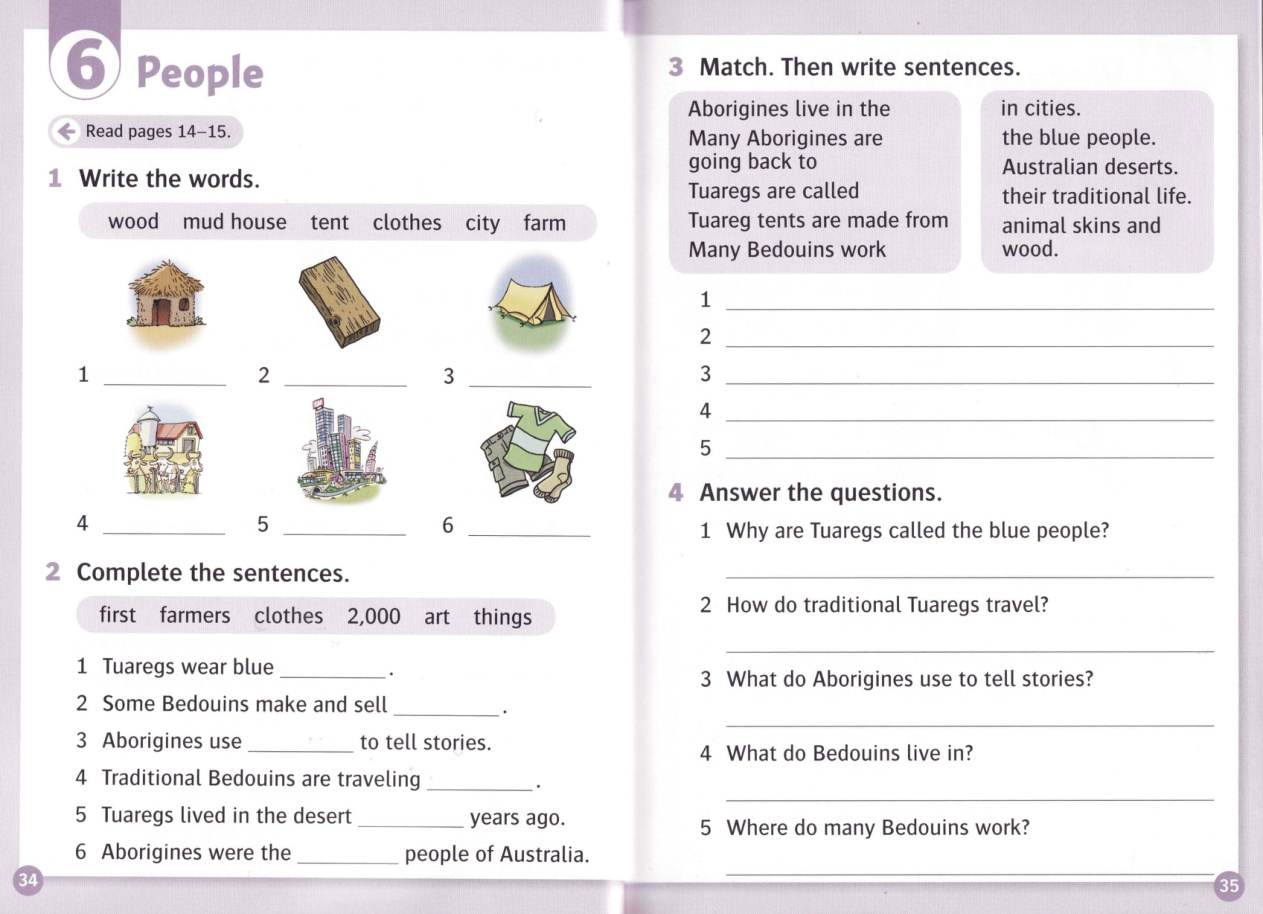
1. Picture 1: Write the word.
2. Picture 2: Write the word.
3. Picture 3: Write the word.
4. Picture 4: Write the word.
5. Picture 5: Write the word.
6. Picture 6: Write the word.
7. Tuaregs wear blue ____.
8. Some Bedouins make and sell ____.
9. Aborigines use ____ to tell stories.
10. Traditional Bedouins are traveling ____.
11. Tuaregs lived in the desert ____ years ago.
12. Aborigines were the ____ people of Australia.
13. Aborigines live in the …
14. Many Aborigines are going back to …
15. Tuaregs are called …
16. Tuareg tents are made from …
17. Many Bedouins work …
18. Why are Tuaregs called the blue people?
19. How do traditional Tuaregs travel?
20. What do Aborigines use to tell stories?
21. What do Bedouins live in?
22. Where do many Bedouins work?
Water in the Desert
1 Đọc trang sách

2 Đọc & Nghe
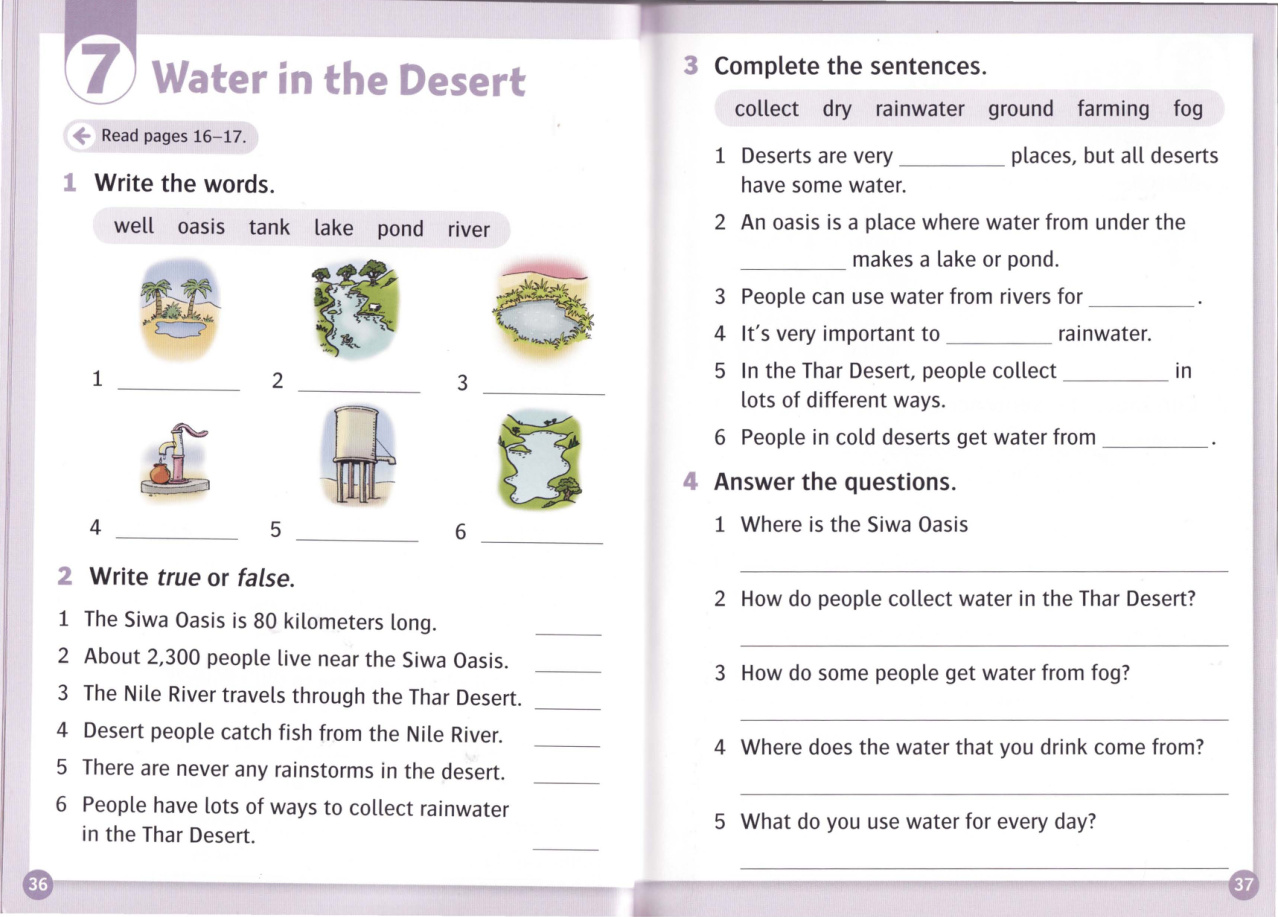
Deserts are very dry places, but all deserts have some water.
An oasis is a place where water from under the ground makes a lake or pond. Some oases are small, but some are very big.
The Siwa Oasis in Egypt is 80 kilometers long and 20 kilometers across. About 23,000 people live here.
Some deserts have rivers. The Nile River travels through the Sahara Desert. Many people live near this river. They can catch fish and use the water for farming.
In some deserts, there are big rainstorms. Then there's no more rain for a long time. So it's very important to collect rainwater.
In the Thar Desert, people collect water in ponds, wells, and big tanks.
People in some cold deserts use nets to collect the water from fog. Each net can catch about 14 liters of water every day.
Từ vựng
3 Xem trang bài tập
4 Bài tập tương tác
1. Picture 1: Write the word.
2. Picture 2: Write the word.
3. Picture 3: Write the word.
4. Picture 4: Write the word.
5. Picture 5: Write the word.
6. Picture 6: Write the word.
7. The Siwa Oasis is 80 kilometers long.
8. About 2,300 people live near the Siwa Oasis.
9. The Nile River travels through the Thar Desert.
10. Desert people catch fish from the Nile River.
11. There are never any rainstorms in the desert.
12. People have lots of ways to collect rainwater in the Thar Desert.
13. Deserts are very ____ places, but all deserts have some water.
14. An oasis is a place where water from under the ____ makes a lake or pond.
15. People can use water from rivers for ____.
16. It's very important to ____ rainwater.
17. In the Thar Desert, people collect ____ in lots of different ways.
18. People in cold deserts get water from ____.
19. Where is the Siwa Oasis?
20. How do people collect water in the Thar Desert?
21. How do some people get water from fog?
22. Where does the water that you drink come from?
23. What do you use water for every day?
Staying Cool
1 Đọc trang sách
2 Đọc & Nghe
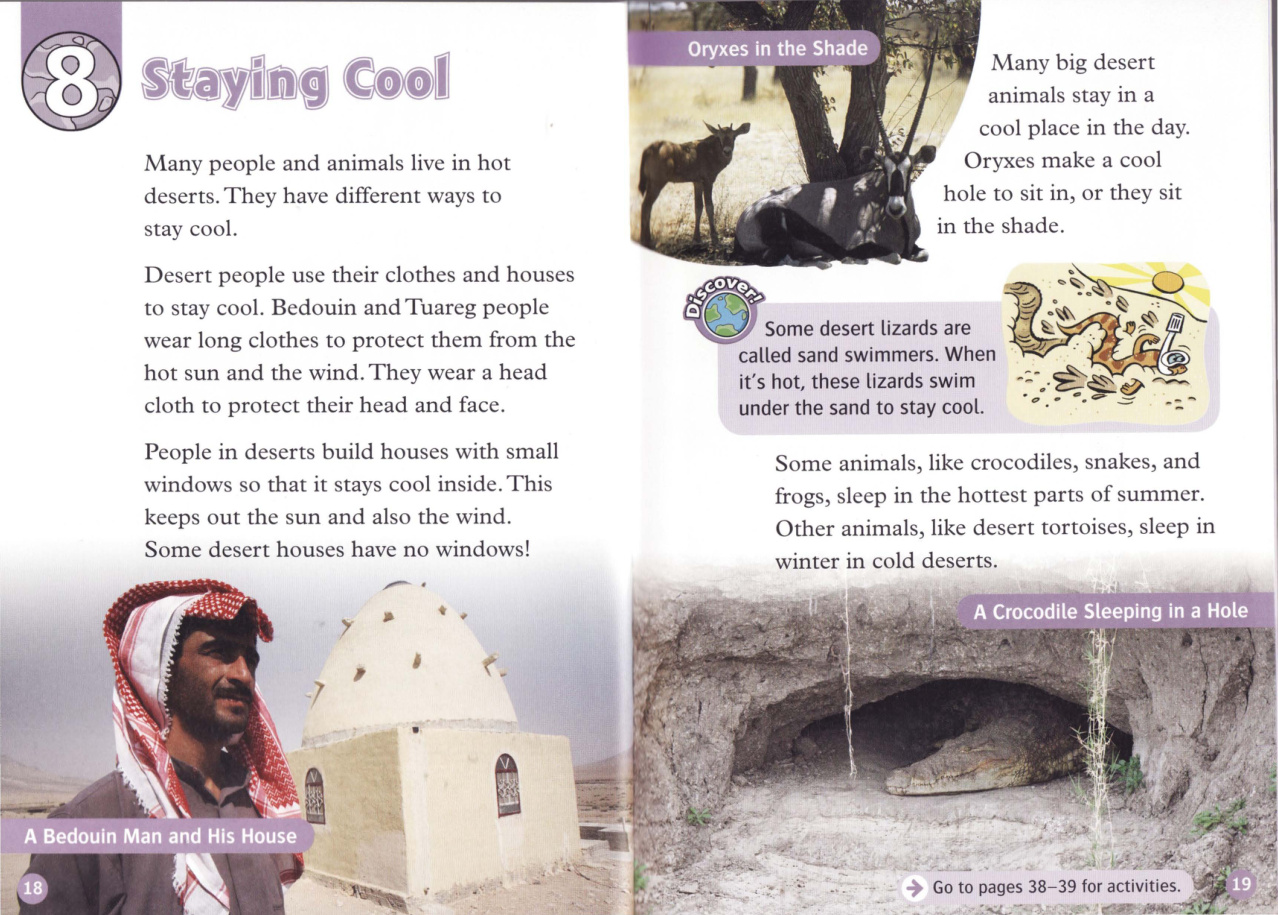
Many people and animals live in hot deserts. They have different ways to stay cool.
Desert people use their clothes and houses to stay cool. Bedouin and Tuareg people wear long clothes to protect them from the hot sun and the wind.
They wear a head cloth to protect their head and face.
People in deserts build houses with small windows so that it stays cool inside. This keeps out the sun and also the wind.
Many big desert animals stay in a cool place in the day. Oryxes make a cool hole to sit in, or they sit in the shade.
Some desert lizards are called sand swimmers. When it's hot, these lizards swim under the sand to stay cool.
Some animals, like crocodiles, snakes, and frogs, sleep in the hottest parts of summer. Other animals, like desert tortoises, sleep in winter in cold deserts.
Từ vựng
3 Xem trang bài tập

4 Bài tập tương tác
1. People wear long …
2. People wear a head cloth to …
3. Some desert houses …
4. The houses keep out …
5. ____ sit in the shade to stay cool.
6. ____ and ____ sleep in summer.
7. Desert ____ sleep in winter in cold deserts.
8. Some ____ swim under the sand to stay cool.
9. Some animals make a cool ____ to sit in.
10. People wear long ____ to stay cool.
11. Order the words: live / people / in / animals / deserts. / and / Many
12. Order the words: Desert / clothes / cool. / use / to / people / stay
13. Order the words: no / desert / have / houses / windows. / Some
14. Order the words: a / place. / Big / cool / in / animals / stay
15. Order the words: in / Some / sleep / summer. / animals
16. Order the words: swim / lizards / sand. / under / Some / can / the
17. What do some desert people wear to protect their face?
18. Why do people build houses with small windows?
19. What can big desert animals do to stay cool?
20. How do some lizards stay cool?
Living in the Desert
1 Đọc trang sách

2 Đọc & Nghe
Living in the desert is very different from living in a city, but people still cook, travel, and go to school.
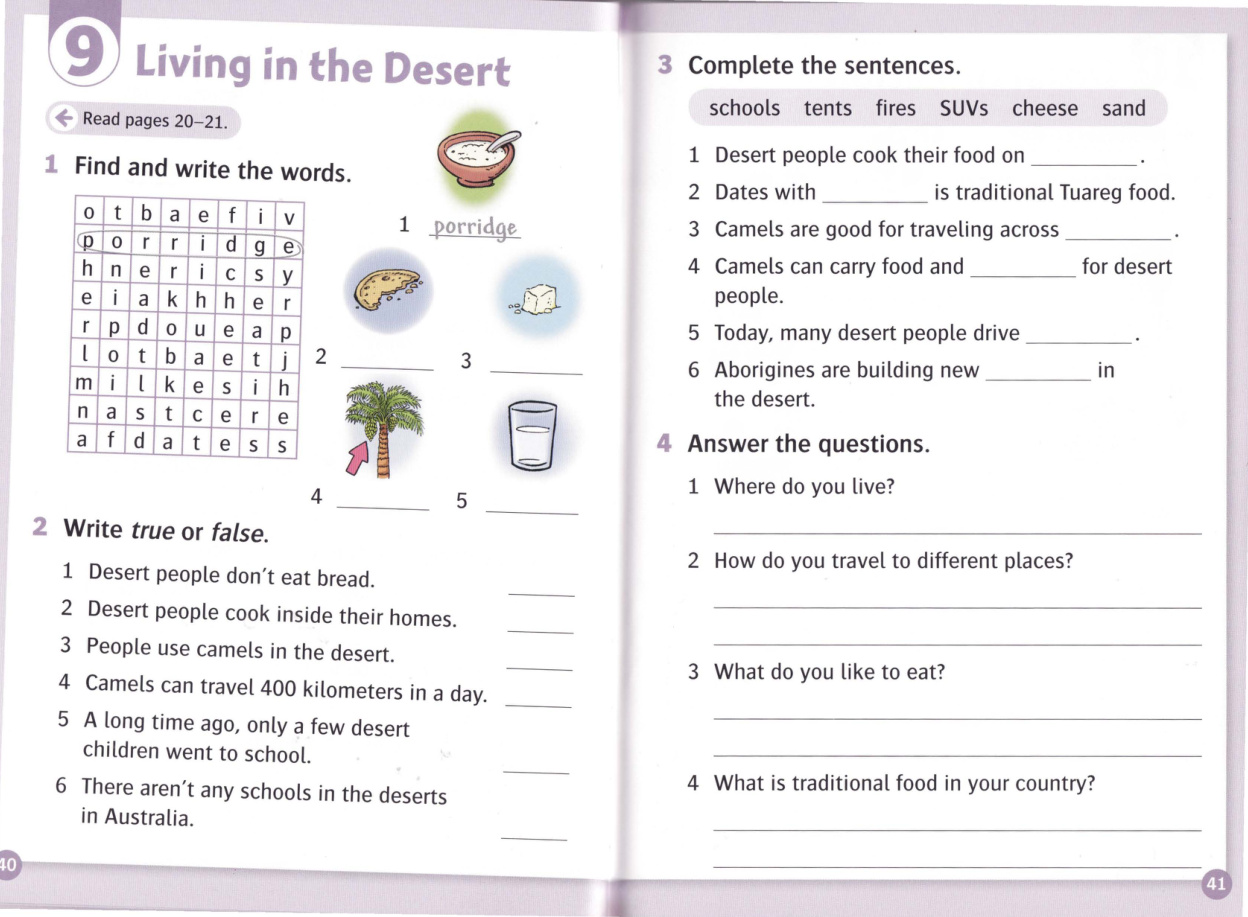
Most desert people eat bread, porridge, milk, cheese, and food from desert plants.
They cook their food on a fire outside their home. Dates grow well in deserts. Dates with cheese is traditional Tuareg food.
Today, many desert people drive SUVs, but camels are better for traveling across sand.
Camels can travel more than 40 kilometers in a day. They are strong animals. Desert people can use camels to carry food, tents, and other things from their homes.
A long time ago, only a few desert children went to school, but this is changing.
In the deserts in Australia, Aborigines are building new schools. Students speak their own language, and they also learn English.
Từ vựng
3 Xem trang bài tập
4 Bài tập tương tác
1. Word-search picture 1: Write the word.
2. Word-search picture 2: Write the word.
3. Word-search picture 3: Write the word.
4. Word-search picture 4: Write the word.
5. Word-search picture 5: Write the word.
6. Desert people don't eat bread.
7. Desert people cook inside their homes.
8. People use camels in the desert.
9. Camels can travel 400 kilometers in a day.
10. A long time ago, only a few desert children went to school.
11. There aren't any schools in the deserts in Australia.
12. Desert people cook their food on ____.
13. Dates with ____ is traditional Tuareg food.
14. Camels are good for traveling across ____.
15. Camels can carry food and ____ for desert people.
16. Today, many desert people drive ____.
17. Aborigines are building new ____ in the desert.
18. Where do you live?
Câu trả lời tự do — không tính vào điểm.19. How do you travel to different places?
Câu trả lời tự do — không tính vào điểm.20. What do you like to eat?
Câu trả lời tự do — không tính vào điểm.21. What is traditional food in your country?
Câu trả lời tự do — không tính vào điểm.Desertification
1 Đọc trang sách

2 Đọc & Nghe
Deserts are getting bigger. Every year, the land around many deserts gets dry and changes into new desert. This is called desertification.
The land can get too dry when there's no rain for a long time.
Sometimes people also make the land dry. When there are too many farms in one place, animals eat all the plants, and the soil blows away.
Then new plants can't grow and there isn't food for everyone.
Desertification is a big problem in countries in Africa near the Sahara Desert.
In 50 years, these countries have lost 650,000 square kilometers of land. Millions of people here are hungry, because they can't grow food in the desert.
In many countries people are growing more trees. Trees stop the soil blowing away.
In China, people are using a wall of trees to stop desertification near the Gobi Desert. The wall is 4,000 kilometers long.
Từ vựng
3 Xem trang bài tập

4 Bài tập tương tác
1. Puzzle picture 1: Write the word.
2. Puzzle picture 2: Write the word.
3. Puzzle picture 3: Write the word.
4. Puzzle picture 4: Write the word.
5. Puzzle picture 5: Write the word.
6. Puzzle picture 6: Write the word.
7. Deserts are getting bigger.
8. Land gets dry when there's no rain.
9. It's a good idea to have lots of farms in one place.
10. People are hungry because of desertification.
11. People can grow trees to stop soil blowing away.
12. Every year, more land gets dry and changes into ____.
13. The land can get too dry when there's no ____.
14. Farm animals eat too many plants and the soil ____.
15. When plants can't grow, there isn't ____ for everyone.
16. Millions of people are ____ in Africa.
17. When can the land get too dry?
18. What happens when new plants can't grow?
19. Where is desertification a big problem?
20. How can people help to stop desertification?
Desert Projects
Trang dự án
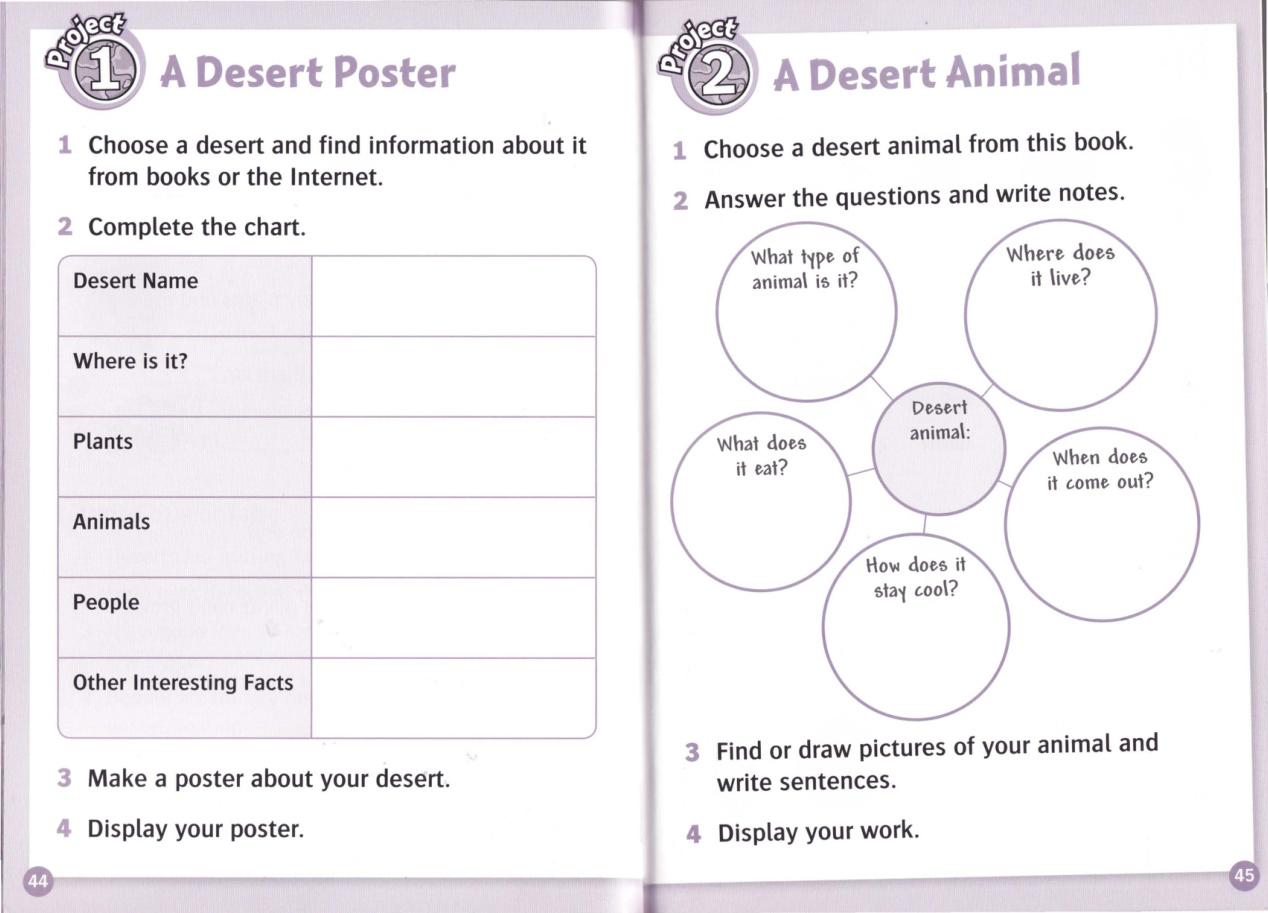
Project 1: A Desert Poster — choose a desert, find information about where it is, its plants, animals, people, and other interesting facts, then make a poster. Project 2: A Desert Animal — choose a desert animal, note its type, habitat, diet, active time, and how it stays cool, then add pictures and sentences.
Từ điển tranh
Từ điển tranh
