All About Ocean Life
Đọc · Nghe · Từ vựng · Bài tập · Dự án · Từ điển tranh
Oceans of the World
1 Đọc trang sách
2 Đọc & Nghe
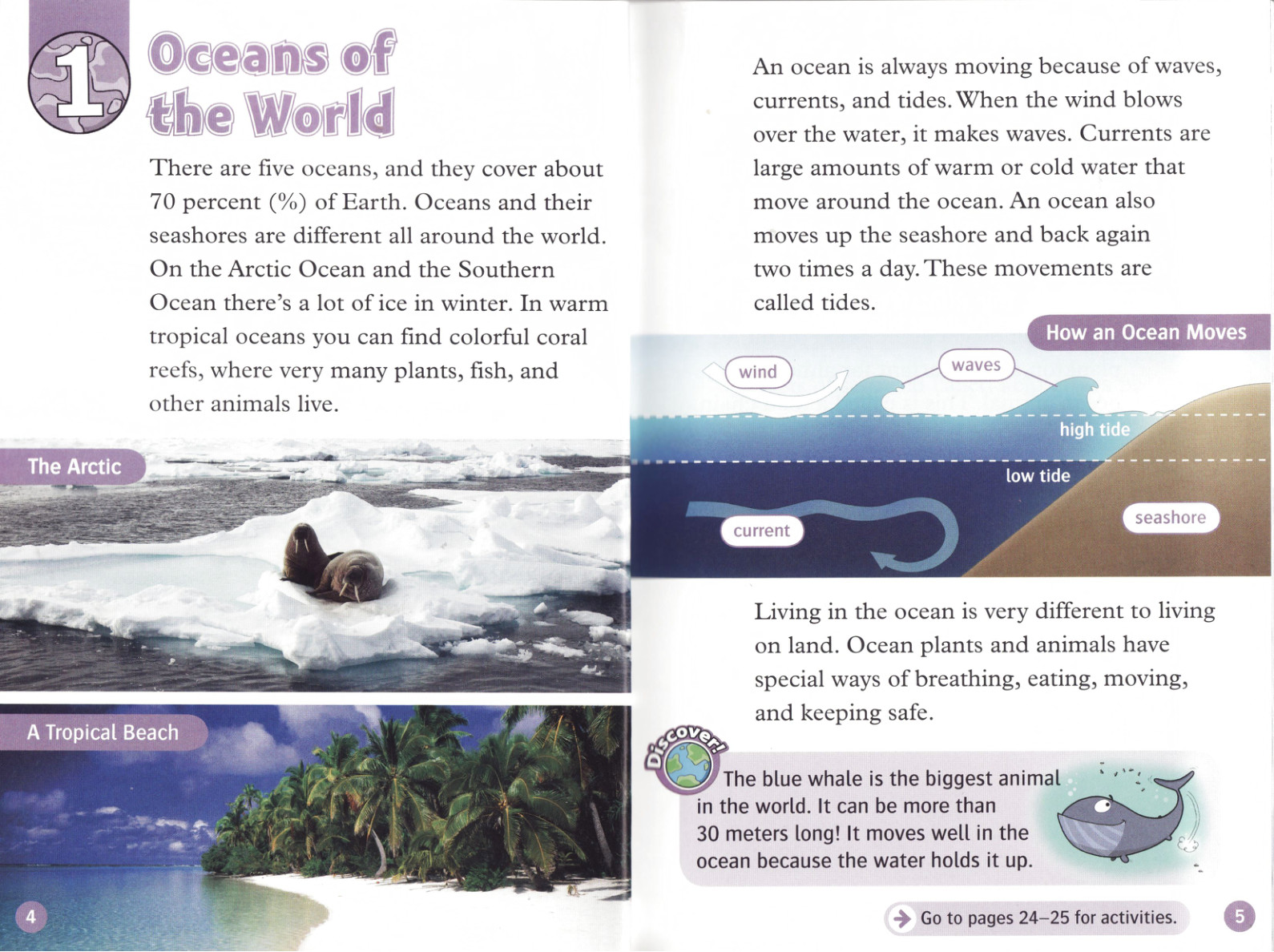
There are five oceans, and they cover about 70 percent (%) of Earth. Oceans and their seashores are different all around the world. On the Arctic Ocean and the Southern Ocean there's a lot of ice in winter. In warm tropical oceans you can find colorful coral reefs, where very many plants, fish, and other animals live.
An ocean is always moving because of waves, currents, and tides. When the wind blows over the water, it makes waves. Currents are large amounts of warm or cold water that move around the ocean. An ocean also moves up the seashore and back again two times a day. These movements are called tides.
Living in the ocean is very different to living on land. Ocean plants and animals have special ways of breathing, eating, moving, and keeping safe.
The blue whale is the biggest animal in the world. It can be more than 30 meters long! It moves well in the ocean because the water holds it up.
Từ vựng
3 Xem trang bài tập
4 Bài tập tương tác
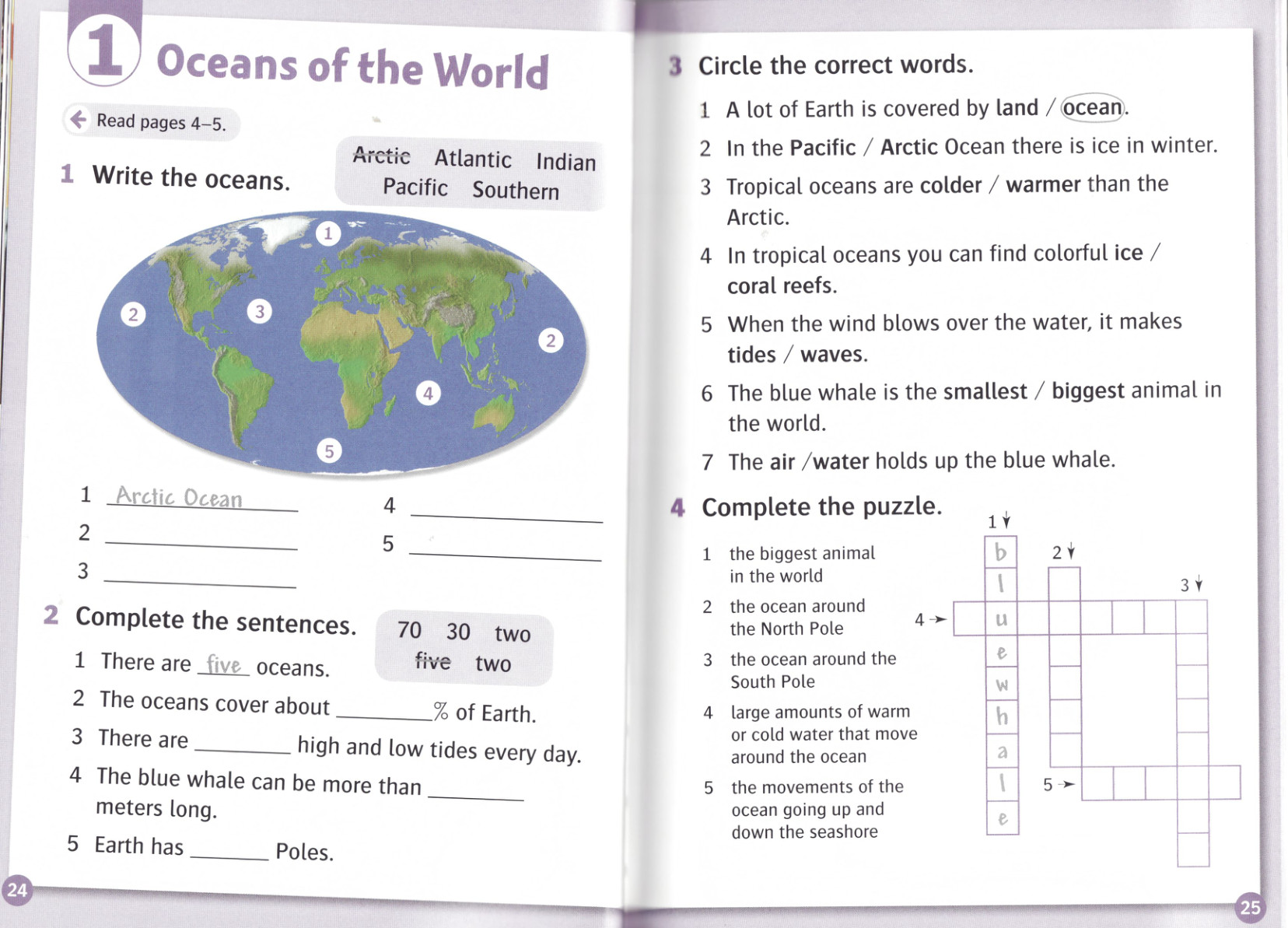
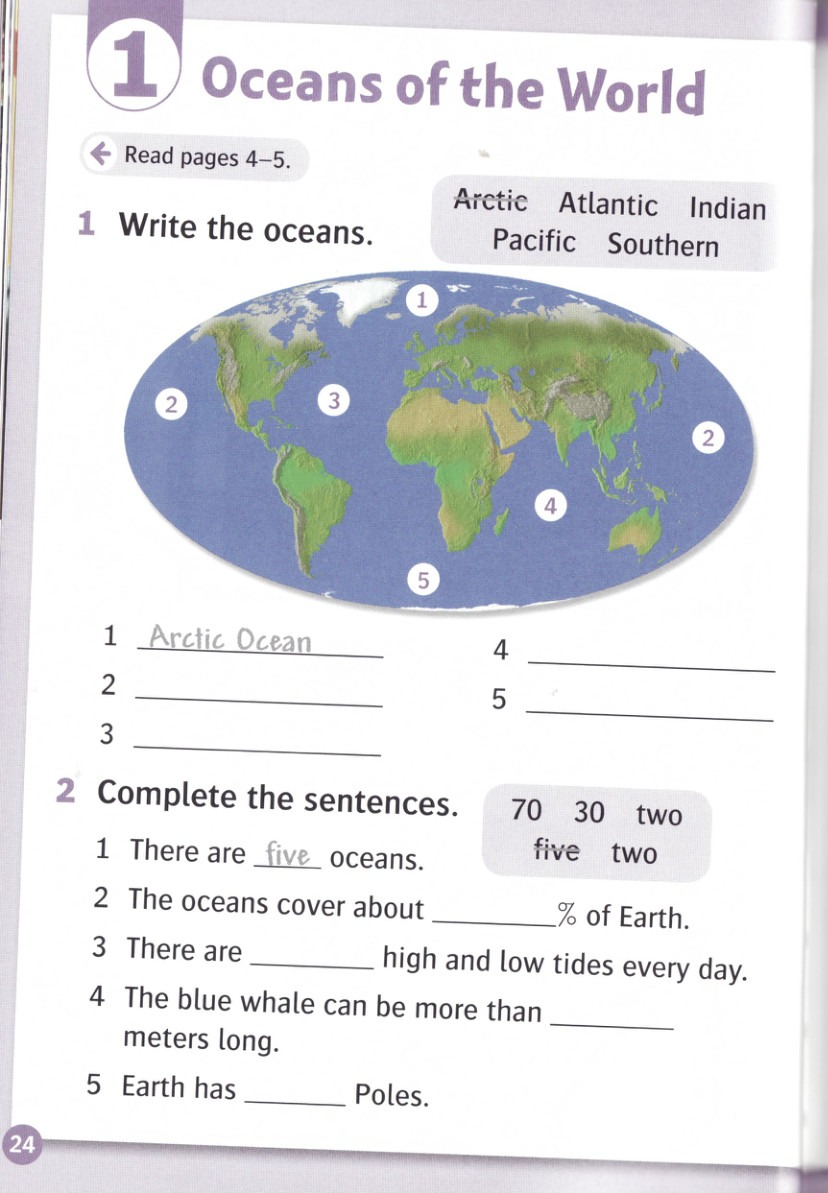
1. Write the oceans.
Viết tên đại dương theo số trên bản đồ.
1: Arctic Ocean.
1. Write the words for the numbered pictures.
2. Complete the sentences.
Chọn số trong khung.
There are five oceans.
2. Complete the sentences.
2. There are high and low tides every day.
3. The blue whale can be more than meters long.
4. Earth has Poles.
3. Circle the correct words.
Chọn từ đúng.
3. A lot of Earth is covered by …
4. In the … Ocean there is ice in winter.
5. Tropical oceans are … than the Arctic.
6. In tropical oceans you can find colorful …
7. When the wind blows over the water, it makes …
8. The blue whale is the … animal in the world.
9. The … holds up the blue whale.
4. Complete the puzzle.
Điền từ theo gợi ý; viết liền các chữ cái trong ô chữ tương tác.
The biggest animal in the world → blue whale.
10. Complete the crossword. Write letters without spaces.
- Hàng dọc: The ocean around the North Pole.
- Hàng ngang: The ocean around the South Pole.
- Hàng dọc: Large amounts of warm or cold water that move around the ocean.
- Hàng dọc: Movements of the ocean going up and down the seashore.
Who Eats What?
1 Đọc trang sách
2 Đọc & Nghe
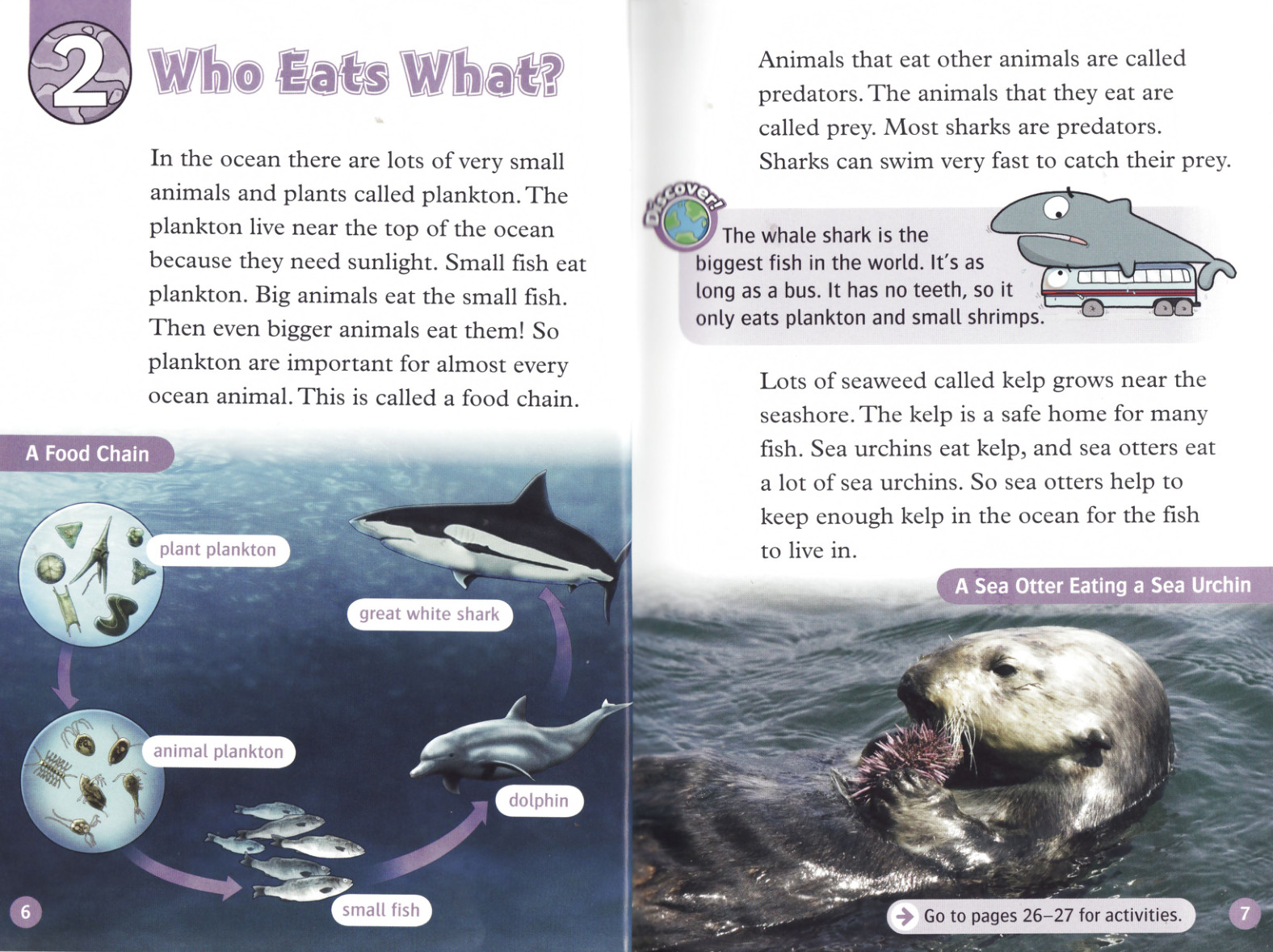
In the ocean there are lots of very small animals and plants called plankton. The plankton live near the top of the ocean because they need sunlight. Small fish eat plankton. Big animals eat the small fish. Then even bigger animals eat them! So plankton are important for almost every ocean animal. This is called a food chain.
Animals that eat other animals are called predators. The animals that they eat are called prey. Most sharks are predators. Sharks can swim very fast to catch their prey.
The whale shark is the biggest fish in the world. It's as long as a bus. It has no teeth, so it only eats plankton and small shrimps.
Lots of seaweed called kelp grows near the seashore. The kelp is a safe home for many fish. Sea urchins eat kelp, and sea otters eat a lot of sea urchins. So sea otters help to keep enough kelp in the ocean for the fish to live in.
Từ vựng
3 Xem trang bài tập
4 Bài tập tương tác
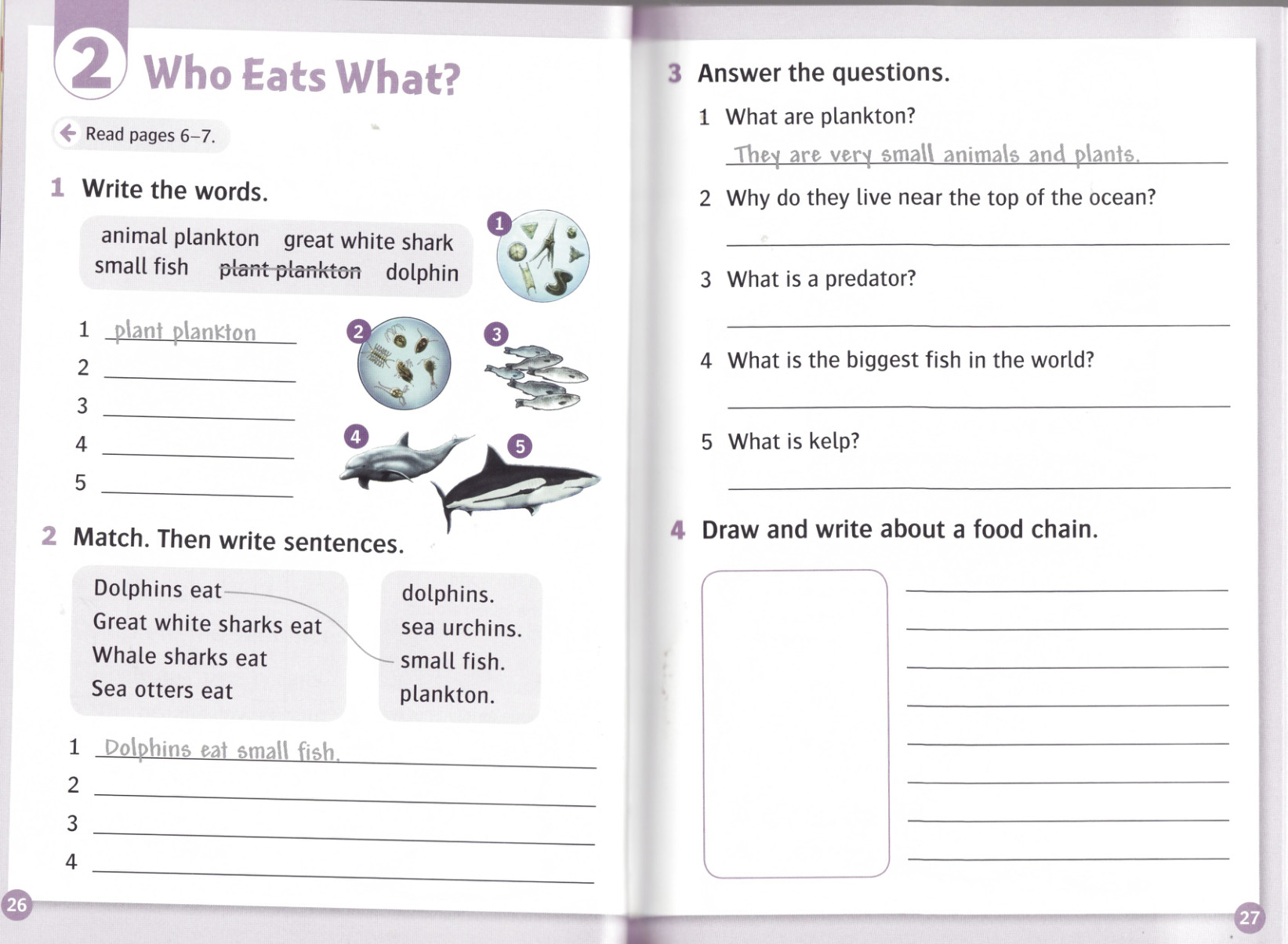
1. Write the words.
Viết từ theo hình của chuỗi thức ăn.
1: plant plankton.
1. Write the words for the numbered pictures.
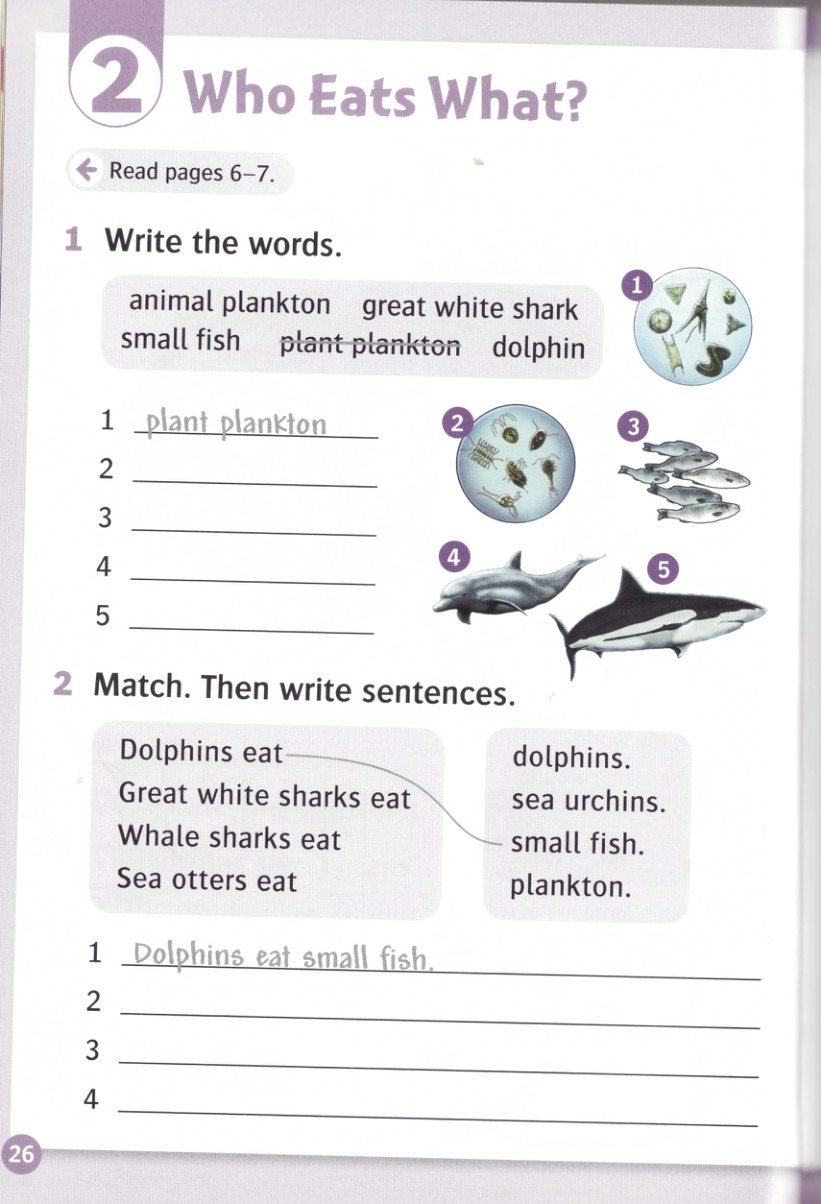
2. Match. Then write sentences.
Nối rồi viết thành câu hoàn chỉnh.
Dolphins eat small fish.
2. Match the sentence halves.
3. Write the sentence: Great white sharks eat …
4. Write the sentence: Whale sharks eat …
5. Write the sentence: Sea otters eat …
3. Answer the questions.
Trả lời theo bài đọc.
What are plankton? → They are very small animals and plants.
6. Why do plankton live near the top of the ocean?
- Answer the question clearly.
- Use information from the text or your own experience.
Lời giải và bài mẫu
Because they need sunlight.
7. What is a predator?
- Answer the question clearly.
- Use information from the text or your own experience.
Lời giải và bài mẫu
A predator is an animal that eats other animals.
8. What is the biggest fish in the world?
9. What is kelp?
4. Draw and write about a food chain.
Viết các mắt xích trong một chuỗi thức ăn; em có thể vẽ thêm trên giấy.
10. Write about an ocean food chain.
- Answer the question clearly.
- Use information from the text or your own experience.
Lời giải và bài mẫu
Plant plankton are eaten by animal plankton. Small fish eat plankton. Dolphins eat small fish, and great white sharks can eat dolphins.
The Seashore
1 Đọc trang sách
2 Đọc & Nghe
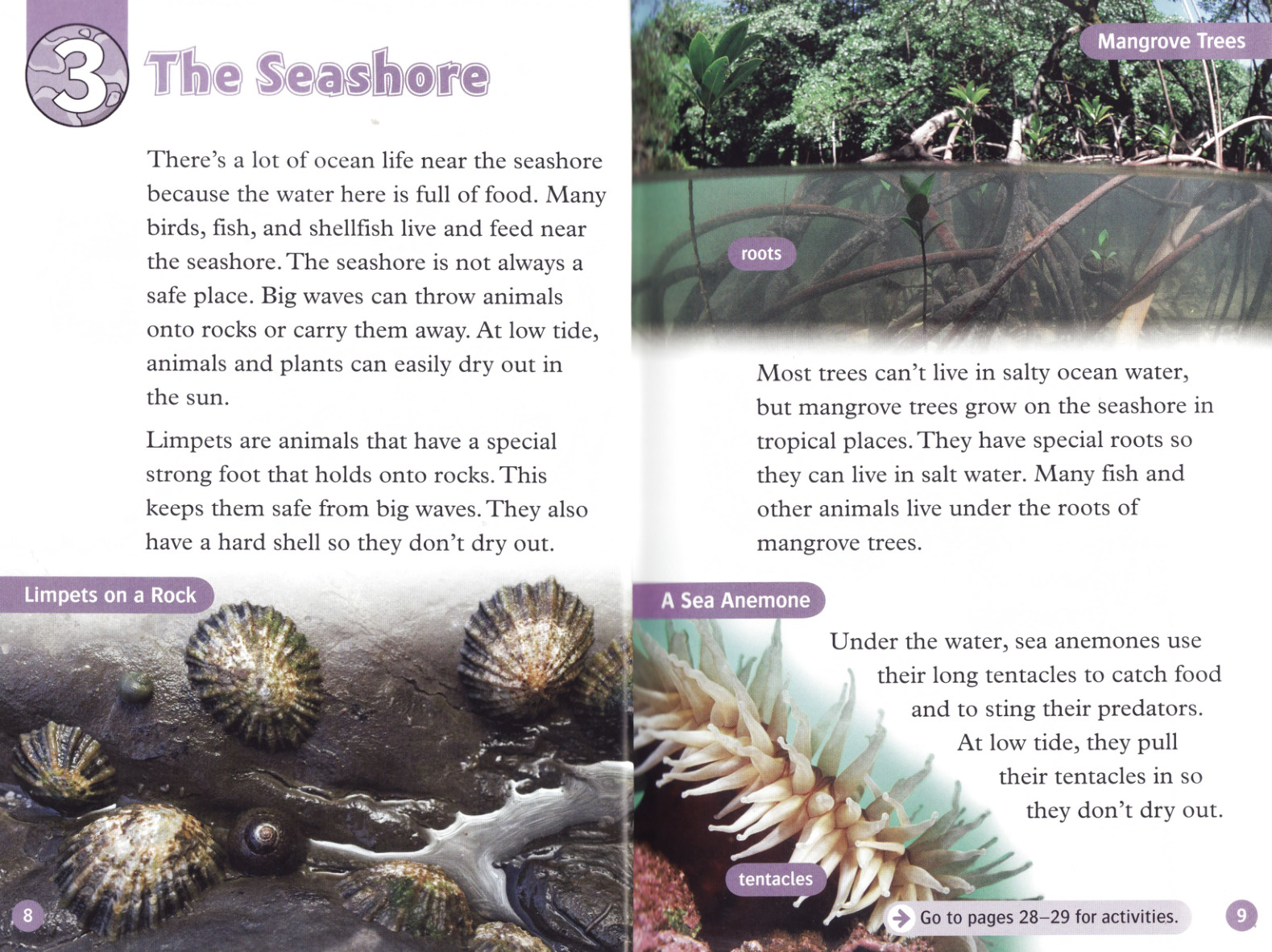
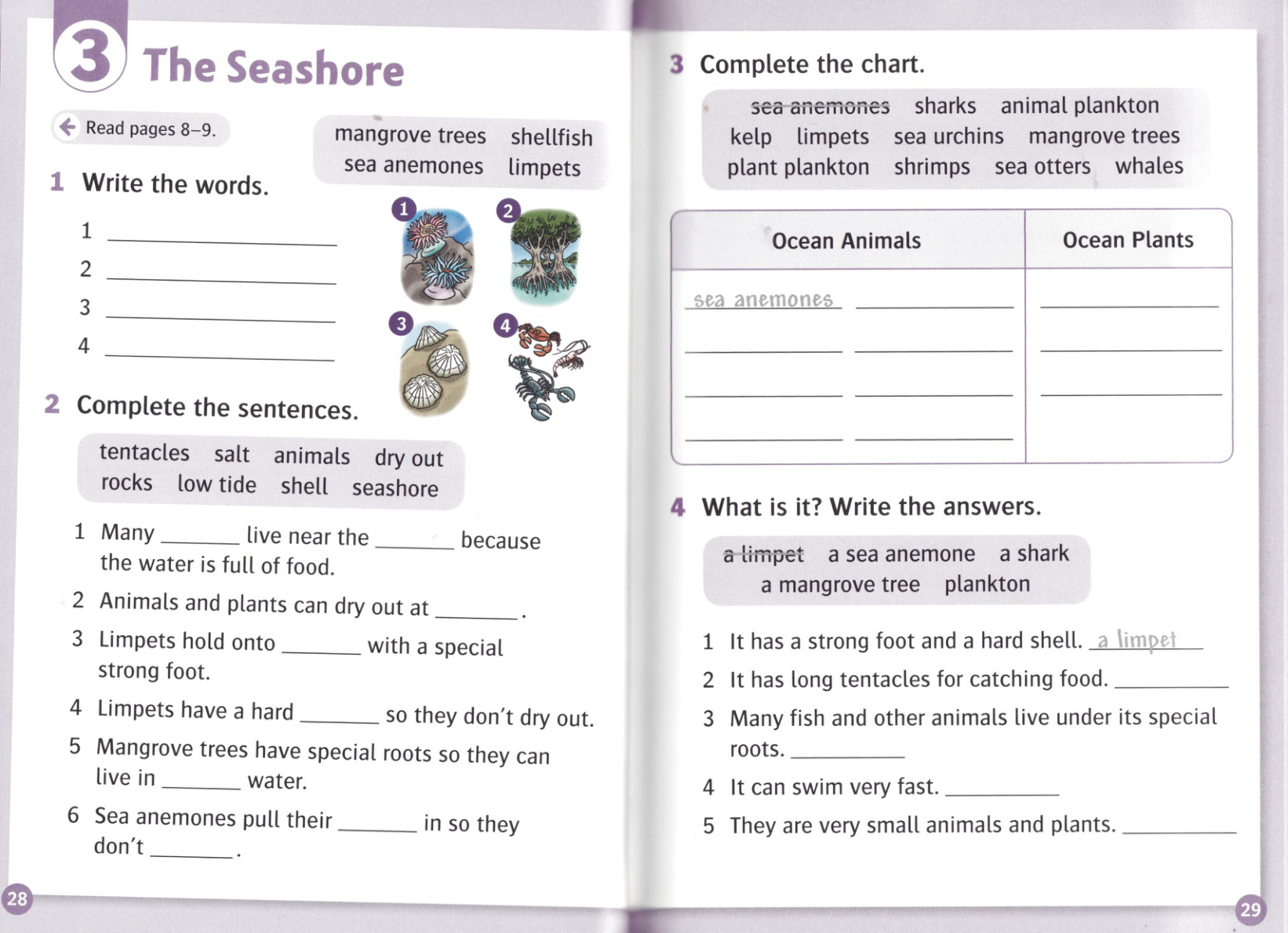
There's a lot of ocean life near the seashore because the water here is full of food. Many birds, fish, and shellfish live and feed near the seashore. The seashore is not always a safe place. Big waves can throw animals onto rocks or carry them away. At low tide, animals and plants can easily dry out in the sun.
Limpets are animals that have a special strong foot that holds onto rocks. This keeps them safe from big waves. They also have a hard shell so they don't dry out.
Most trees can't live in salty ocean water, but mangrove trees grow on the seashore in tropical places. They have special roots so they can live in salt water. Many fish and other animals live under the roots of mangrove trees.
Under the water, sea anemones use their long tentacles to catch food and to sting their predators. At low tide, they pull their tentacles in so they don't dry out.
Từ vựng
3 Xem trang bài tập
4 Bài tập tương tác
1. Write the words.
Viết từ theo hình.
1. Write the words for the numbered pictures.
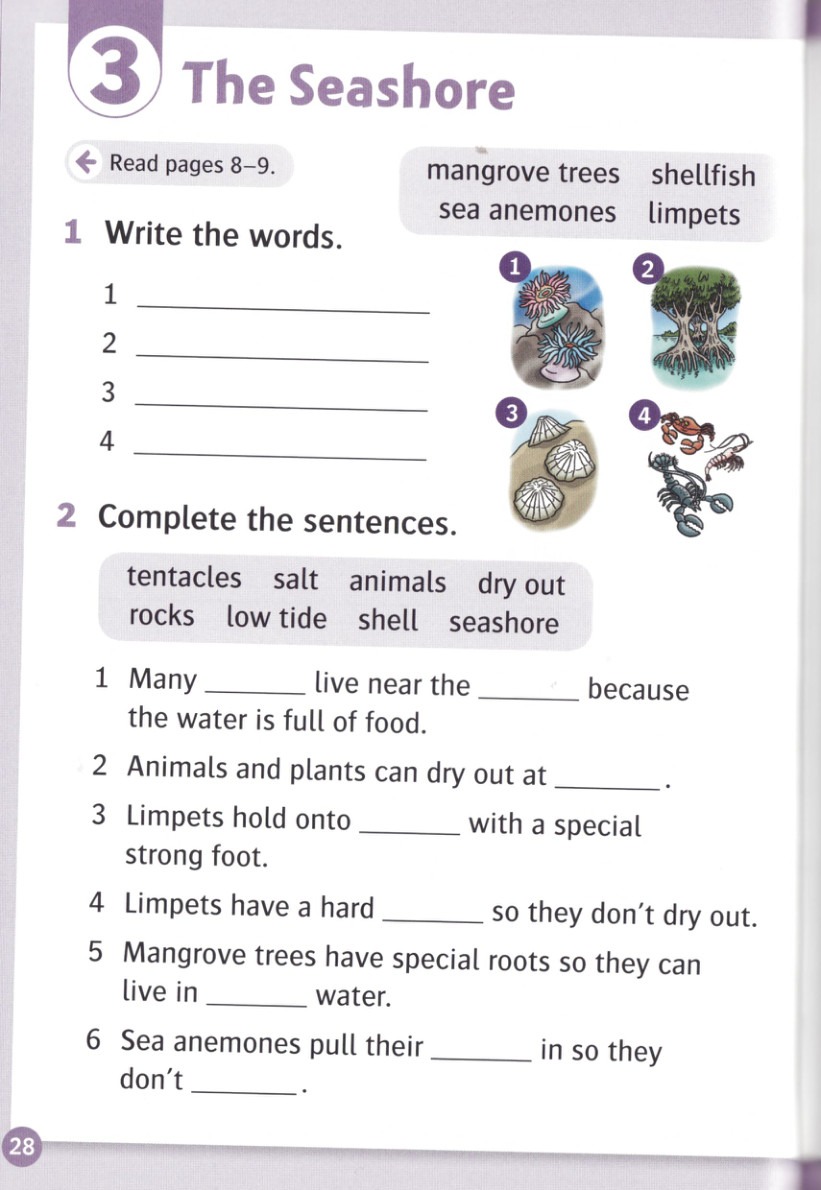
2. Complete the sentences.
Điền các từ trong khung.
2. Complete the sentences.
2. Animals and plants can dry out at .
3. Limpets hold onto with a special strong foot.
4. Limpets have a hard so they don't dry out.
5. Mangrove trees have special roots so they can live in water.
6. Sea anemones pull their in so they don't .
3. Complete the chart.
Phân loại thành động vật hoặc thực vật biển.
Ocean Animals: sea anemones.
3. Complete the chart.
4. What is it? Write the answers.
Chọn từ ứng với mô tả.
It has a strong foot and a hard shell. → a limpet.
4. Complete the sentences.
2. Many fish and other animals live under its special roots: .
3. It can swim very fast: .
4. They are very small animals and plants: .
Mammals and Birds
1 Đọc trang sách
2 Đọc & Nghe
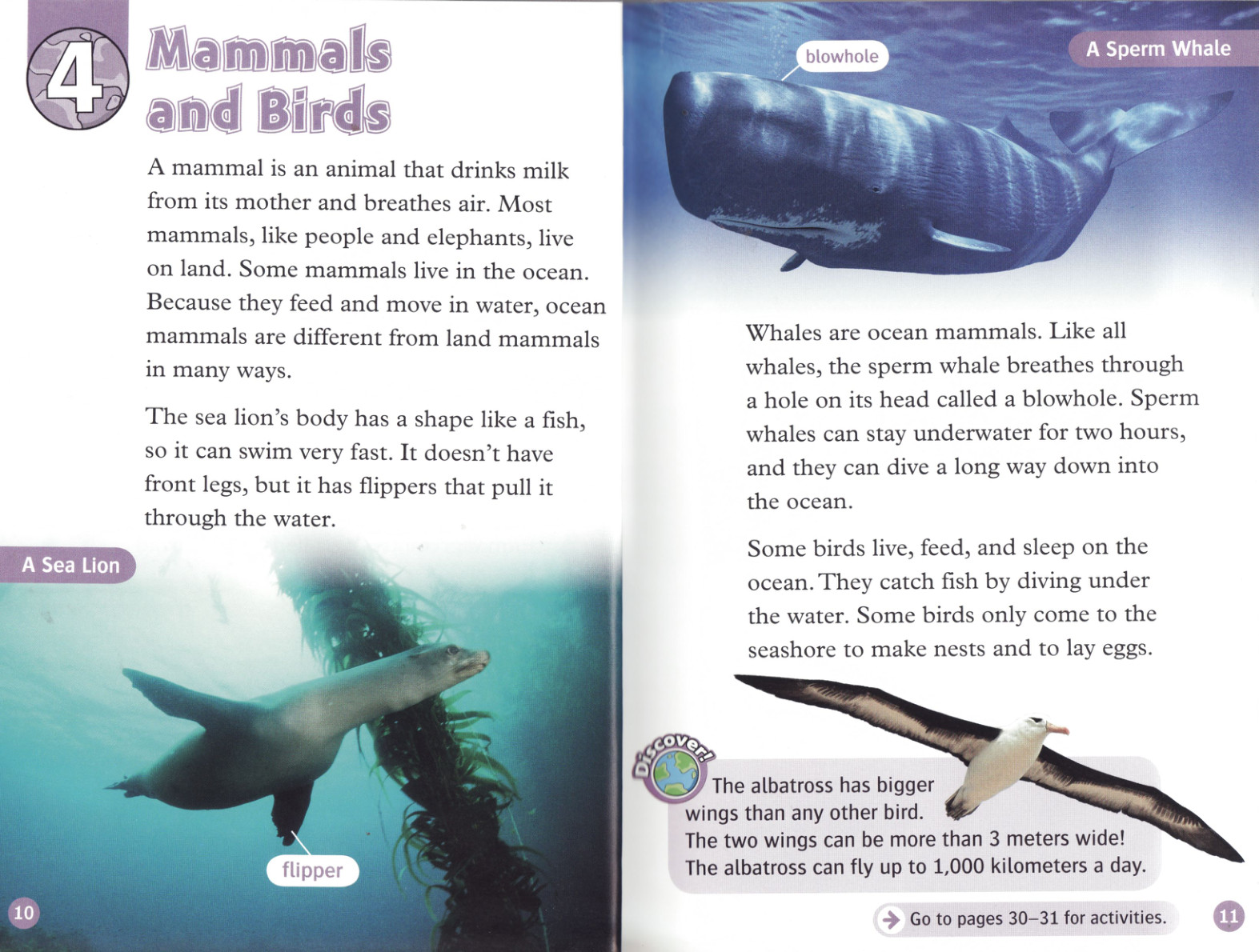
A mammal is an animal that drinks milk from its mother and breathes air. Most mammals, like people and elephants, live on land. Some mammals live in the ocean. Because they feed and move in water, ocean mammals are different from land mammals in many ways.
The sea lion's body has a shape like a fish, so it can swim very fast. It doesn't have front legs, but it has flippers that pull it through the water.
Whales are ocean mammals. Like all whales, the sperm whale breathes through a hole on its head called a blowhole. Sperm whales can stay underwater for two hours, and they can dive a long way down into the ocean.
Some birds live, feed, and sleep on the ocean. They catch fish by diving under the water. Some birds only come to the seashore to make nests and to lay eggs.
The albatross has bigger wings than any other bird. The two wings can be more than 3 meters wide! The albatross can fly up to 1,000 kilometers a day.
Từ vựng
3 Xem trang bài tập
4 Bài tập tương tác
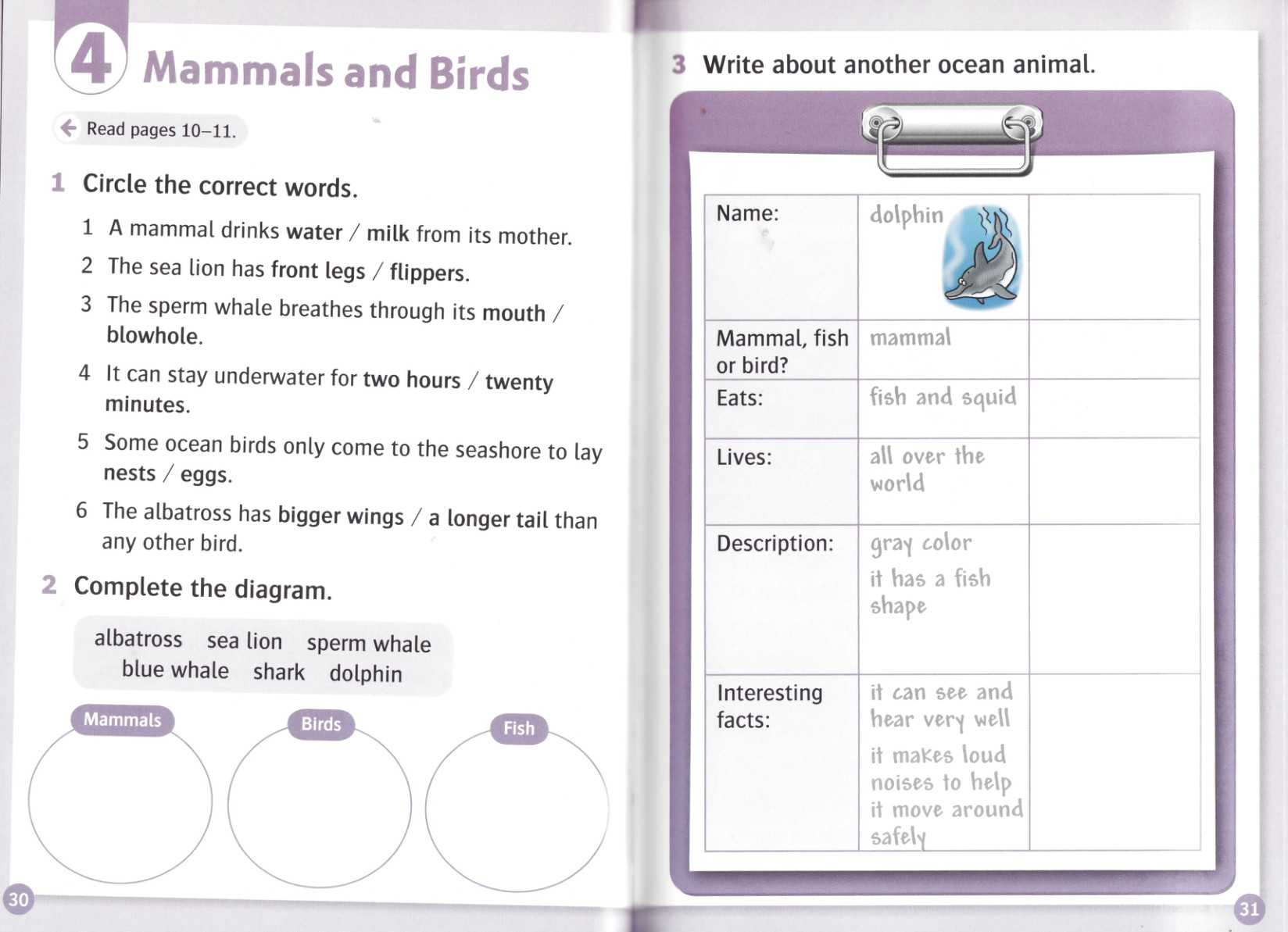
1. Circle the correct words.
Chọn từ đúng.
1. A mammal drinks … from its mother.
2. The sea lion has …
3. The sperm whale breathes through its …
4. It can stay underwater for …
5. Some ocean birds only come to the seashore to lay …
6. The albatross has … than any other bird.
2. Complete the diagram.
Phân loại thành động vật có vú, chim hoặc cá.
7. Complete the chart.
3. Write about another ocean animal.
Hoàn thành hồ sơ con vật; cột dolphin là mẫu đã cho.
8. Describe another ocean animal.
| Mục | Example: dolphin | Your animal |
|---|---|---|
| Animal | dolphin | |
| Mammal, fish or bird? | mammal | |
| Eats | fish and squid | |
| Lives | all over the world | |
| Description | gray color; it has a fish shape | |
| Interesting facts | it can see and hear very well; it makes loud noises to help it move around safely |
Coral Reefs
1 Đọc trang sách
2 Đọc & Nghe
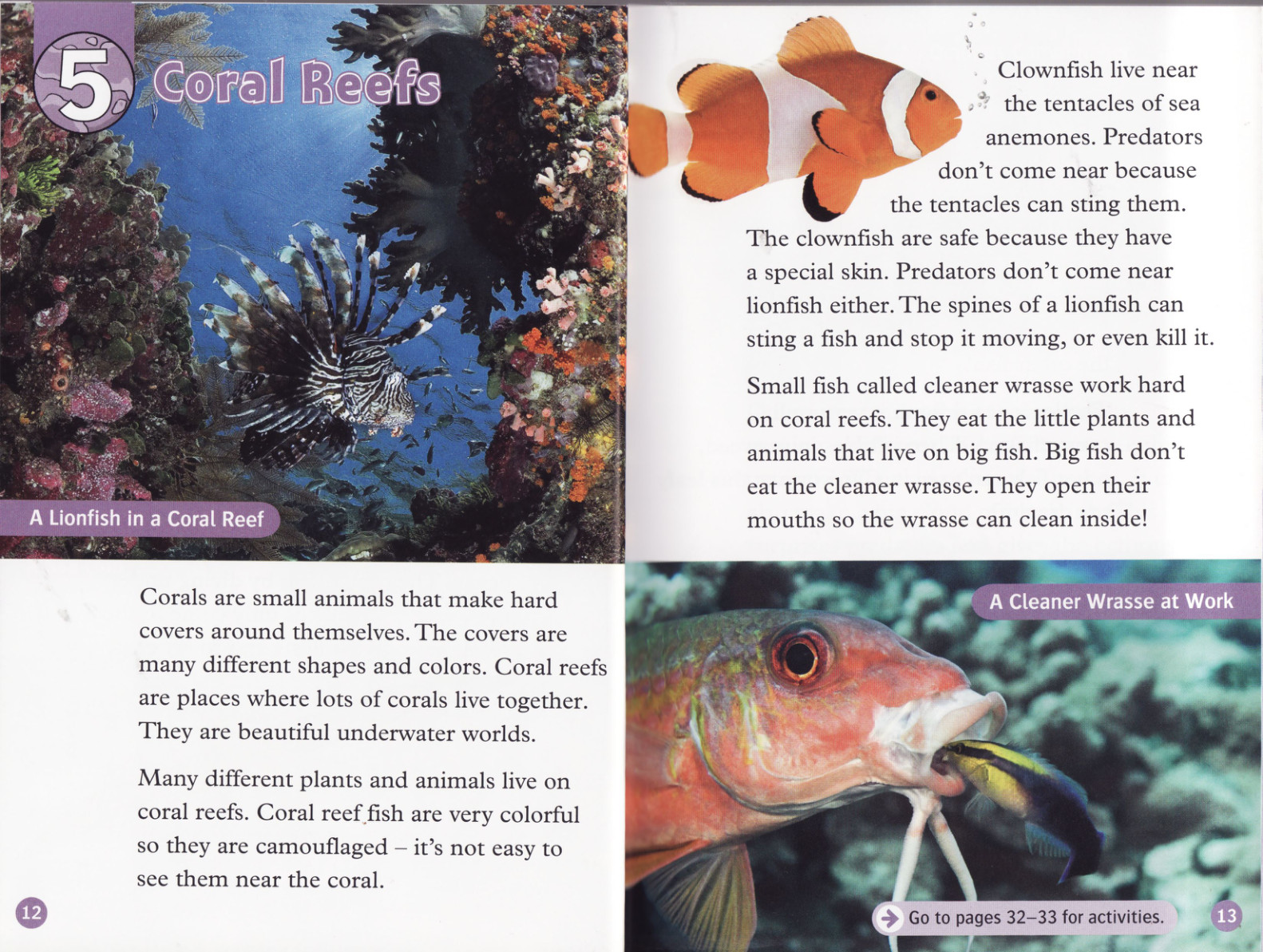
Corals are small animals that make hard covers around themselves. The covers are many different shapes and colors. Coral reefs are places where lots of corals live together. They are beautiful underwater worlds.
Many different plants and animals live on coral reefs. Coral reef fish are very colorful so they are camouflaged – it's not easy to see them near the coral.
Clownfish live near the tentacles of sea anemones. Predators don't come near because the tentacles can sting them. The clownfish are safe because they have a special skin. Predators don't come near lionfish either. The spines of a lionfish can sting a fish and stop it moving, or even kill it.
Small fish called cleaner wrasse work hard on coral reefs. They eat the little plants and animals that live on big fish. Big fish don't eat the cleaner wrasse. They open their mouths so the wrasse can clean inside!
Từ vựng
3 Xem trang bài tập
4 Bài tập tương tác
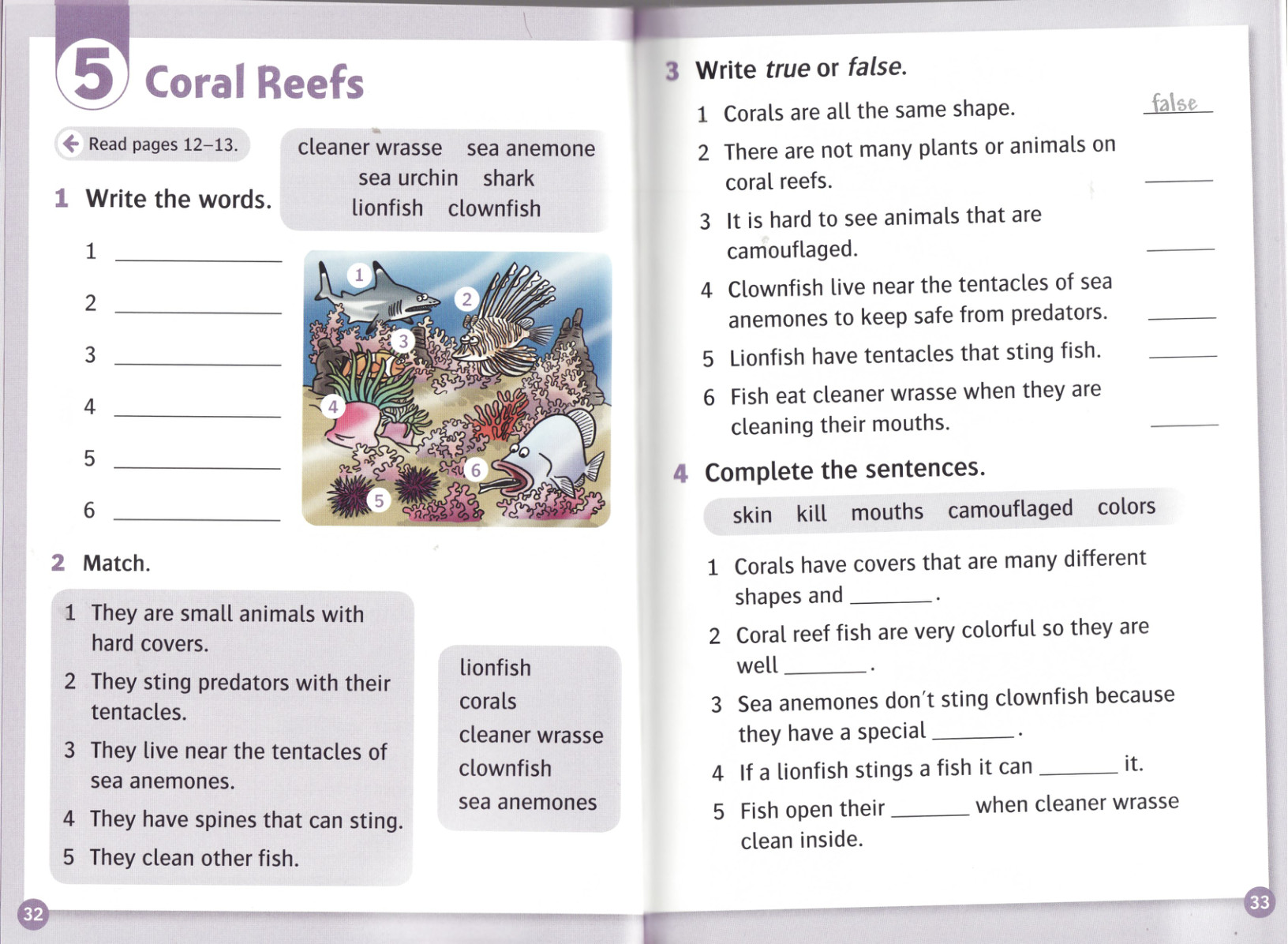
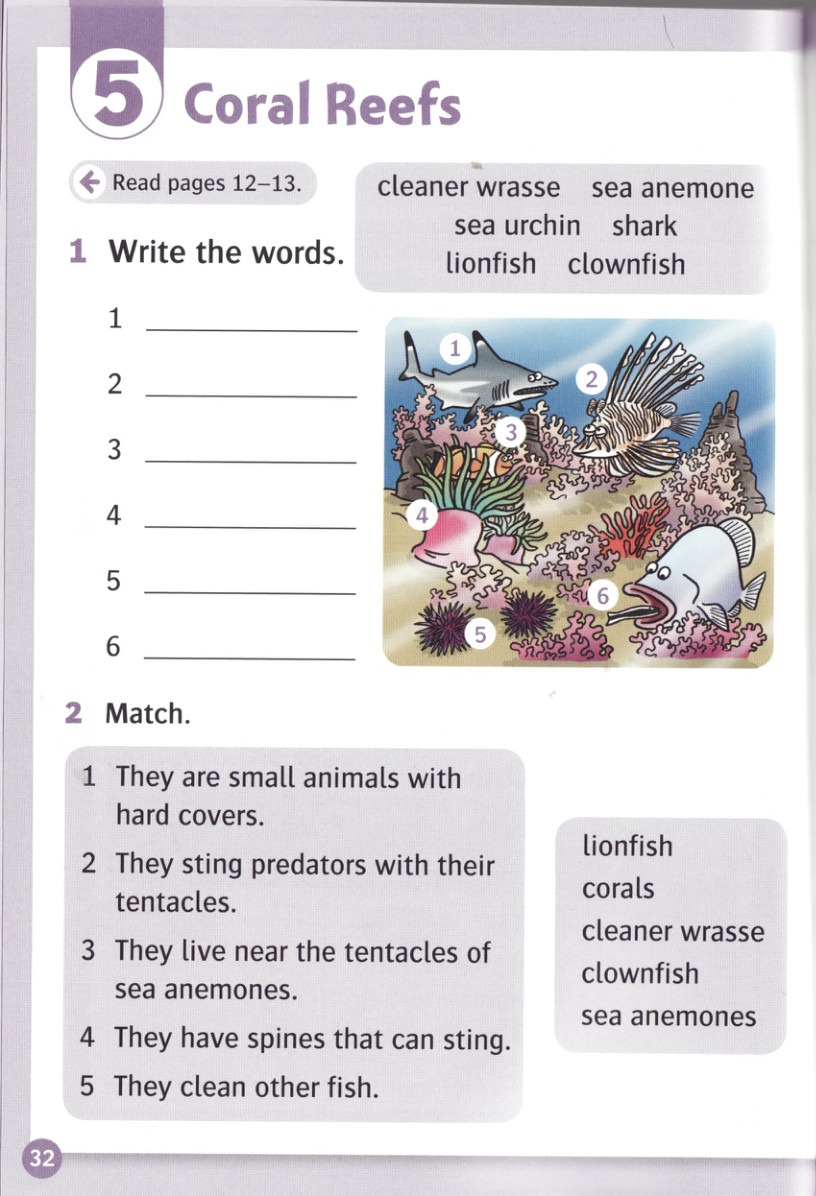
1. Write the words.
Viết từ theo hình.
1. Write the words for the numbered pictures.
2. Match.
Nối mô tả với loài tương ứng.
2. Match the sentence halves.
3. Write true or false.
Đánh dấu đúng hoặc sai.
Corals are all the same shape. → false
3. There are not many plants or animals on coral reefs.
4. It is hard to see animals that are camouflaged.
5. Clownfish live near the tentacles of sea anemones to keep safe from predators.
6. Lionfish have tentacles that sting fish.
7. Fish eat cleaner wrasse when they are cleaning their mouths.
4. Complete the sentences.
Chọn từ trong khung.
8. Complete the sentences.
2. Coral reef fish are very colorful so they are well .
3. Sea anemones don't sting clownfish because they have a special .
4. If a lionfish stings a fish it can it.
5. Fish open their when cleaner wrasse clean inside.
Keeping Safe
1 Đọc trang sách
2 Đọc & Nghe
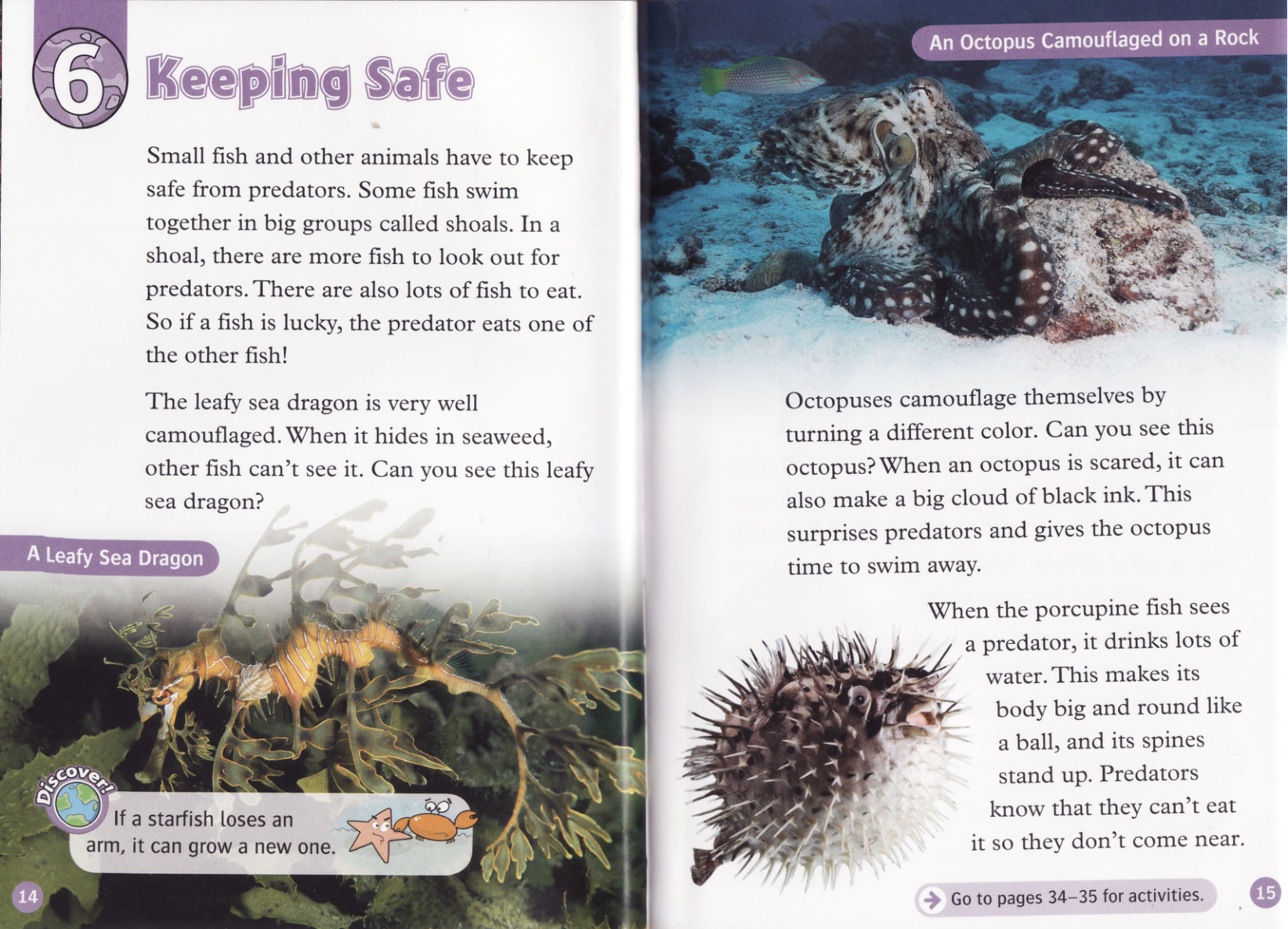
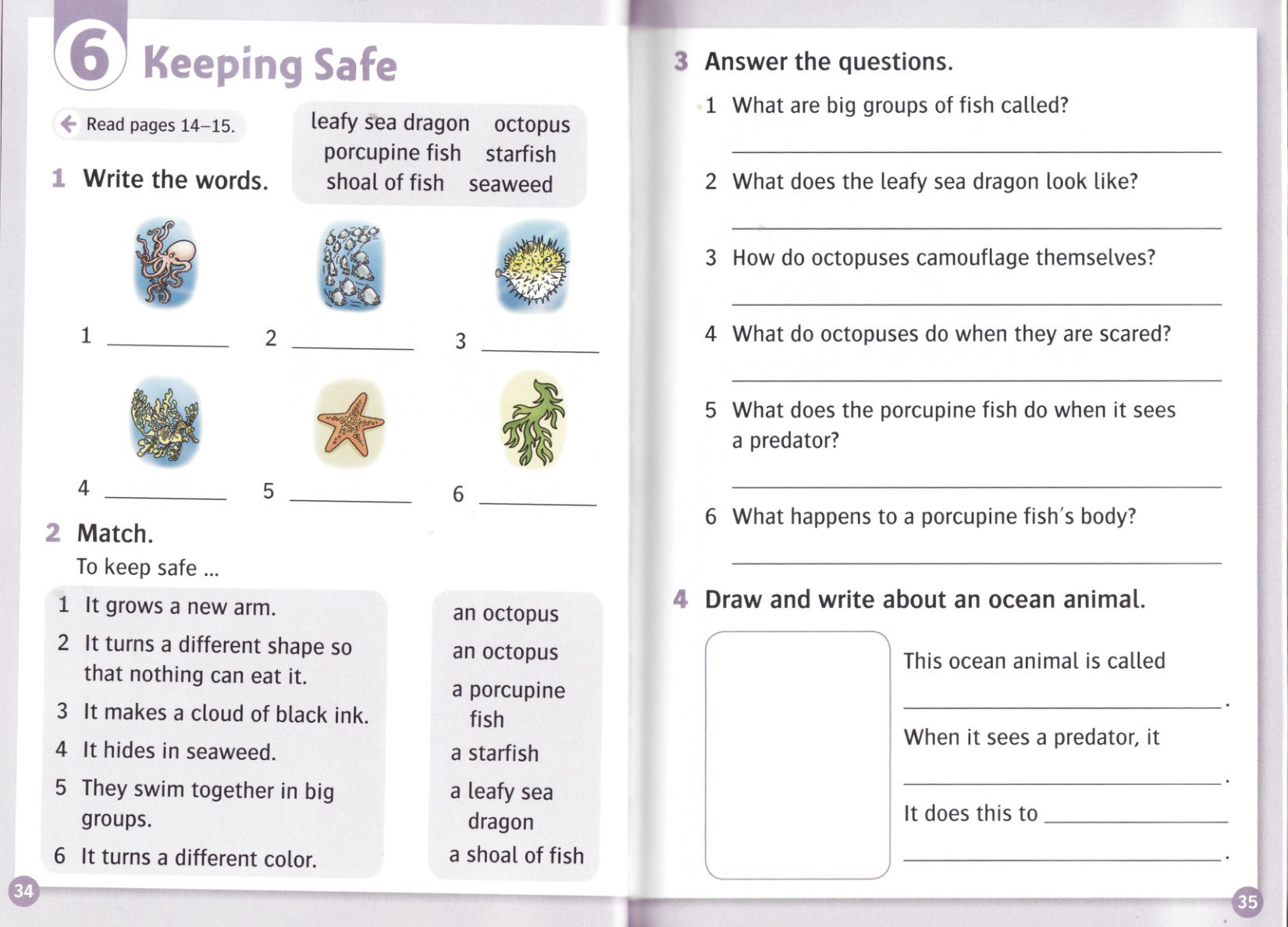
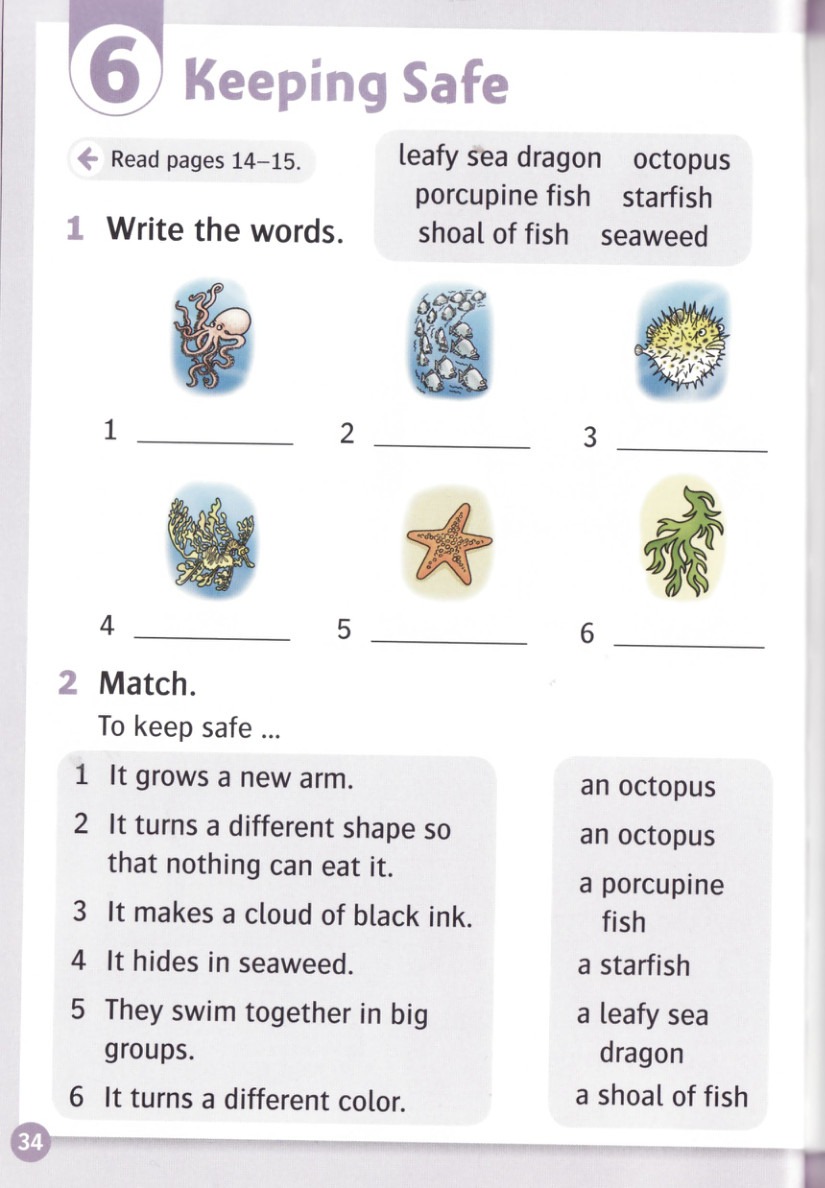
Small fish and other animals have to keep safe from predators. Some fish swim together in big groups called shoals. In a shoal, there are more fish to look out for predators. There are also lots of fish to eat. So if a fish is lucky, the predator eats one of the other fish!
The leafy sea dragon is very well camouflaged. When it hides in seaweed, other fish can't see it. Can you see this leafy sea dragon?
When a starfish loses an arm, it can grow a new one.
Octopuses camouflage themselves by turning a different color. Can you see this octopus? When an octopus is scared, it can also make a big cloud of black ink. This surprises predators and gives the octopus time to swim away.
When the porcupine fish sees a predator, it drinks lots of water. This makes its body big and round like a ball, and its spines stand up. Predators know that they can't eat it so they don't come near.
Từ vựng
3 Xem trang bài tập
4 Bài tập tương tác
1. Write the words.
Viết từ theo hình.
1. Write the words for the numbered pictures.
2. Match.
Chọn loài tương ứng với mỗi cách tự bảo vệ. Một loài có thể dùng nhiều lần.
2. Complete the chart.
3. Answer the questions.
Trả lời theo bài đọc.
3. What are big groups of fish called?
4. What does the leafy sea dragon look like?
5. How do octopuses camouflage themselves?
- Answer the question clearly.
- Use information from the text or your own experience.
Lời giải và bài mẫu
They camouflage themselves by turning a different color.
6. What do octopuses do when they are scared?
- Answer the question clearly.
- Use information from the text or your own experience.
Lời giải và bài mẫu
They make a big cloud of black ink.
7. What does the porcupine fish do when it sees a predator?
- Answer the question clearly.
- Use information from the text or your own experience.
Lời giải và bài mẫu
It drinks lots of water.
8. What happens to a porcupine fish's body?
- Answer the question clearly.
- Use information from the text or your own experience.
Lời giải và bài mẫu
It gets big and round like a ball.
4. Draw and write about an ocean animal.
Hoàn thành đoạn mô tả và vẽ con vật trên giấy nếu muốn.
9. This ocean animal is called … When it sees a predator, it … It does this to …
- Answer the question clearly.
- Use information from the text or your own experience.
Catching Prey
1 Đọc trang sách
2 Đọc & Nghe
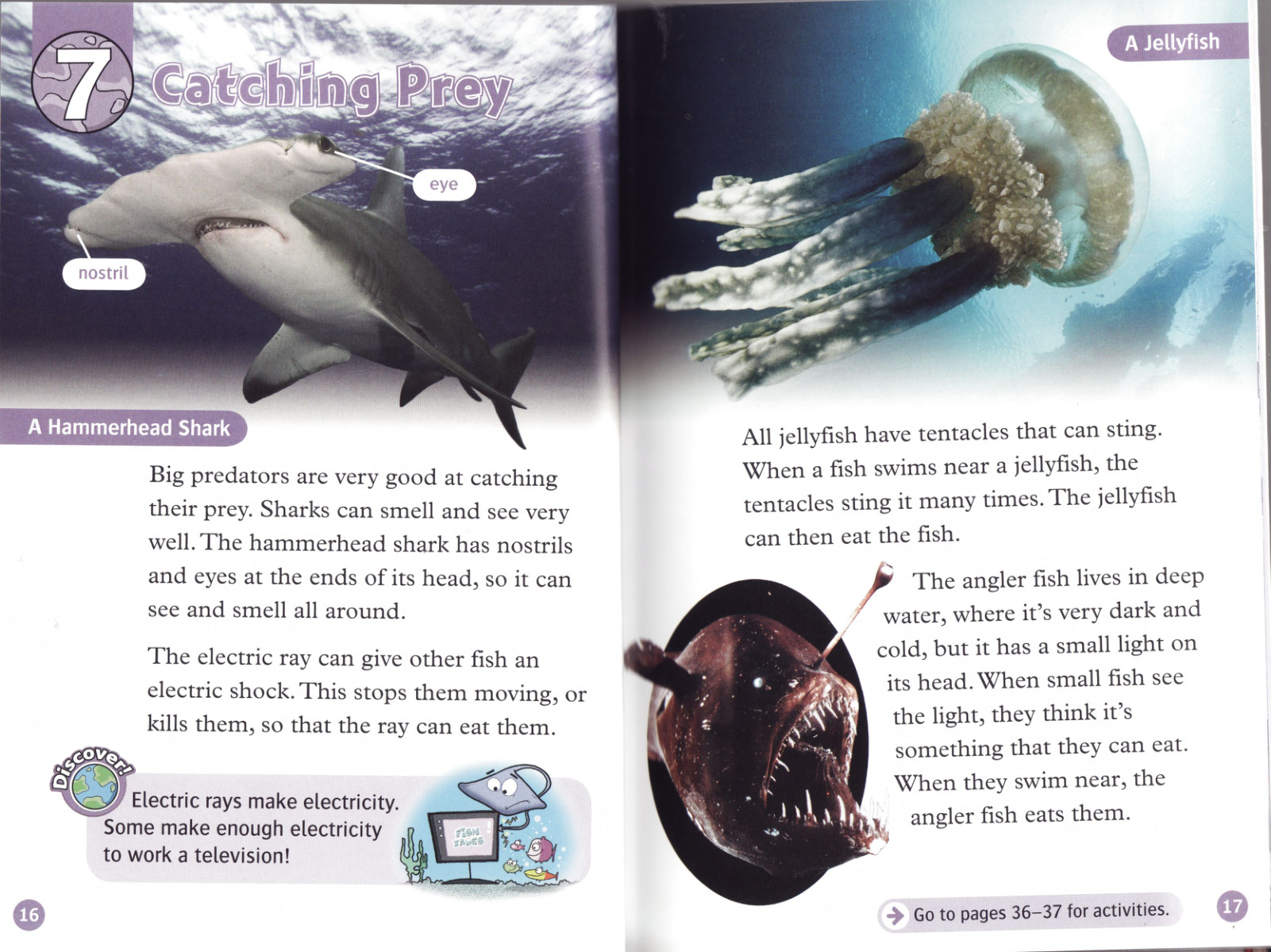
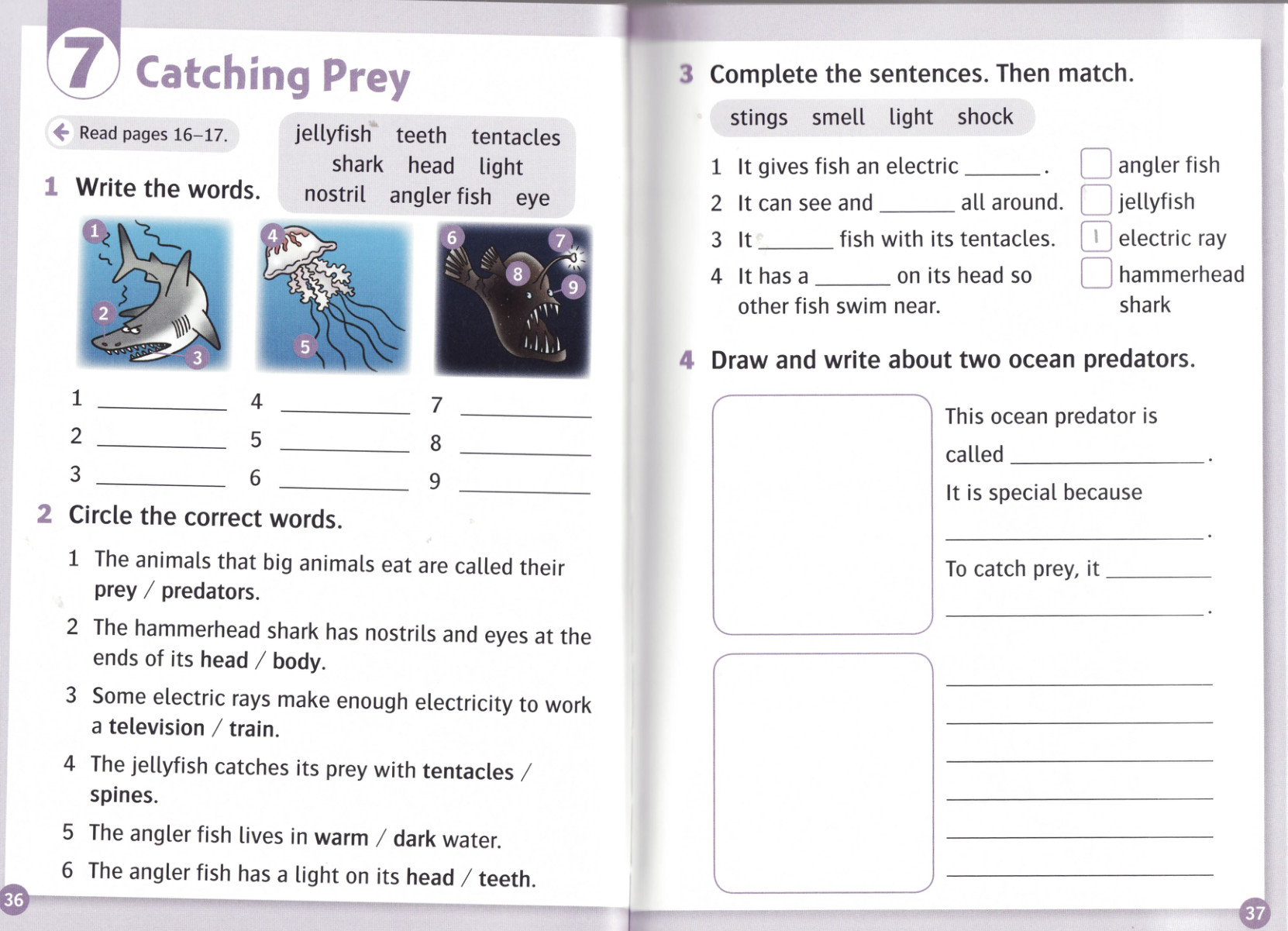
Big predators are very good at catching their prey. Sharks can smell and see very well. The hammerhead shark has nostrils and eyes at the ends of its head, so it can see and smell all around.
The electric ray can give other fish an electric shock. This stops them moving, or kills them, so that the ray can eat them.
Electric rays make electricity. Some make enough electricity to work a television!
All jellyfish have tentacles that can sting. When a fish swims near a jellyfish, the tentacles sting it many times. The jellyfish can then eat the fish.
The angler fish lives in deep water, where it's very dark and cold, but it has a small light on its head. When small fish see the light, they think it's something that they can eat. When they swim near, the angler fish eats them.
Từ vựng
3 Xem trang bài tập
4 Bài tập tương tác
1. Write the words.
Viết từ theo hình.
1. Write the words for the numbered pictures.
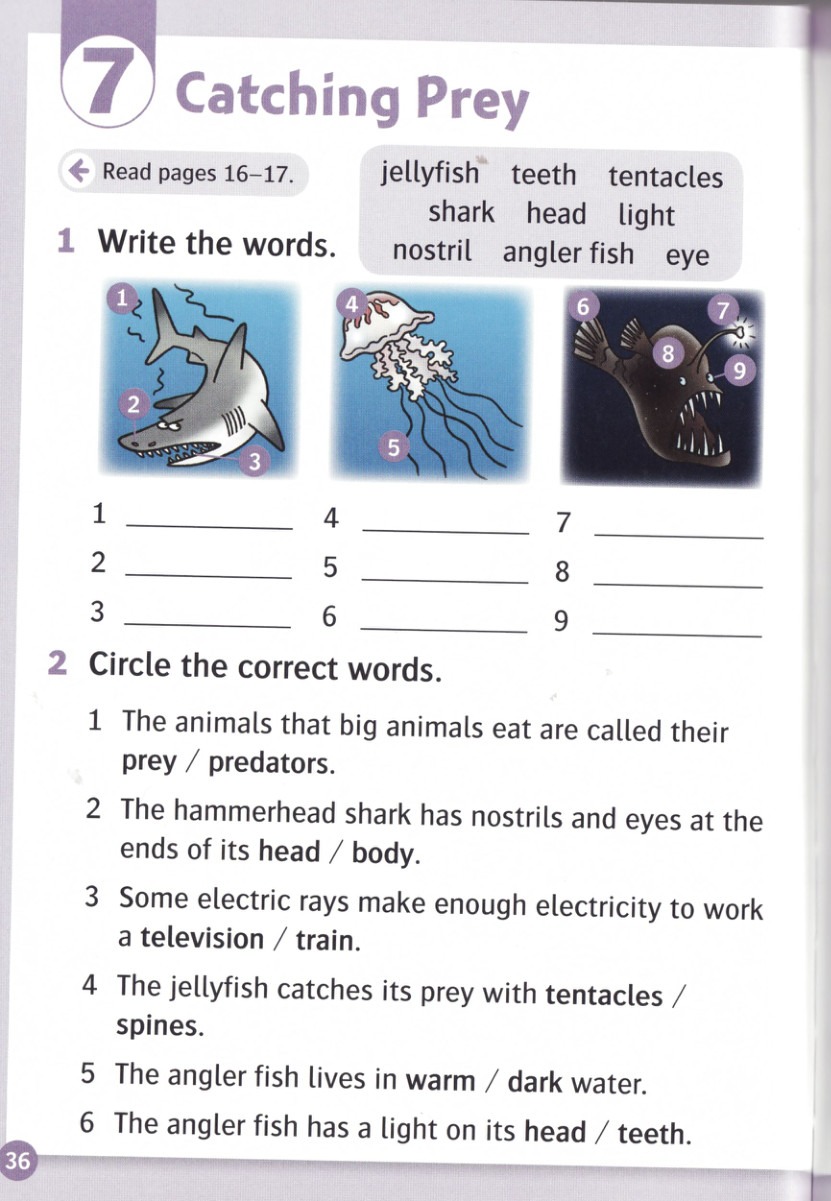
2. Circle the correct words.
Chọn từ đúng.
2. The animals that big animals eat are called their …
3. The hammerhead shark has nostrils and eyes at the ends of its …
4. Some electric rays make enough electricity to work a …
5. The jellyfish catches its prey with …
6. The angler fish lives in … water.
7. The angler fish has a light on its …
3. Complete the sentences. Then match.
Điền từ rồi nối với con vật.
8. Complete the sentences.
2. It can see and all around.
3. It fish with its tentacles.
4. It has a on its head so other fish swim near.
9. Match the sentence halves.
4. Draw and write about two ocean predators.
Viết tên, đặc điểm và cách bắt mồi của hai con vật.
10. Ocean predator 1: This ocean predator is called … It is special because … To catch prey, it …
- Answer the question clearly.
- Use information from the text or your own experience.
11. Ocean predator 2: This ocean predator is called … It is special because … To catch prey, it …
- Answer the question clearly.
- Use information from the text or your own experience.
Icy Oceans
1 Đọc trang sách
2 Đọc & Nghe
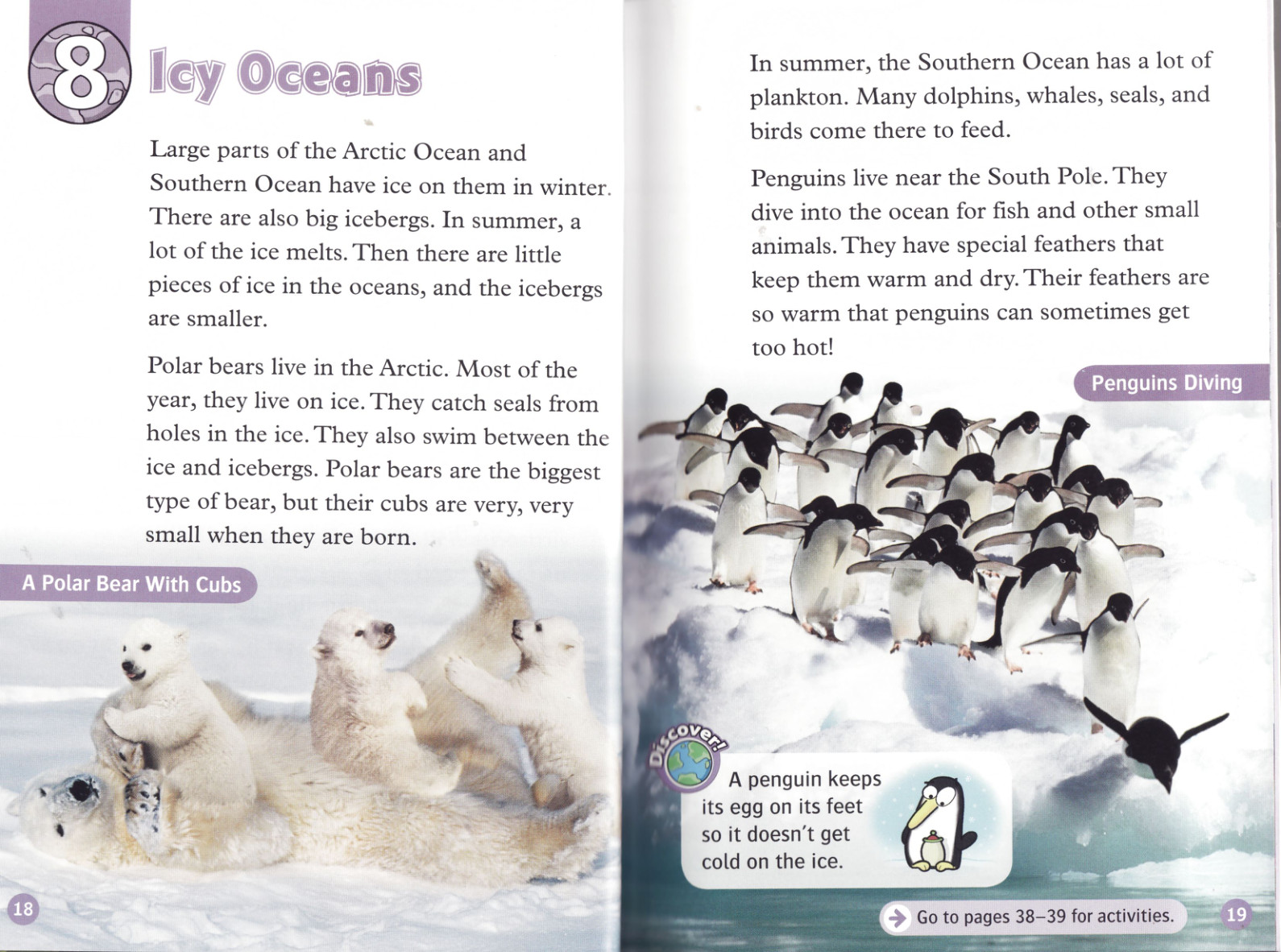
Large parts of the Arctic Ocean and Southern Ocean have ice on them in winter. There are also big icebergs. In summer, a lot of the ice melts. Then there are little pieces of ice in the oceans, and the icebergs are smaller.
Polar bears live in the Arctic. Most of the year, they live on ice. They catch seals from holes in the ice. They also swim between the ice and icebergs. Polar bears are the biggest type of bear, but their cubs are very, very small when they are born.
In summer, the Southern Ocean has a lot of plankton. Many dolphins, whales, seals, and birds come there to feed.
Penguins live near the South Pole. They dive into the ocean for fish and other small animals. They have special feathers that keep them warm and dry. Their feathers are so warm that penguins can sometimes get too hot!
A penguin keeps its egg on its feet so it doesn't get cold on the ice.
Từ vựng
3 Xem trang bài tập
4 Bài tập tương tác
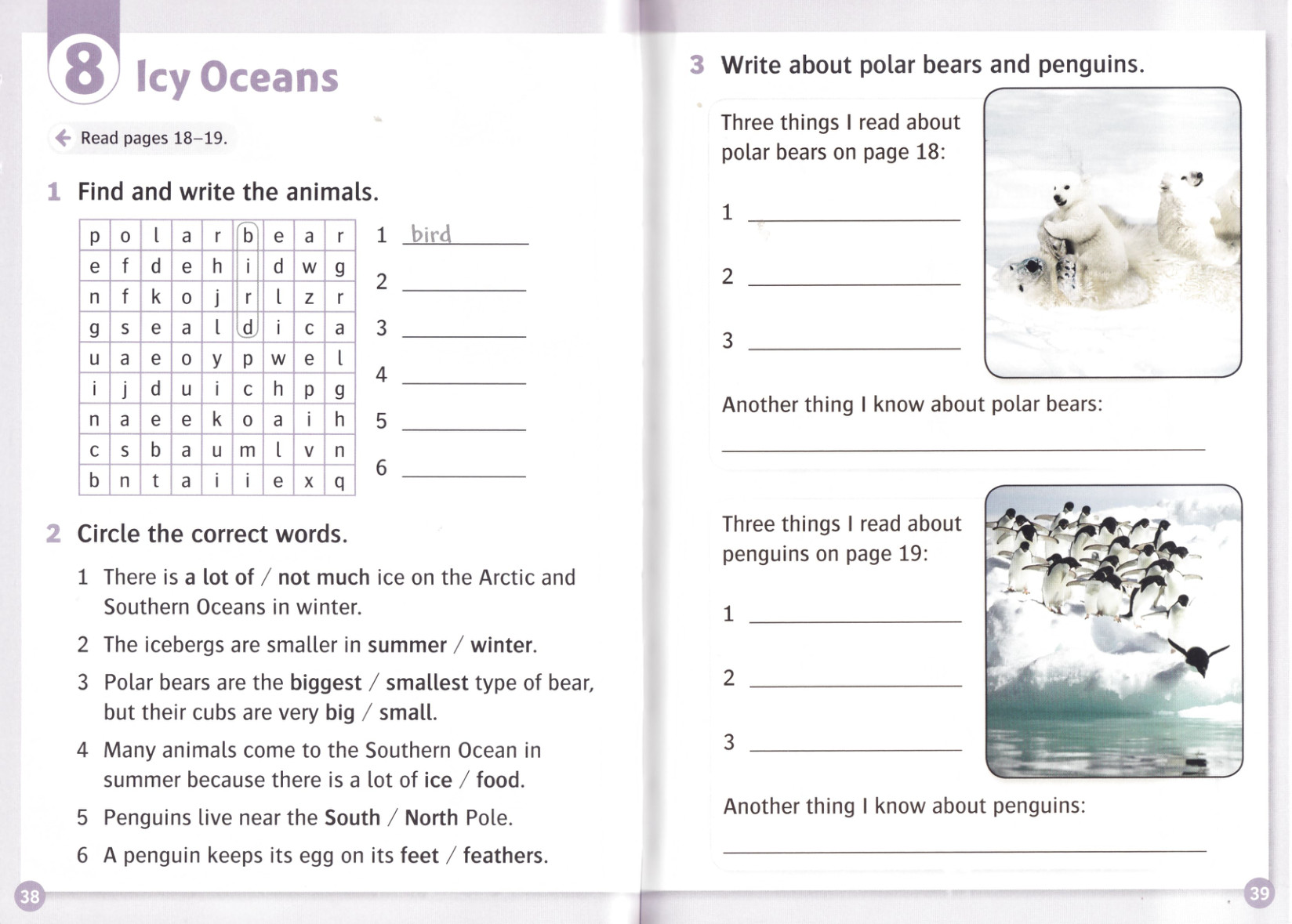
1. Find and write the animals.
Tìm tên các con vật trong ô chữ; POLAR BEAR được viết liền.
1: bird.
1. Find the words in the grid.
2. Circle the correct words.
Chọn từ đúng.
2. There is … ice on the Arctic and Southern Oceans in winter.
3. The icebergs are smaller in …
4. Polar bears are the … type of bear.
5. Their cubs are very …
6. Many animals come to the Southern Ocean in summer because there is a lot of …
7. Penguins live near the … Pole.
8. A penguin keeps its egg on its …
3. Write about polar bears and penguins.
Điền ba điều trong bài và một điều em biết thêm cho mỗi con vật.
9. Compare polar bears and penguins.
| Mục | Polar bears | Penguins |
|---|---|---|
| Thing 1 I read | ||
| Thing 2 I read | ||
| Thing 3 I read | ||
| Another thing I know |
Lời giải và bài mẫu
Polar bears live in the Arctic, catch seals and are the biggest bears. Penguins live near the South Pole, dive for food and have feathers that keep them warm and dry.
Farming the Oceans
1 Đọc trang sách
2 Đọc & Nghe
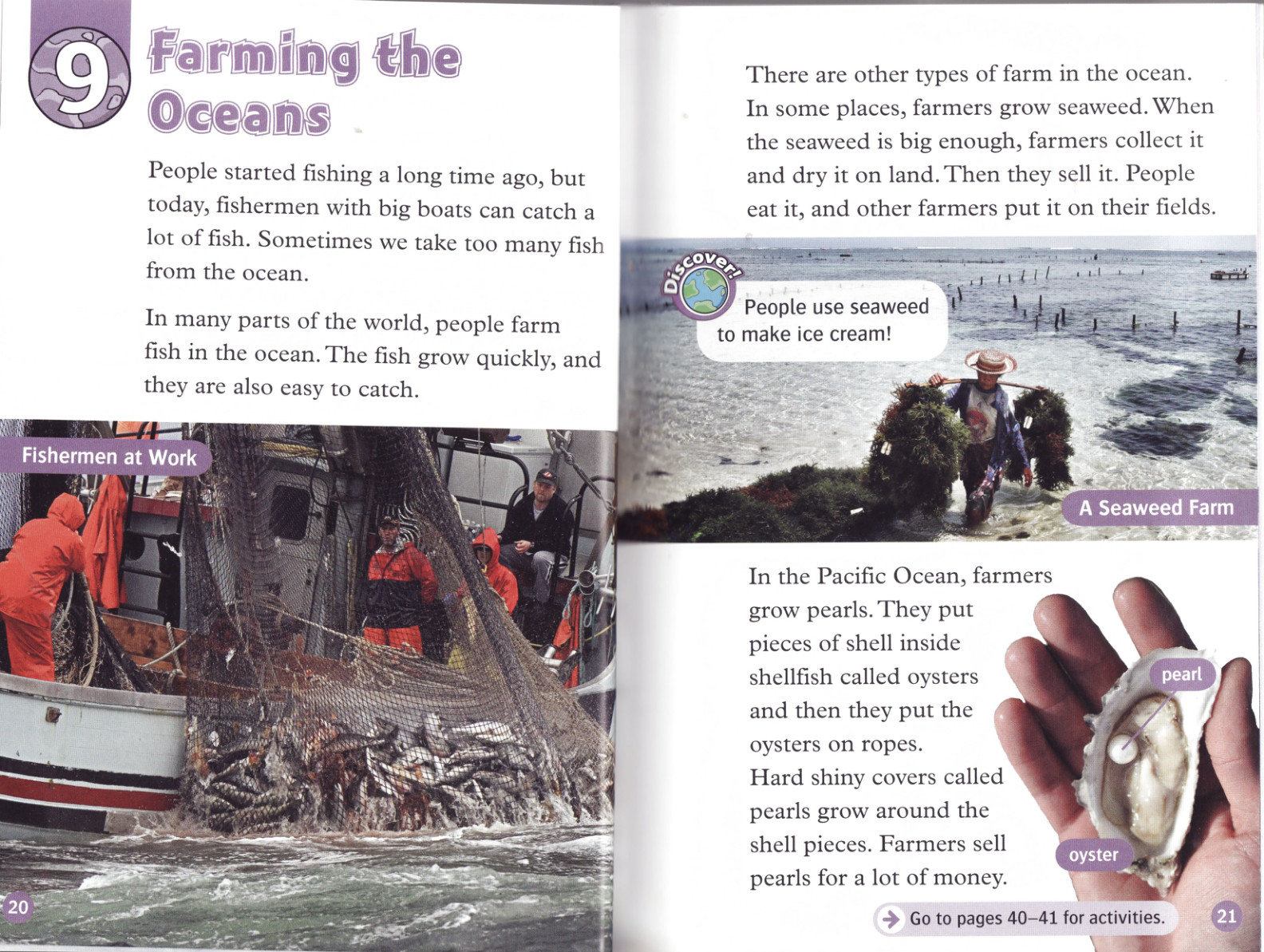
People started fishing a long time ago, but today, fishermen with big boats can catch a lot of fish. Sometimes we take too many fish from the ocean.
In many parts of the world, people farm fish in the ocean. The fish grow quickly, and they are also easy to catch.
There are other types of farm in the ocean. In some places, farmers grow seaweed. When the seaweed is big enough, farmers collect it and dry it on land. Then they sell it. People eat it, and other farmers put it on their fields.
People use seaweed to make ice cream!
In the Pacific Ocean, farmers grow pearls. They put pieces of shell inside shellfish called oysters and then they put the oysters on ropes. Hard shiny covers called pearls grow around the shell pieces. Farmers sell pearls for a lot of money.
Từ vựng
3 Xem trang bài tập
4 Bài tập tương tác
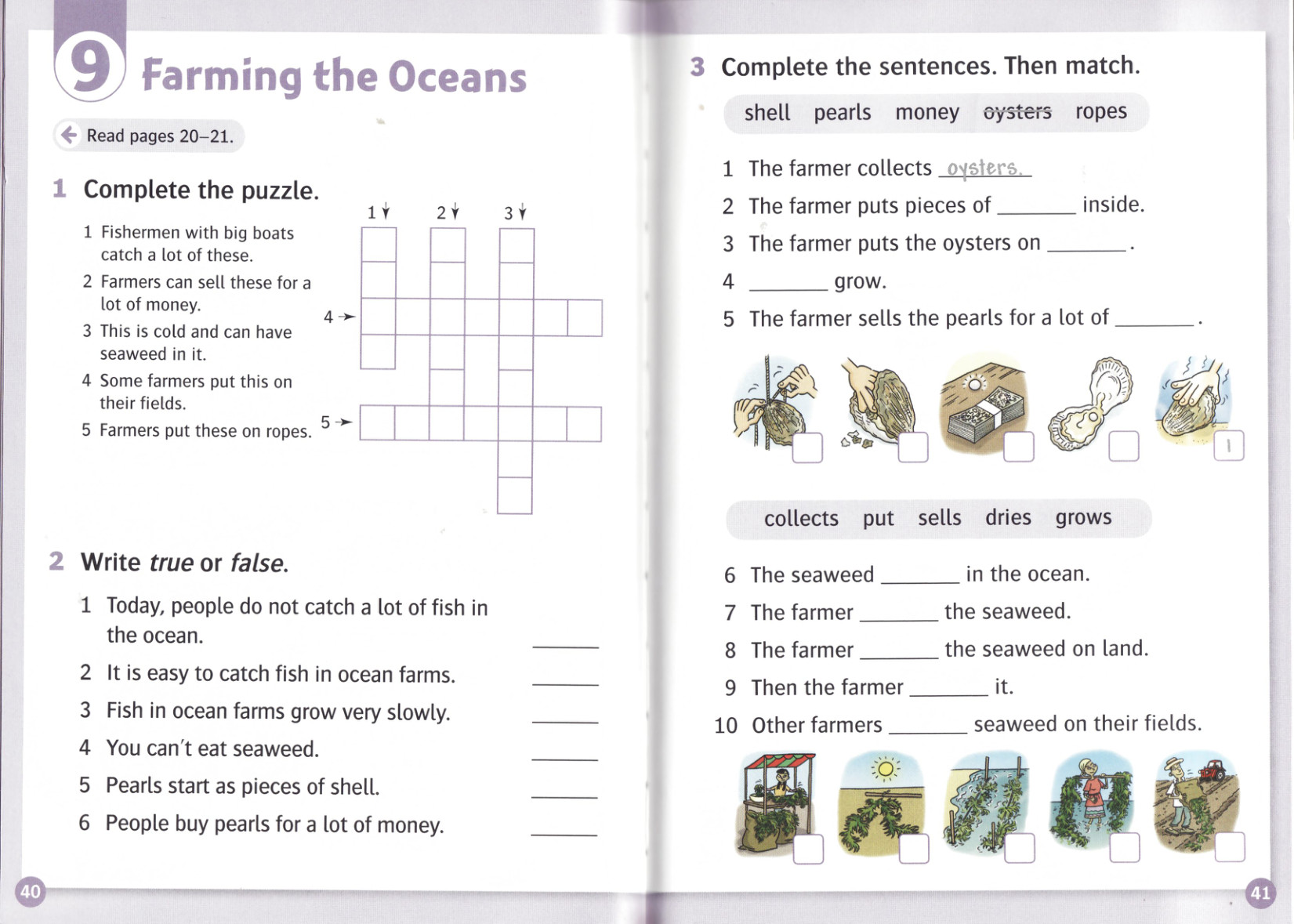
1. Complete the puzzle.
Điền từ theo gợi ý; viết liền chữ trong ô chữ tương tác.
1. Complete the crossword. Write letters without spaces.
- Hàng dọc: Fishermen with big boats catch a lot of these.
- Hàng dọc: Farmers can sell these for a lot of money.
- Hàng ngang: This is cold and can have seaweed in it.
- Hàng dọc: Some farmers put this on their fields.
- Hàng dọc: Farmers put these on ropes.
2. Write true or false.
Đánh dấu đúng hoặc sai.
2. Today, people do not catch a lot of fish in the ocean.
3. It is easy to catch fish in ocean farms.
4. Fish in ocean farms grow very slowly.
5. You can't eat seaweed.
6. Pearls start as pieces of shell.
7. People buy pearls for a lot of money.
3. Complete the sentences. Then match.
Điền từ, rồi ghép câu với các hình trên trang bài tập.
The farmer collects oysters. → Picture 3.
8. Complete the sentences.
2. The farmer puts the oysters on .
3. grow.
4. The farmer sells the pearls for a lot of .
9. Match the sentence halves.
10. Complete the sentences.
2. The farmer the seaweed.
3. The farmer the seaweed on land.
4. Then the farmer it.
5. Other farmers seaweed on their fields.
11. Match the sentence halves.
Oceans in Danger
1 Đọc trang sách
2 Đọc & Nghe
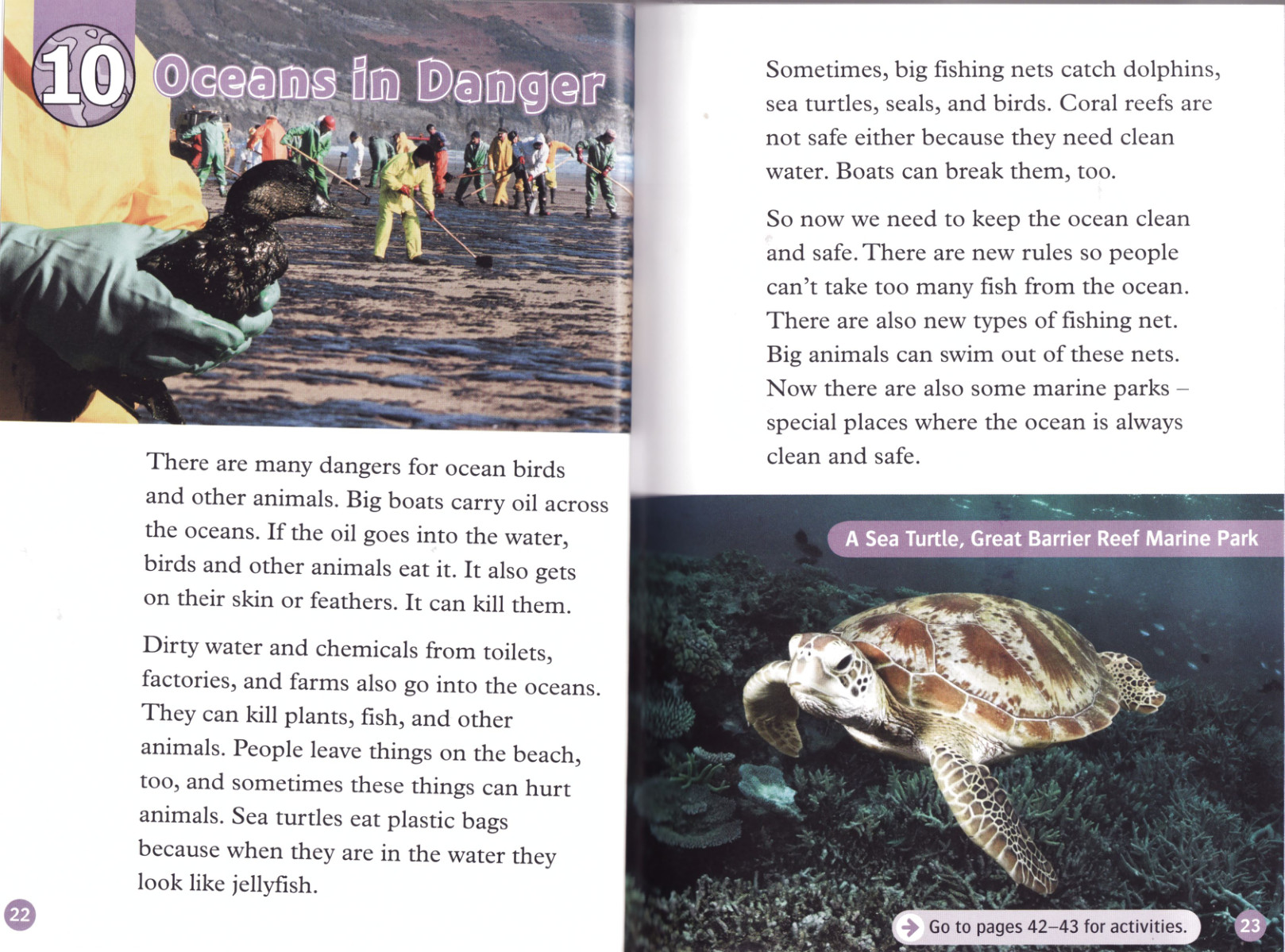
There are many dangers for ocean birds and other animals. Big boats carry oil across the oceans. If the oil goes into the water, birds and other animals eat it. It also gets on their skin or feathers. It can kill them.
Dirty water and chemicals from toilets, factories, and farms also go into the oceans. They can kill plants, fish, and other animals. People leave things on the beach, too, and sometimes these things can hurt animals. Sea turtles eat plastic bags because when they are in the water they look like jellyfish.
Sometimes, big fishing nets catch dolphins, sea turtles, seals, and birds. Coral reefs are not safe either because they need clean water. Boats can break them, too.
So now we need to keep the ocean clean and safe. There are new rules so people can't take too many fish from the ocean. There are also new types of fishing net. Big animals can swim out of these nets. Now there are also some marine parks – special places where the ocean is always clean and safe.
Từ vựng
3 Xem trang bài tập
4 Bài tập tương tác
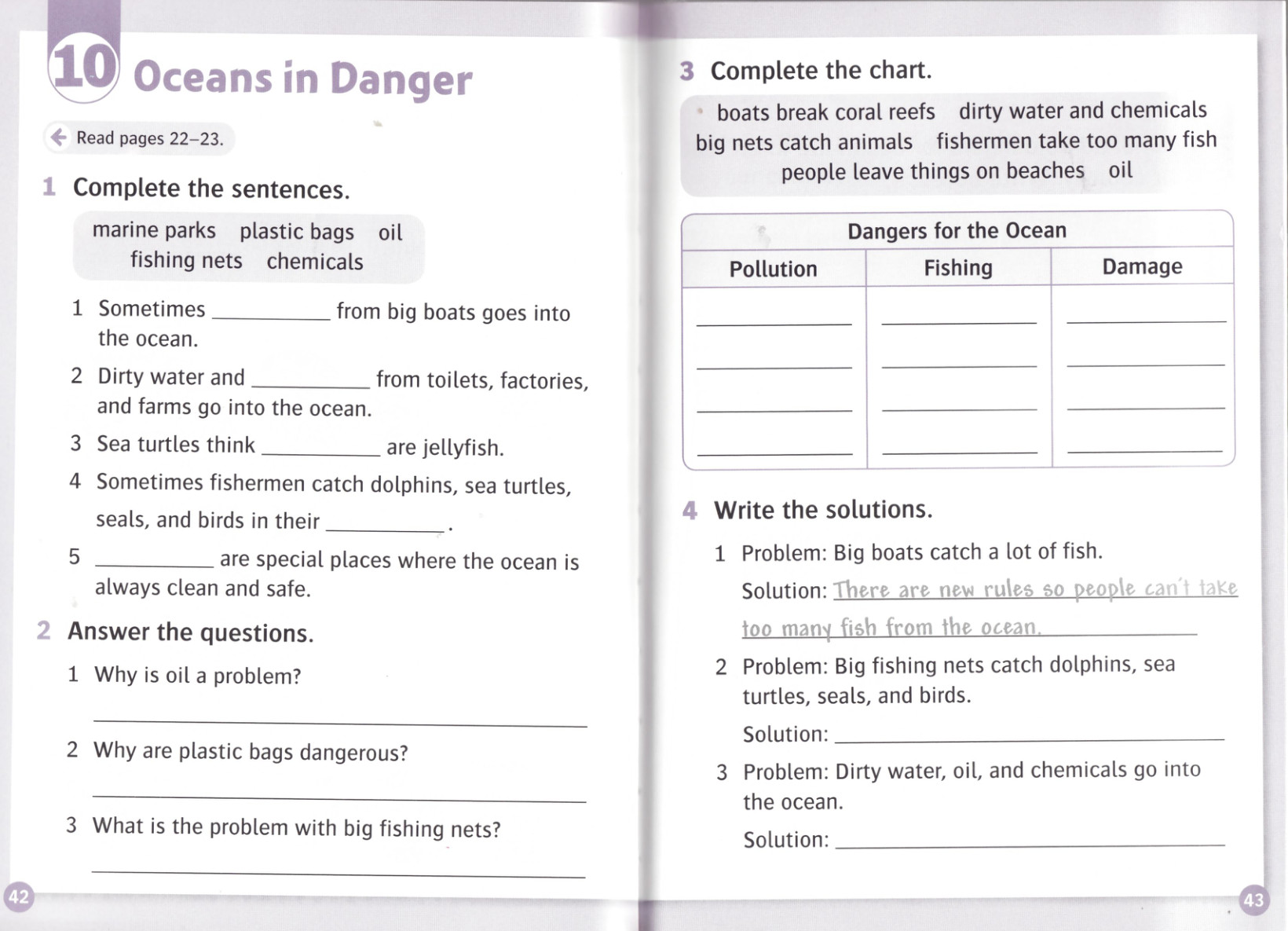
1. Complete the sentences.
Chọn từ trong khung.
1. Complete the sentences.
2. Dirty water and from toilets, factories, and farms go into the ocean.
3. Sea turtles think are jellyfish.
4. Sometimes fishermen catch dolphins, sea turtles, seals, and birds in their .
5. are special places where the ocean is always clean and safe.
2. Answer the questions.
Giải thích theo bài đọc; giáo viên nhận xét câu trả lời.
2. Why is oil a problem?
- Answer the question clearly.
- Use information from the text or your own experience.
Lời giải và bài mẫu
Birds and other animals eat it, and it gets on their skin or feathers. It can kill them.
3. Why are plastic bags dangerous?
- Answer the question clearly.
- Use information from the text or your own experience.
Lời giải và bài mẫu
They look like jellyfish in the water, so sea turtles eat them.
4. What is the problem with big fishing nets?
- Answer the question clearly.
- Use information from the text or your own experience.
Lời giải và bài mẫu
Sometimes they catch dolphins, sea turtles, seals and birds.
3. Complete the chart.
Phân loại các nguy cơ cho đại dương.
5. Complete the chart.
4. Write the solutions.
Viết giải pháp theo bài đọc.
Big boats catch a lot of fish. → There are new rules so people cannot take too many fish from the ocean.
6. Problem: Big fishing nets catch dolphins, sea turtles, seals and birds. Write a solution.
- Answer the question clearly.
- Use information from the text or your own experience.
Lời giải và bài mẫu
There are new types of fishing net which big animals can swim out of.
7. Problem: Dirty water, oil and chemicals go into the ocean. Write a solution.
- Answer the question clearly.
- Use information from the text or your own experience.
Lời giải và bài mẫu
There are marine parks where the ocean is always clean and safe.
Projects
Trang dự án
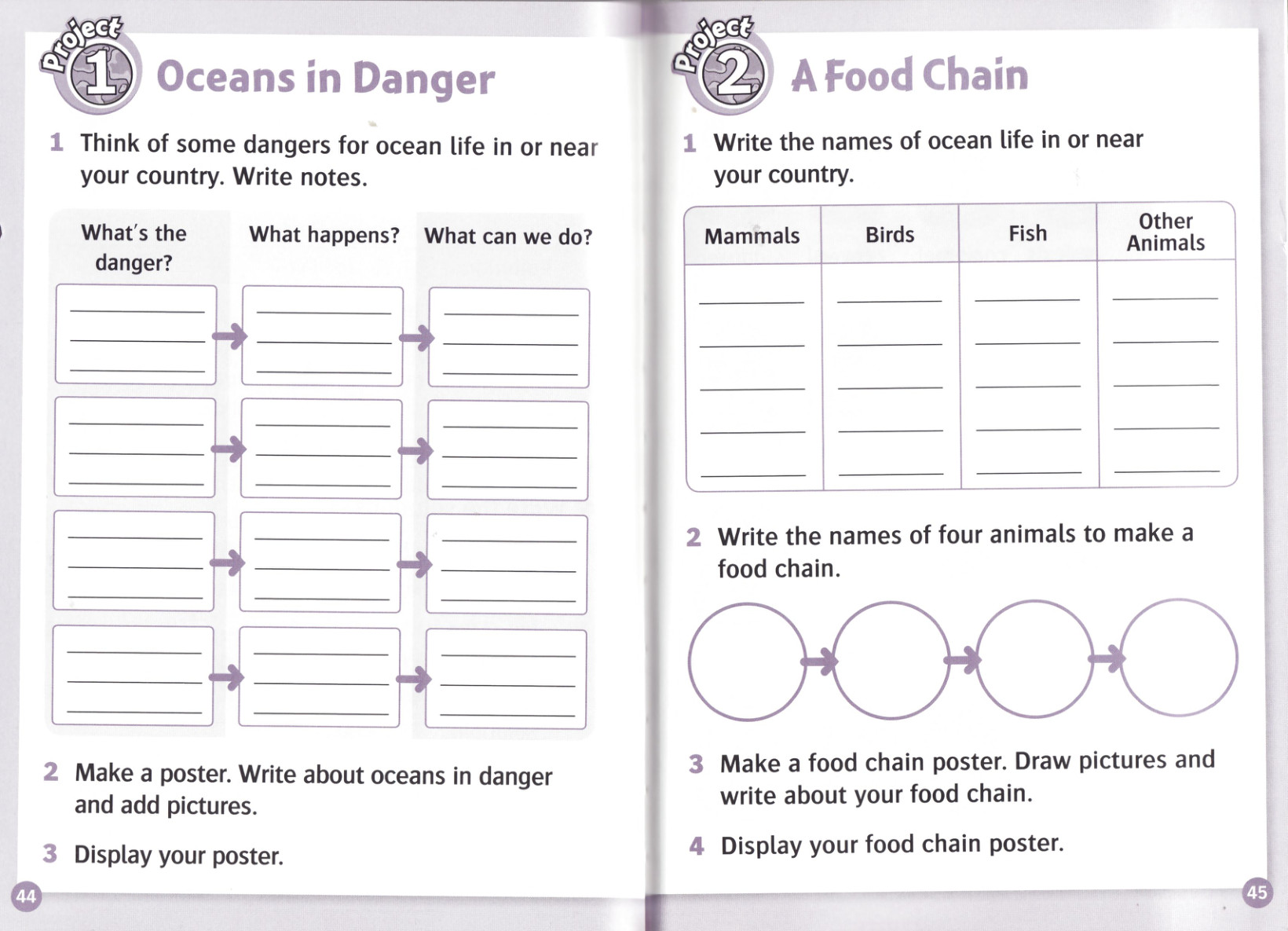
Project 1: Oceans in Danger. Think of dangers for ocean life in or near your country. Note what happens and what we can do, then make and display a poster with pictures. Project 2: A Food Chain. List ocean mammals, birds, fish and other animals near your country. Choose four animals for a food chain, then draw and write about it on a poster.
Từ điển tranh
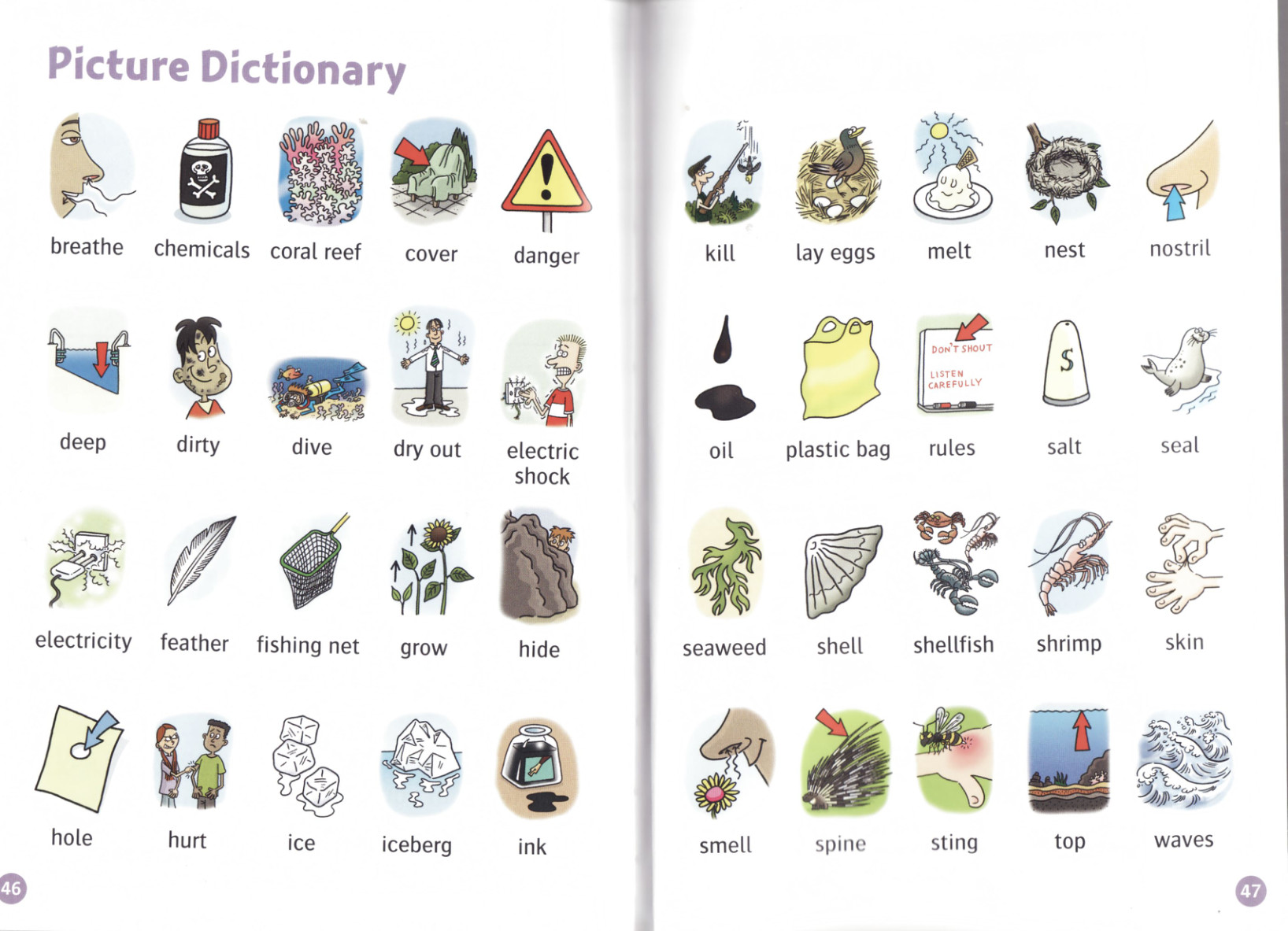
Từ điển tranh