Amazing Minibeasts
Đọc · Nghe · Từ vựng · Bài tập · Dự án · Từ điển tranh
Minibeasts
1 Đọc trang sách
2 Đọc & Nghe
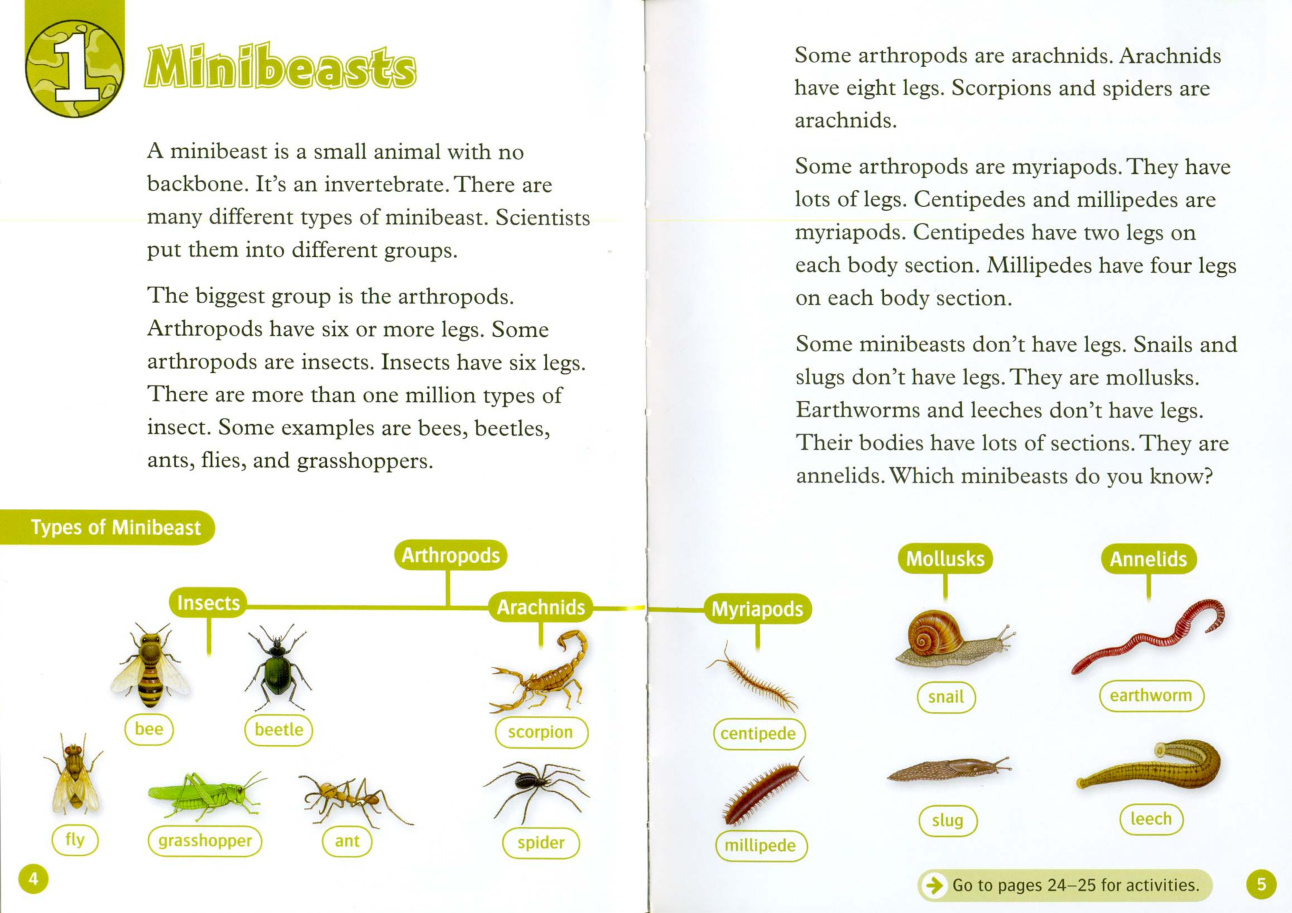
A minibeast is a small animal with no backbone. It's an invertebrate. There are many different types of minibeast. Scientists put them into different groups.
The biggest group is the arthropods. Arthropods have six or more legs. Some arthropods are insects. Insects have six legs. There are more than one million types of insect.
Some arthropods are arachnids. Arachnids have eight legs. Scorpions and spiders are arachnids.
Some arthropods are myriapods. They have lots of legs. Centipedes and millipedes are myriapods.
Some minibeasts don't have legs. Snails and slugs don't have legs. They are mollusks. Earthworms and leeches are annelids.
Từ vựng
3 Xem trang bài tập

4 Bài tập tương tác
1. Classify each minibeast into the correct group.
2. It has six legs. It has wings. It's black and yellow.
3. It has eight legs. It has a tail. It's an arachnid.
4. It doesn't have legs. It has a shell. It's a mollusc.
5. It doesn't have legs. It doesn't have a shell. It's an annelid.
6. Draw and write about two minibeasts.
Câu trả lời tự do — không tính vào điểm.Insect Bodies
1 Đọc trang sách
2 Đọc & Nghe
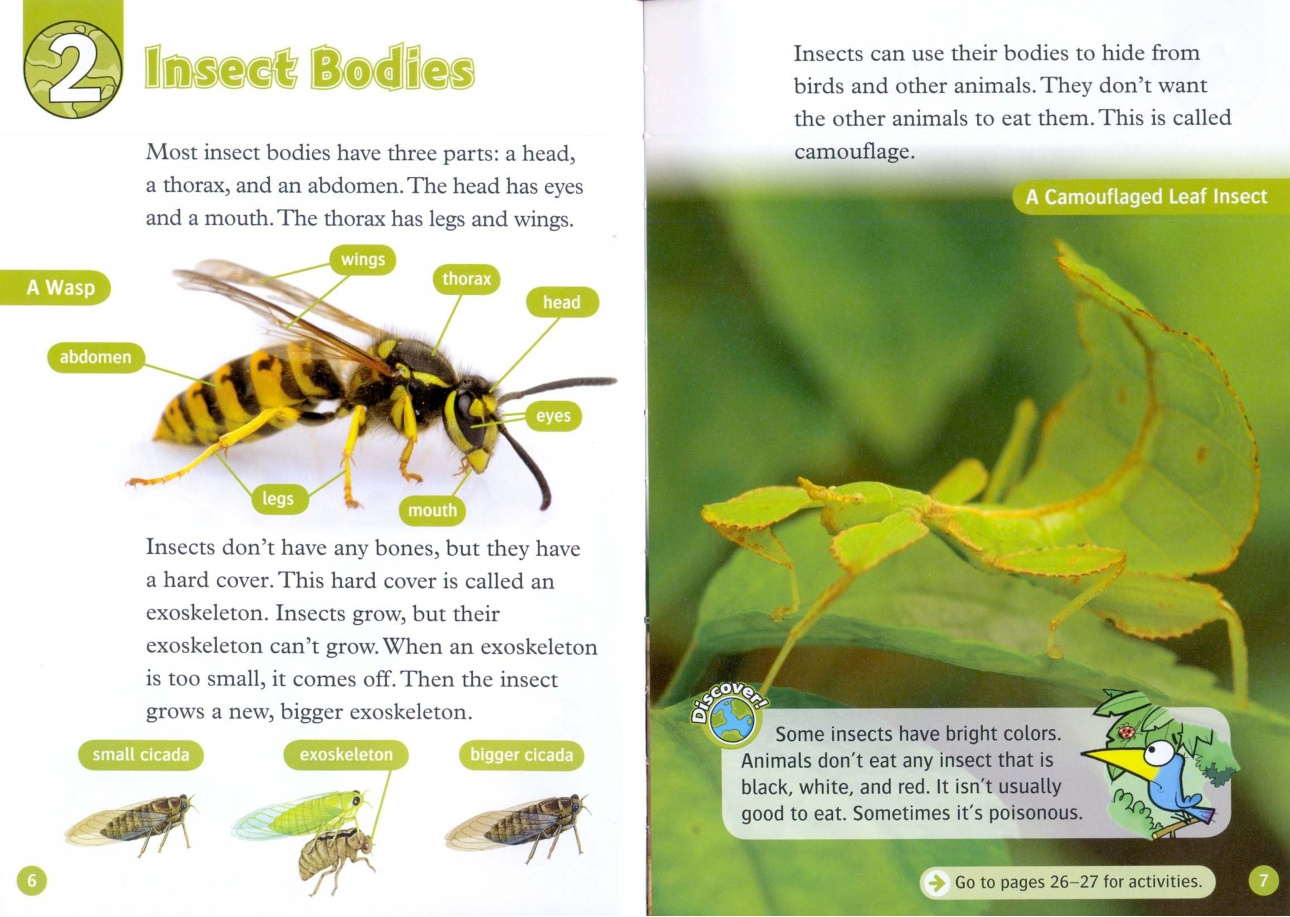
Most insect bodies have three parts: a head, a thorax, and an abdomen. The head has eyes and a mouth. The thorax has legs and wings.
Insects don't have any bones, but they have a hard cover. This hard cover is called an exoskeleton.
Insects grow, but their exoskeleton can't grow. When an exoskeleton is too small, it comes off. Then the insect grows a new, bigger exoskeleton.
Insects can use their bodies to hide from birds and other animals. This is called camouflage.
Some insects have bright colors. Animals don't eat any insect that is black, white, and red. It isn't usually good to eat. Sometimes it's poisonous.
Từ vựng
3 Xem trang bài tập

4 Bài tập tương tác
1. Wasp diagram label 1.
2. Wasp diagram label 2.
3. Wasp diagram label 3.
4. Wasp diagram label 4.
5. Wasp diagram label 5.
6. Insects don't have any ____.
7. They have a hard ____ called an exoskeleton.
8. When an exoskeleton is too ____, it comes off.
9. Then the insect grows a ____ exoskeleton.
10. Insects can / can't use their body to hide.
11. Insects want / don't want other animals to eat them.
12. Some / All insect bodies are camouflaged.
13. An insect that is black, white, and red is / isn't good to eat.
14. Insects are sometimes / never poisonous.
15. An exoskeleton can / can't grow.
16. What color are insects that are not good to eat?
17. How many parts do most insects have?
18. What are the names of the insect parts?
19. What happens when an exoskeleton is too small?
20. How do insects hide from other animals?
Insect Senses
1 Đọc trang sách

2 Đọc & Nghe
Most insects have two very big eyes. They can't see clearly, but they can see things move very well. Some insects have extra eyes that can only see light and dark.
Some minibeasts have antennae on their head. They use their antennae to feel and touch things. They can also smell food and other minibeasts with their antennae.
Butterflies have a very long tongue called a proboscis. They use their tongue to taste and drink nectar in flowers. Butterflies can also taste with their feet.
Most insects don't have ears on their head. They have ears on their body or their legs. Crickets have ears on their front legs.
Từ vựng
3 Xem trang bài tập
4 Bài tập tương tác
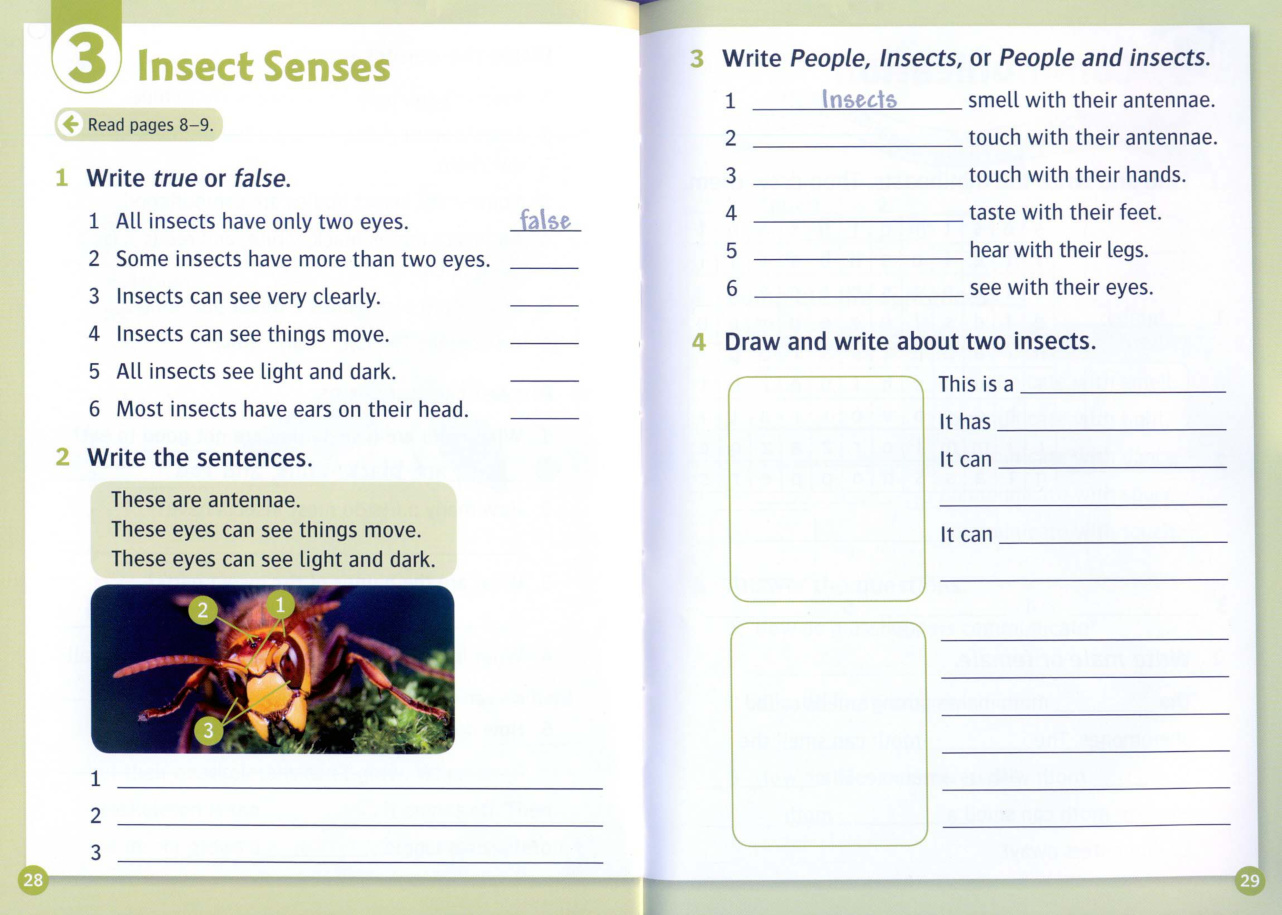
1. All insects have only two eyes.
2. Some insects have more than two eyes.
3. Insects can see very clearly.
4. Insects can see things move.
5. All insects see light and dark.
6. Most insects have ears on their head.
7. These are antennae.
8. These eyes can see things move.
9. These eyes can see light and dark.
10. ____ smell with their antennae.
11. ____ touch with their antennae.
12. ____ touch with their hands.
13. ____ taste with their feet.
14. ____ hear with their legs.
15. ____ see with their eyes.
16. Draw and write about two insects and their senses.
Câu trả lời tự do — không tính vào điểm.Communication
1 Đọc trang sách

2 Đọc & Nghe
Most male and female minibeasts communicate with each other because they need to make new, baby minibeasts.
Some minibeasts communicate with sound. Grasshoppers can sing. They move their legs up and down to make a singing sound.
Some minibeasts communicate with smell. The female moth makes strong smells called pheromones. The male moth can smell the female with its antennae.
Some minibeasts communicate with light. Fireflies can make light with their abdomen. Male and female fireflies flash their lights to each other.
Some minibeasts communicate to give each other information. Bees dance to tell other bees where there is food. Ants touch each other's antennae or head to give information about food or danger.
Từ vựng
3 Xem trang bài tập
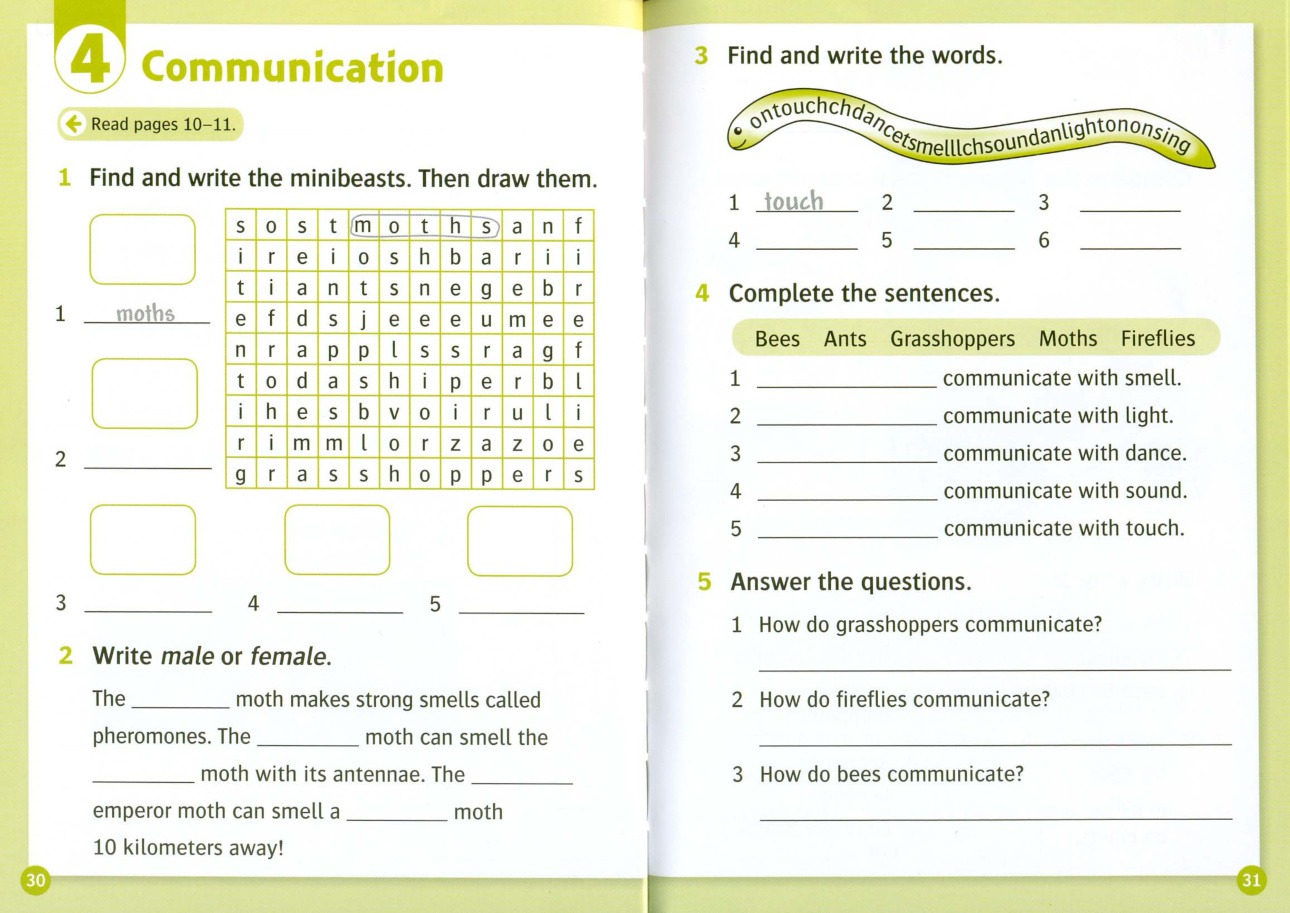
4 Bài tập tương tác
1. Find and write a minibeast from the word search.
2. Find and write a minibeast from the word search.
3. Find and write a minibeast from the word search.
4. Find and write a minibeast from the word search.
5. Find and write a minibeast from the word search.
6. The ____ moth makes strong smells called pheromones.
7. The ____ moth can catch the smell with its antennae.
8. The male emperor moth can smell a ____ moth 10 kilometers away.
9. Find and write the hidden communication word.
10. Find and write the hidden communication word.
11. Find and write the hidden communication word.
12. Find and write the hidden communication word.
13. Find and write the hidden communication word.
14. Find and write the hidden communication word.
15. ____ communicate with smell.
16. ____ communicate with light.
17. ____ communicate with dance.
18. ____ communicate with sound.
19. ____ communicate with touch.
20. How do grasshoppers communicate?
21. How do fireflies communicate?
22. How do bees communicate?
Baby Minibeasts
1 Đọc trang sách
2 Đọc & Nghe
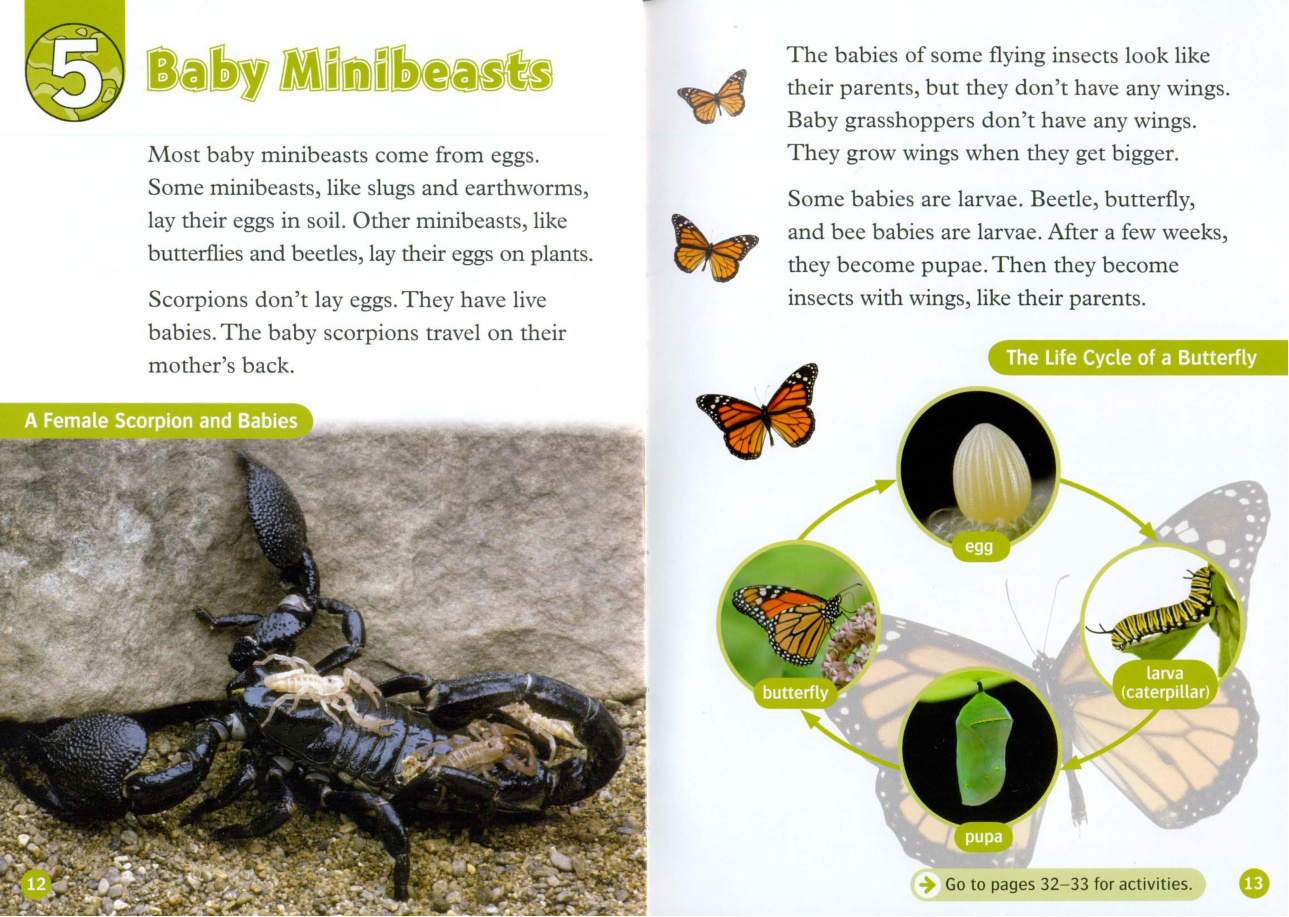
Most baby minibeasts come from eggs. Some minibeasts, like slugs and earthworms, lay their eggs in soil. Other minibeasts, like butterflies and beetles, lay their eggs on plants.
Scorpions don't lay eggs. They have live babies. The baby scorpions travel on their mother's back.
The babies of some flying insects look like their parents, but they don't have any wings. Baby grasshoppers don't have any wings. They grow wings when they get bigger.
Some babies are larvae. Beetle, butterfly, and bee babies are larvae. After a few weeks, they become pupae. Then they become insects with wings, like their parents.
Từ vựng
3 Xem trang bài tập
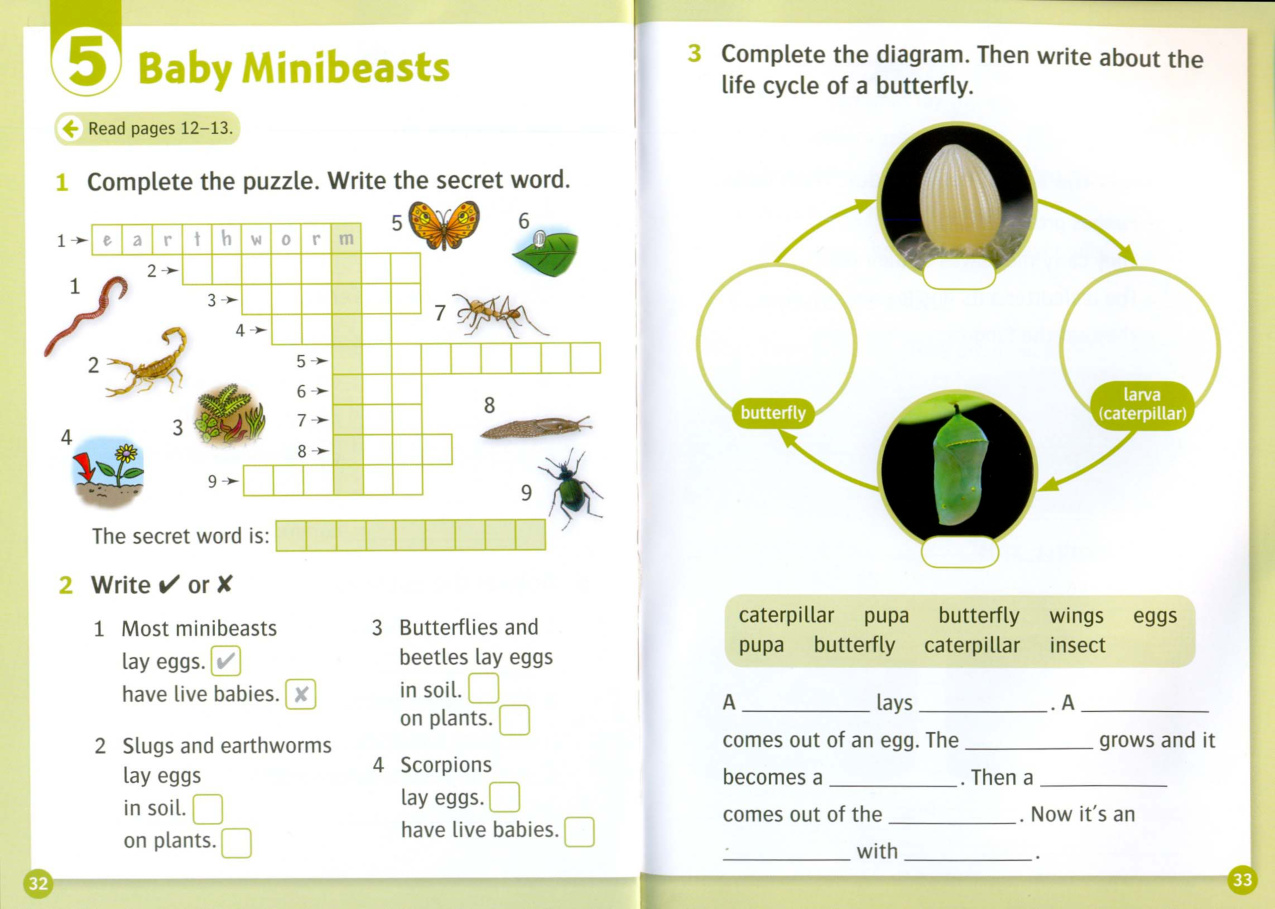
4 Bài tập tương tác
1. Complete the baby minibeasts puzzle.
2. Complete the baby minibeasts puzzle.
3. Complete the baby minibeasts puzzle.
4. Complete the baby minibeasts puzzle.
5. Complete the baby minibeasts puzzle.
6. Complete the baby minibeasts puzzle.
7. Complete the baby minibeasts puzzle.
8. Complete the baby minibeasts puzzle.
9. Complete the baby minibeasts puzzle.
10. Most minibeasts lay eggs.
11. Slugs and earthworms lay eggs on plants.
12. Butterflies and beetles lay eggs on plants.
13. Scorpions lay eggs.
14. A ____ lays ____.
15. A ____ comes out of an egg.
16. The ____ grows and it becomes a ____.
17. Then a ____ comes out of the ____.
18. Now it's an ____ with ____.
Working Insects
1 Đọc trang sách
2 Đọc & Nghe
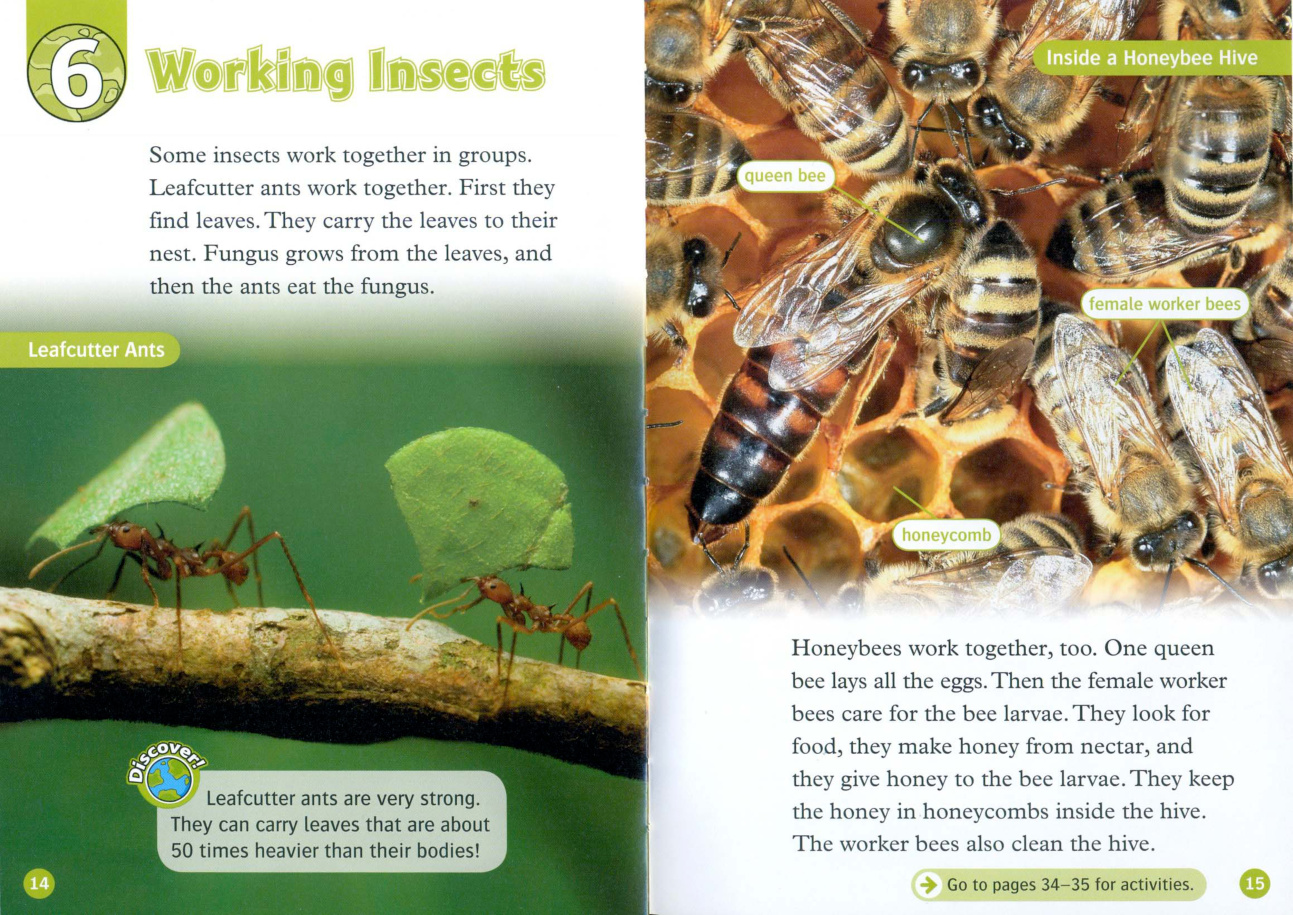
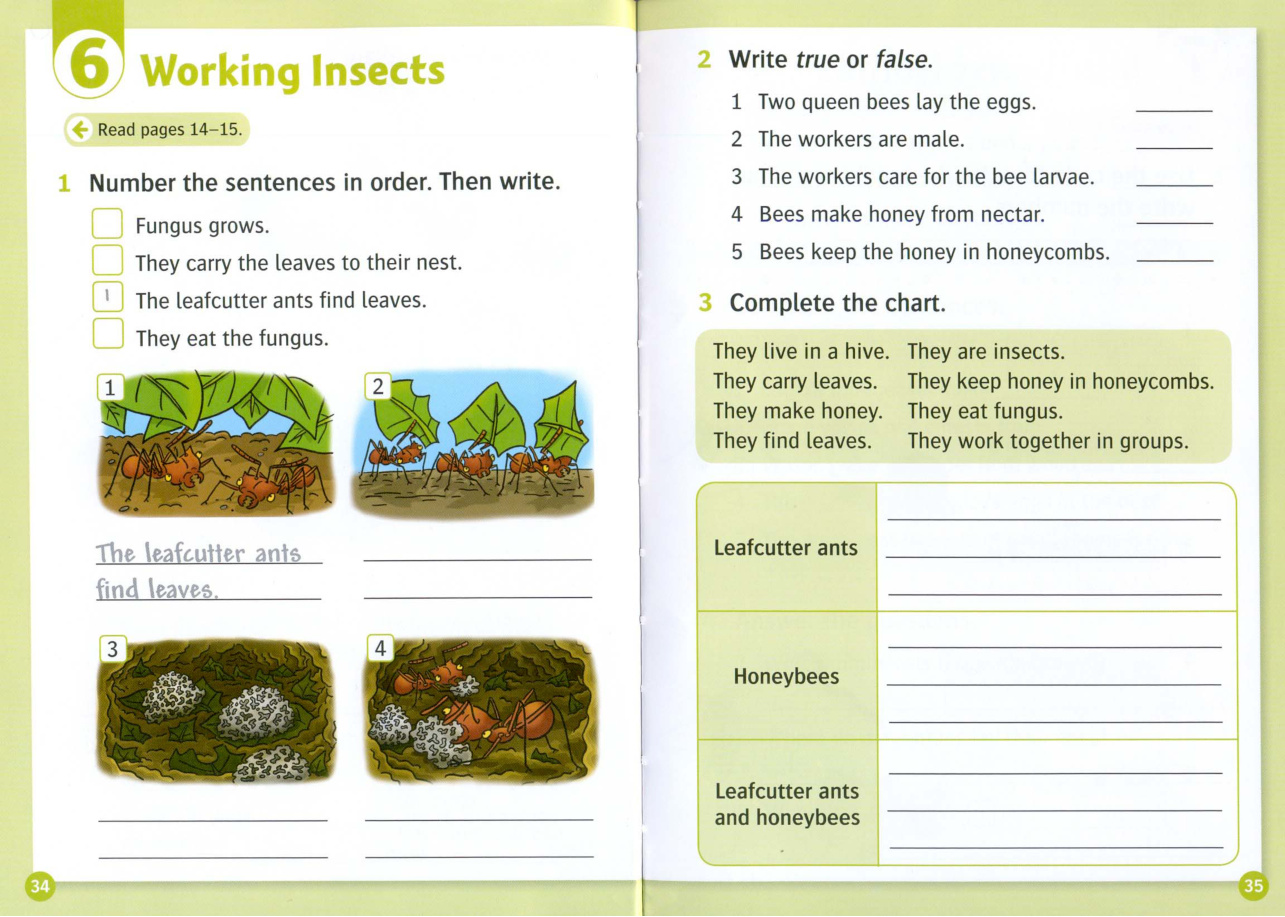
Some insects work together in groups. Leafcutter ants work together. First they find leaves. They carry the leaves to their nest. Fungus grows from the leaves, and then the ants eat the fungus.
Leafcutter ants are very strong. They can carry leaves that are about 50 times heavier than their bodies.
Honeybees work together, too. One queen bee lays all the eggs. Then the female worker bees care for the bee larvae.
The workers look for food, they make honey from nectar, and they give honey to the bee larvae. They keep the honey in honeycombs inside the hive. The worker bees also clean the hive.
Từ vựng
3 Xem trang bài tập
4 Bài tập tương tác
1. Put the leafcutter ant food-making steps in the correct order.
- Leafcutter ants find leaves.
- They carry the leaves to their nest.
- Fungus grows.
- They eat the fungus.
2. Two queen bees lay the eggs.
3. The workers are male.
4. The workers care for the bee larvae.
5. Bees make honey from nectar.
6. Bees keep the honey in honeycombs.
7. Leafcutter ants: They eat ____.
8. Honeybees: They live in a ____.
9. Honeybees: They keep honey in ____.
10. Honeybees: They make ____.
11. Leafcutter ants and honeybees: They are ____.
12. Leafcutter ants and honeybees: They work together in ____.
Minibeast Homes
1 Đọc trang sách
2 Đọc & Nghe
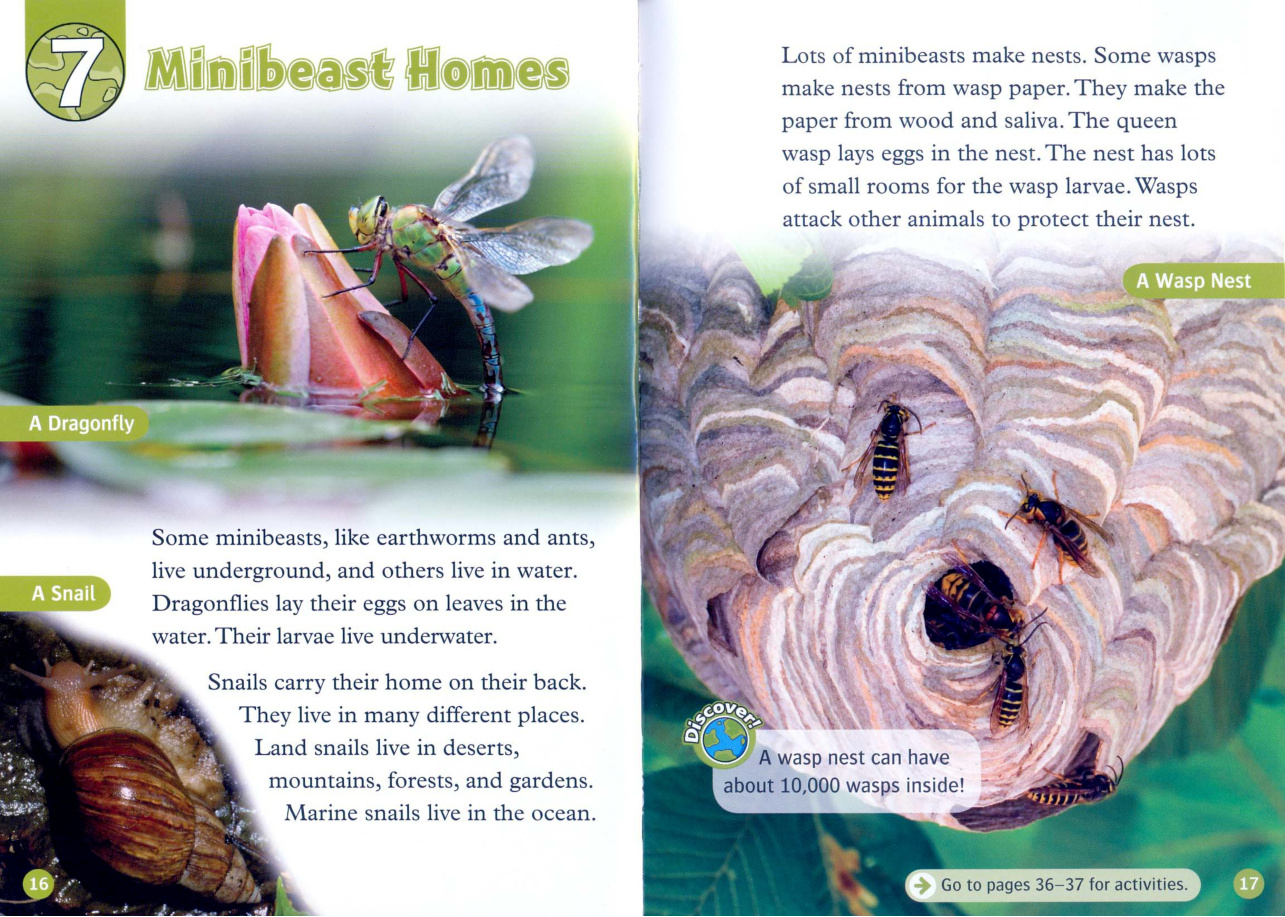
Some minibeasts, like earthworms and ants, live underground, and others live in water. Dragonflies lay their eggs on leaves in the water. Their larvae live underwater.
Snails carry their home on their back. They live in many different places. Land snails live in deserts, mountains, forests, and gardens. Marine snails live in the ocean.
Lots of minibeasts make nests. Some wasps make nests from wasp paper. They make the paper from wood and saliva.
The queen wasp lays eggs in the nest. The nest has lots of small rooms for the wasp larvae. Wasps attack other animals to protect their nest.
Từ vựng
3 Xem trang bài tập
4 Bài tập tương tác
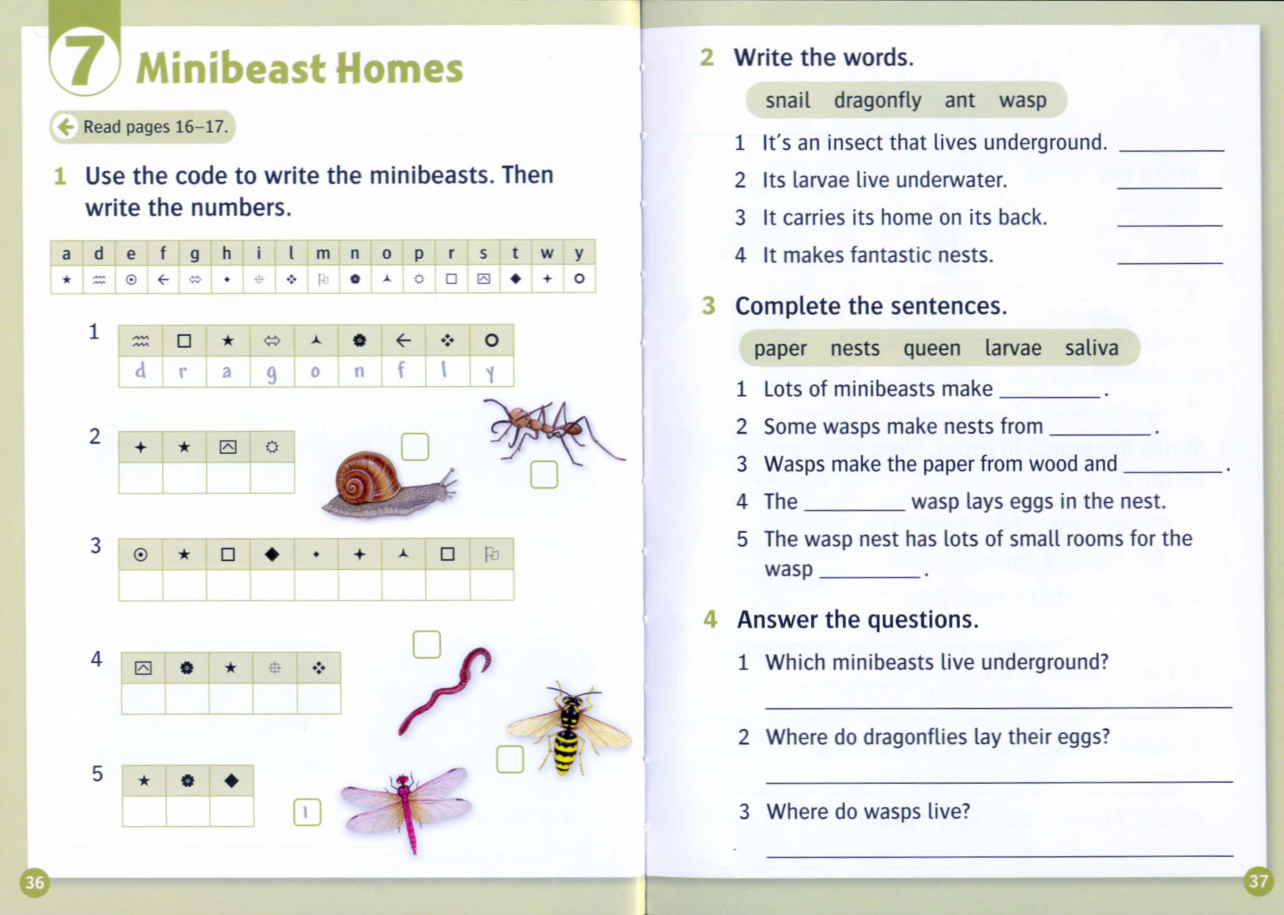
1. Decode and write the minibeast.
2. Decode and write the minibeast.
3. Decode and write the minibeast.
4. Decode and write the minibeast.
5. Decode and write the minibeast.
6. It's an insect that lives underground.
7. Its larvae live underwater.
8. It carries its home on its back.
9. It makes fantastic nests.
10. Lots of minibeasts make ____.
11. Some wasps make nests from ____.
12. Wasps make the paper from wood and ____.
13. The ____ wasp lays eggs in the nest.
14. The wasp nest has lots of small rooms for the wasp ____.
15. Which minibeasts live underground?
16. Where do dragonflies lay their eggs?
17. Where do wasps live?
Spiders
1 Đọc trang sách

2 Đọc & Nghe
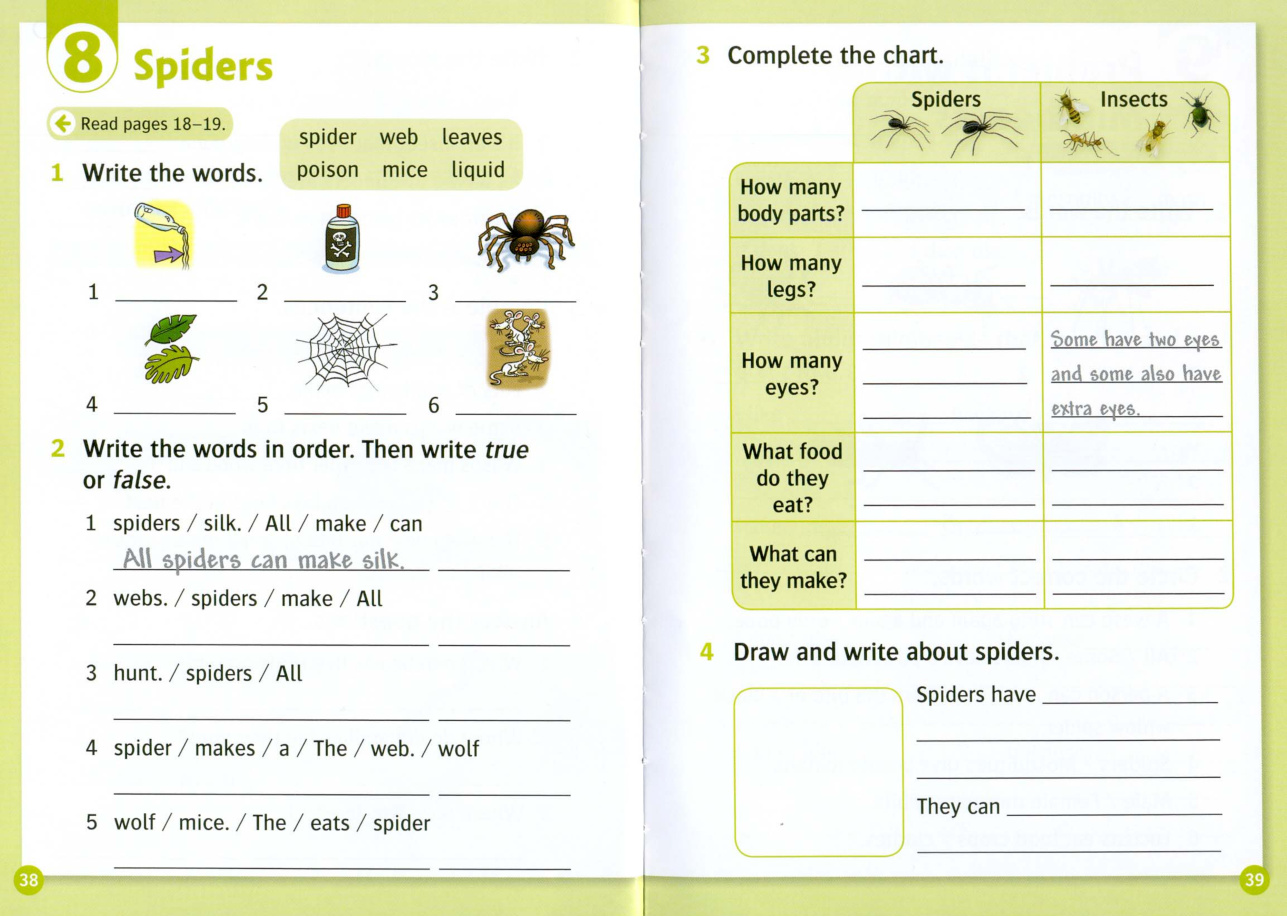
Spiders have two body parts and eight legs. They have six or eight eyes.
All spiders can make silk. Some spiders use the silk to make webs. Insects fly into the web. Then the spider eats the insects.
Some spiders hunt. The wolf spider hides in leaves. Then it jumps out and catches insects, mice, and frogs.
A spider can only eat liquid food. It bites an animal with a poison that makes the animal liquid inside. Then the spider drinks the liquid.
Female spiders are often much bigger than male spiders.
Từ vựng
3 Xem trang bài tập
4 Bài tập tương tác
1. Spider picture word 1.
2. Spider picture word 2.
3. Spider picture word 3.
4. Spider picture word 4.
5. Spider picture word 5.
6. Spider picture word 6.
7. Order the words: spiders / silk. / All / make / can
8. Order the words: webs. / spiders / make / All
9. Order the words: hunt. / spiders / All
10. Order the words: spider / makes / a / The / web. / wolf
11. Order the words: wolf / mice. / The / eats / spider
12. How many body parts do spiders have?
13. How many legs do spiders have?
14. How many eyes do spiders have?
15. What food do spiders eat?
16. What can spiders make?
17. Draw and write about spiders.
Câu trả lời tự do — không tính vào điểm.Problems with Minibeasts
1 Đọc trang sách

2 Đọc & Nghe
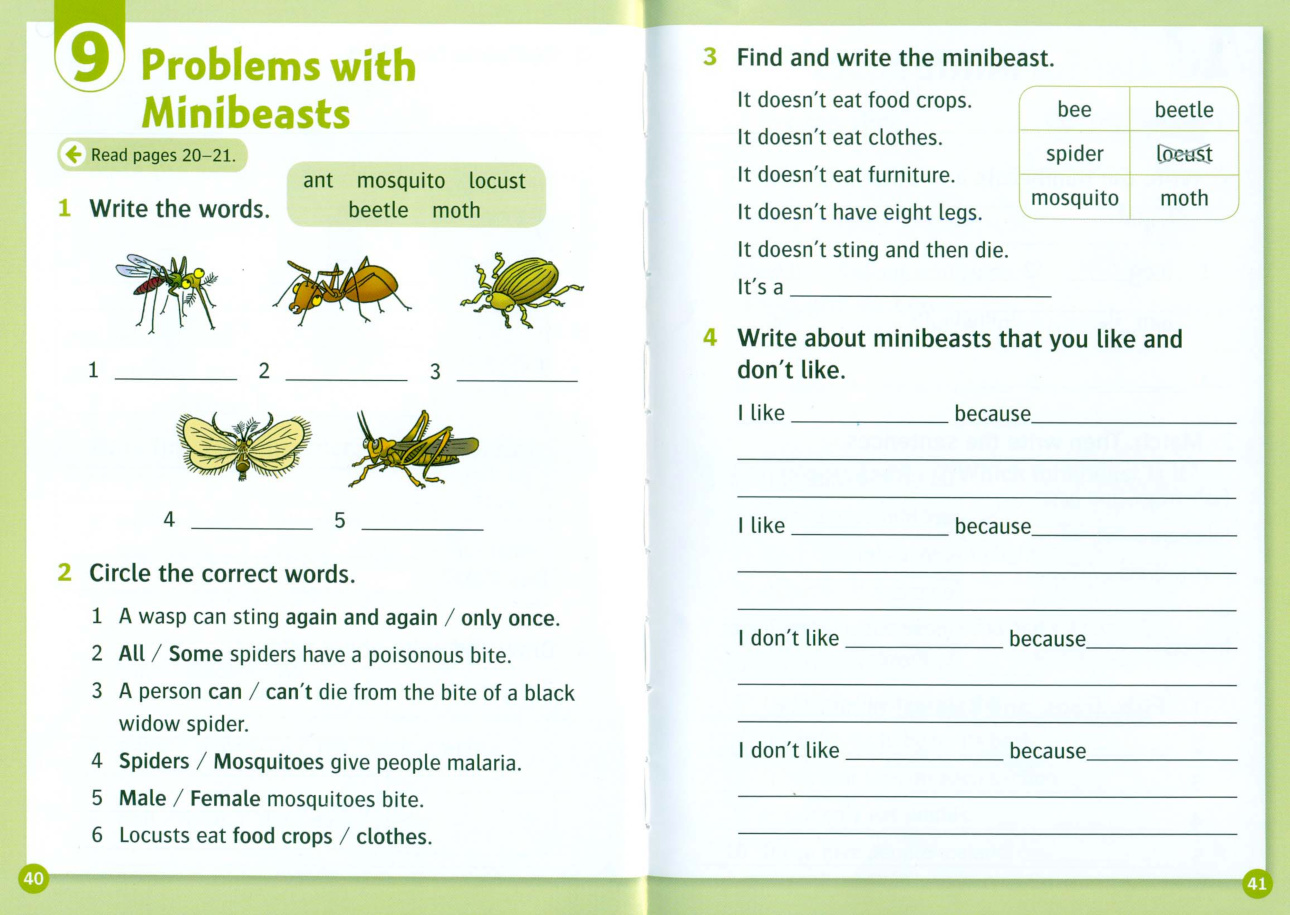
Some minibeasts can sting. The part that can sting is called a stinger. A wasp and an ant can sting again and again. A bee can only sting once. Then it dies.
Other minibeasts can bite. Some spiders have a poisonous bite, and other animals can die from this poison. A person can die from the bite of a black widow spider.
Minibeasts can also make people sick. They can bite people and give them diseases. Mosquitoes can give people a very bad disease called malaria.
Some minibeasts make problems for farmers. Locusts are a type of grasshopper. They eat a lot of food crops. Other minibeasts make problems in our homes. Some moths eat clothes, and some beetles eat wood.
Từ vựng
3 Xem trang bài tập
4 Bài tập tương tác
1. Picture 1: Write the word.
2. Picture 2: Write the word.
3. Picture 3: Write the word.
4. Picture 4: Write the word.
5. Picture 5: Write the word.
6. A wasp can sting again and again / only once.
7. All / Some spiders have a poisonous bite.
8. A person can / can't die from the bite of a black widow spider.
9. Spiders / Mosquitoes give people malaria.
10. Male / Female mosquitoes bite.
11. Locusts eat food crops / clothes.
12. It doesn't eat food crops.
13. It doesn't eat clothes.
14. It doesn't eat furniture.
15. It doesn't have eight legs.
16. It doesn't sting and then die.
17. Write about minibeasts that you like and don't like.
Câu trả lời tự do — không tính vào điểm.Useful Minibeasts
1 Đọc trang sách
2 Đọc & Nghe
Minibeasts are important food for many other animals. Fish, frogs, bats, and birds eat minibeasts.
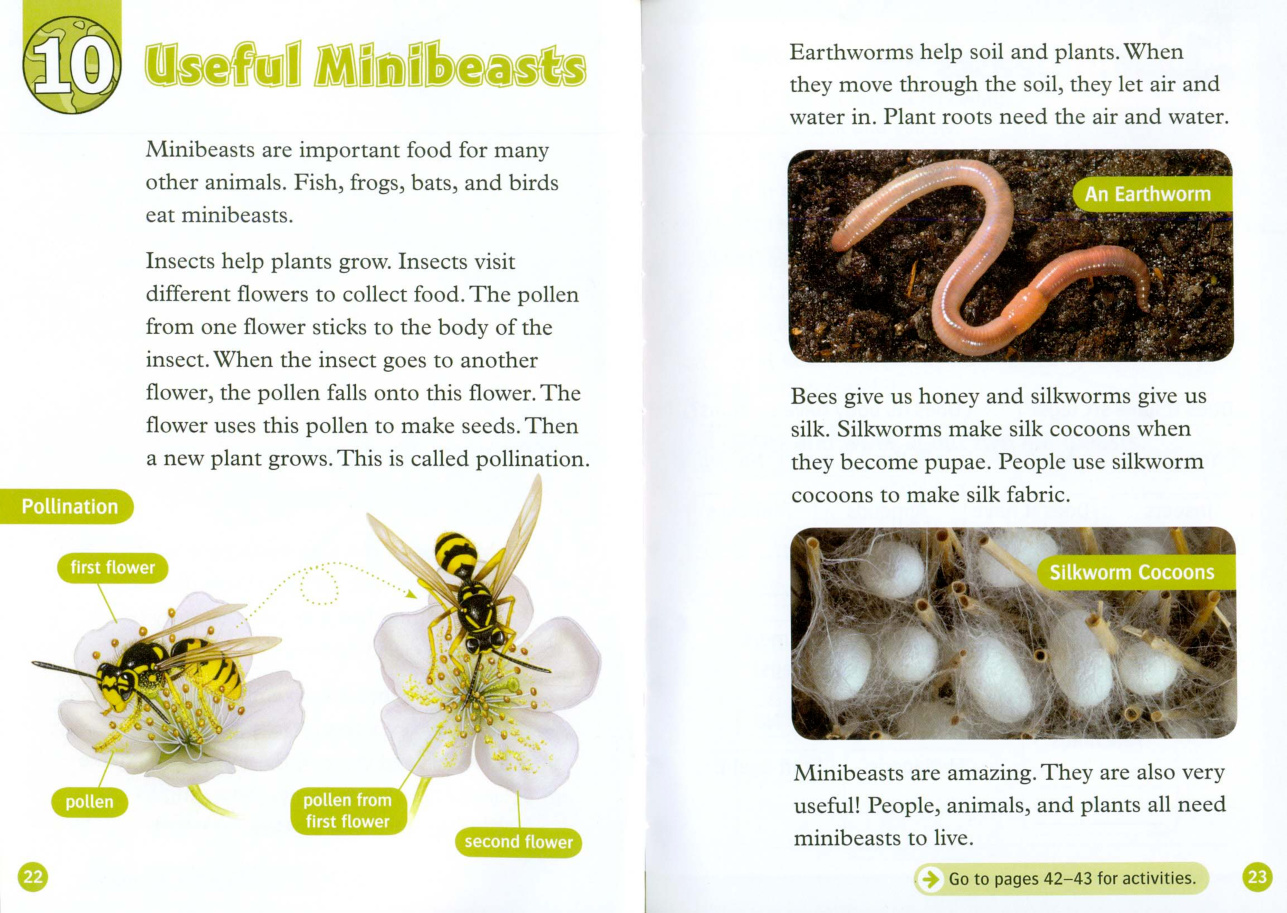
Insects help plants grow. Insects visit different flowers to collect food. The pollen from one flower sticks to the body of the insect. When the insect goes to another flower, the pollen falls onto this flower. The flower uses this pollen to make seeds. Then a new plant grows. This is called pollination.
Earthworms help soil and plants. When they move through the soil, they let air and water in. Plant roots need the air and water.
Bees give us honey and silkworms give us silk. Silkworms make silk cocoons when they become pupae. People use silkworm cocoons to make silk fabric.
Minibeasts are amazing. They are also very useful. People, animals, and plants all need minibeasts to live.
Từ vựng
3 Xem trang bài tập

4 Bài tập tương tác
1. Unscramble and write the minibeast or animal.
2. Unscramble and write the minibeast or animal.
3. Unscramble and write the minibeast or animal.
4. Unscramble and write the minibeast or animal.
5. Unscramble and write the minibeast or animal.
6. Unscramble and write the minibeast or animal.
7. Fish, frogs, and bats …
8. Silkworms …
9. Earthworms …
10. Bees …
11. Insects …
12. Write about problems with minibeasts and good things about minibeasts.
Câu trả lời tự do — không tính vào điểm.13. It tastes with its feet.
14. They communicate with light.
15. It carries its home.
16. It makes nests with wood and saliva.
17. It eats fungus.
18. Its larvae live underwater.
19. It carries its baby on its back.
20. It has four legs on each section.
21. It can only eat liquid.
22. It can give people malaria.
Minibeast Projects
Trang dự án
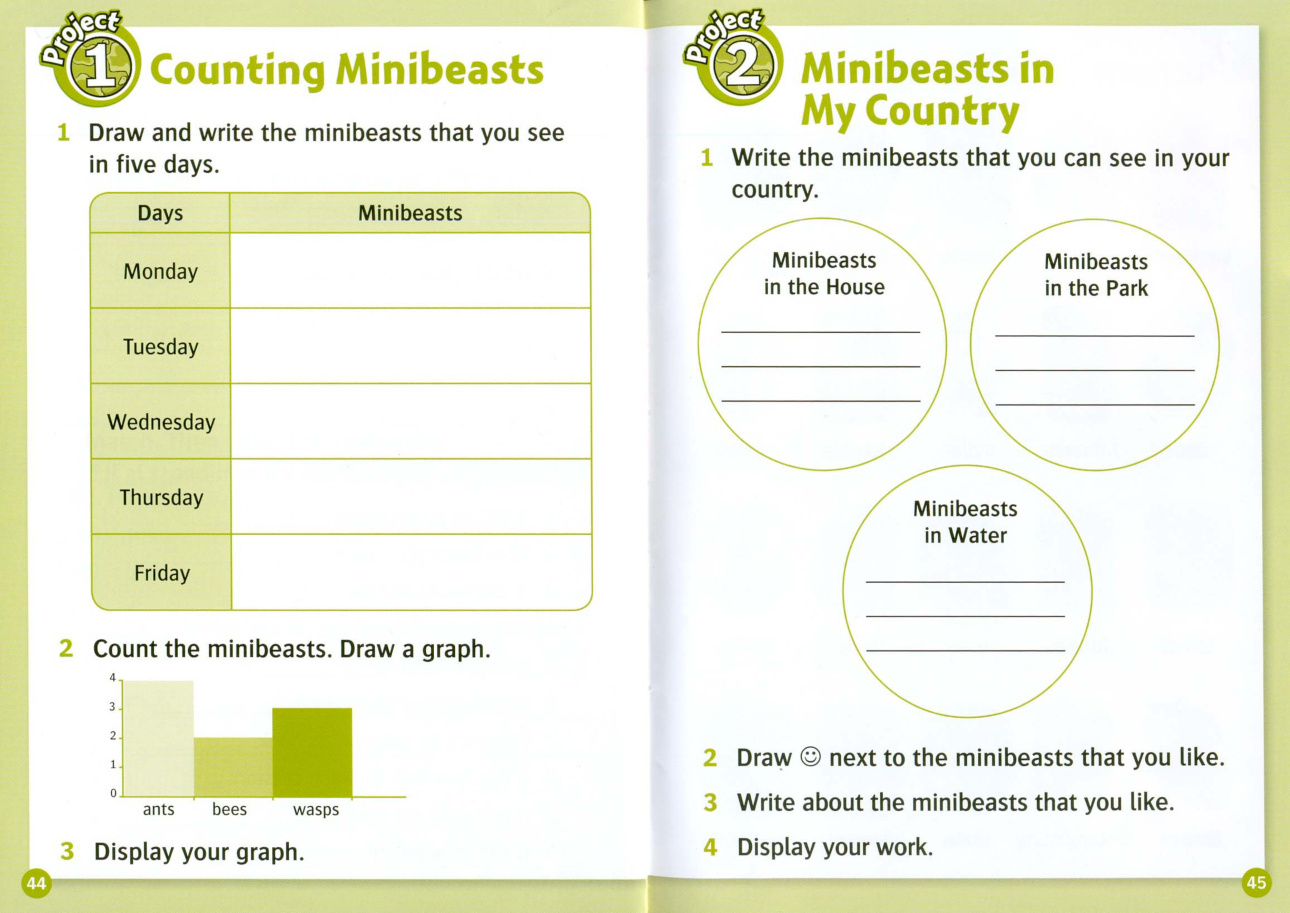
Project 1: Counting Minibeasts – record minibeasts seen over five days, count them, draw a graph, and display it. Project 2: Minibeasts in My Country – list minibeasts found in the house, park, and water; mark favorites; write about them; display the work.
Từ điển tranh
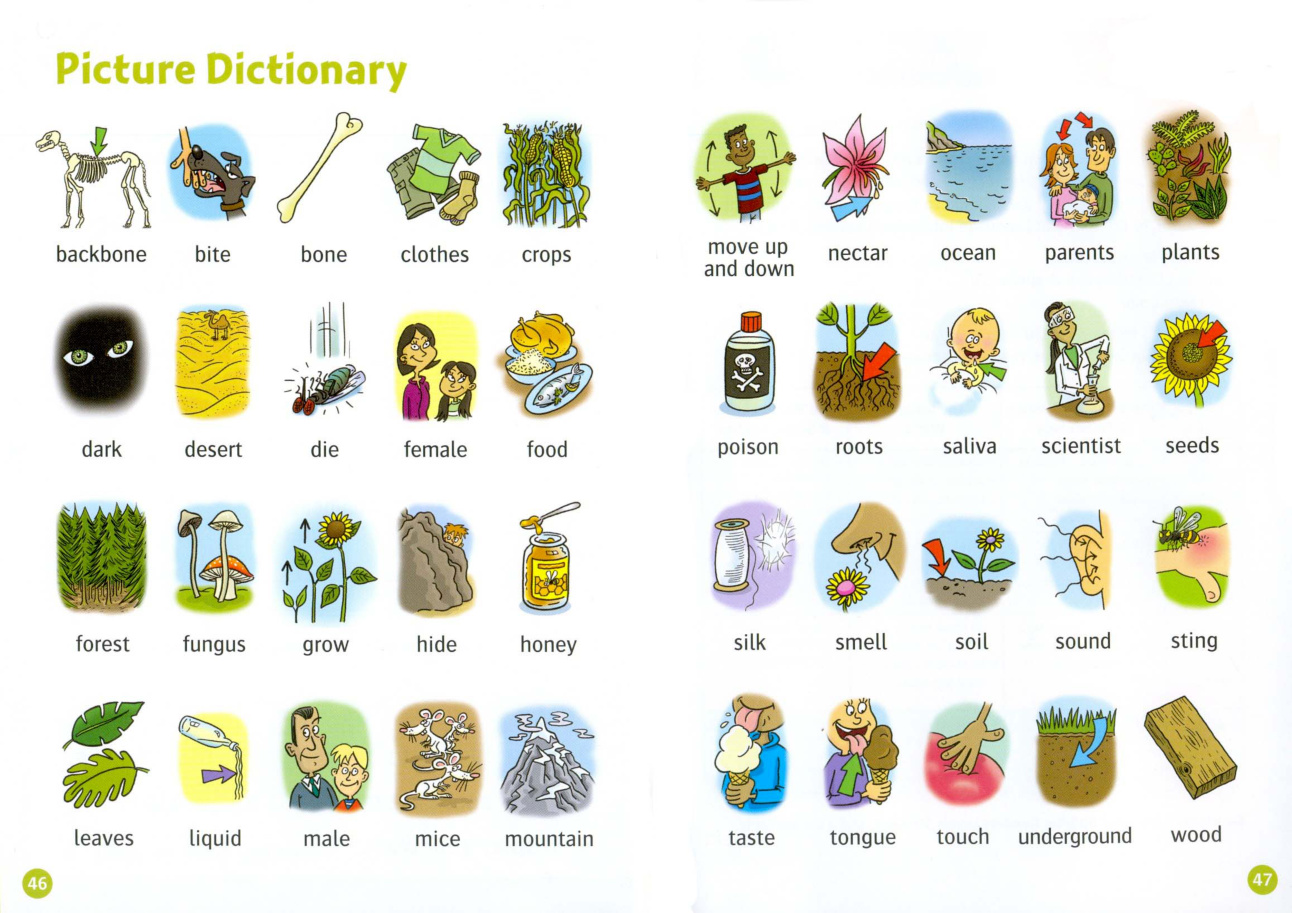
Từ điển tranh