At the Beach
Đọc · Nghe · Từ vựng · Bài tập · Dự án · Từ điển tranh
The Beach
1 Đọc trang sách

2 Đọc & Nghe
Every day the ocean goes up the beach at high tide, and it goes down the beach at low tide.
The ocean moves with the wind, too. The wind makes waves. The ocean is salt water. It's big and strong.
The ocean can break rocks and shells into pieces. The pieces of rock and shell hit the water and other rocks. Then they get very little. This is how the ocean makes rocks and shells into sand.
Từ vựng
3 Xem trang bài tập

4 Bài tập tương tác
1. The ocean …
2. At low tide …
3. Sand …
4. At high tide …
5. Puzzle word 2
6. Puzzle word 3
7. Puzzle word 4
8. Puzzle word 5
9. The secret word is …
Sand and Rocks
1 Đọc trang sách
2 Đọc & Nghe
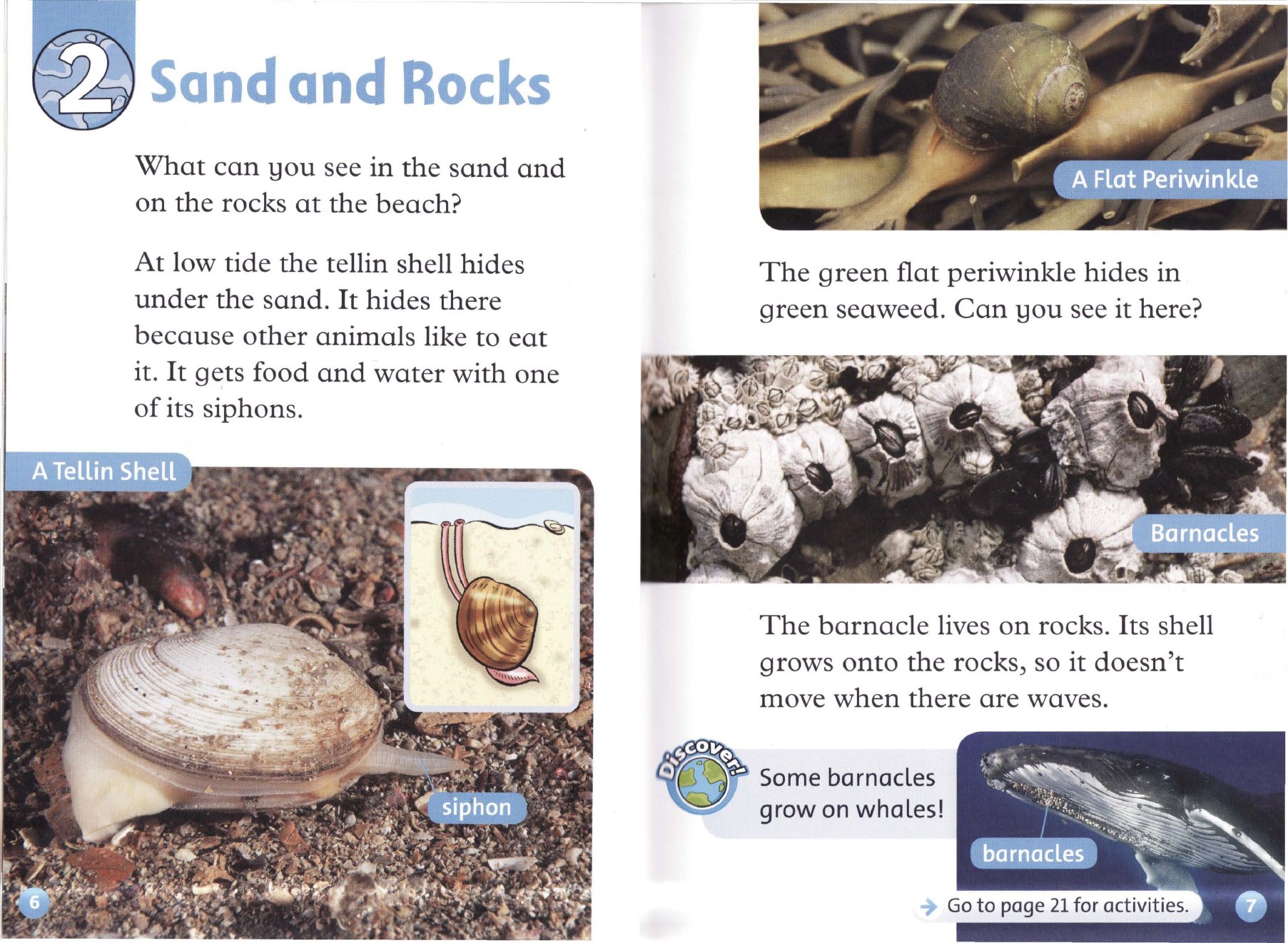
What can you see in the sand and on the rocks at the beach?
At low tide the tellin shell hides under the sand. It hides there because other animals like to eat it. It gets food and water with one of its siphons.
The green flat periwinkle hides in green seaweed. Can you see it here?
The barnacle lives on rocks. Its shell grows onto the rocks, so it doesn't move when there are waves. Some barnacles grow on whales!
Từ vựng
3 Xem trang bài tập
4 Bài tập tương tác
1. The tellin shell …
2. The flat periwinkle …
3. The barnacle …
4. Picture number: barnacle
5. Picture number: flat periwinkle
6. Picture number: tellin shell
7. Order the words: with / gets / food / The / a siphon. / tellin shell
8. Order the words: barnacle's / rocks. / onto / grows / The / shell
9. Order the words: grow / Some / whales. / on / barnacles
In Rockpools
1 Đọc trang sách

2 Đọc & Nghe
At low tide, the ocean moves down the beach. Then you can find rockpools.
Let's look in a rockpool. Here's a crab. It gets food with its big, strong claws. It eats barnacles, starfish, and other little animals. It eats plants, too.
The starfish can put its stomach out of its mouth! Then it can eat this big clam.
Crabs eat starfish, and starfish eat clams. This is called a food chain.
Từ vựng
3 Xem trang bài tập

4 Bài tập tương tác
1. Write the word for picture 1
2. Write the word for picture 2
3. Write the word for picture 3
4. Write the word for picture 4
5. The crab gets food with its ____.
6. The crab eats ____, other little animals, and plants.
7. The starfish can put its ____ out of its mouth.
8. Crabs eat starfish, and starfish eat ____.
Near the Beach
1 Đọc trang sách
2 Đọc & Nghe
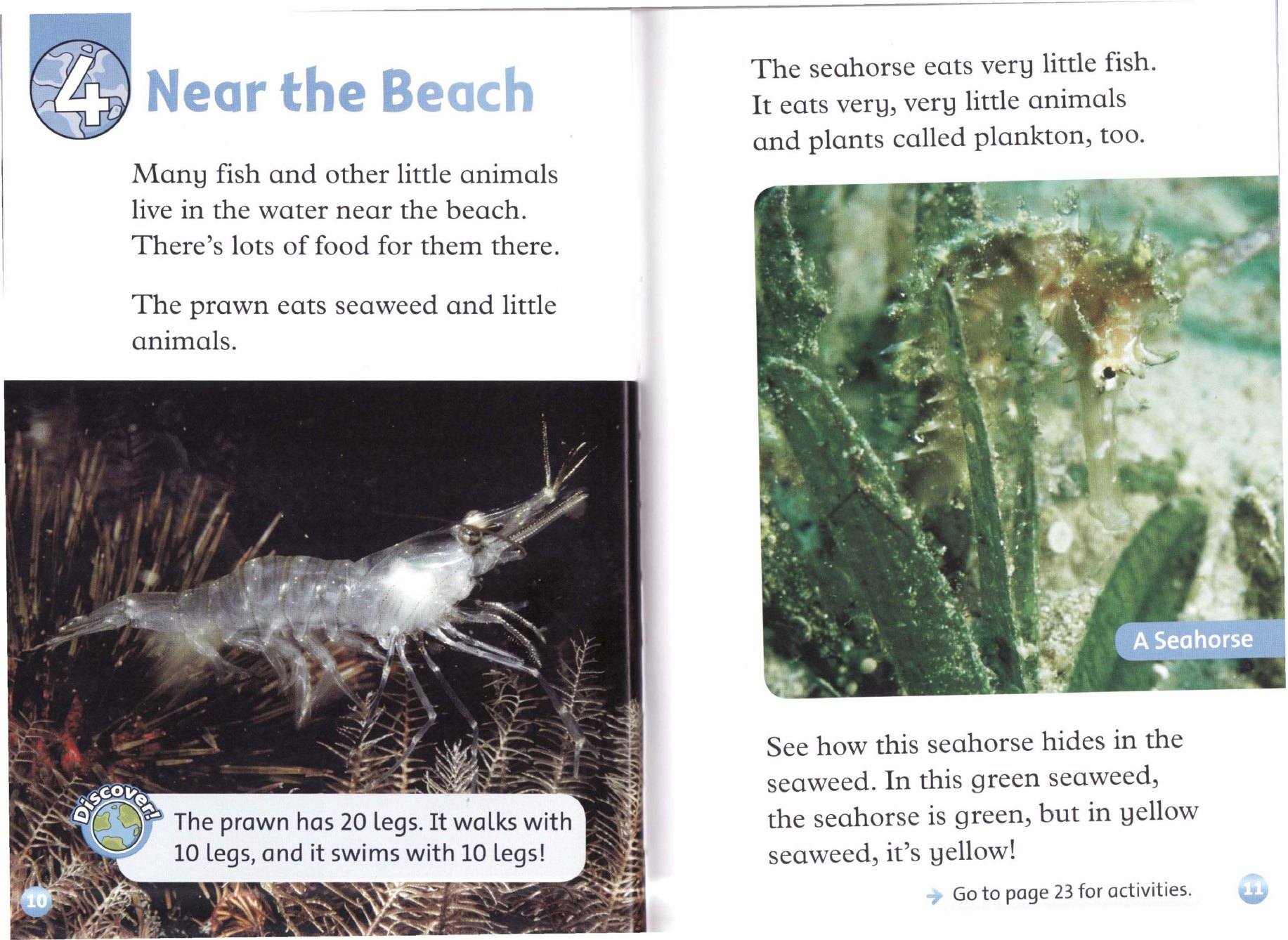
Many fish and other little animals live in the water near the beach. There's lots of food for them there.
The prawn eats seaweed and little animals.
The seahorse eats very little fish. It eats very, very little animals and plants called plankton, too.
See how this seahorse hides in the seaweed. In this green seaweed, the seahorse is green, but in yellow seaweed, it's yellow!
The prawn has 20 legs. It walks with 10 legs, and it swims with 10 legs!
Từ vựng
3 Xem trang bài tập
4 Bài tập tương tác
1. Draw and write about a seahorse.
Câu trả lời tự do — không tính vào điểm.2. Near the beach, there's lots of ____ for little animals.
3. Plankton are very, very ____ animals and plants.
4. The prawn has ____ legs.
5. The prawn walks and ____ with its legs.
6. In green seaweed, the seahorse is ____.
In the Ocean
1 Đọc trang sách

2 Đọc & Nghe
You can see some amazing animals in the ocean.
Here's a seal. The seal lives in the ocean and on land. When it swims in the ocean, it puts its head out of the water to get air.
The dolphin jumps out of the water, and little fish are scared. They swim away, and then the dolphin can catch them! The dolphin gets air with a blowhole on its head.
On sunny days, the basking shark swims at the top of the ocean. It can eat lots of plankton there. Plankton is its favorite food.
Từ vựng
3 Xem trang bài tập

4 Bài tập tương tác
1. Picture 1
2. Picture 2
3. Picture 3
4. The seal puts its head out of the water to get …
5. The dolphin gets air with a blowhole on its …
6. The dolphin can catch little …
7. The basking shark's favorite food is …
In the Air
1 Đọc trang sách

2 Đọc & Nghe
Many birds live near the beach. There's lots of food for them there.
The puffin lives on cliffs. When it's hungry, it flies down and swims under the ocean. Then it catches its favorite fish!
The pelican can catch lots of fish in its big bill. It opens its bill and the water goes out. Then it can eat the fish.
A pelican can get 11 liters of water in its bill!
Oystercatchers don't eat oysters! They eat mussels. They open the shells with their bill.
Từ vựng
3 Xem trang bài tập
4 Bài tập tương tác
1. It has a big bill.
2. It lives on cliffs.
3. It eats mussels.
4. There's no food for birds at the beach.
5. The puffin can swim, but it can't fly.
6. The pelican catches fish in its big bill.
7. The pelican can get 13 liters of water in its bill.
8. Oystercatchers eat oysters.
9. Oystercatchers eat mussels.
At the Coast
1 Đọc trang sách
2 Đọc & Nghe
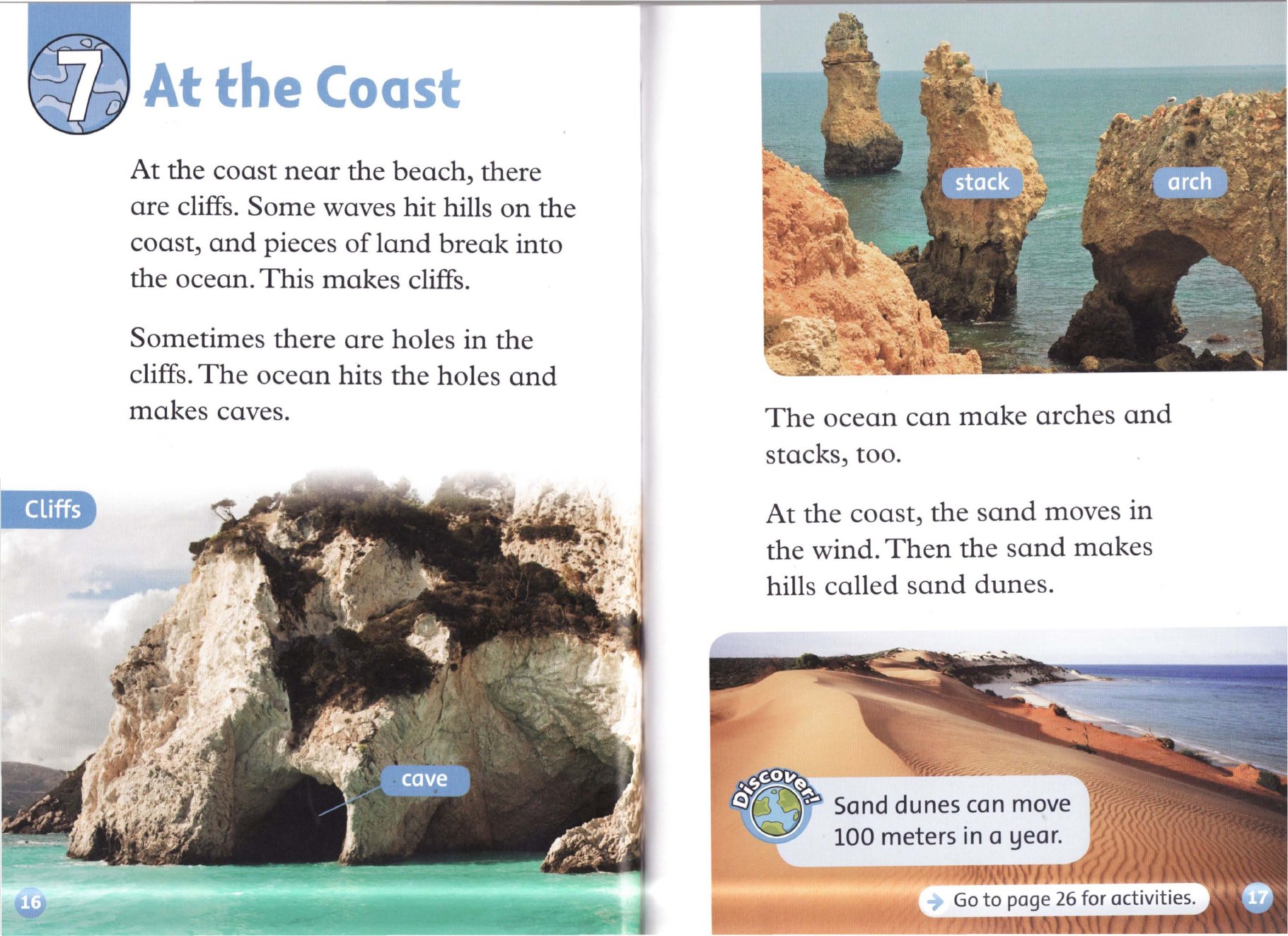
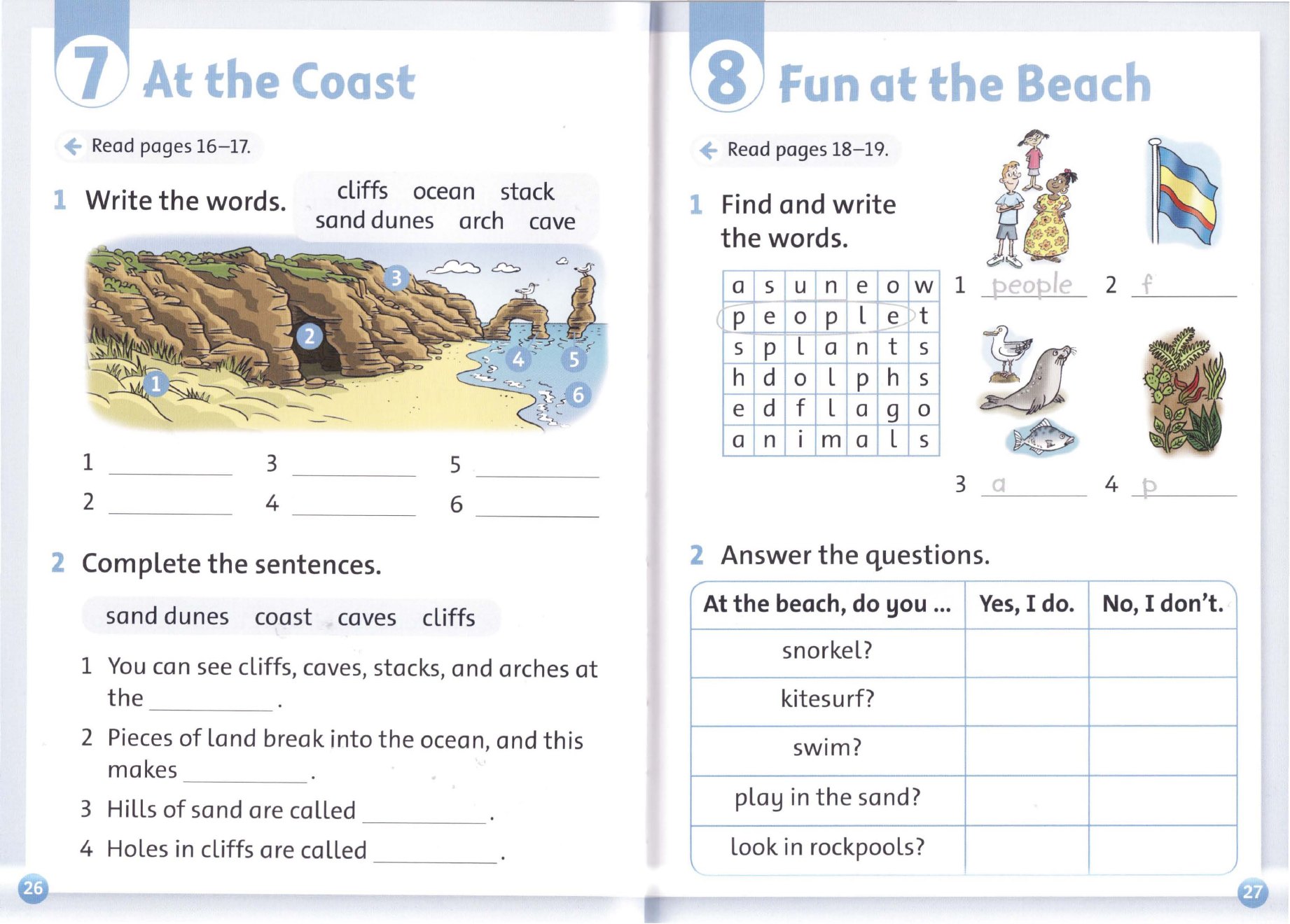
At the coast near the beach, there are cliffs. Some waves hit hills on the coast, and pieces of land break into the ocean. This makes cliffs.
Sometimes there are holes in the cliffs. The ocean hits the holes and makes caves. The ocean can make arches and stacks, too.
At the coast, the sand moves in the wind. Then the sand makes hills called sand dunes.
Sand dunes can move 100 meters in a year.
Từ vựng
3 Xem trang bài tập
4 Bài tập tương tác
1. Picture 1
2. Picture 2
3. Picture 3
4. Picture 4
5. Picture 5
6. Picture 6
7. You can see cliffs, caves, stacks, and arches at the ____.
8. Pieces of land break into the ocean, and this makes ____.
9. Hills of sand are called ____.
10. Holes in cliffs are called ____.
Fun at the Beach
1 Đọc trang sách

2 Đọc & Nghe
You can do many things at the beach! You can kitesurf, and the wind moves you on the ocean. You can snorkel, too. Then you can see amazing fish in the water.
The ocean is big and strong. Don't go away from the people you know. Look for flags – they tell you where and when you can swim.
Have fun at the beach, but remember the ocean plants and animals. Keep the beach clean for plants, animals, and other people.
Từ vựng
3 Xem trang bài tập
4 Bài tập tương tác
1. Find and write word 1
2. Find and write word 2
3. Find and write word 3
4. Find and write word 4
5. At the beach, do you snorkel?
Câu trả lời tự do — không tính vào điểm.6. At the beach, do you kitesurf?
Câu trả lời tự do — không tính vào điểm.7. At the beach, do you swim?
Câu trả lời tự do — không tính vào điểm.8. At the beach, do you play in the sand?
Câu trả lời tự do — không tính vào điểm.9. At the beach, do you look in rockpools?
Câu trả lời tự do — không tính vào điểm.At the Beach Project
Trang dự án
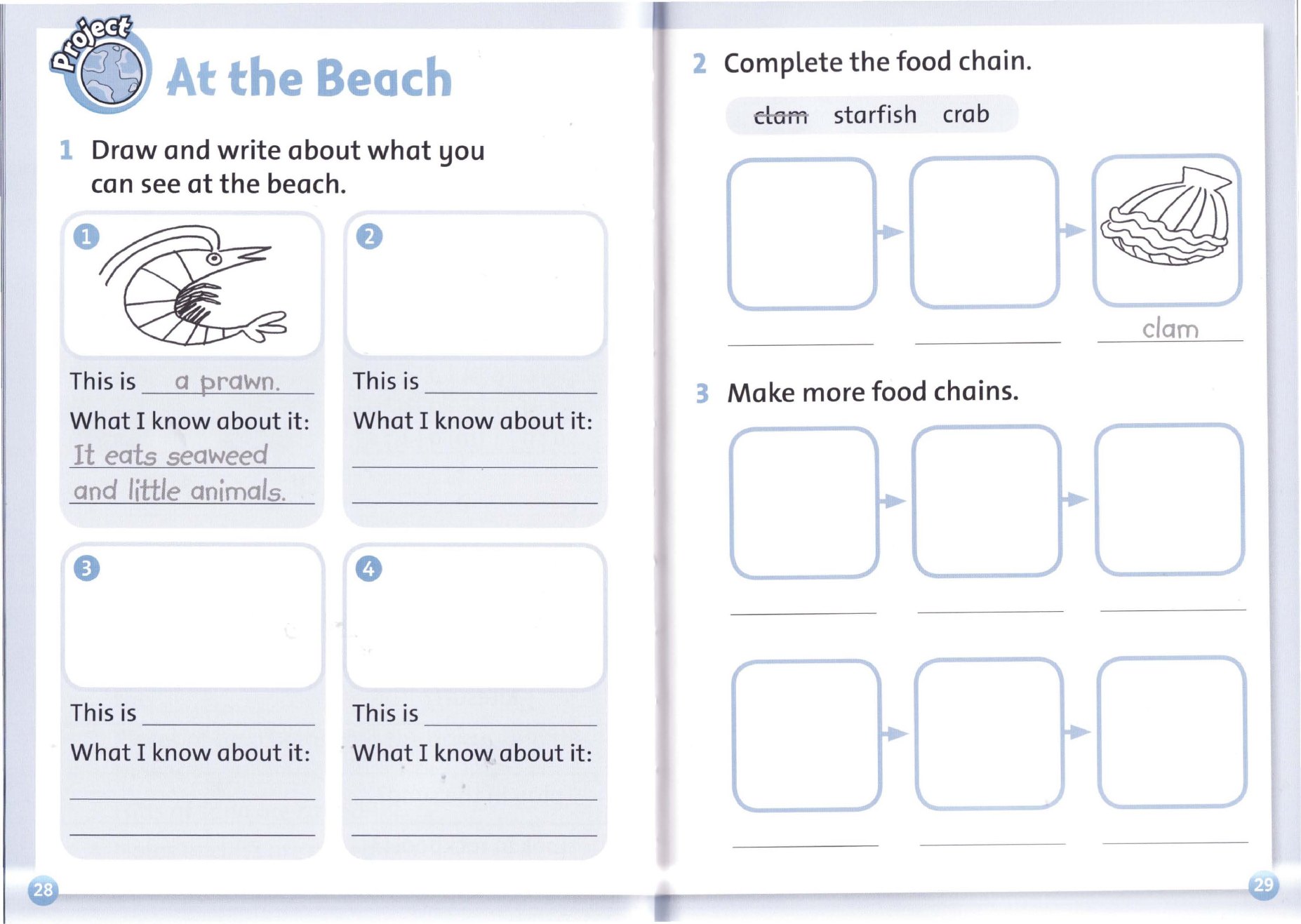
Draw and write about what you can see at the beach, then complete and make food chains using the project page.
Từ điển tranh
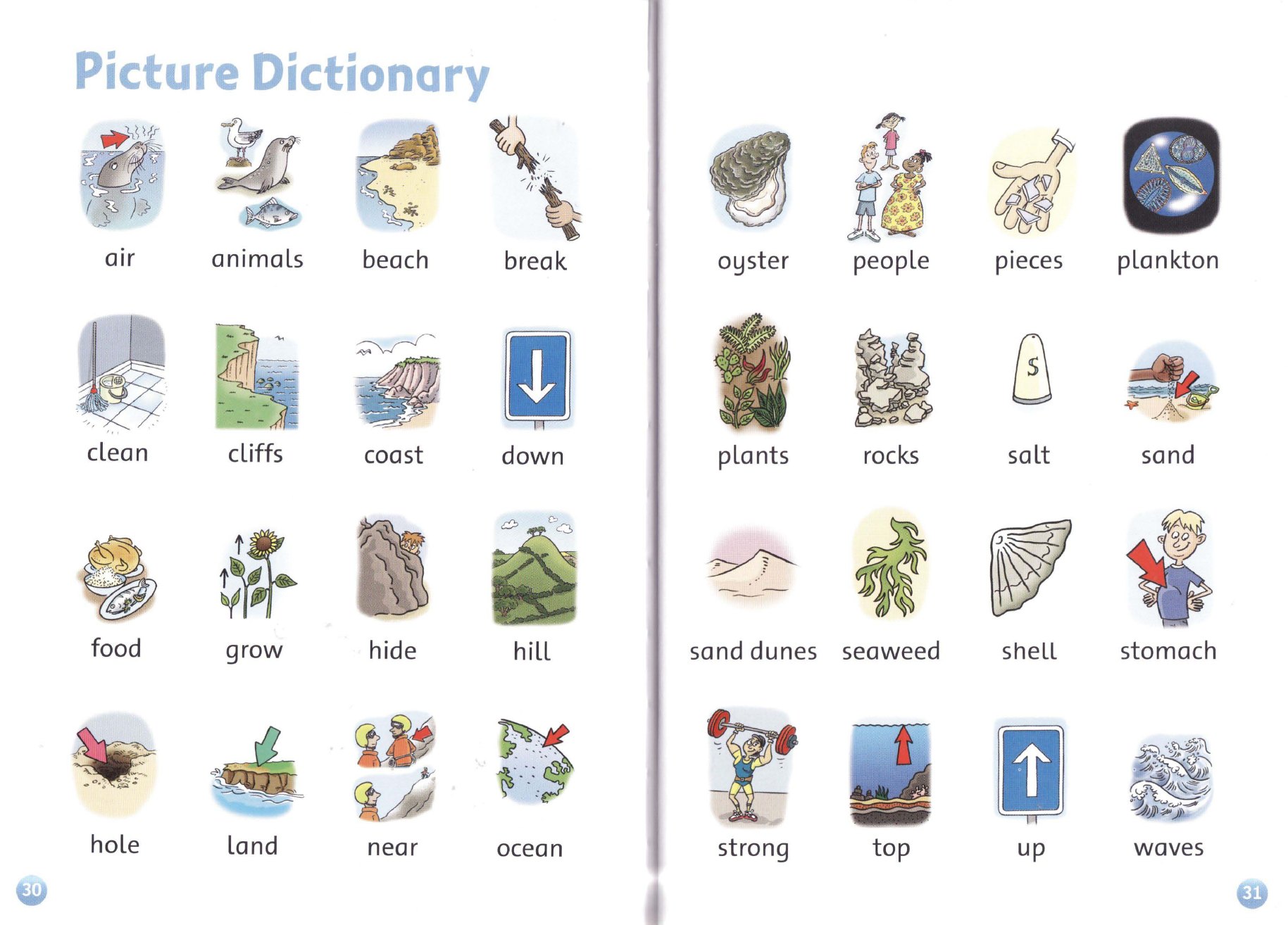
Từ điển tranh