How We Make Products
Đọc · Nghe · Từ vựng · Bài tập · Dự án · Từ điển tranh
Making Products by Hand
1 Đọc trang sách

2 Đọc & Nghe
About 200 years ago, there weren't many factories or machines, and people made many products by hand. Today, some people still make products by hand.
They use tools to make products like chairs, clocks, jewelry, and musical instruments. It takes years to learn how to make these things.
People make guitars from wood. They cut thin pieces of wood to make the front and back of the guitar.
To make the sides, they put long, thin pieces of wood in water. Then they use hot tools to make the wood the right shape for the sides.
They fix these pieces together with glue. Later, they make the neck of the guitar, and they put the strings on it.
Từ vựng
3 Xem trang bài tập
4 Bài tập tương tác
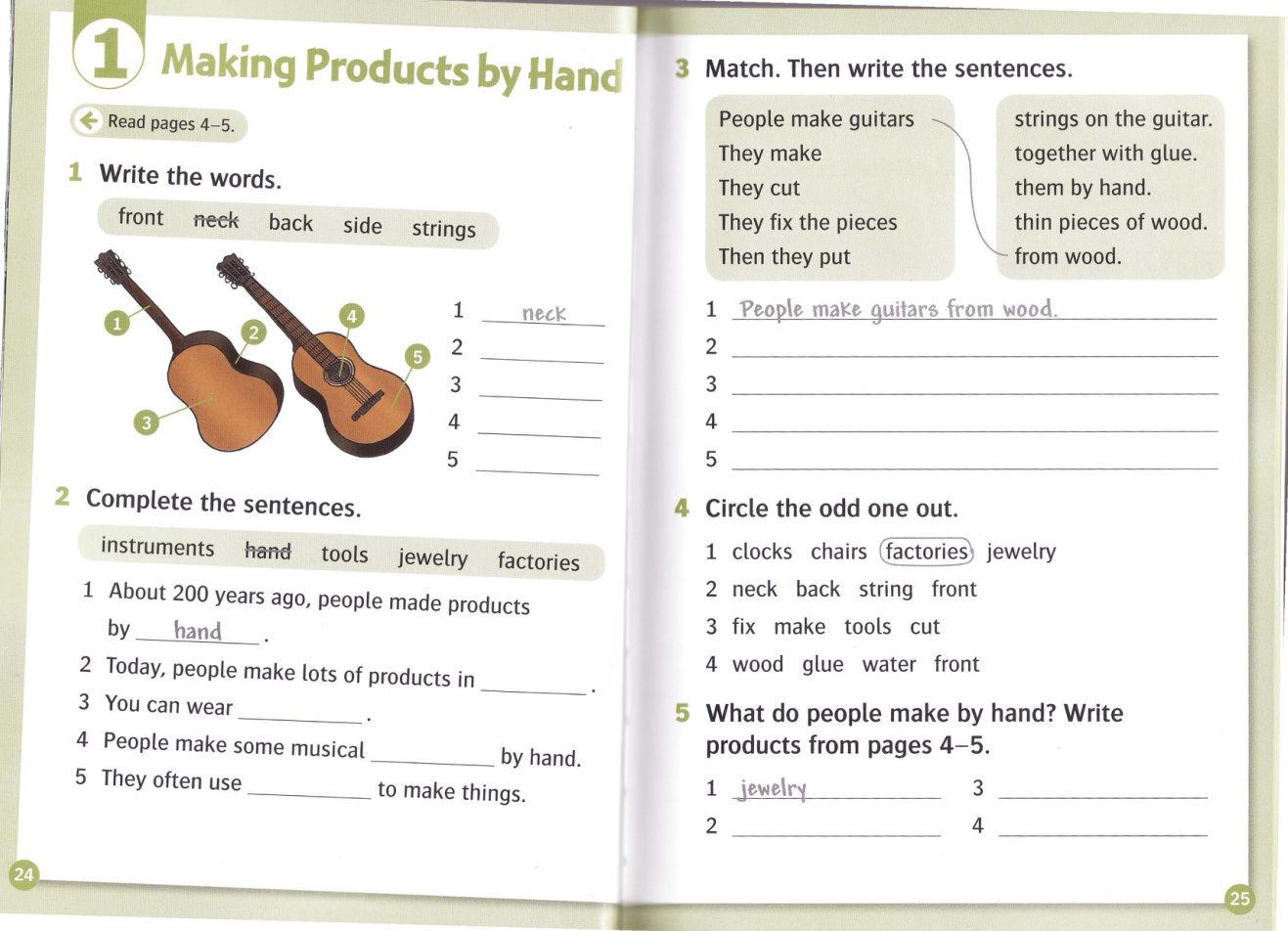
1. Write the guitar-part words shown by numbers 1-5.
2. About 200 years ago, people made products by _____.
3. Today, people make lots of products in _____.
4. You can wear _____.
5. People make some musical _____ by hand.
6. They often use _____ to make things.
7. Match the beginnings and endings.
8. clocks / chairs / factories / jewelry – choose the odd one out
9. neck / back / string / front – choose the odd one out
10. fix / make / tools / cut – choose the odd one out
11. wood / glue / water / front – choose the odd one out
12. What products do people make by hand? Write four examples.
Clothes
1 Đọc trang sách
2 Đọc & Nghe
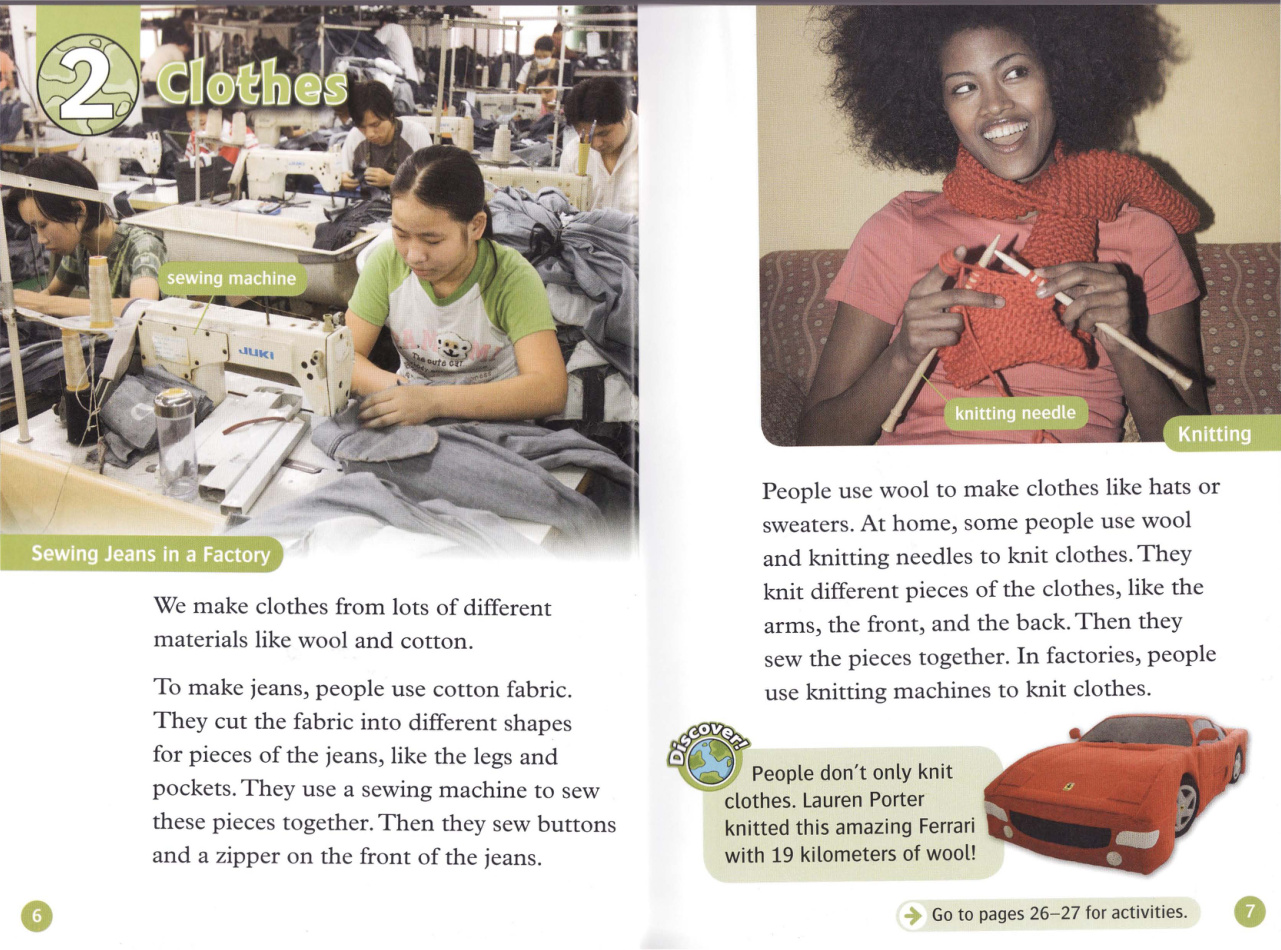
We make clothes from lots of different materials like wool and cotton.
To make jeans, people use cotton fabric. They cut the fabric into different shapes for pieces of the jeans, like the legs and pockets.
They use a sewing machine to sew these pieces together. Then they sew buttons and a zipper on the front of the jeans.
People use wool to make clothes like hats or sweaters. At home, some people use wool and knitting needles to knit clothes.
They knit different pieces of the clothes, like the arms, the front, and the back. Then they sew the pieces together. In factories, people use knitting machines to knit clothes.
People don't only knit clothes. Lauren Porter knitted this amazing Ferrari with 19 kilometers of wool!
Từ vựng
3 Xem trang bài tập
4 Bài tập tương tác
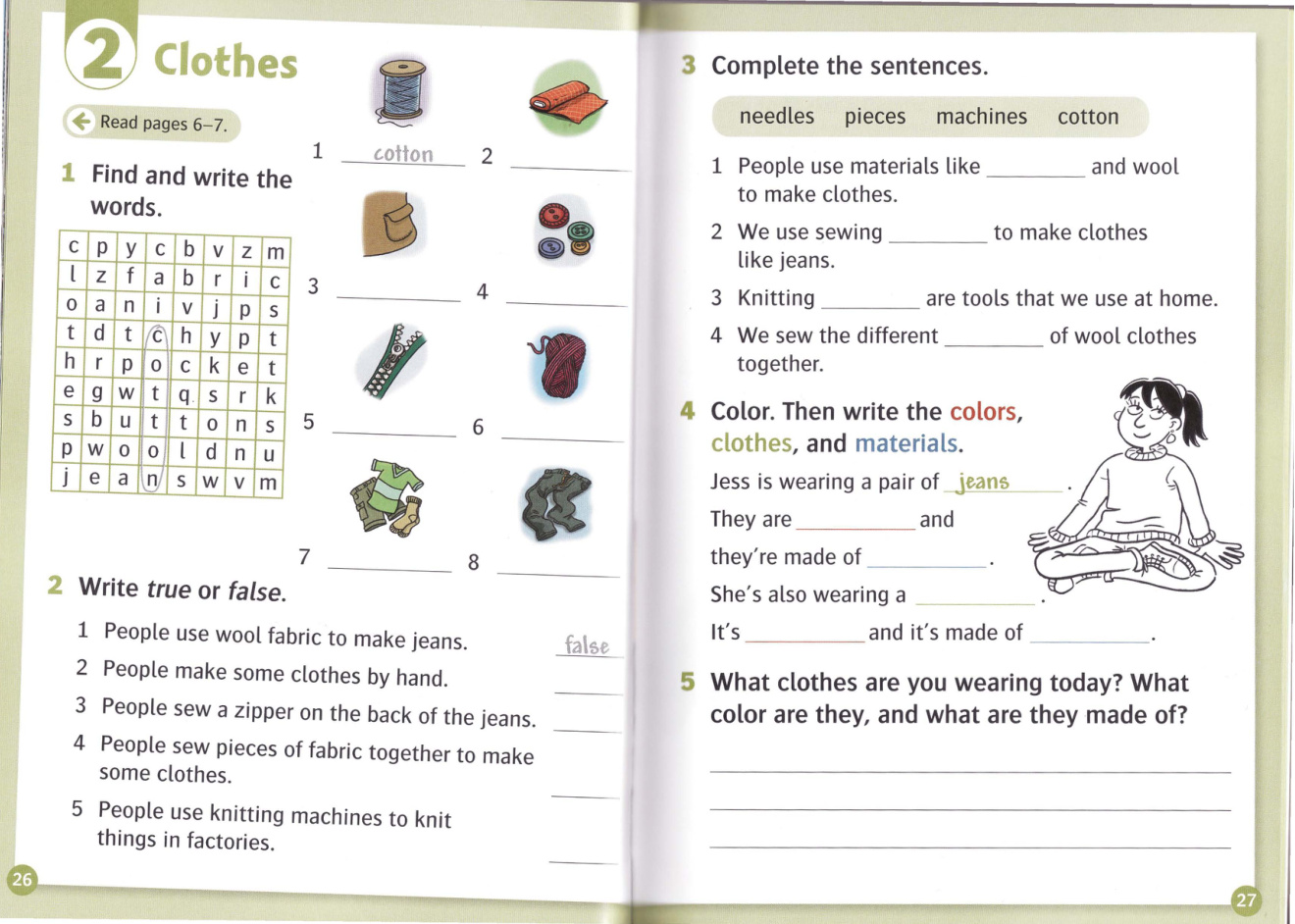
1. Find the eight clothes/material words in the letter grid.
2. People use wool fabric to make jeans.
3. People make some clothes by hand.
4. People sew a zipper on the back of the jeans.
5. People sew pieces of fabric together to make some clothes.
6. People use knitting machines to knit things in factories.
7. People use materials like _____ and wool to make clothes.
8. We use sewing _____ to make clothes like jeans.
9. Knitting _____ are tools that we use at home.
10. We sew the different _____ of wool clothes together.
11. What clothes are you wearing today? What color are they, and what are they made of?
Câu trả lời tự do — không tính vào điểm.Plastic Products
1 Đọc trang sách
2 Đọc & Nghe
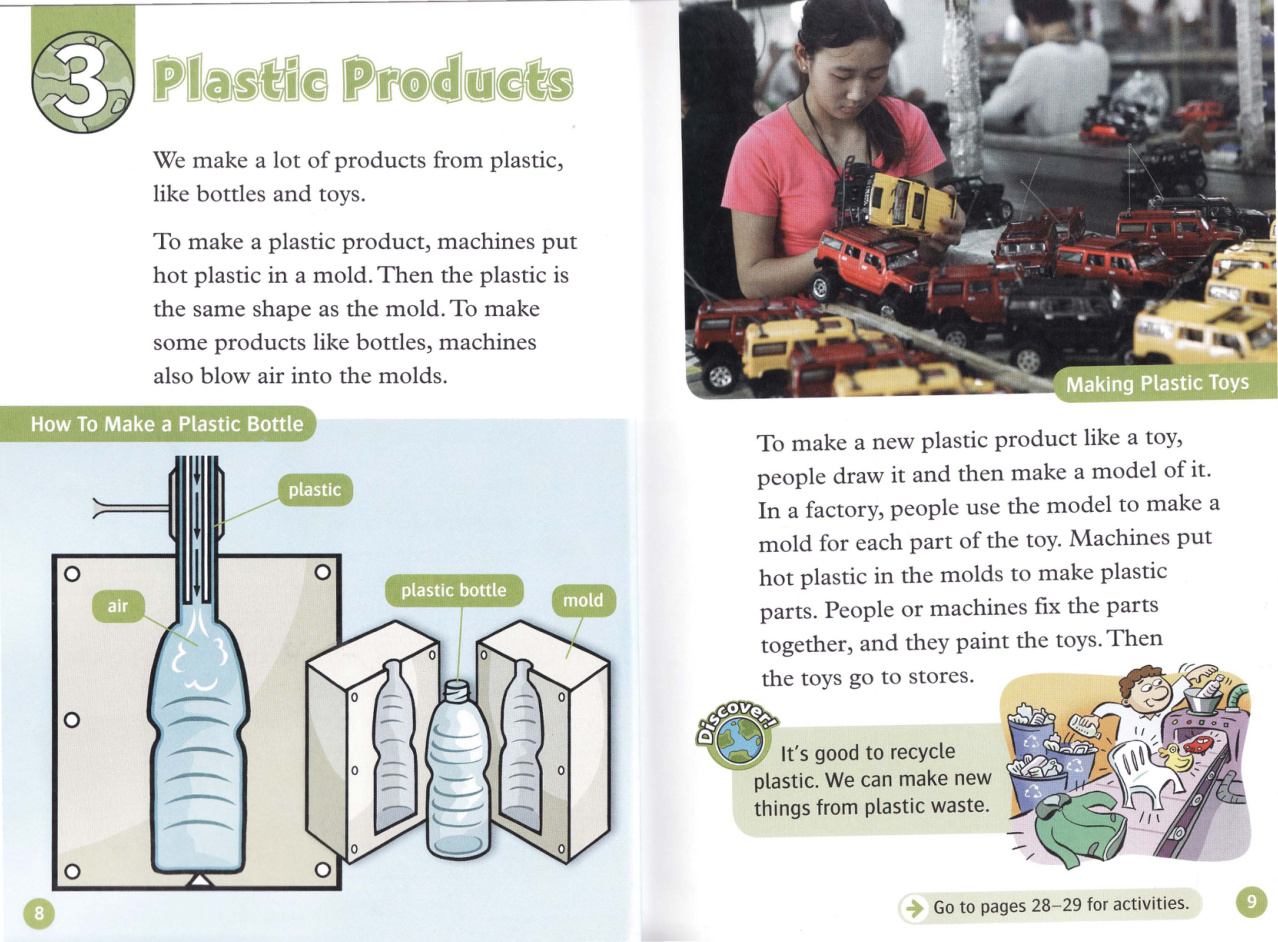
We make a lot of products from plastic, like bottles and toys.
To make a plastic product, machines put hot plastic in a mold. Then the plastic is the same shape as the mold.
To make some products like bottles, machines also blow air into the molds.
To make a new plastic product like a toy, people draw it and then make a model of it.
In a factory, people use the model to make a mold for each part of the toy. Machines put hot plastic in the molds to make plastic parts.
People or machines fix the parts together, and they paint the toys. Then the toys go to stores.
It's good to recycle plastic. We can make new things from plastic waste.
Từ vựng
3 Xem trang bài tập
4 Bài tập tương tác
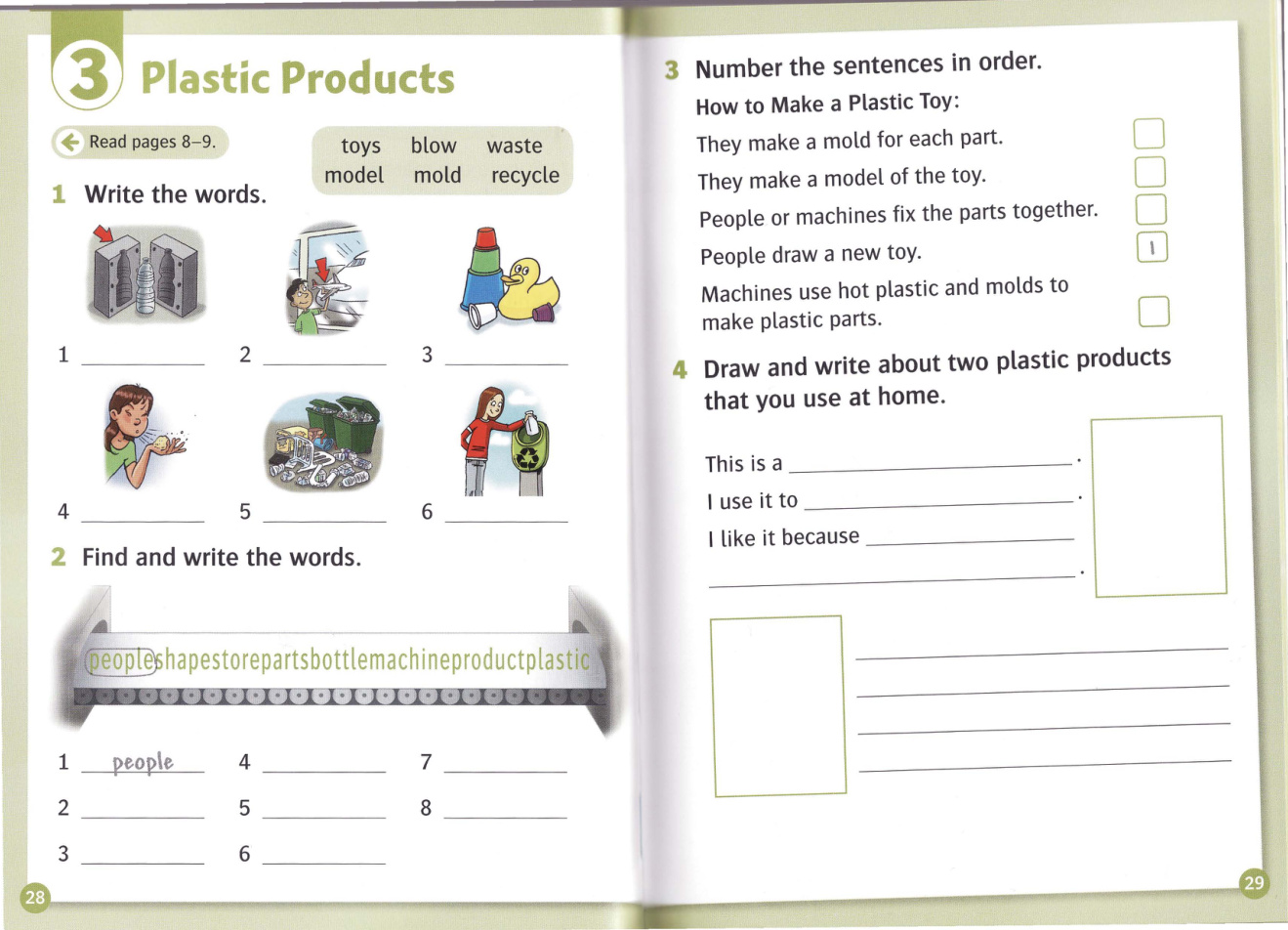
1. Write the six words for the pictures in Activity 1.
2. Find the product-making words.
3. Put the steps for making a plastic toy in the correct order.
- They make a mold for each part.
- They make a model of the toy.
- People or machines fix the parts together.
- People draw a new toy.
- Machines use hot plastic and molds to make plastic parts.
4. Draw and write about two plastic products that you use at home.
Câu trả lời tự do — không tính vào điểm.Cars
1 Đọc trang sách

2 Đọc & Nghe
To make a car, people use a metal called steel to make a strong chassis.
People also use steel to make big shapes for the outside of the car. Then robots fix the outside to the chassis.
A conveyor moves the chassis around the car factory, and people fix many parts on the chassis.
Later, other machines paint the car. Then, people fix other parts on the car, like the engine, doors, wheels, and seats for people to sit on.
There are about 35,000 parts in a car!
Around the world, people make 48 million cars every year. This uses lots of steel. We can recycle steel from old cars, and use it again.
Từ vựng
3 Xem trang bài tập
4 Bài tập tương tác
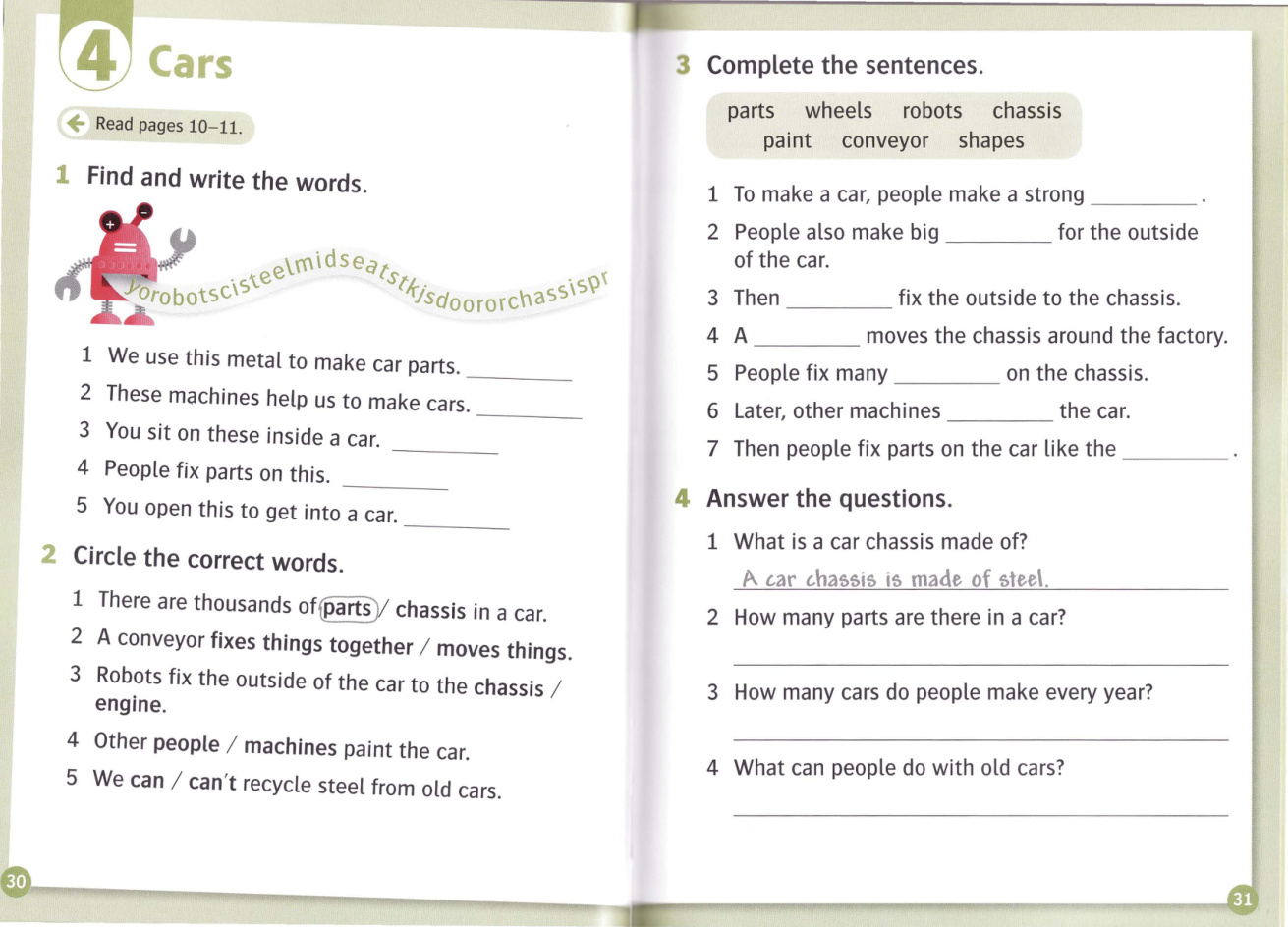
1. We use this metal to make car parts.
2. These machines help us to make cars.
3. You sit on these inside a car.
4. People fix parts on this.
5. You open this to get into a car.
6. There are thousands of parts / chassis in a car.
7. A conveyor fixes things together / moves things.
8. Robots fix the outside of the car to the chassis / engine.
9. Other people / machines paint the car.
10. We can / can't recycle steel from old cars.
11. To make a car, people make a strong _____.
12. People also make big _____ for the outside of the car.
13. Then _____ fix the outside to the chassis.
14. A _____ moves the chassis around the factory.
15. People fix many _____ on the chassis.
16. Later, other machines _____ the car.
17. Then people fix parts on the car like the _____.
18. What is a car chassis made of?
19. How many parts are there in a car?
20. How many cars do people make every year?
21. What can people do with old cars?
Food
1 Đọc trang sách
2 Đọc & Nghe
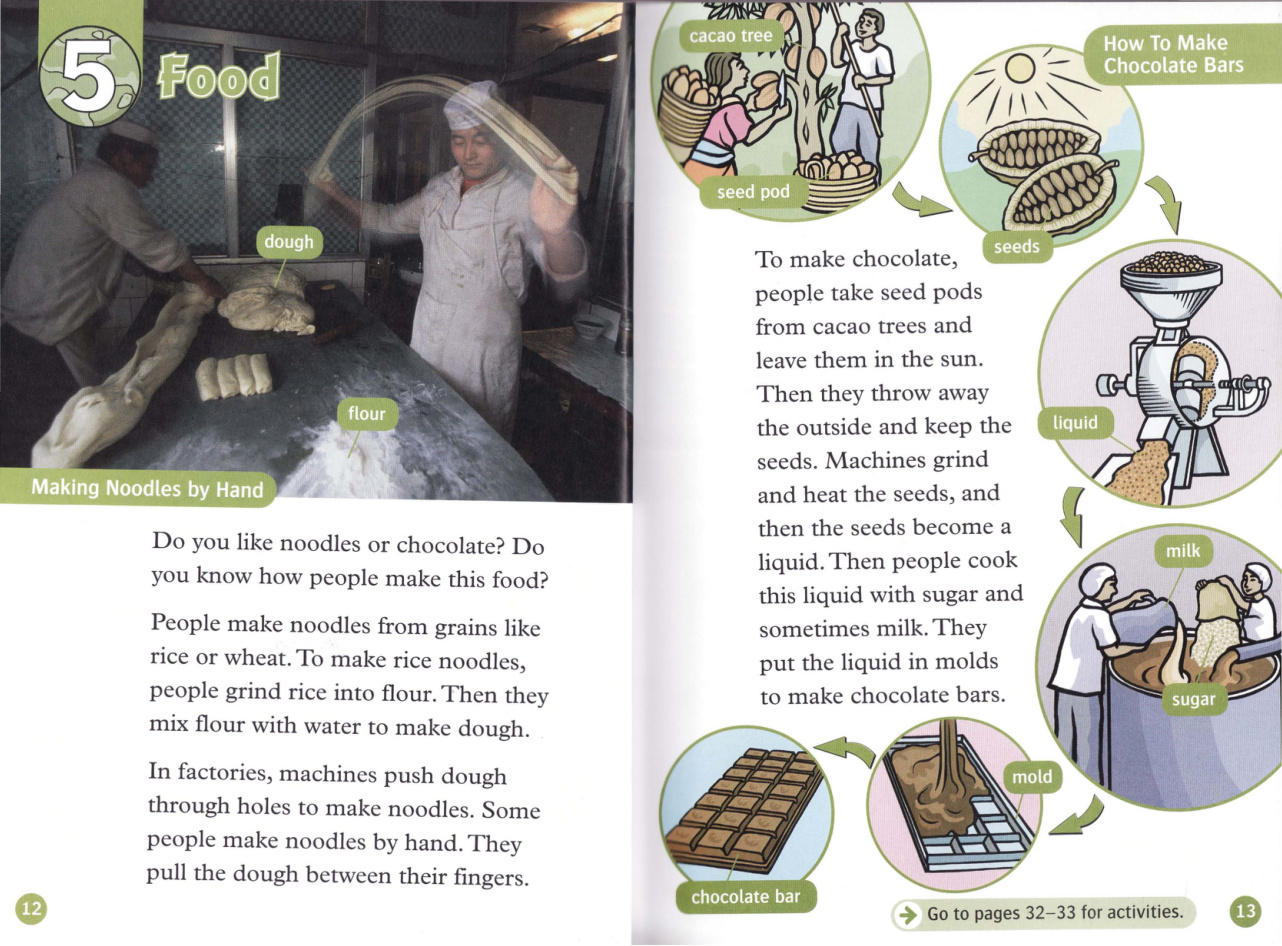
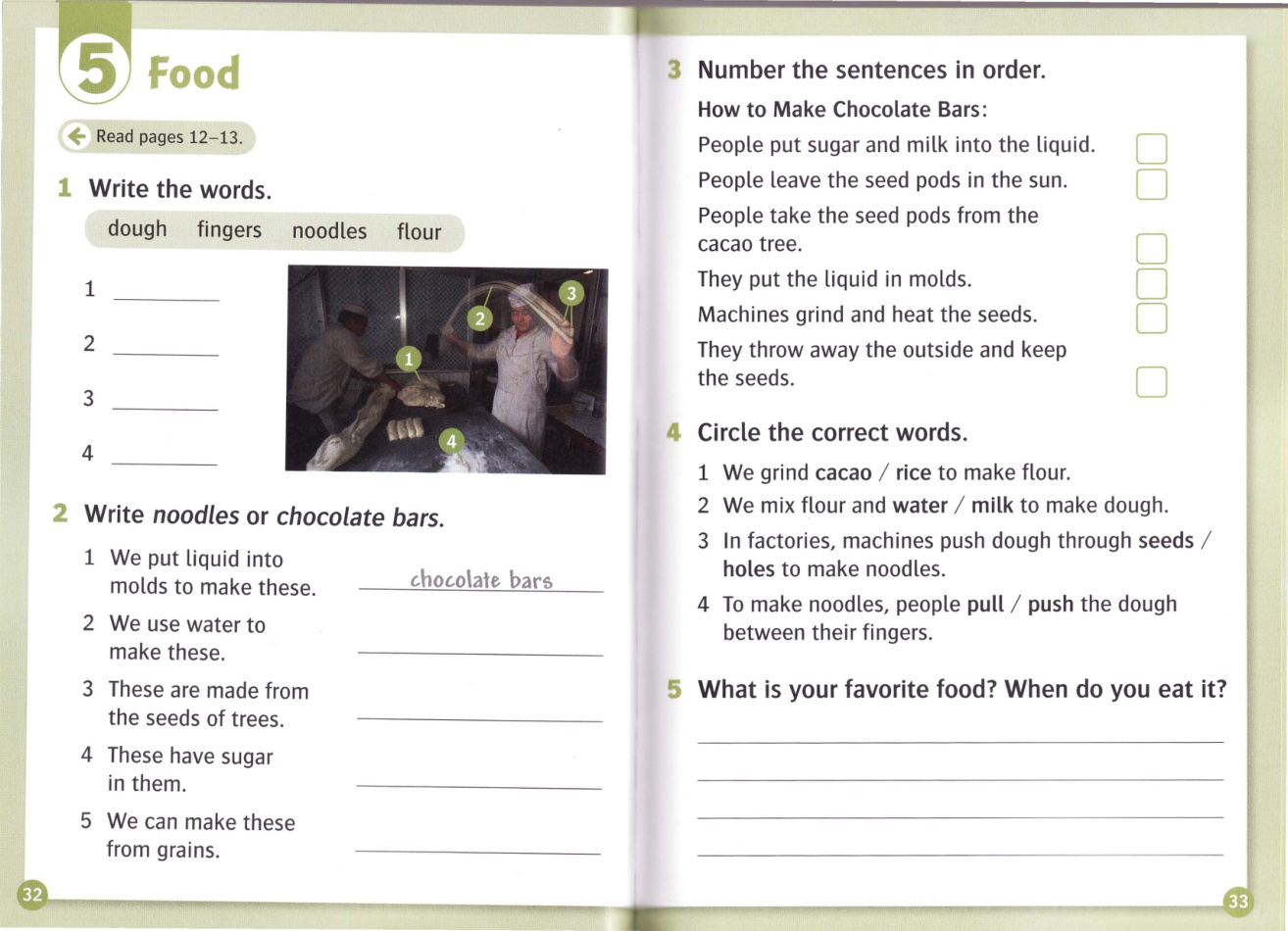
Do you like noodles or chocolate? Do you know how people make this food?
People make noodles from grains like rice or wheat. To make rice noodles, people grind rice into flour. Then they mix flour with water to make dough.
In factories, machines push dough through holes to make noodles. Some people make noodles by hand. They pull the dough between their fingers.
To make chocolate, people take seed pods from cacao trees and leave them in the sun.
Then they throw away the outside and keep the seeds. Machines grind and heat the seeds, and then the seeds become a liquid.
Then people cook this liquid with sugar and sometimes milk. They put the liquid in molds to make chocolate bars.
Từ vựng
3 Xem trang bài tập
4 Bài tập tương tác
1. Write the four food-making words shown by numbers 1-4.
2. We put liquid into molds to make these.
3. We use water to make these.
4. These are made from the seeds of trees.
5. These have sugar in them.
6. We can make these from grains.
7. Put the steps for making chocolate bars in the correct order.
- People put sugar and milk into the liquid.
- People leave the seed pods in the sun.
- People take the seed pods from the cacao tree.
- They put the liquid in molds.
- Machines grind and heat the seeds.
- They throw away the outside and keep the seeds.
8. We grind cacao / rice to make flour.
9. We mix flour and water / milk to make dough.
10. In factories, machines push dough through seeds / holes to make noodles.
11. To make noodles, people pull / push the dough between their fingers.
12. What is your favorite food? When do you eat it?
Câu trả lời tự do — không tính vào điểm.Homes
1 Đọc trang sách

2 Đọc & Nghe
We build different homes in different ways.
To build an apartment block, people make shapes for the floors and columns from long pieces of steel.
Then people put wood around the shapes, and they put a liquid called concrete in them. When the concrete becomes hard like stone, they take the wood away.
People build walls to make the rooms in each apartment.
They put wires in the walls to carry electricity, and they put pipes in the walls and floors to carry water.
They often fix tiles on the floors, and on the walls in the bathroom and kitchen. They put plaster on the walls. Then they can paint the walls.
This apartment block in Germany has a garden on the roof!
Từ vựng
3 Xem trang bài tập
4 Bài tập tương tác
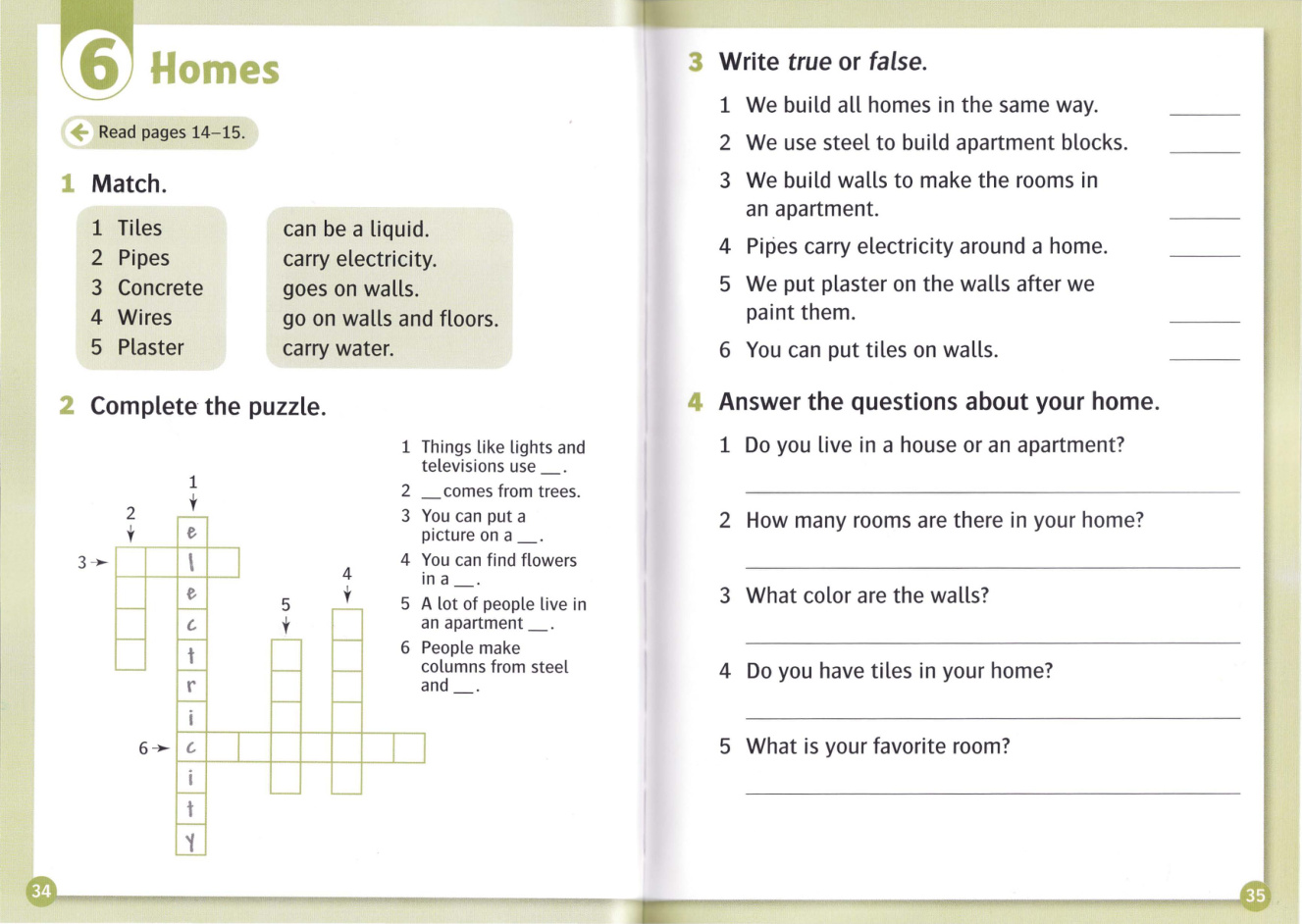
1. Match each building material with its use.
2. Complete the homes crossword.
- 1 Hàng ngang: Things like lights and televisions use this.
- 2 Hàng ngang: This comes from trees.
- 3 Hàng ngang: You can put a picture on a ___.
- 4 Hàng ngang: You can find flowers in a ___.
- 5 Hàng ngang: A lot of people live in an apartment ___.
- 6 Hàng ngang: People make columns from steel and ___.
3. We build all homes in the same way.
4. We use steel to build apartment blocks.
5. We build walls to make the rooms in an apartment.
6. Pipes carry electricity around a home.
7. We put plaster on the walls after we paint them.
8. You can put tiles on walls.
9. Do you live in a house or an apartment?
Câu trả lời tự do — không tính vào điểm.10. How many rooms are there in your home?
Câu trả lời tự do — không tính vào điểm.11. What color are the walls?
Câu trả lời tự do — không tính vào điểm.12. Do you have tiles in your home?
Câu trả lời tự do — không tính vào điểm.13. What is your favorite room?
Câu trả lời tự do — không tính vào điểm.Books
1 Đọc trang sách
2 Đọc & Nghe
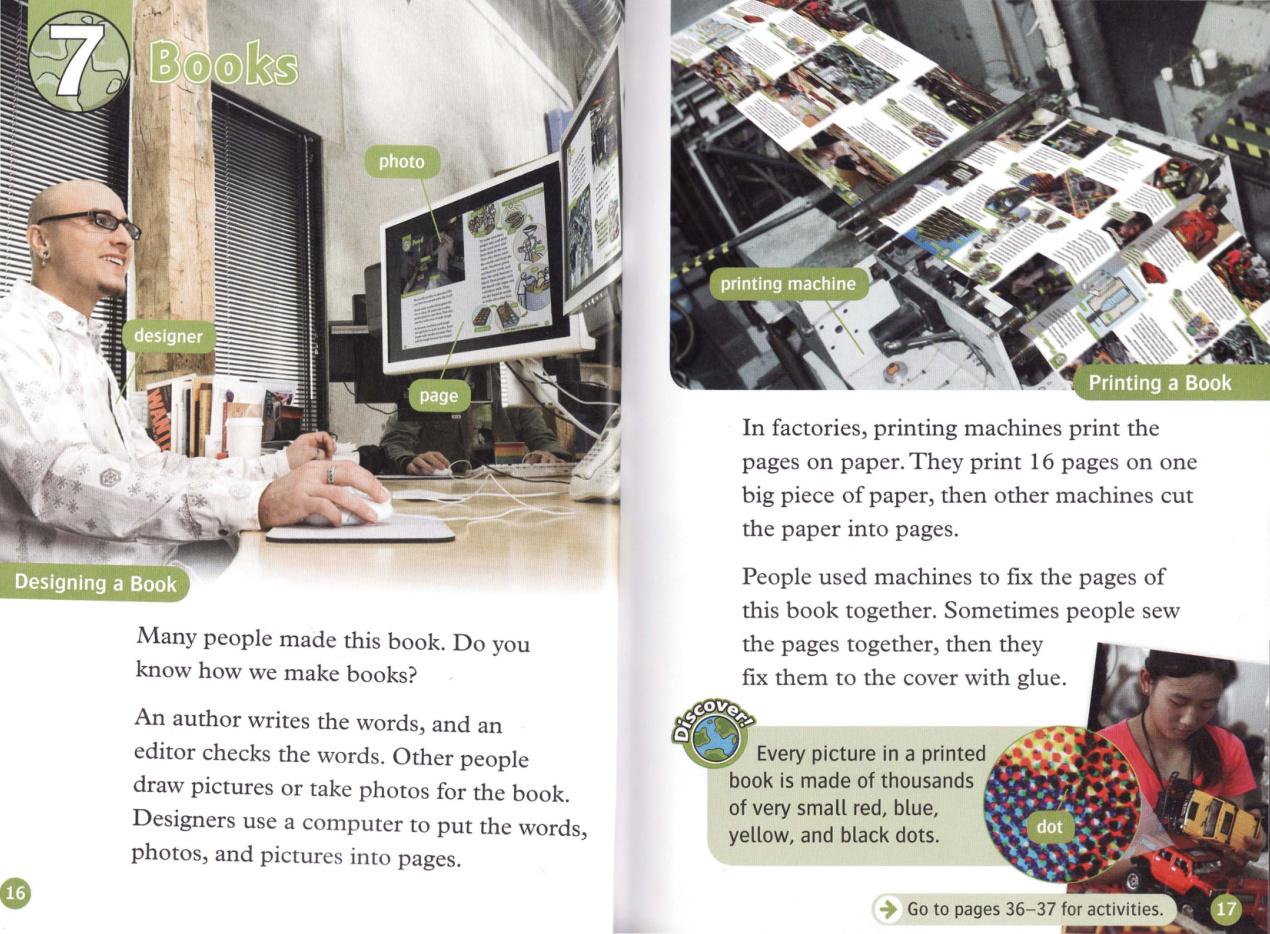
Many people made this book. Do you know how we make books?
An author writes the words, and an editor checks the words. Other people draw pictures or take photos for the book.
Designers use a computer to put the words, photos, and pictures into pages.
In factories, printing machines print the pages on paper. They print 16 pages on one big piece of paper, then other machines cut the paper into pages.
People used machines to fix the pages of this book together. Sometimes people sew the pages together, then they fix them to the cover with glue.
Every picture in a printed book is made of thousands of very small red, blue, yellow, and black dots.
Từ vựng
3 Xem trang bài tập
4 Bài tập tương tác
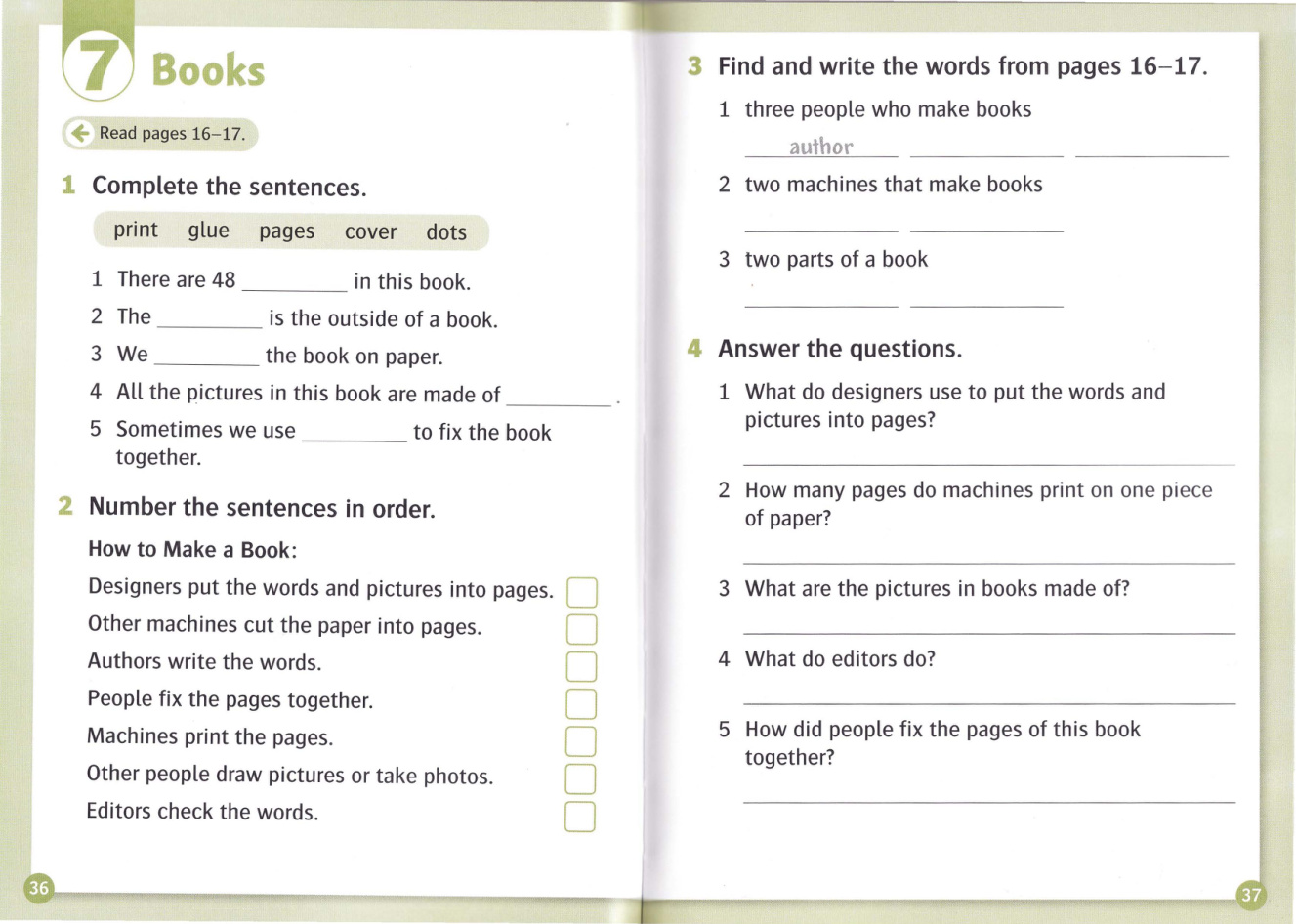
1. There are 48 _____ in this book.
2. The _____ is the outside of a book.
3. We _____ the book on paper.
4. All the pictures in this book are made of _____.
5. Sometimes we use _____ to fix the book together.
6. Put the steps for making a book in the correct order.
- Designers put the words and pictures into pages.
- Other machines cut the paper into pages.
- Authors write the words.
- People fix the pages together.
- Machines print the pages.
- Other people draw pictures or take photos.
- Editors check the words.
7. Name three people who make books.
8. Name two machines that make books.
9. Name two parts of a book.
10. What do designers use to put the words and pictures into pages?
11. How many pages do machines print on one piece of paper?
12. What are the pictures in books made of?
13. What do editors do?
14. How did people fix the pages of this book together?
Electronic Products
1 Đọc trang sách
2 Đọc & Nghe
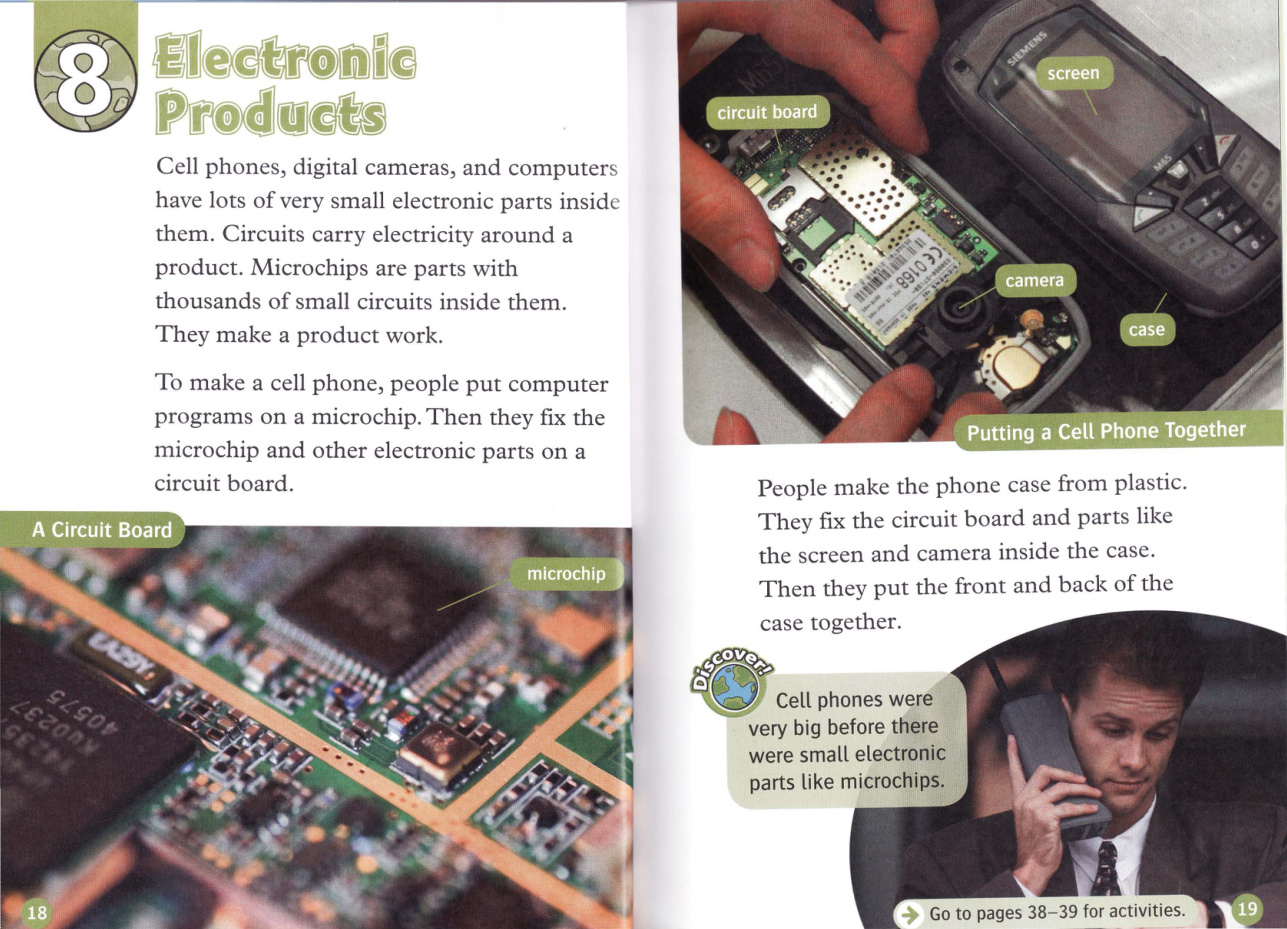
Cell phones, digital cameras, and computers have lots of very small electronic parts inside them.
Circuits carry electricity around a product. Microchips are parts with thousands of small circuits inside them. They make a product work.
To make a cell phone, people put computer programs on a microchip. Then they fix the microchip and other electronic parts on a circuit board.
People make the phone case from plastic. They fix the circuit board and parts like the screen and camera inside the case.
Then they put the front and back of the case together.
Cell phones were very big before there were small electronic parts like microchips.
Từ vựng
3 Xem trang bài tập
4 Bài tập tương tác
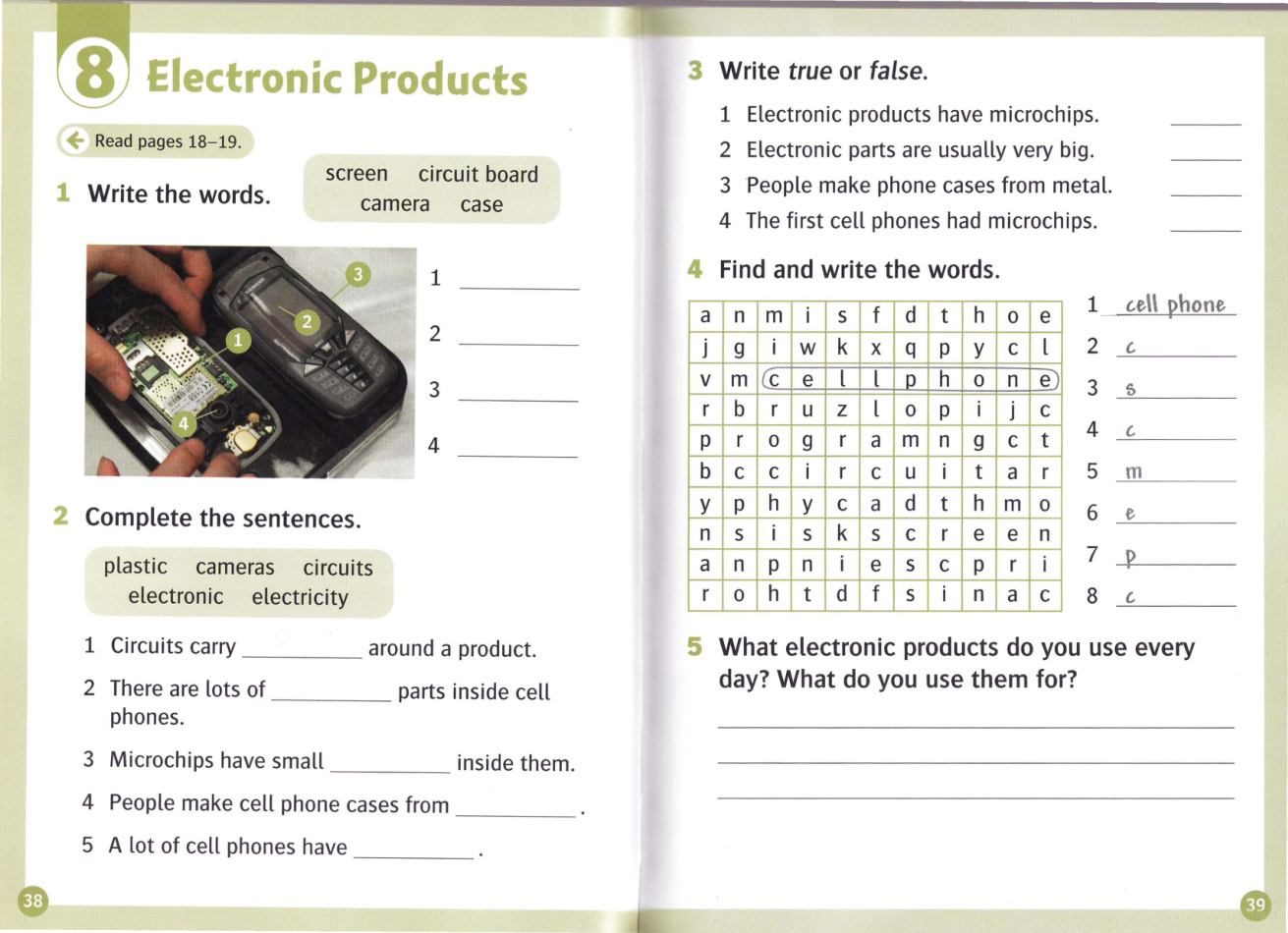
1. Label the four parts shown in the cell-phone picture.
2. Circuits carry _____ around a product.
3. There are lots of _____ parts inside cell phones.
4. Microchips have small _____ inside them.
5. People make cell phone cases from _____.
6. A lot of cell phones have _____.
7. Electronic products have microchips.
8. Electronic parts are usually very big.
9. People make phone cases from metal.
10. The first cell phones had microchips.
11. Find eight electronic-product words.
12. What electronic products do you use every day? What do you use them for?
Câu trả lời tự do — không tính vào điểm.Computer Games
1 Đọc trang sách
2 Đọc & Nghe
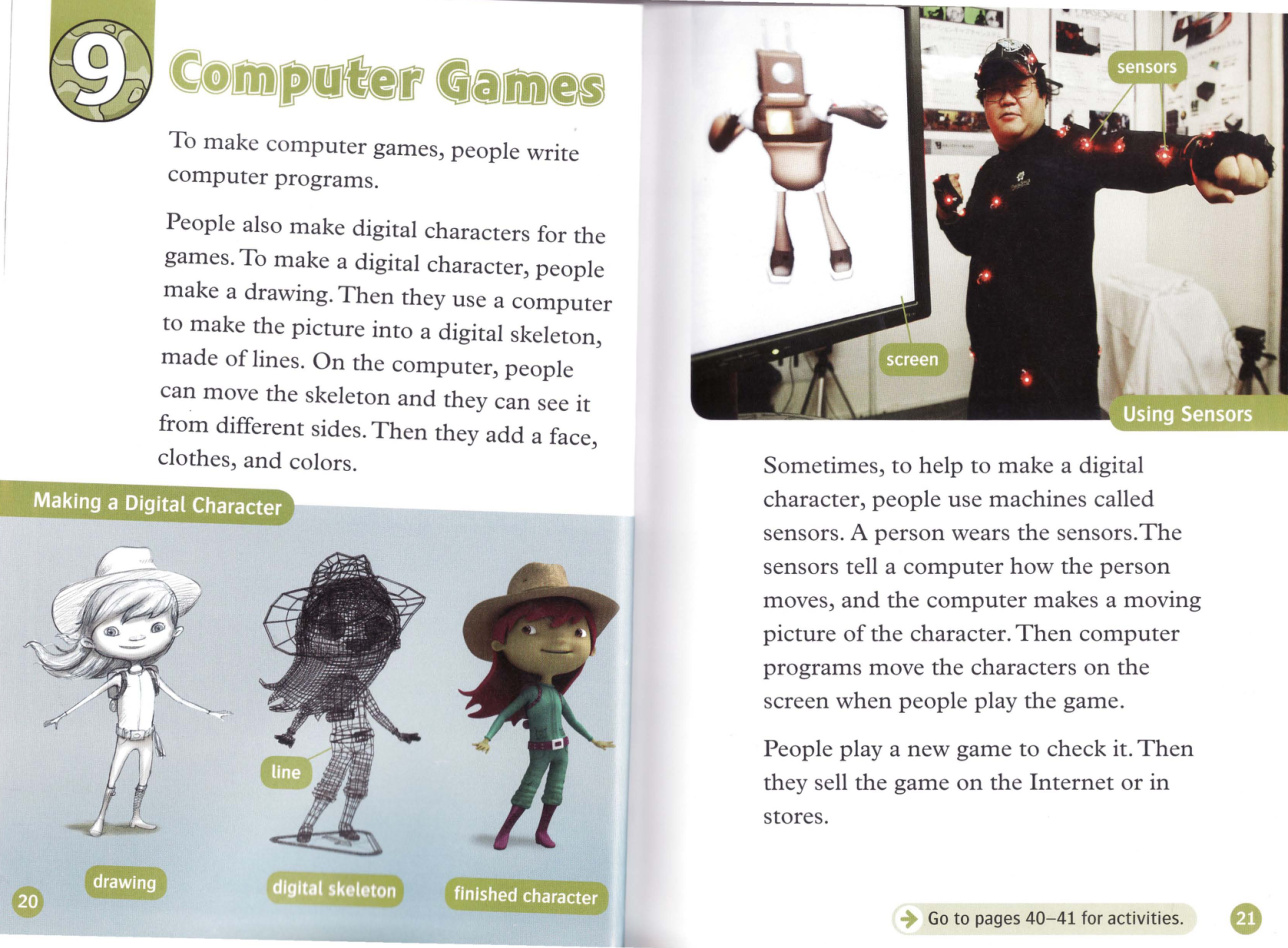
To make computer games, people write computer programs.
People also make digital characters for the games. To make a digital character, people make a drawing.
Then they use a computer to make the picture into a digital skeleton, made of lines. On the computer, people can move the skeleton and they can see it from different sides.
Then they add a face, clothes, and colors.
Sometimes, to help to make a digital character, people use machines called sensors. A person wears the sensors.
The sensors tell a computer how the person moves, and the computer makes a moving picture of the character. Then computer programs move the characters on the screen when people play the game.
People play a new game to check it. Then they sell the game on the Internet or in stores.
Từ vựng
3 Xem trang bài tập
4 Bài tập tương tác
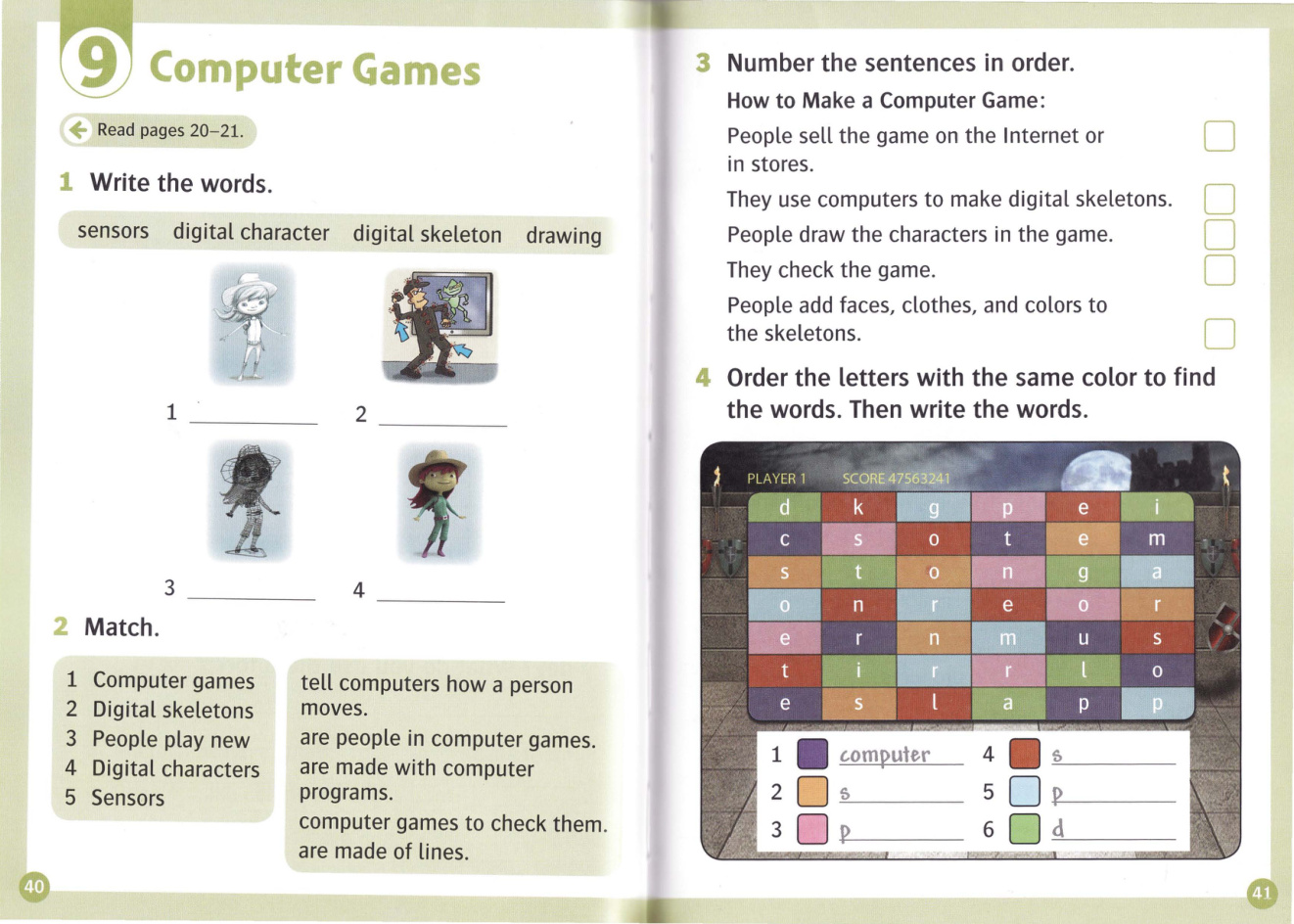
1. Write the four digital-character words shown by numbers 1-4.
2. Match the computer-game terms with their meanings.
3. Put the steps for making a computer game in the correct order.
- People sell the game on the Internet or in stores.
- They use computers to make digital skeletons.
- People draw the characters in the game.
- They check the game.
- People add faces, clothes, and colors to the skeletons.
4. Order the letters to make the words.
Products and Our World
1 Đọc trang sách

2 Đọc & Nghe
When we make products, we use energy like electricity. To make one car, we use the same energy as someone watching television for 100 years!
We also use materials and make waste. To make one car, we make about 28 metric tons of waste.
Every day, people throw away millions of products like toys, cans, and bottles.
Most waste goes to landfills and sometimes people throw waste in other places like rivers. This is bad for our world.
It's good to recycle old products. We can use materials from old products to make new things, like this bag.
We can recycle old products like plastic bottles, metal cans, and clothes. At recycling centers, people sort the old products.
Then machines use the old products to make recycled materials. We can use these materials to make new products.
Từ vựng
3 Xem trang bài tập
4 Bài tập tương tác
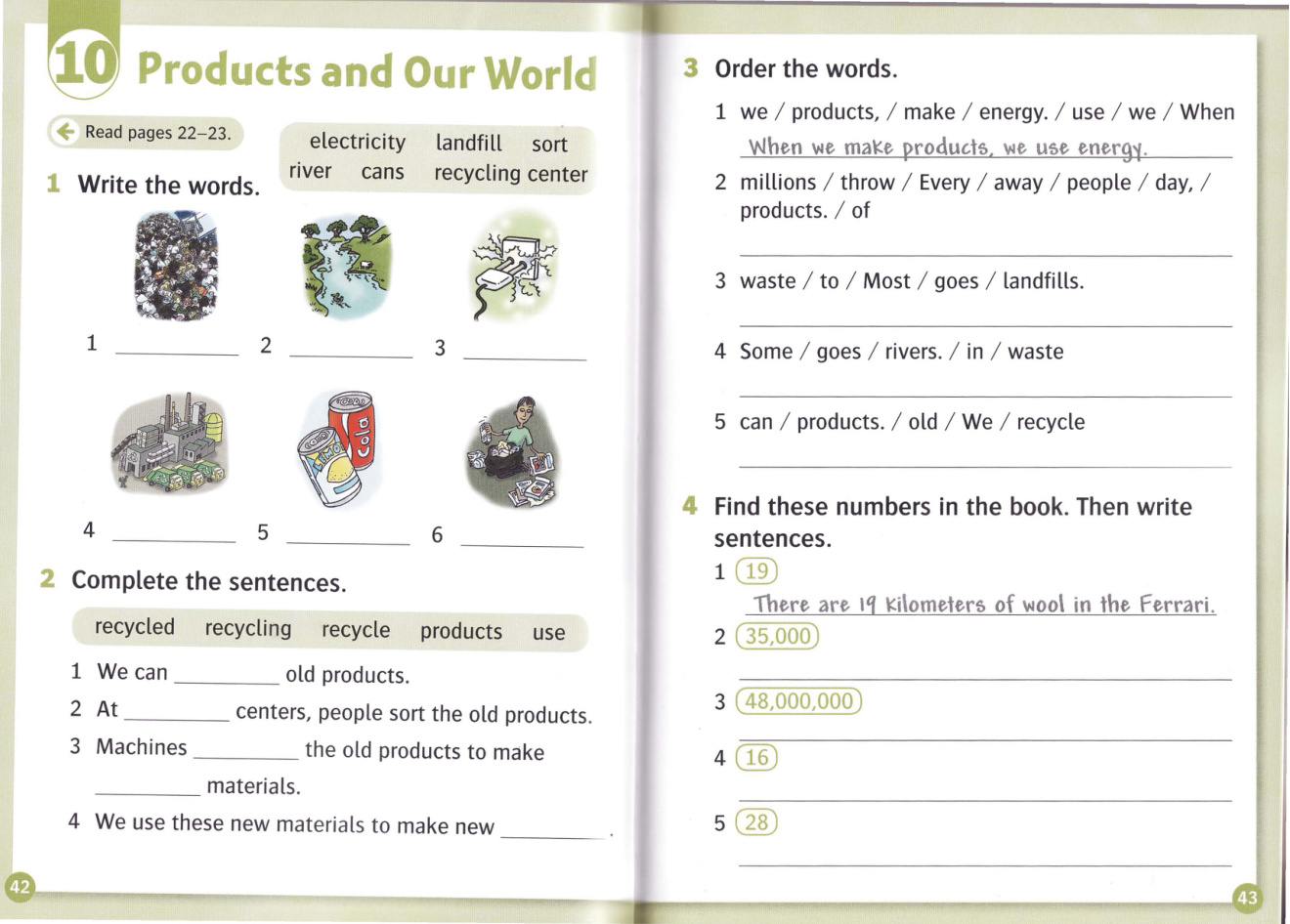
1. Write the six environment/recycling words shown by numbers 1-6.
2. We can _____ old products.
3. At _____ centers, people sort the old products.
4. Machines _____ the old products to make _____ materials.
5. We use these new materials to make new _____.
6. Put the words in the correct order.
- we
- products,
- make
- energy.
- use
- we
- When
7. Put the words in the correct order.
- millions
- throw
- Every
- away
- people
- day,
- products.
- of
8. Put the words in the correct order.
- waste
- to
- Most
- goes
- landfills.
9. Put the words in the correct order.
- Some
- goes
- rivers.
- in
- waste
10. Put the words in the correct order.
- can
- products.
- old
- We
- recycle
11. What does 19 refer to in this book?
12. What does 35,000 refer to?
13. What does 48,000,000 refer to?
14. What does 16 refer to?
15. What does 28 refer to?
Projects
Trang dự án
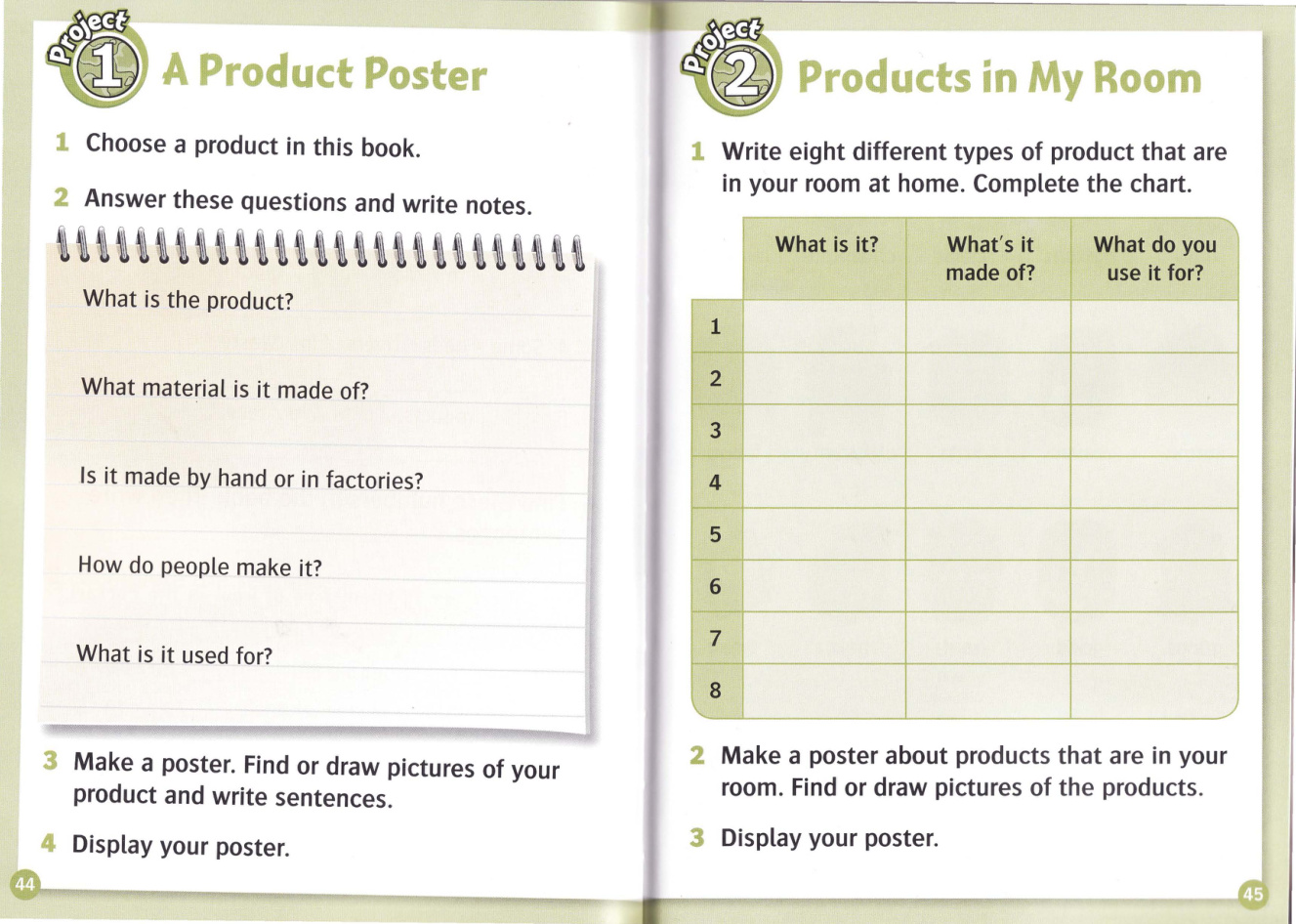
Project 1: A Product Poster. Choose a product, note its material, how and where it is made, and what it is used for, then make a poster. Project 2: Products in My Room. List eight products in your room, what they are made of, and what you use them for, then make a poster.
Từ điển tranh
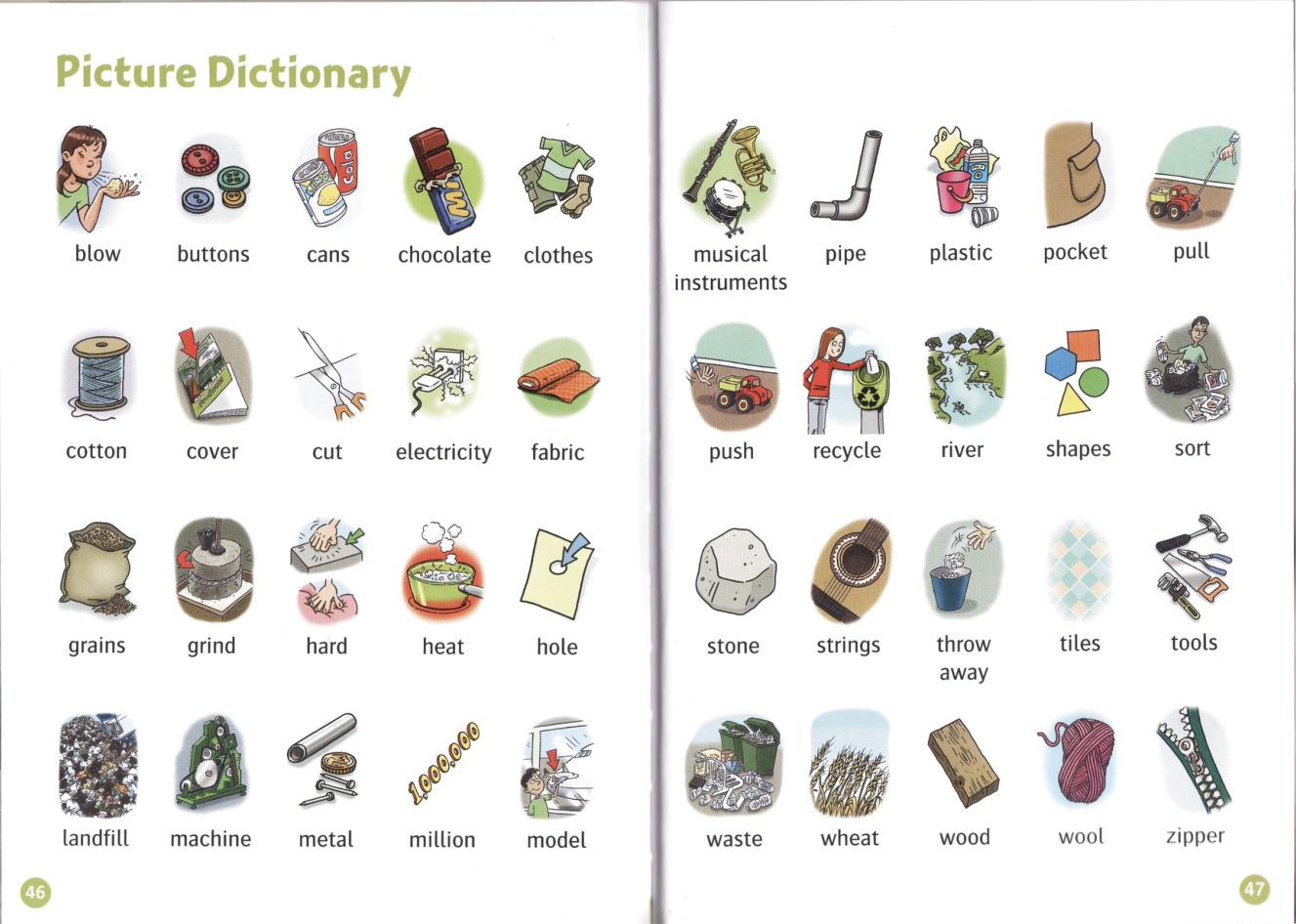
Từ điển tranh