Incredible Earth
Đọc · Nghe · Từ vựng · Bài tập · Dự án · Từ điển tranh
Earth's Crust
1 Đọc trang sách
2 Đọc & Nghe
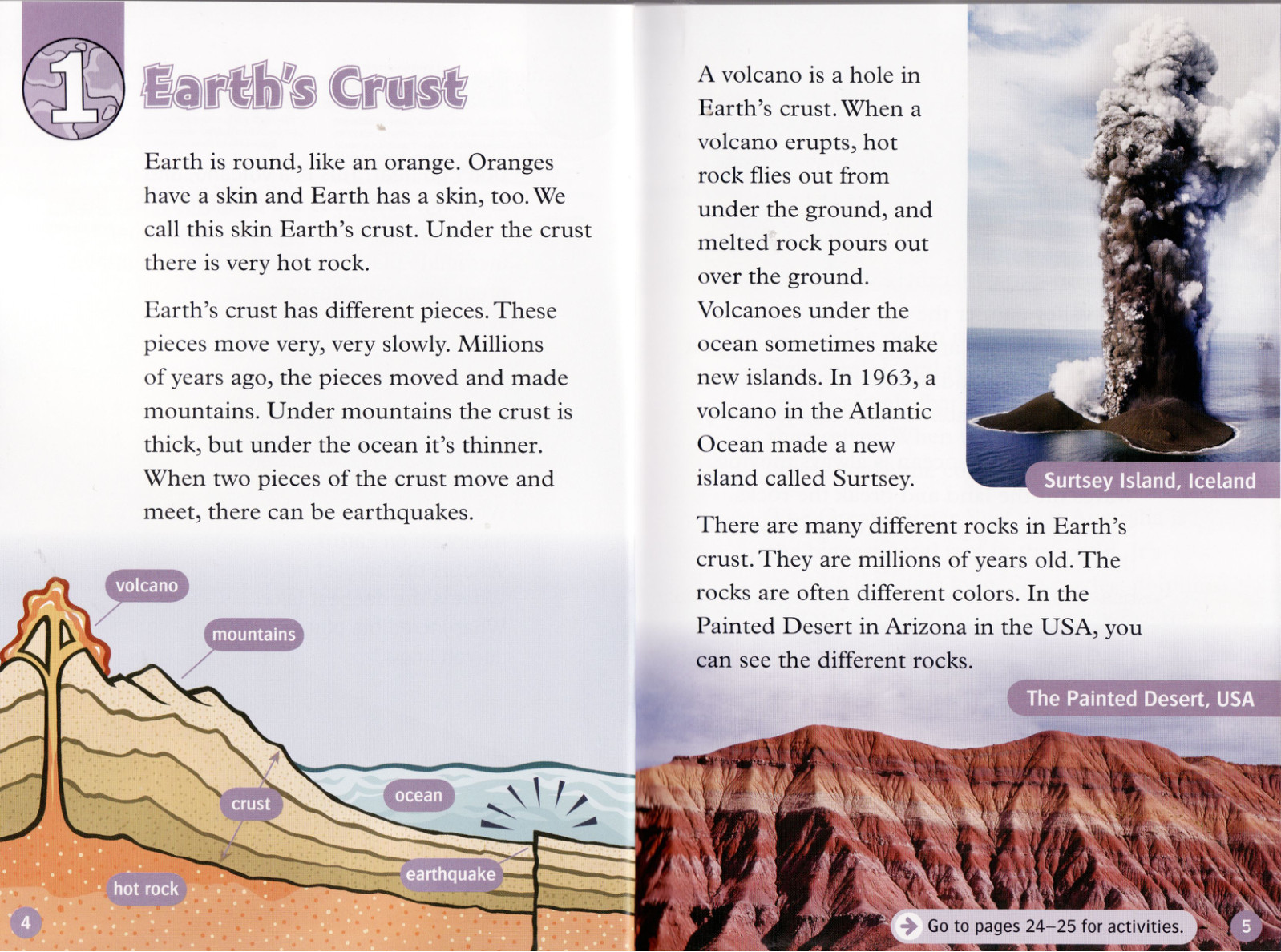
Earth is round, like an orange. Oranges have a skin and Earth has a skin, too. We call this skin Earth's crust. Under the crust there is very hot rock.
Earth's crust has different pieces. These pieces move very, very slowly. Millions of years ago, the pieces moved and made mountains. Under mountains the crust is thick, but under the ocean it's thinner. When two pieces of the crust move and meet, there can be earthquakes.
A volcano is a hole in Earth's crust. When a volcano erupts, hot rock flies out from under the ground, and melted rock pours out over the ground. Volcanoes under the ocean sometimes make new islands. In 1963, a volcano in the Atlantic Ocean made a new island called Surtsey.
There are many different rocks in Earth's crust. They are millions of years old. The rocks are often different colors. In the Painted Desert in Arizona in the USA, you can see the different rocks.
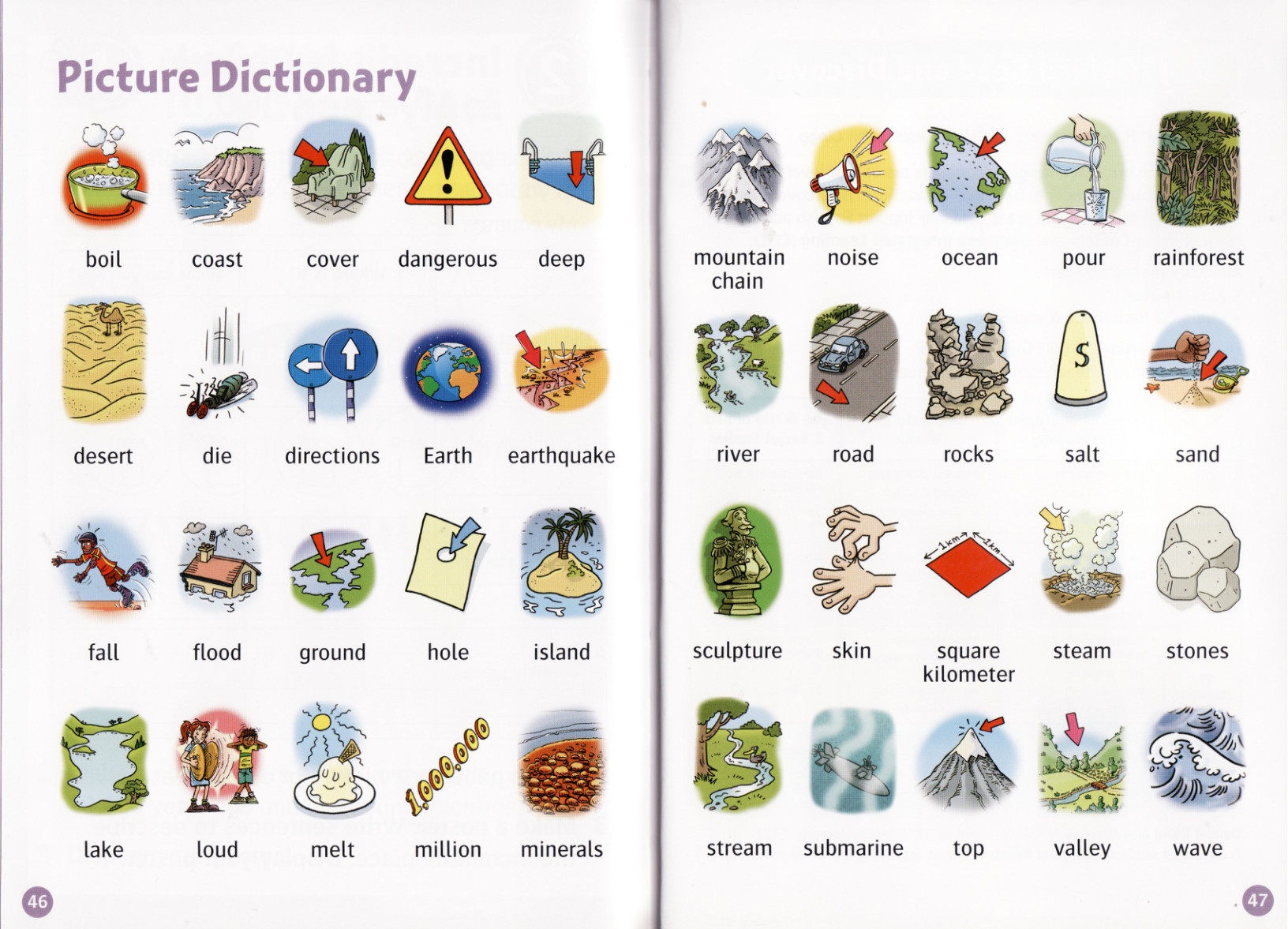
Từ vựng
3 Xem trang bài tập
4 Bài tập tương tác
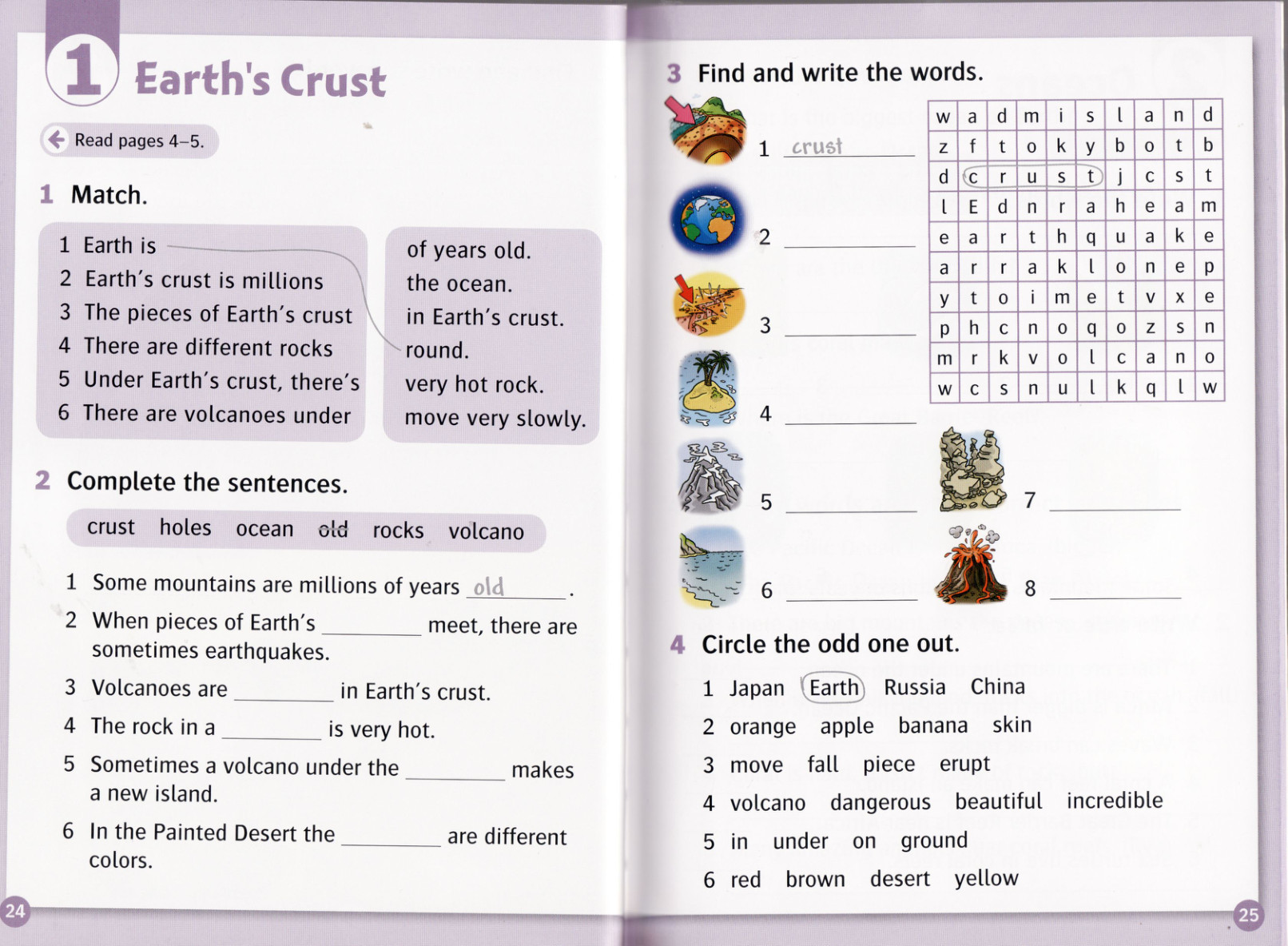
1. Match.
Nối các phần để hoàn thành câu.
Earth is round.
1. Match the sentence halves.
2. Complete the sentences.
Chọn từ trong khung.
Some mountains are millions of years old.
2. Complete the sentences.
2. Volcanoes are in Earth's crust.
3. The rock in a is very hot.
4. Sometimes a volcano under the makes a new island.
5. In the Painted Desert the are different colors.
3. Find and write the words.
Tìm từ trong ô chữ; đối chiếu hình minh họa trên trang bài tập.
Picture 1: crust.
3. Find the words in the grid.
4. Circle the odd one out.
Chọn từ không cùng nhóm.
Japan / Earth / Russia / China → Earth
4. Choose the odd one out.
5. Choose the odd one out.
6. Choose the odd one out.
7. Choose the odd one out.
8. Choose the odd one out.
Oceans
1 Đọc trang sách
2 Đọc & Nghe
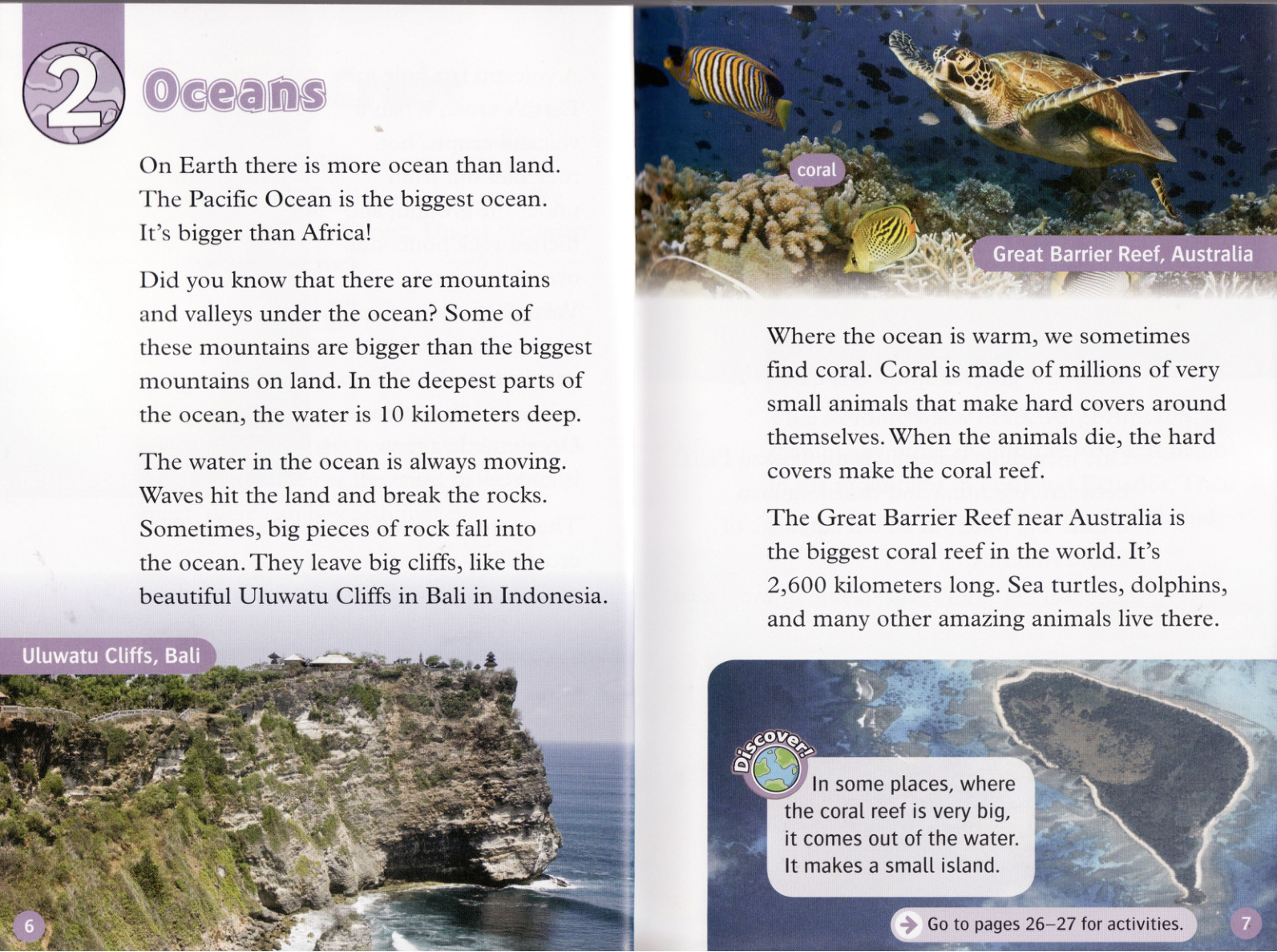
On Earth there is more ocean than land. The Pacific Ocean is the biggest ocean. It's bigger than Africa!
Did you know that there are mountains and valleys under the ocean? Some of these mountains are bigger than the biggest mountains on land. In the deepest parts of the ocean, the water is 10 kilometers deep.
The water in the ocean is always moving. Waves hit the land and break the rocks. Sometimes, big pieces of rock fall into the ocean. They leave big cliffs, like the beautiful Uluwatu Cliffs in Bali in Indonesia.
Where the ocean is warm, we sometimes find coral. Coral is made of millions of very small animals that make hard covers around themselves. When the animals die, the hard covers make the coral reef.
The Great Barrier Reef near Australia is the biggest coral reef in the world. It's 2,600 kilometers long. Sea turtles, dolphins, and many other amazing animals live there.
Sometimes, when the coral reef is very big, it comes out of the water. It makes a small island.
Từ vựng
3 Xem trang bài tập
4 Bài tập tương tác
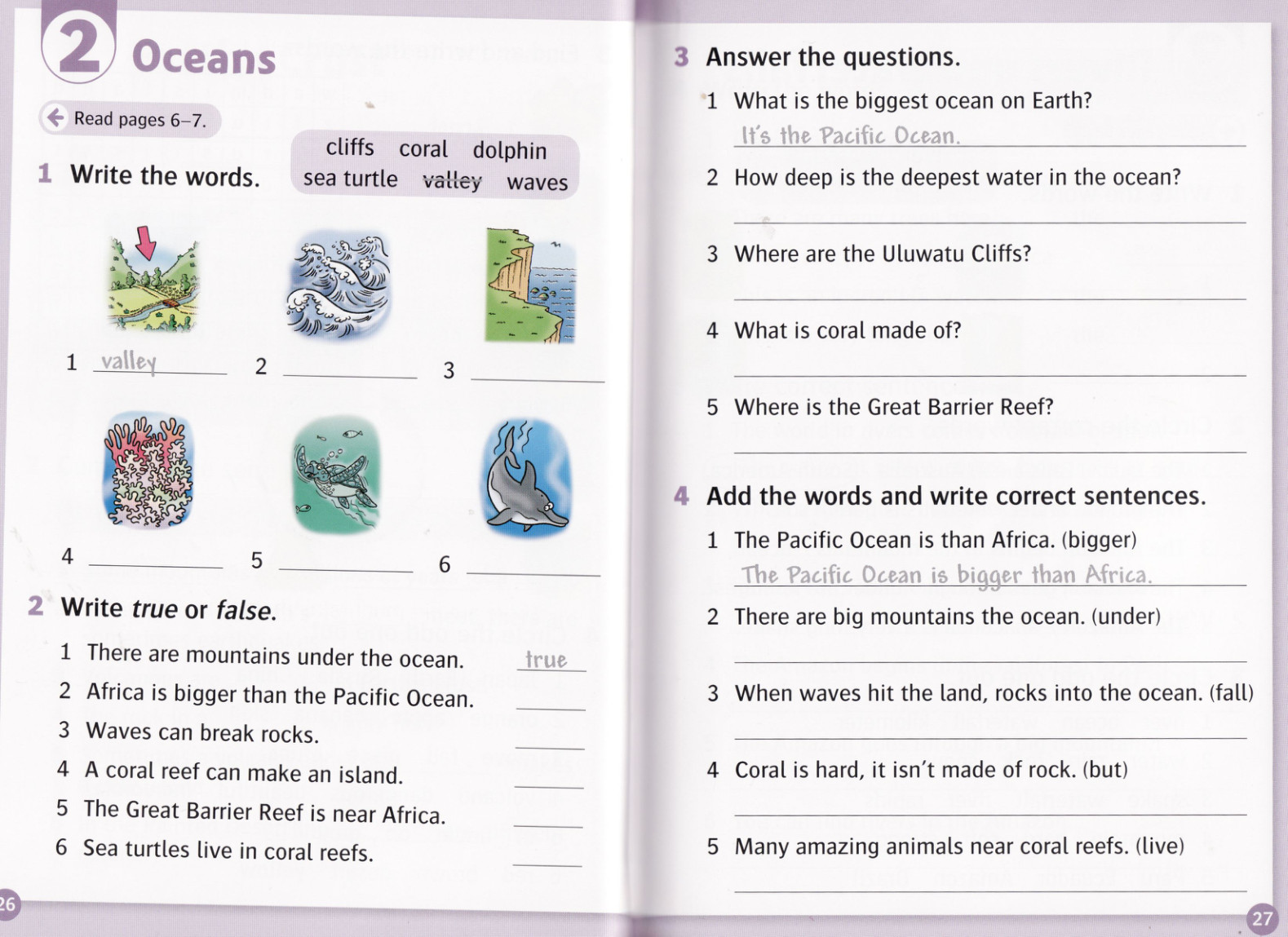
1. Write the words.
Viết từ đúng với từng hình.
Picture 1: valley.
1. Write the words for the numbered pictures.
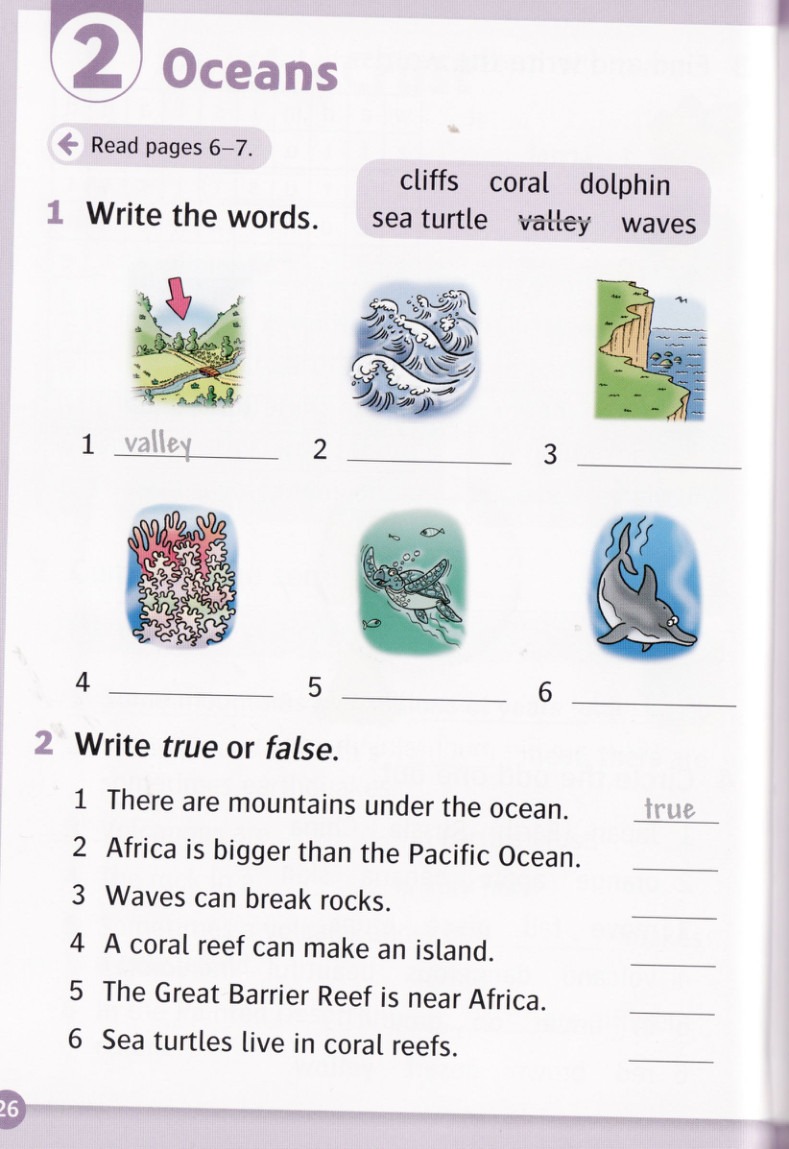
2. Write true or false.
Đánh dấu đúng hoặc sai.
There are mountains under the ocean. → true
2. Africa is bigger than the Pacific Ocean.
3. Waves can break rocks.
4. A coral reef can make an island.
5. The Great Barrier Reef is near Africa.
6. Sea turtles live in coral reefs.
3. Answer the questions.
Trả lời theo nội dung bài đọc.
What is the biggest ocean on Earth? → The Pacific Ocean.
7. How deep is the deepest water in the ocean?
8. Where are the Uluwatu Cliffs?
9. What is coral made of?
10. Where is the Great Barrier Reef?
4. Add the words and write correct sentences.
Thêm từ được cho rồi viết lại câu đúng.
The Pacific Ocean is bigger than Africa.
11. There are big mountains the ocean. (under)
12. When waves hit the land, rocks into the ocean. (fall)
13. Coral is hard, it isn't made of rock. (but)
14. Many amazing animals near coral reefs. (live)
Rivers and Waterfalls
1 Đọc trang sách
2 Đọc & Nghe
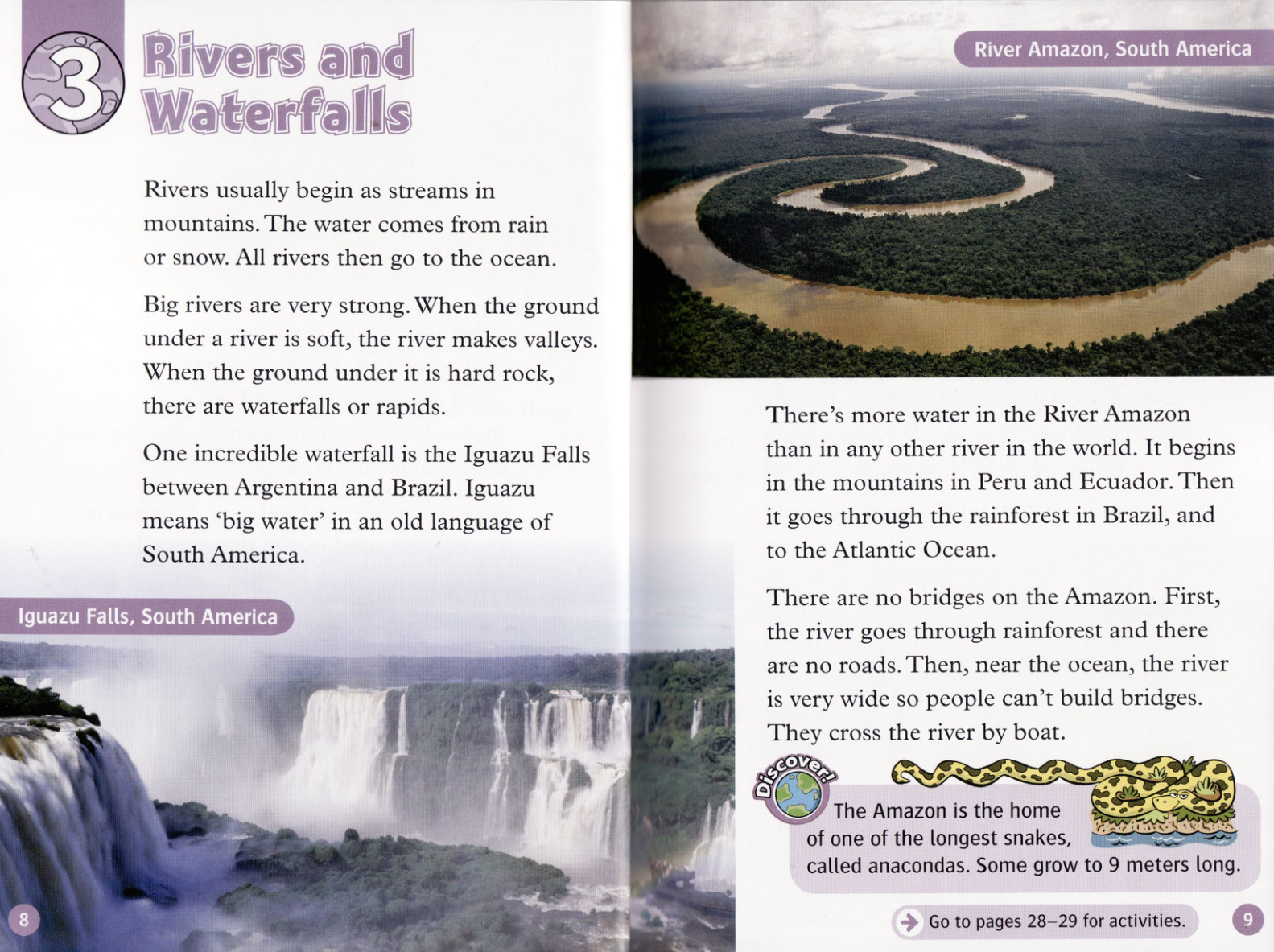
Rivers usually begin as streams in mountains. The water comes from rain or snow. All rivers then go to the ocean.
Big rivers are very strong. When the ground under a river is soft, the river makes valleys. When the ground under it is hard rock, there are waterfalls or rapids.
One incredible waterfall is the Iguazu Falls between Argentina and Brazil. Iguazu means 'big water' in an old language of South America.
There's more water in the River Amazon than in any other river in the world. It begins in the mountains in Peru and Ecuador. Then it goes through the rainforest in Brazil, and to the Atlantic Ocean.
There are no bridges on the Amazon. First, the river goes through rainforest and there are no roads. Then, near the ocean, the river is very wide so people can't build bridges. They cross the river by boat.
The Amazon is the home of one of the longest snakes, called anacondas. Some grow to 9 meters long.
Từ vựng
3 Xem trang bài tập
4 Bài tập tương tác
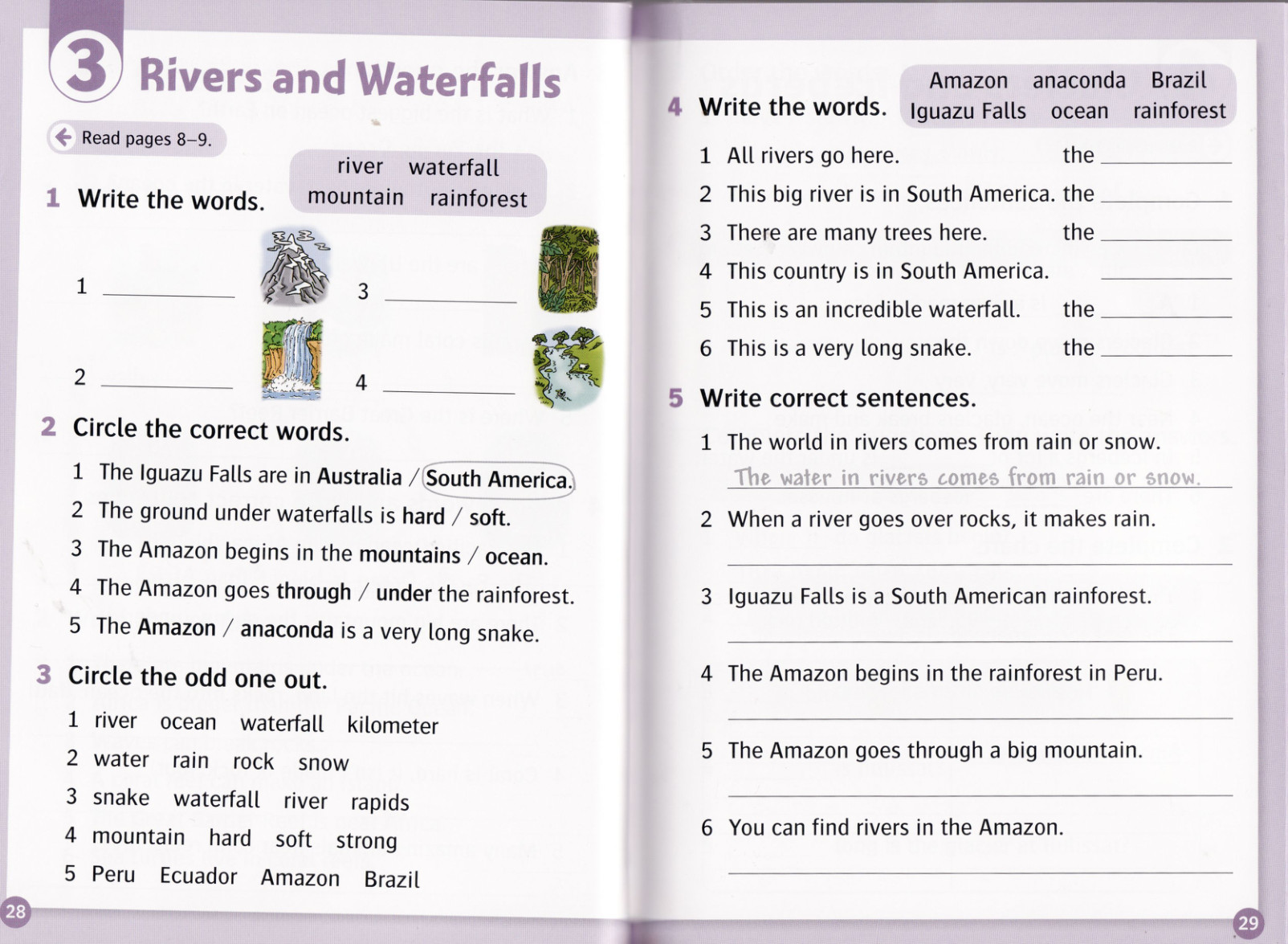
1. Write the words.
Viết từ đúng với từng hình.
1. Write the words for the numbered pictures.
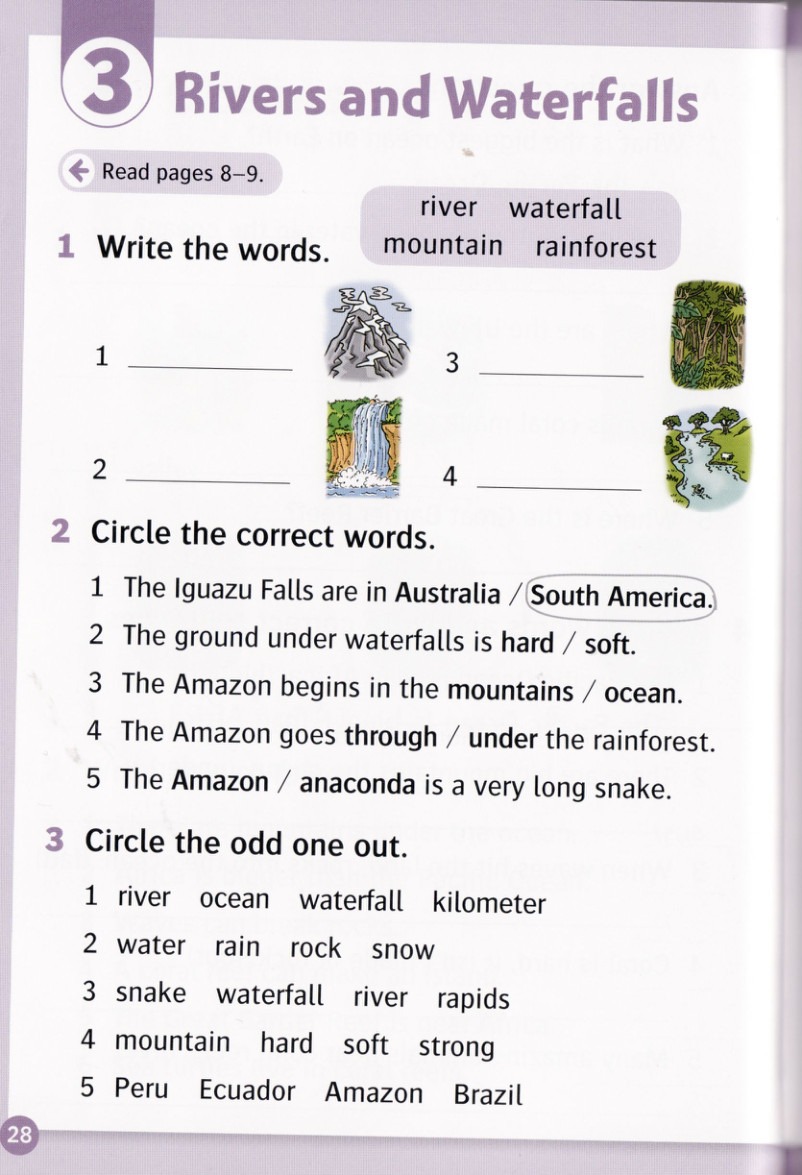
2. Circle the correct words.
Chọn từ đúng.
The Iguazu Falls are in South America.
2. The ground under waterfalls is …
3. The Amazon begins in the …
4. The Amazon goes … the rainforest.
5. The … is a very long snake.
3. Circle the odd one out.
Chọn từ không cùng nhóm.
6. Choose the odd one out.
7. Choose the odd one out.
8. Choose the odd one out.
9. Choose the odd one out.
10. Choose the odd one out.
4. Write the words.
Chọn từ phù hợp với gợi ý.
11. Complete the sentences.
2. This big river is in South America: the .
3. There are many trees here: the .
4. This country is in South America: .
5. This is an incredible waterfall: the .
6. This is a very long snake: the .
5. Write correct sentences.
Sửa từ sai trong mỗi câu.
12. The world in rivers comes from rain or snow.
13. When a river goes over rocks, it makes rain.
14. Iguazu Falls is a South American rainforest.
15. The Amazon begins in the rainforest in Peru.
16. The Amazon goes through a big mountain.
17. You can find rivers in the Amazon.
Glaciers and Icebergs
1 Đọc trang sách
2 Đọc & Nghe
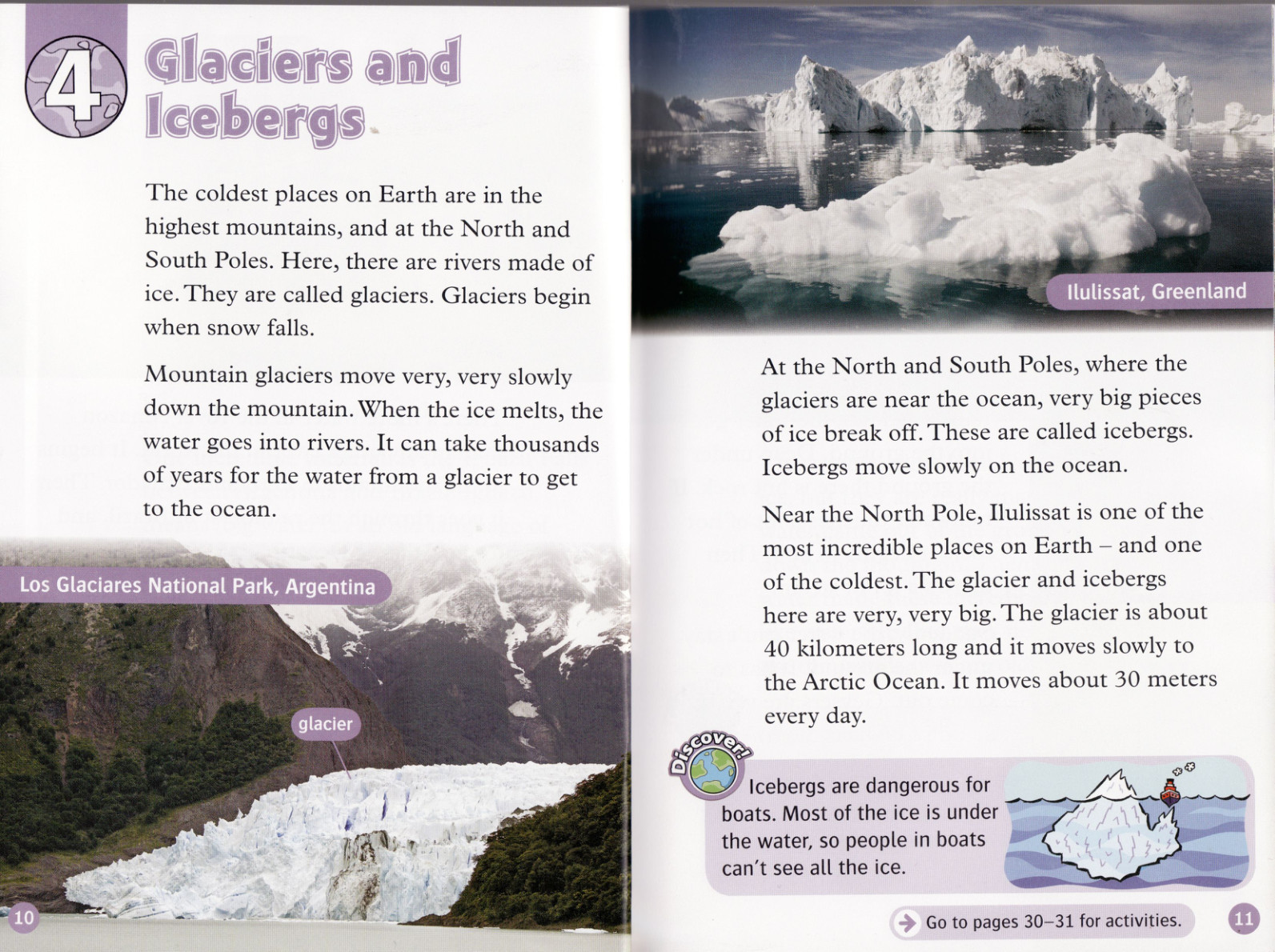
The coldest places on Earth are in the highest mountains, and at the North and South Poles. Here, there are rivers made of ice. They are called glaciers. Glaciers begin when snow falls.
Mountain glaciers move very, very slowly down the mountain. When the ice melts, the water goes into rivers. It can take thousands of years for the water from a glacier to get to the ocean.
At the North and South Poles, where the glaciers are near the ocean, very big pieces of ice break off. These are called icebergs. Icebergs move slowly on the ocean.
Near the North Pole, Ilulissat is one of the most incredible places on Earth – and one of the coldest. The glacier and icebergs here are very, very big. The glacier is about 40 kilometers long and it moves slowly to the Arctic Ocean. It moves about 30 meters every day.
Icebergs are dangerous for boats. Most of the ice is under the water, so people in boats can't see all the ice.
Từ vựng
3 Xem trang bài tập
4 Bài tập tương tác
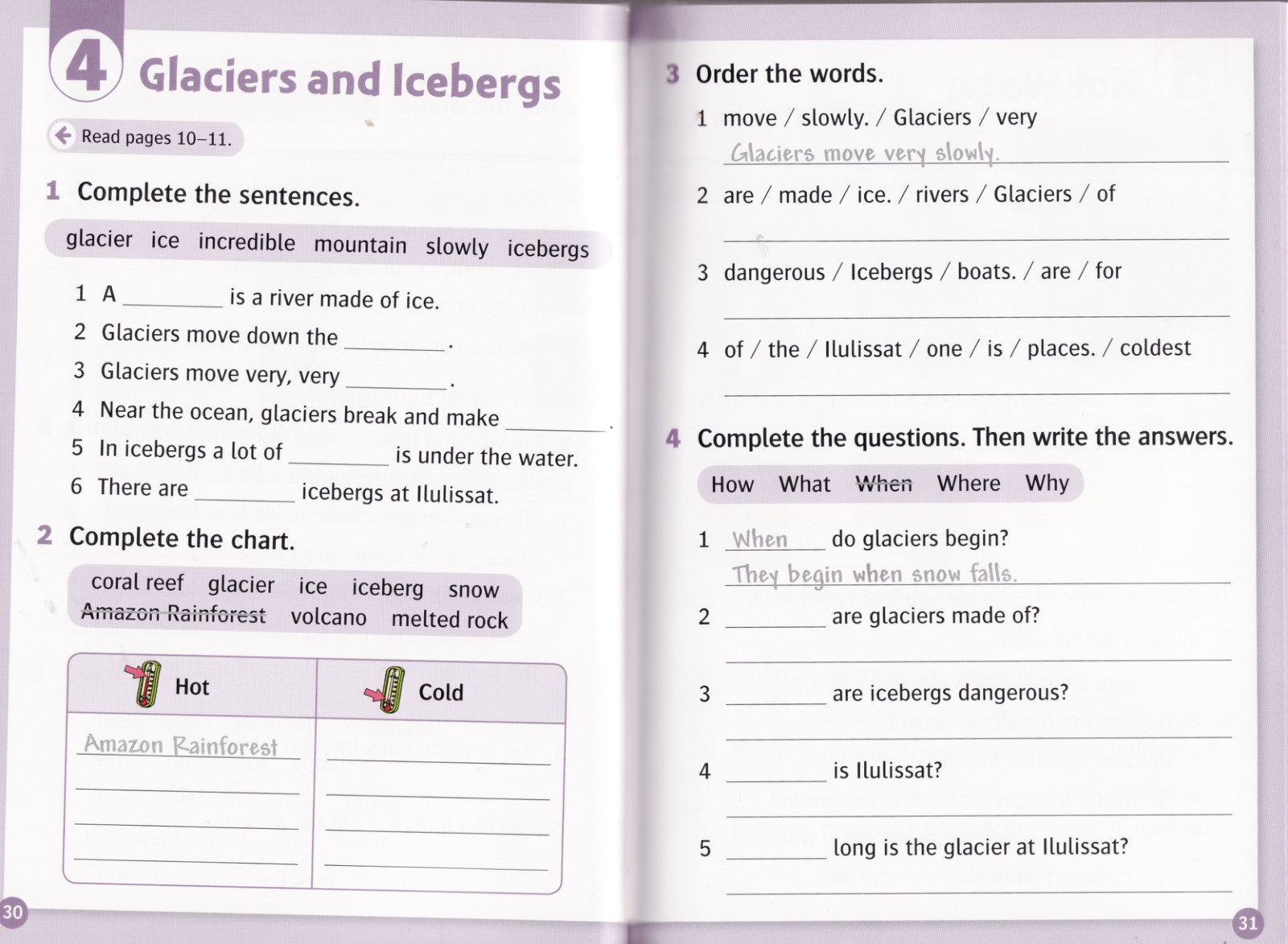
1. Complete the sentences.
Chọn từ thích hợp.
1. Complete the sentences.
2. Glaciers move down the .
3. Glaciers move very, very .
4. Near the ocean, glaciers break and make .
5. In icebergs a lot of is under the water.
6. There are icebergs at Ilulissat.
2. Complete the chart.
Phân loại vào nhóm nóng hoặc lạnh.
2. Complete the chart.
3. Order the words.
Sắp xếp từ để tạo câu đúng.
Glaciers move very slowly.
3. Put the words in order.
- are
- made
- ice.
- rivers
- Glaciers
- of
4. Put the words in order.
- dangerous
- Icebergs
- boats.
- are
- for
5. Put the words in order.
- of
- the
- Ilulissat
- one
- is
- places.
- coldest
4. Complete the questions. Then write the answers.
Hoàn thành câu hỏi và trả lời.
When do glaciers begin? → They begin when snow falls.
6. Complete the sentences.
2. are icebergs dangerous?
3. is Ilulissat?
4. long is the glacier at Ilulissat?
7. What are glaciers made of?
8. Why are icebergs dangerous?
- Answer the question clearly.
- Use information from the text or your own experience.
Lời giải và bài mẫu
Because most of the ice is under the water.
9. Where is Ilulissat?
10. How long is the glacier at Ilulissat?
Hot Water
1 Đọc trang sách
2 Đọc & Nghe
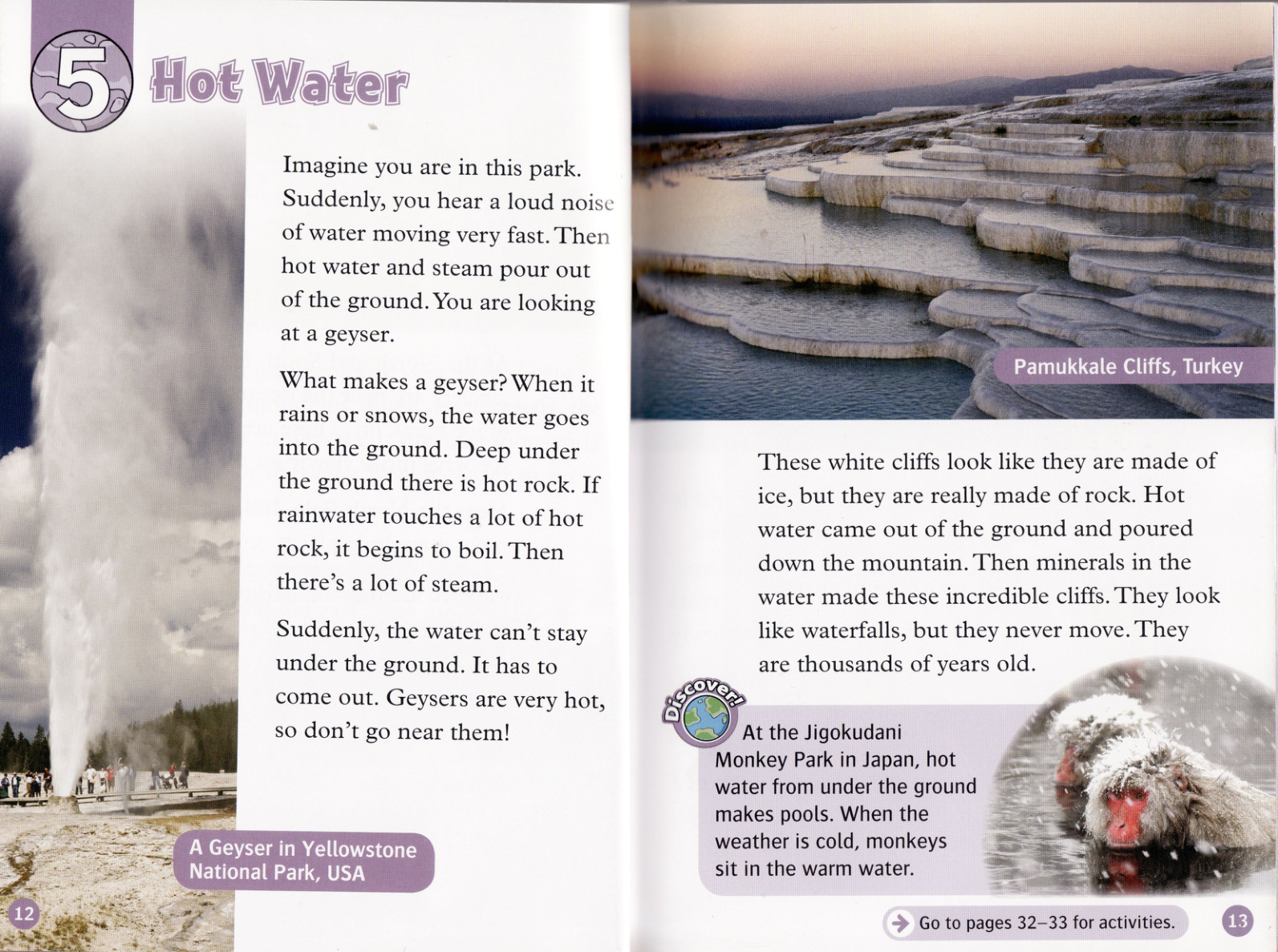
Imagine you are in this park. Suddenly, you hear a loud noise of water moving very fast. Then hot water and steam pour out of the ground. You are looking at a geyser.
What makes a geyser? When it rains or snows, the water goes into the ground. Deep under the ground there is hot rock. If rainwater touches a lot of hot rock, it begins to boil. Then there's a lot of steam.
Suddenly, the water can't stay under the ground. It has to come out. Geysers are very hot, so don't go near them!
These white cliffs look like they are made of ice, but they are really made of rock. Hot water came out of the ground and poured down the mountain. Then minerals in the water made these incredible cliffs. They look like waterfalls, but they never move. They are thousands of years old.
At the Jigokudani Monkey Park in Japan, hot water from under the ground makes pools. When the weather is cold, monkeys sit in the warm water.
Từ vựng
3 Xem trang bài tập
4 Bài tập tương tác
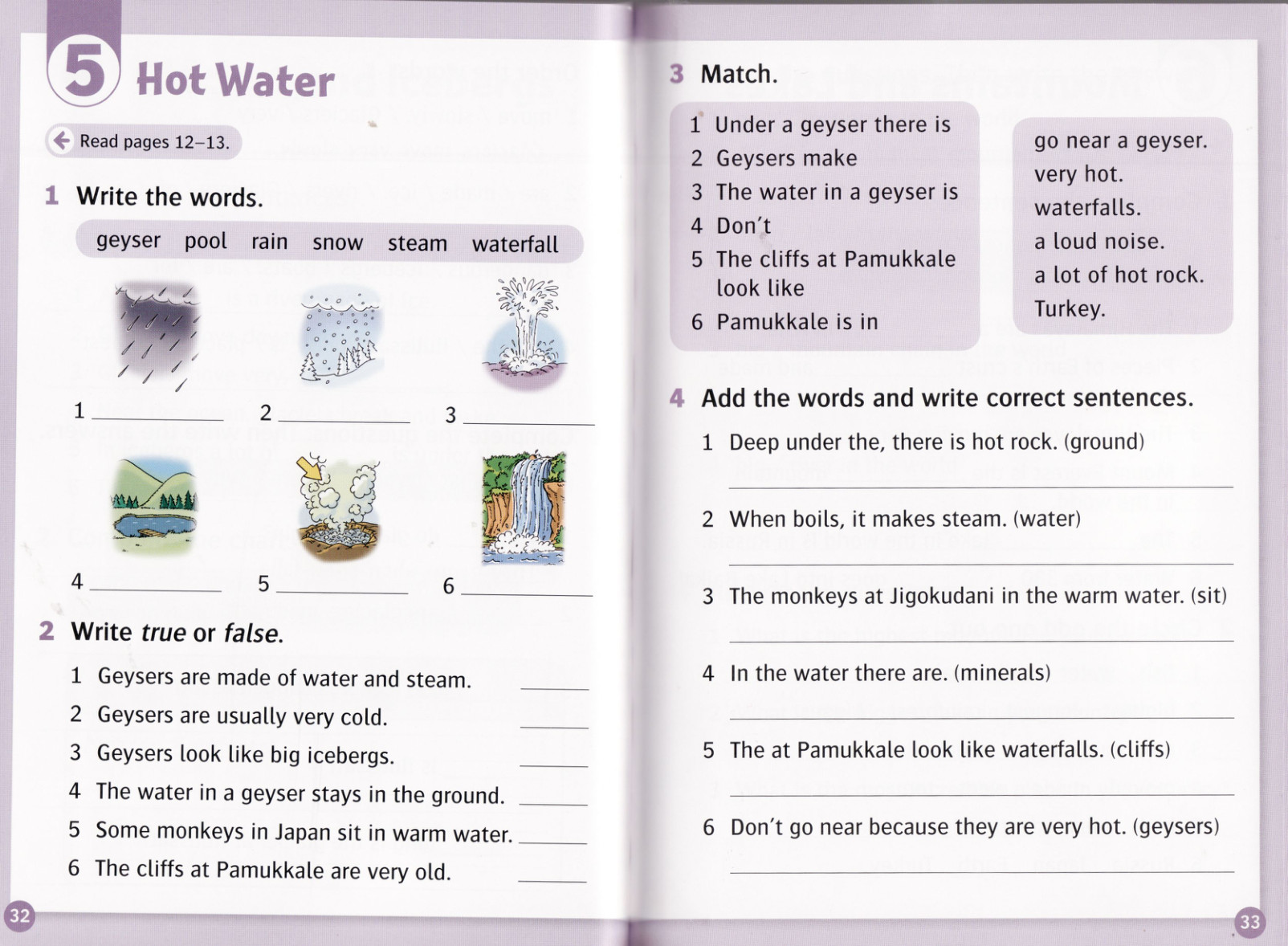
1. Write the words.
Viết từ đúng với từng hình.
1. Write the words for the numbered pictures.
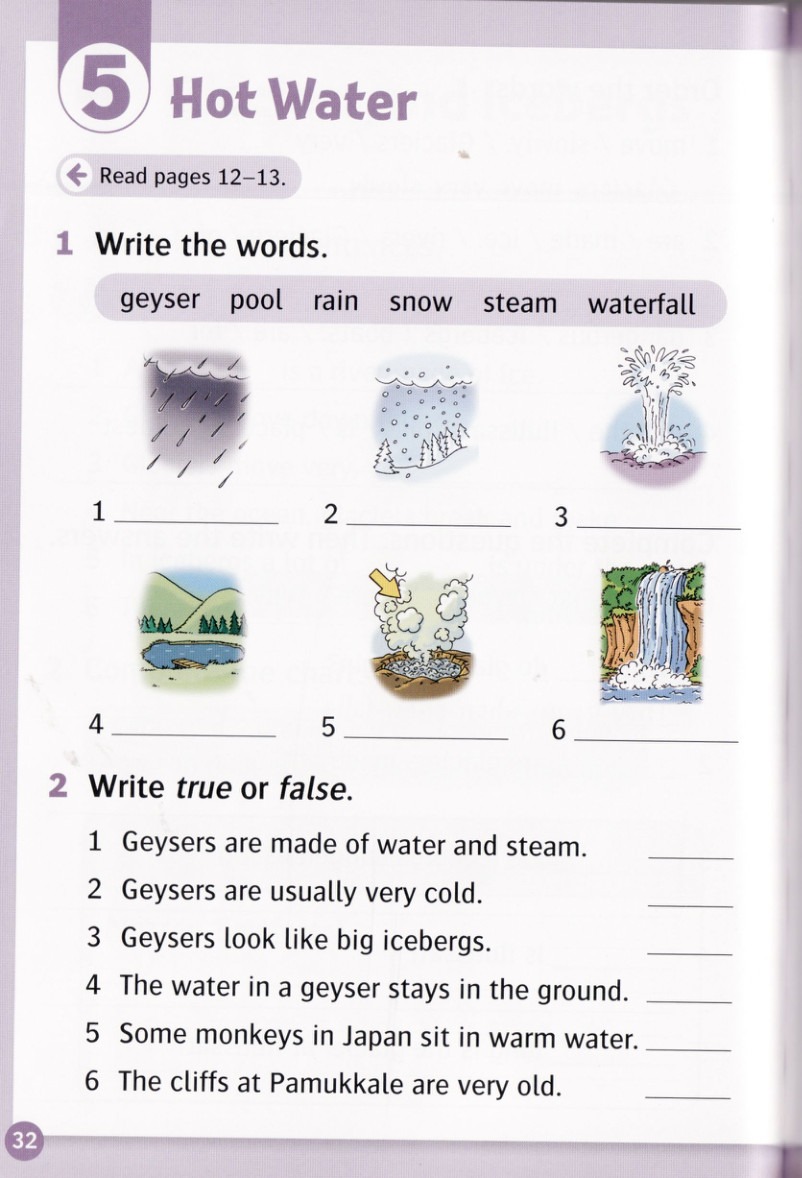
2. Write true or false.
Đánh dấu đúng hoặc sai.
2. Geysers are made of water and steam.
3. Geysers are usually very cold.
4. Geysers look like big icebergs.
5. The water in a geyser stays in the ground.
6. Some monkeys in Japan sit in warm water.
7. The cliffs at Pamukkale are very old.
3. Match.
Nối các phần của câu.
8. Match the sentence halves.
4. Add the words and write correct sentences.
Thêm từ được cho rồi viết lại câu đúng.
9. Deep under the, there is hot rock. (ground)
10. When boils, it makes steam. (water)
11. The monkeys at Jigokudani in the warm water. (sit)
12. In the water there are. (minerals)
13. The at Pamukkale look like waterfalls. (cliffs)
14. Don't go near because they are very hot. (geysers)
Mountains and Lakes
1 Đọc trang sách
2 Đọc & Nghe
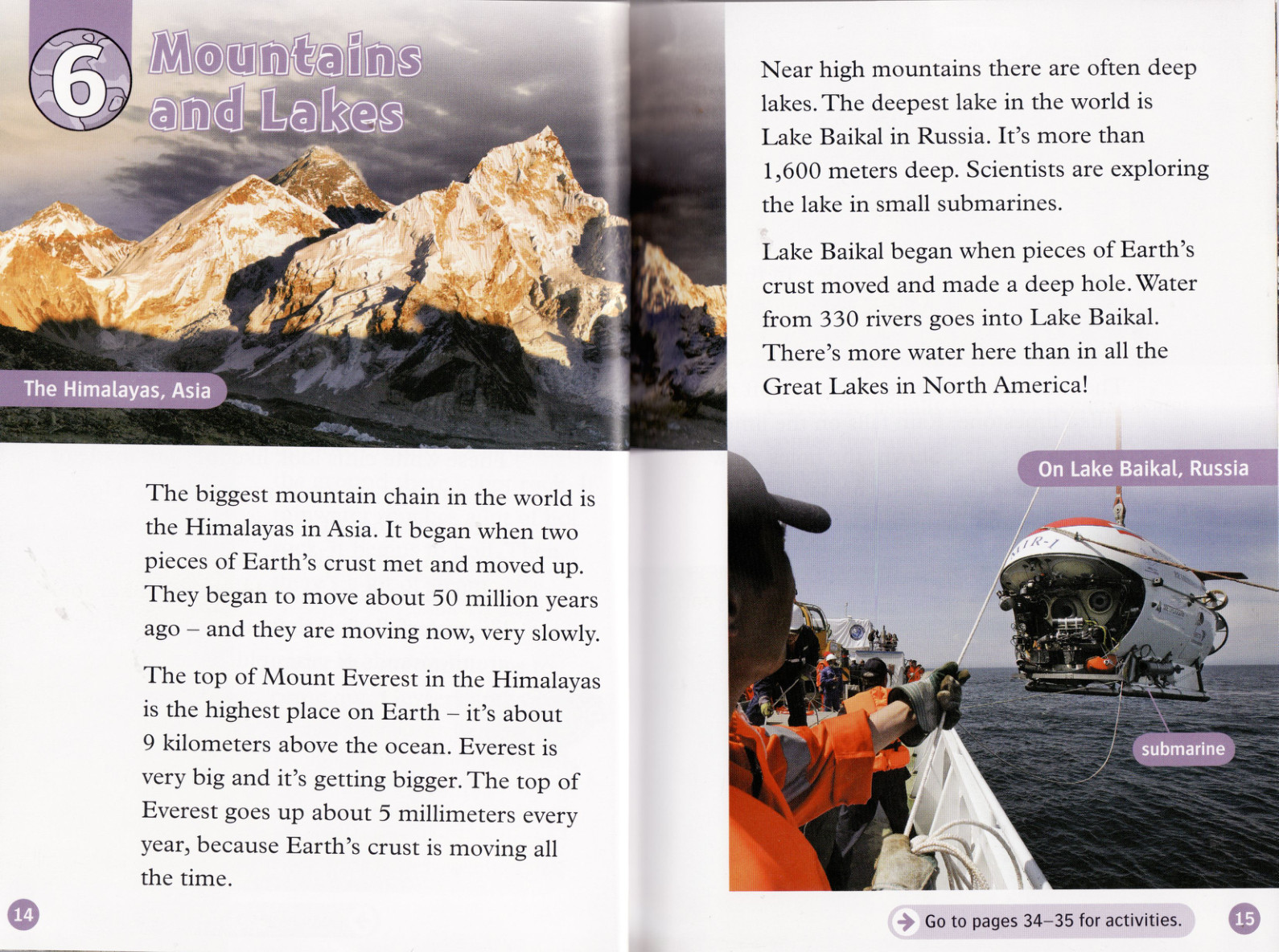
The biggest mountain chain in the world is the Himalayas in Asia. It began when two pieces of Earth's crust met and moved up. They began to move about 50 million years ago – and they are moving now, very slowly.
The top of Mount Everest in the Himalayas is the highest place on Earth – it's about 9 kilometers above the ocean. Everest is very big and it's getting bigger. The top of Everest goes up about 5 millimeters every year, because Earth's crust is moving all the time.
Near high mountains there are often deep lakes. The deepest lake in the world is Lake Baikal in Russia. It's more than 1,600 meters deep. Scientists are exploring the lake in small submarines.
Lake Baikal began when pieces of Earth's crust moved and made a deep hole. Water from 330 rivers goes into Lake Baikal. There's more water here than in all the Great Lakes in North America!
Từ vựng
3 Xem trang bài tập
4 Bài tập tương tác
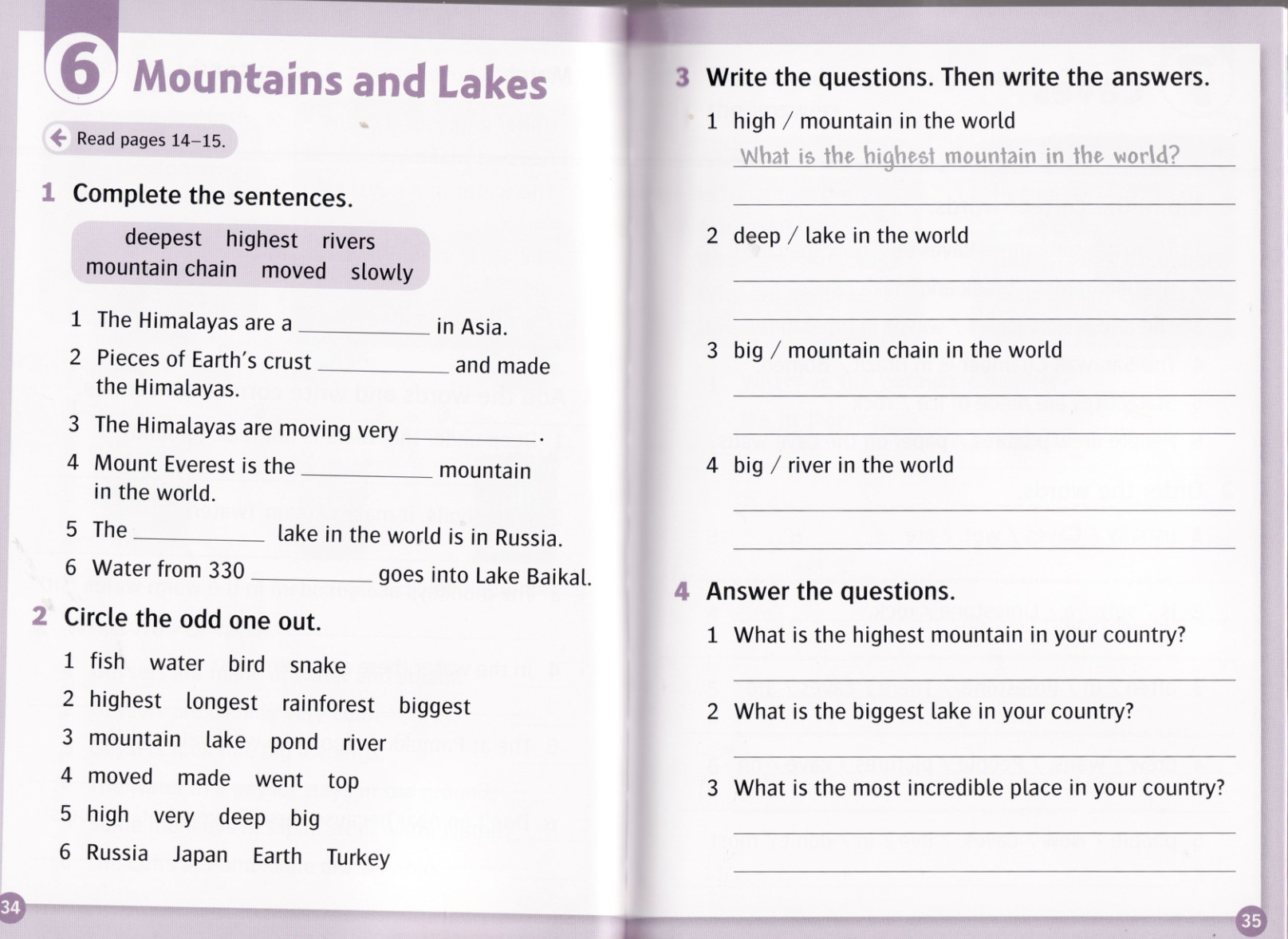
1. Complete the sentences.
Chọn từ thích hợp.
1. Complete the sentences.
2. Pieces of Earth's crust and made the Himalayas.
3. The Himalayas are moving very .
4. Mount Everest is the mountain in the world.
5. The lake in the world is in Russia.
6. Water from 330 goes into Lake Baikal.
2. Circle the odd one out.
Chọn từ không cùng nhóm.
2. Choose the odd one out.
3. Choose the odd one out.
4. Choose the odd one out.
5. Choose the odd one out.
6. Choose the odd one out.
7. Choose the odd one out.
3. Write the questions. Then write the answers.
Viết câu hỏi so sánh nhất, rồi trả lời theo bài.
What is the highest mountain in the world? → Mount Everest.
8. Write the question: deep / lake in the world
9. What is the deepest lake in the world?
10. Write the question: big / mountain chain in the world
11. What is the biggest mountain chain in the world?
12. Write the question: big / river in the world
13. What is the biggest river in the world?
4. Answer the questions.
Trả lời về đất nước của em; câu trả lời được lưu để giáo viên nhận xét.
14. What is the highest mountain in your country?
- Answer the question clearly.
- Use information from the text or your own experience.
15. What is the biggest lake in your country?
- Answer the question clearly.
- Use information from the text or your own experience.
16. What is the most incredible place in your country?
- Answer the question clearly.
- Use information from the text or your own experience.
Caves
1 Đọc trang sách
2 Đọc & Nghe
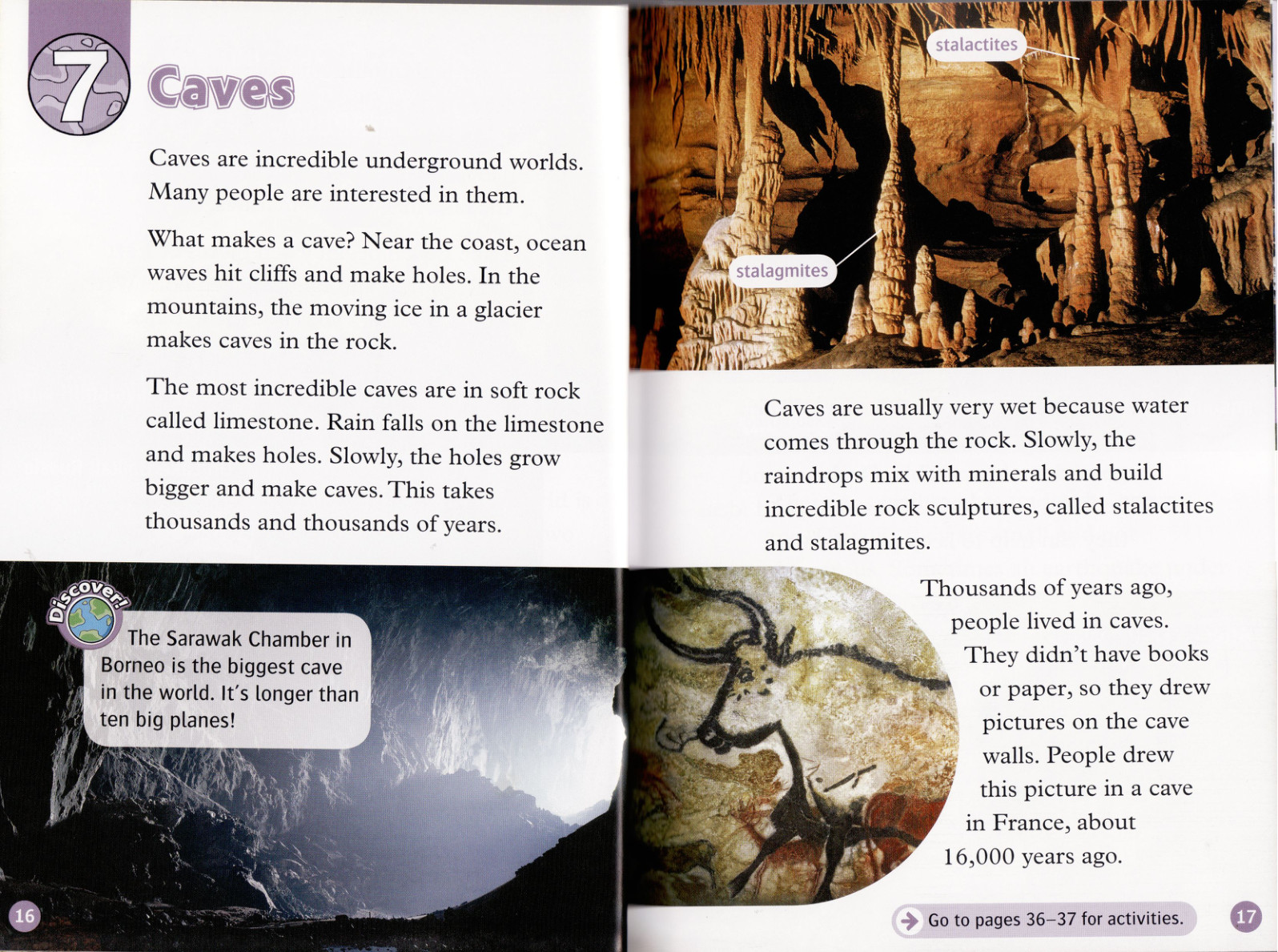
Caves are incredible underground worlds. Many people are interested in them.
What makes a cave? Near the coast, ocean waves hit cliffs and make holes. In the mountains, the moving ice in a glacier makes caves in the rock.
The most incredible caves are in soft rock called limestone. Rain falls on the limestone and makes holes. Slowly, the holes grow bigger and make caves. This takes thousands and thousands of years.
The Sarawak Chamber in Borneo is the biggest cave in the world. It's longer than ten big planes!
Caves are usually very wet because water comes through the rock. Slowly, the raindrops mix with minerals and build incredible rock sculptures, called stalactites and stalagmites.
Thousands of years ago, people lived in caves. They didn't have books or paper, so they drew pictures on the cave walls. People drew this picture in a cave in France, about 16,000 years ago.
Từ vựng
3 Xem trang bài tập
4 Bài tập tương tác
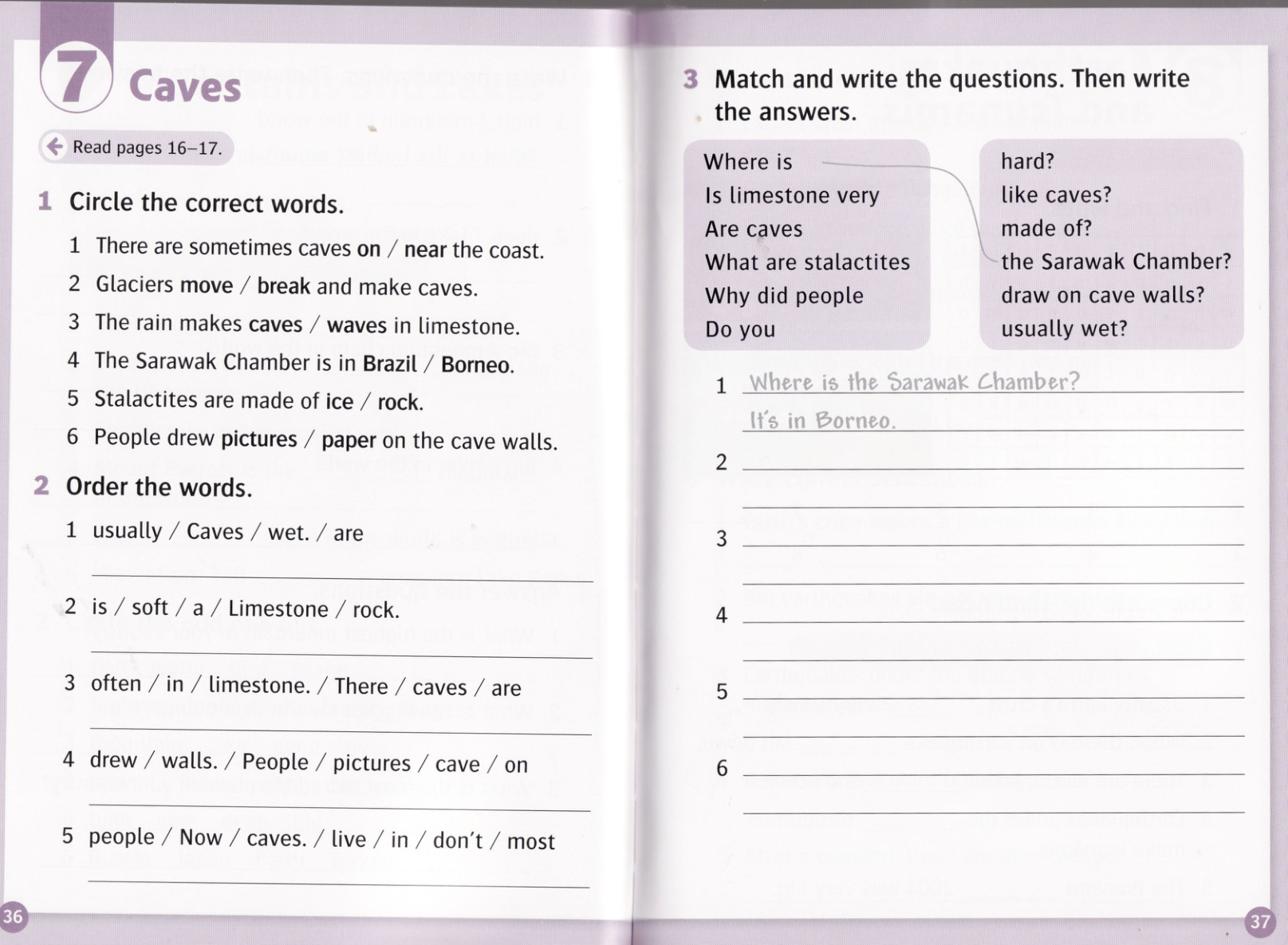
1. Circle the correct words.
Chọn từ đúng.
1. There are sometimes caves … the coast.
2. Glaciers … and make caves.
3. The rain makes … in limestone.
4. The Sarawak Chamber is in …
5. Stalactites are made of …
6. People drew … on the cave walls.
2. Order the words.
Sắp xếp từ để tạo câu đúng.
7. Put the words in order.
- usually
- Caves
- wet.
- are
8. Put the words in order.
- is
- soft
- a
- Limestone
- rock.
9. Put the words in order.
- often
- in
- limestone.
- There
- caves
- are
10. Put the words in order.
- drew
- walls.
- People
- pictures
- cave
- on
11. Put the words in order.
- people
- Now
- caves.
- live
- in
- don't
- most
3. Match and write the questions. Then write the answers.
Nối để tạo câu hỏi, rồi trả lời.
12. Match the sentence halves.
13. Where is the Sarawak Chamber?
14. Is limestone very hard?
15. Are caves usually wet?
16. What are stalactites made of?
17. Why did people draw on cave walls?
- Answer the question clearly.
- Use information from the text or your own experience.
Lời giải và bài mẫu
Because they didn't have books or paper.
18. Do you like caves?
- Answer the question clearly.
- Use information from the text or your own experience.
Earthquakes and Tsunamis
1 Đọc trang sách
2 Đọc & Nghe
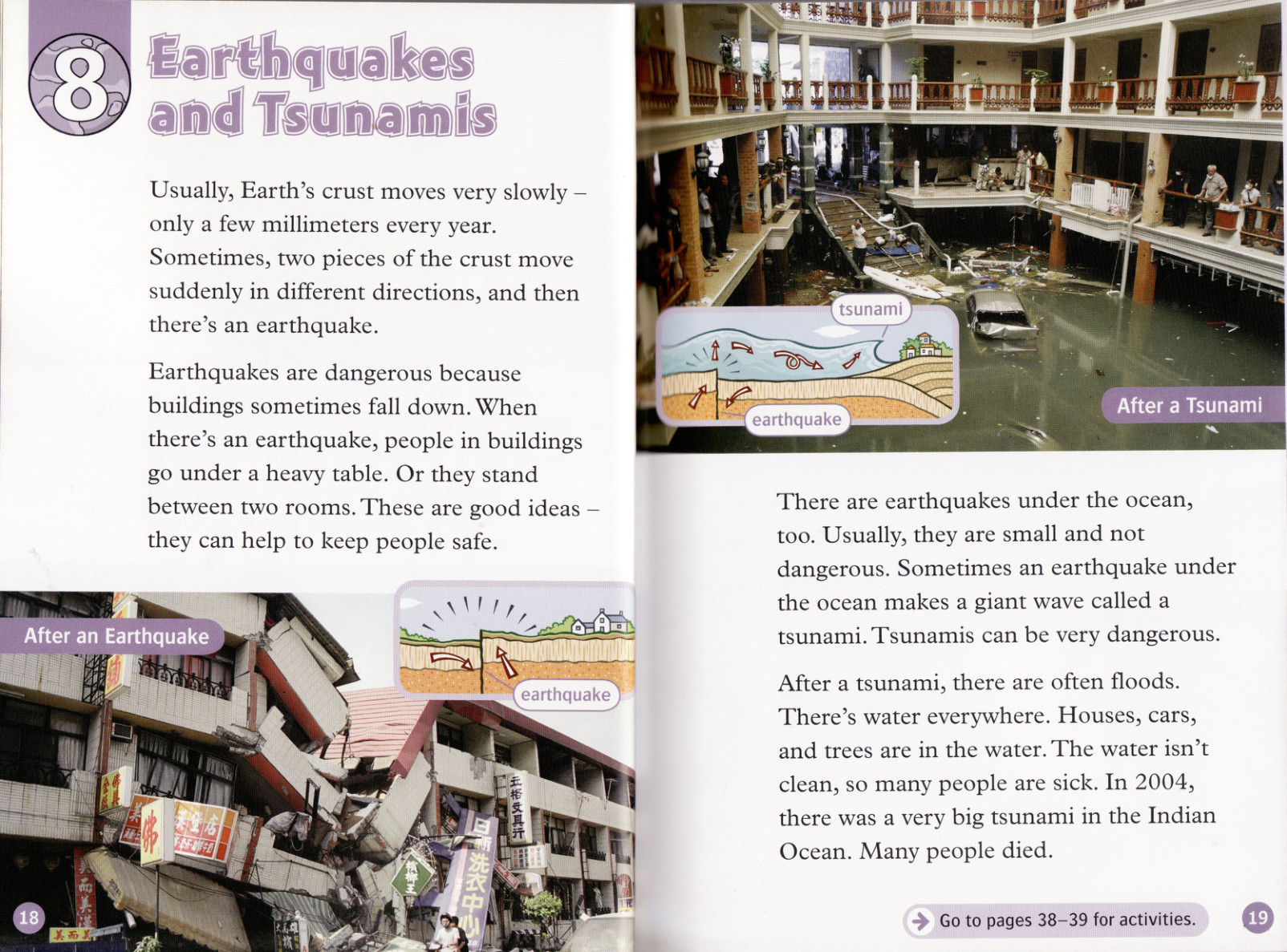
Usually, Earth's crust moves very slowly – only a few millimeters every year. Sometimes, two pieces of the crust move suddenly in different directions, and then there's an earthquake.
Earthquakes are dangerous because buildings sometimes fall down. When there's an earthquake, people in buildings go under a heavy table. Or they stand between two rooms. These are good ideas – they can help to keep people safe.
There are earthquakes under the ocean, too. Usually, they are small and not dangerous. Sometimes an earthquake under the ocean makes a giant wave called a tsunami. Tsunamis can be very dangerous.
After a tsunami, there are often floods. There's water everywhere. Houses, cars, and trees are in the water. The water isn't clean, so many people are sick. In 2004, there was a very big tsunami in the Indian Ocean. Many people died.
Từ vựng
3 Xem trang bài tập
4 Bài tập tương tác
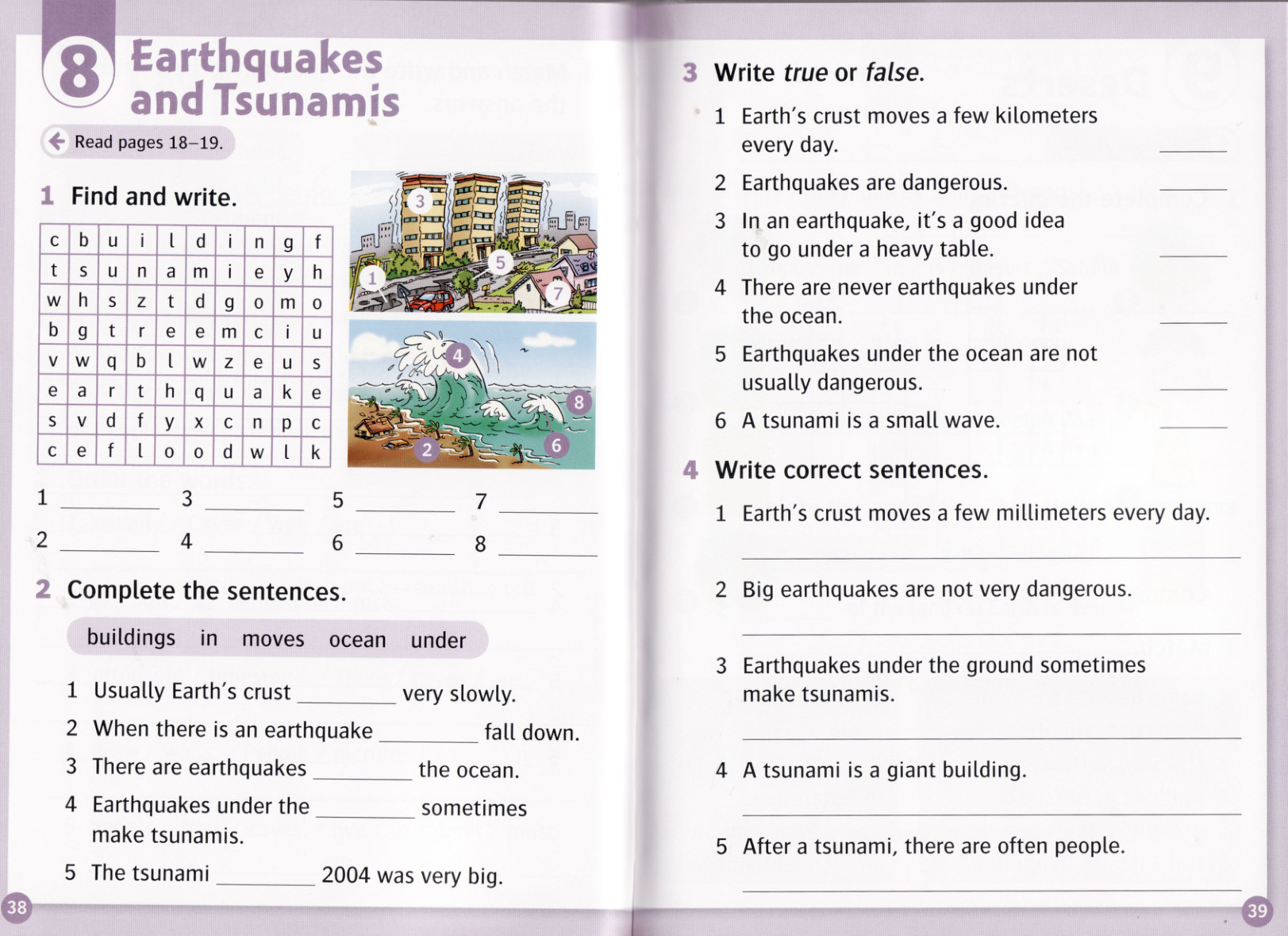
1. Find and write.
Tìm từ tương ứng với các hình trên trang bài tập.
1. Write the words for the numbered pictures.
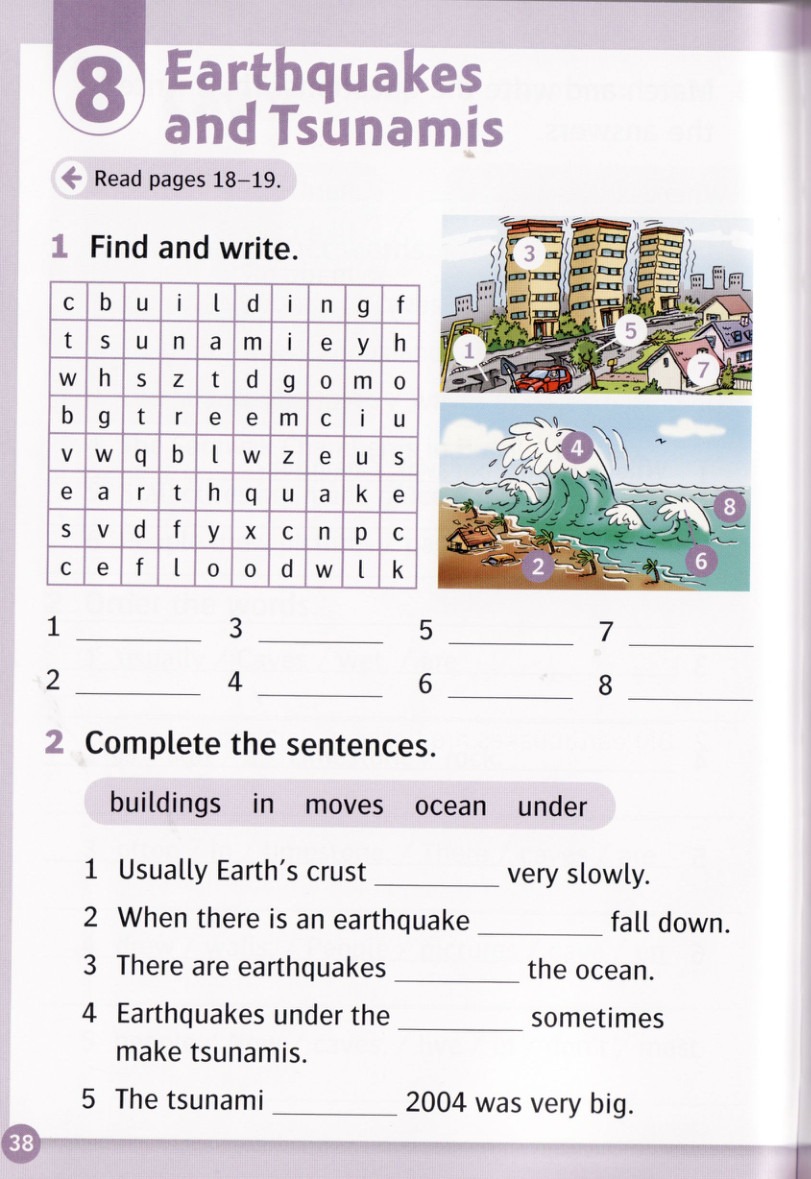
2. Complete the sentences.
Chọn từ thích hợp.
2. Complete the sentences.
2. When there is an earthquake, fall down.
3. There are earthquakes the ocean.
4. Earthquakes under the sometimes make tsunamis.
5. The tsunami 2004 was very big.
3. Write true or false.
Đánh dấu đúng hoặc sai.
3. Earth's crust moves a few kilometers every day.
4. Earthquakes are dangerous.
5. In an earthquake, it's a good idea to go under a heavy table.
6. There are never earthquakes under the ocean.
7. Earthquakes under the ocean are not usually dangerous.
8. A tsunami is a small wave.
4. Write correct sentences.
Sửa từ sai trong câu.
9. Earth's crust moves a few millimeters every day.
10. Big earthquakes are not very dangerous.
11. Earthquakes under the ground sometimes make tsunamis.
12. A tsunami is a giant building.
13. After a tsunami, there are often people.
Deserts
1 Đọc trang sách
2 Đọc & Nghe
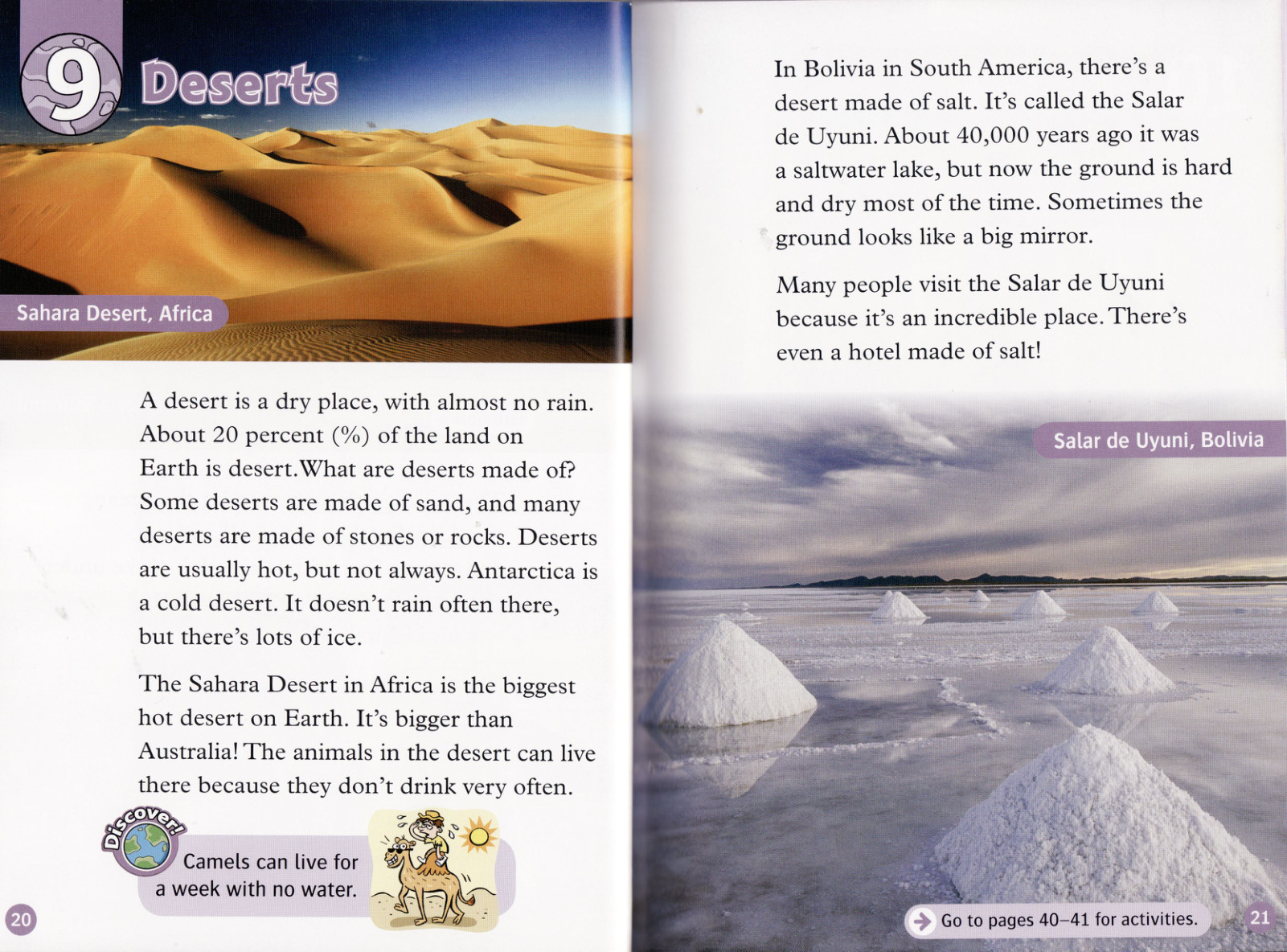
A desert is a dry place, with almost no rain. About 20 percent (%) of the land on Earth is desert. What are deserts made of? Some deserts are made of sand, and many deserts are made of stones or rocks. Deserts are usually hot, but not always. Antarctica is a cold desert. It doesn't rain often there, but there's lots of ice.
The Sahara Desert in Africa is the biggest hot desert on Earth. It's bigger than Australia! The animals in the desert can live there because they don't drink very often.
Camels can live for a week with no water.
In Bolivia in South America, there's a desert made of salt. It's called the Salar de Uyuni. About 40,000 years ago it was a saltwater lake, but now the ground is hard and dry most of the time. Sometimes the ground looks like a big mirror.
Many people visit the Salar de Uyuni because it's an incredible place. There's even a hotel made of salt!
Từ vựng
3 Xem trang bài tập
4 Bài tập tương tác
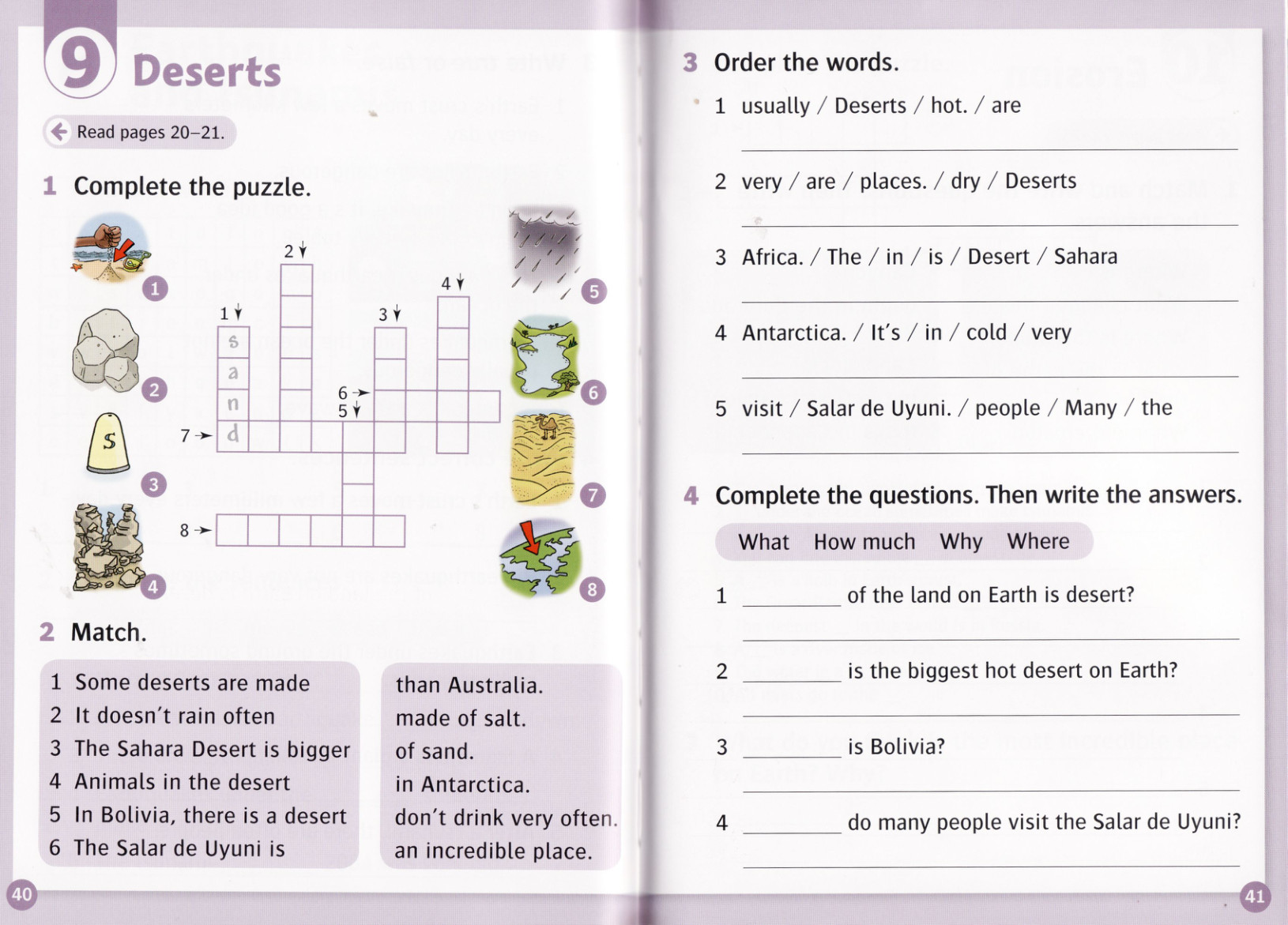
1. Complete the puzzle.
Điền đáp án ứng với hình và số trong ô chữ gốc.
1: sand.
1. Complete puzzle answers 2–8 using the pictures.
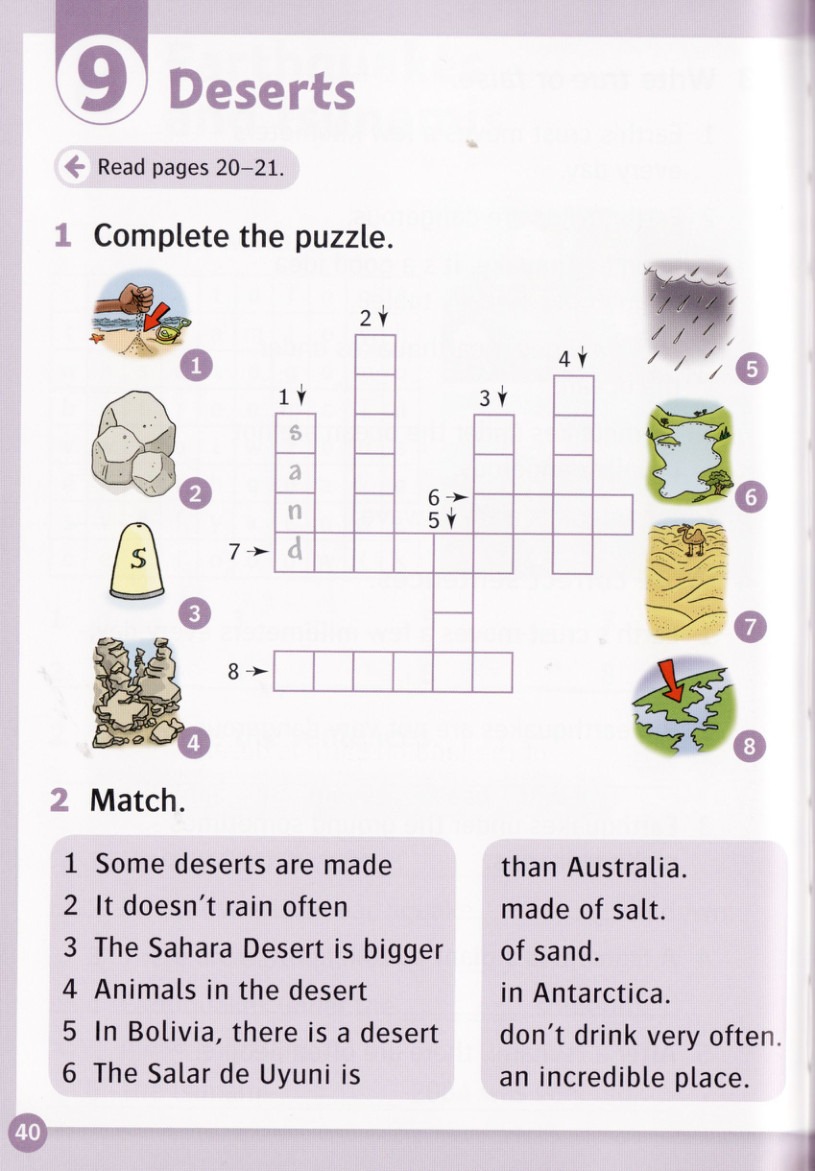
2. Match.
Nối các phần của câu.
2. Match the sentence halves.
3. Order the words.
Sắp xếp từ để tạo câu đúng.
3. Put the words in order.
- usually
- Deserts
- hot.
- are
4. Put the words in order.
- very
- are
- places.
- dry
- Deserts
5. Put the words in order.
- Africa.
- The
- in
- is
- Desert
- Sahara
6. Put the words in order.
- Antarctica.
- It's
- in
- cold
- very
7. Put the words in order.
- visit
- Salar de Uyuni.
- people
- Many
- the
4. Complete the questions. Then write the answers.
Hoàn thành câu hỏi và trả lời.
8. Complete the sentences.
2. is the biggest hot desert on Earth?
3. is Bolivia?
4. do many people visit the Salar de Uyuni?
9. How much of the land on Earth is desert?
10. What is the biggest hot desert on Earth?
11. Where is Bolivia?
12. Why do many people visit the Salar de Uyuni?
- Answer the question clearly.
- Use information from the text or your own experience.
Lời giải và bài mẫu
Because it's an incredible place.
Erosion
1 Đọc trang sách
2 Đọc & Nghe
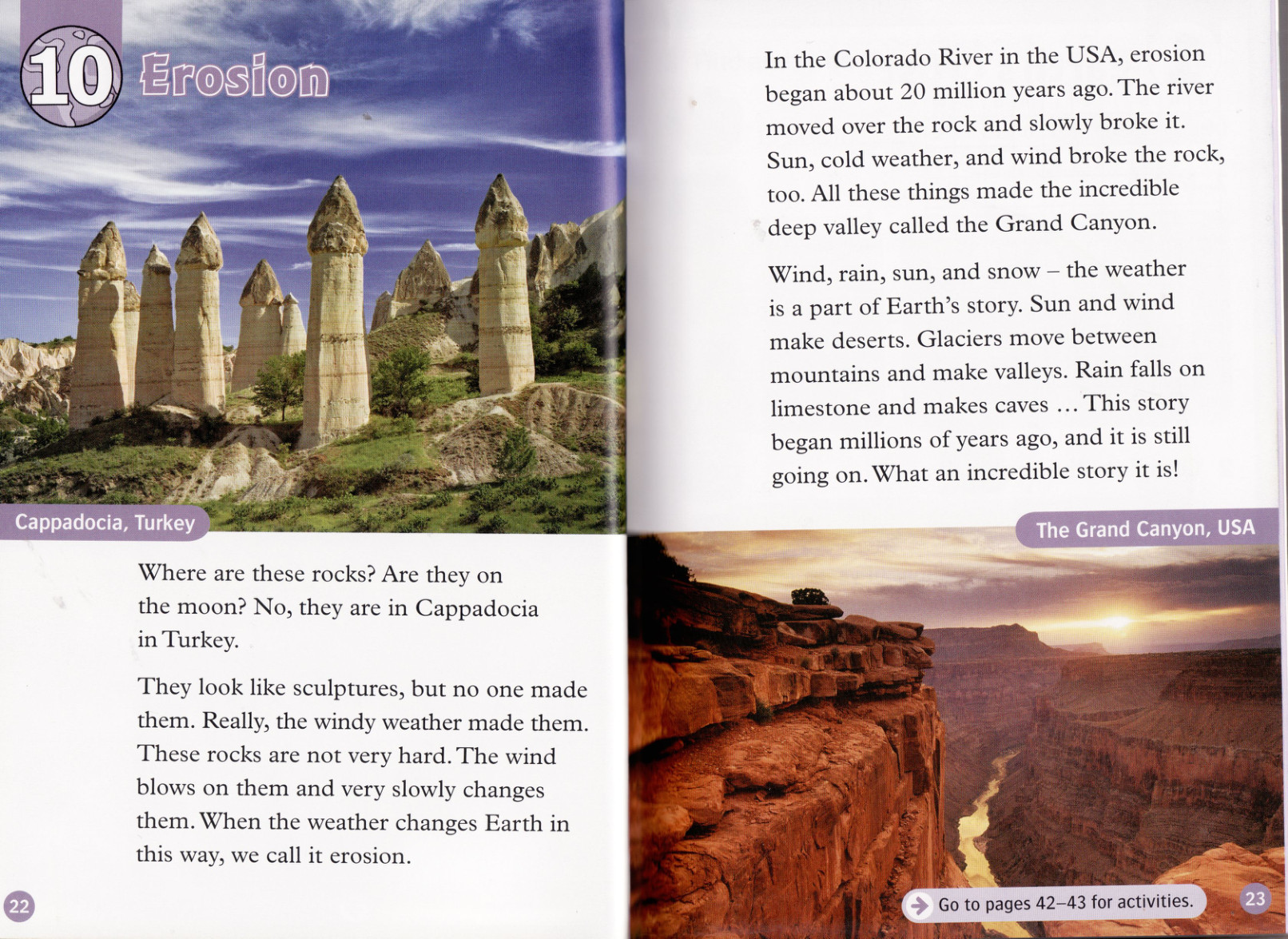
Where are these rocks? Are they on the moon? No, they are in Cappadocia in Turkey.
They look like sculptures, but no one made them. Really, the windy weather made them. These rocks are not very hard. The wind blows on them and very slowly changes them. When the weather changes Earth in this way, we call it erosion.
In the Colorado River in the USA, erosion began about 20 million years ago. The river moved over the rock and slowly broke it. Sun, cold weather, and wind broke the rock, too. All these things made the incredible deep valley called the Grand Canyon.
Wind, rain, sun, and snow – the weather is a part of Earth's story. Sun and wind make deserts. Glaciers move between mountains and make valleys. Rain falls on limestone and makes caves … This story began millions of years ago, and it is still going on. What an incredible story it is!
Từ vựng
3 Xem trang bài tập
4 Bài tập tương tác
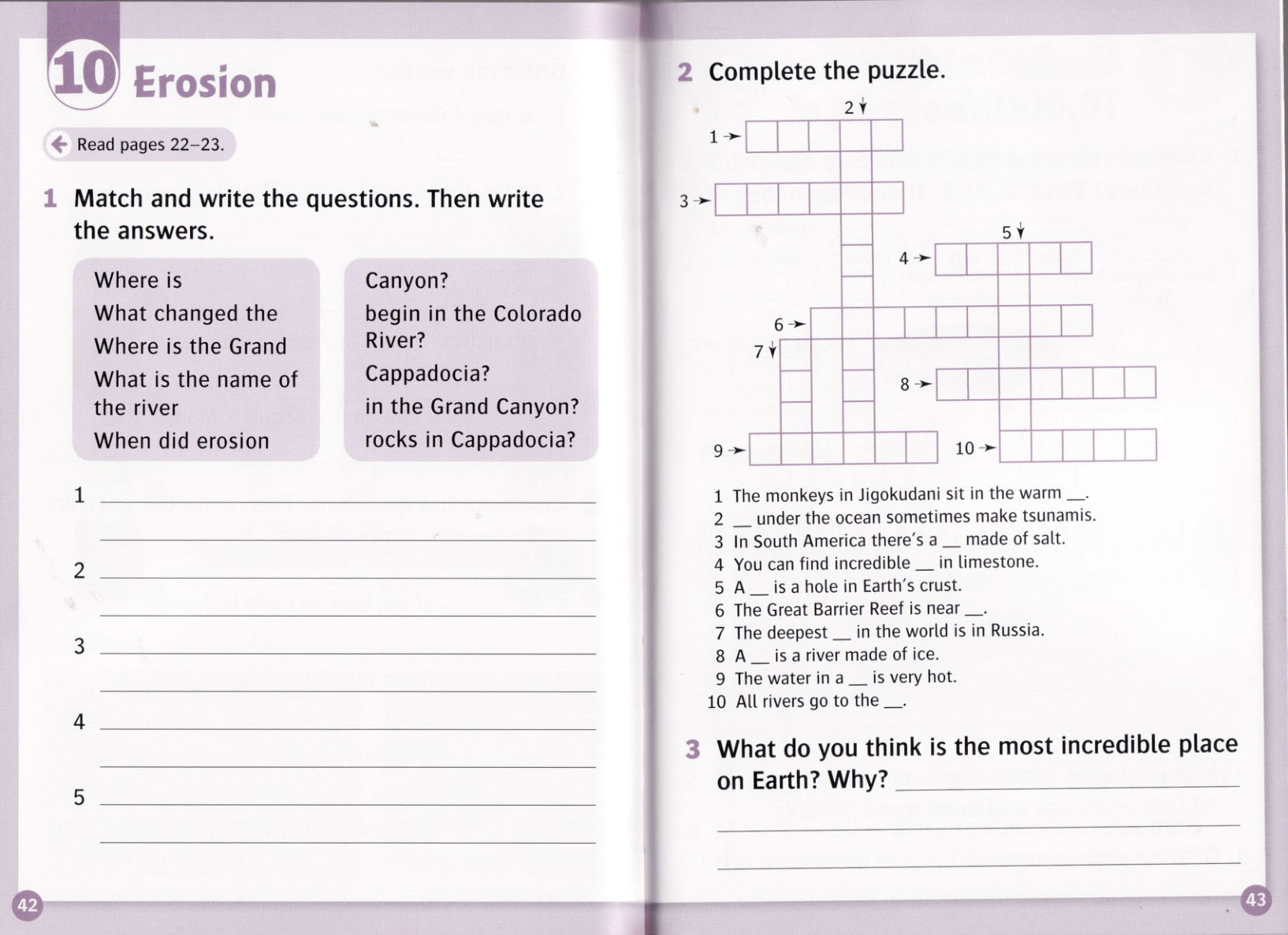
1. Match and write the questions. Then write the answers.
Nối để tạo câu hỏi, rồi trả lời.
1. Match the sentence halves.
2. Where is Cappadocia?
3. What changed the rocks in Cappadocia?
4. Where is the Grand Canyon?
5. What is the name of the river in the Grand Canyon?
6. When did erosion begin in the Colorado River?
2. Complete the puzzle.
Điền từ ứng với mỗi gợi ý. Bản ô chữ gốc ở trang bài tập.
7. Complete the sentences.
2. under the ocean sometimes make tsunamis.
3. In South America there's a made of salt.
4. You can find incredible in limestone.
5. A is a hole in Earth's crust.
6. The Great Barrier Reef is near .
7. The deepest in the world is in Russia.
8. A is a river made of ice.
9. The water in a is very hot.
10. All rivers go to the .
3. What do you think?
Viết ý kiến cá nhân và giải thích.
8. What do you think is the most incredible place on Earth? Why?
- Answer the question clearly.
- Use information from the text or your own experience.
Projects
Trang dự án
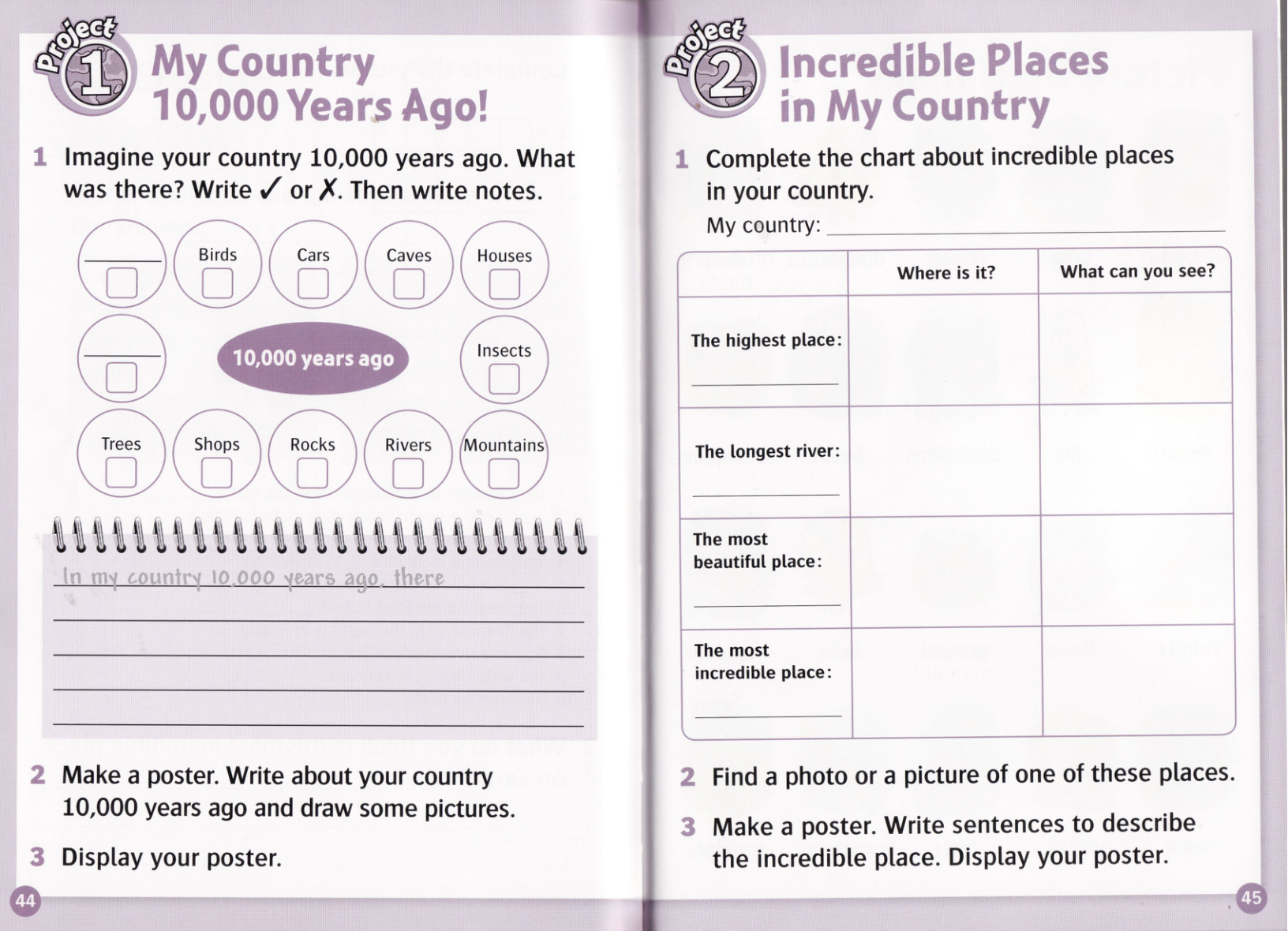
Project 1: My Country 10,000 Years Ago. Imagine your country 10,000 years ago. Note what was there, then write about the country. Project 2: Incredible Places in My Country. Choose places, record names and facts, then write about them and add pictures.
Từ điển tranh
Từ điển tranh