Life in Rainforests
Đọc · Nghe · Từ vựng · Bài tập · Dự án · Từ điển tranh
Tropical Rainforests
1 Đọc trang sách
2 Đọc & Nghe
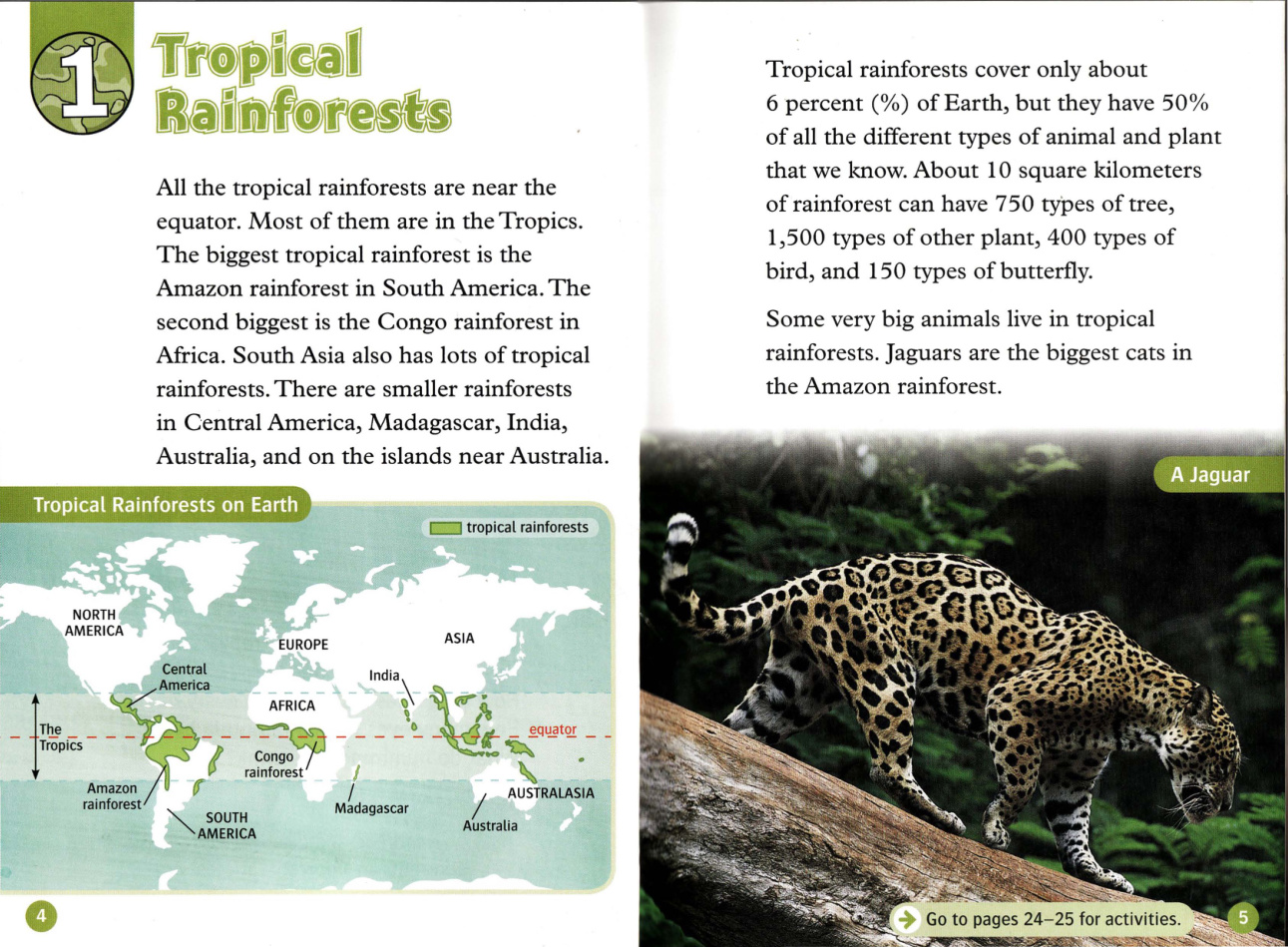
All the tropical rainforests are near the equator. Most of them are in the Tropics.
The biggest tropical rainforest is the Amazon rainforest in South America. The second biggest is the Congo rainforest in Africa.
South Asia also has lots of tropical rainforests. There are smaller rainforests in Central America, Madagascar, India, Australia, and on the islands near Australia.
Tropical rainforests cover only about 6 percent (%) of Earth, but they have 50% of all the different types of animal and plant that we know.
About 10 square kilometers of rainforest can have 750 types of tree, 1,500 types of other plant, 400 types of bird, and 150 types of butterfly.
Some very big animals live in tropical rainforests. Jaguars are the biggest cats in the Amazon rainforest.
Từ vựng
3 Xem trang bài tập

4 Bài tập tương tác
1. Write the names shown by numbers 1-14 on the rainforest map.
2. Tropical rainforests cover only about _____% of Earth.
3. About _____% of all the types of animal and plant live there.
4. About 10 square kilometers of rainforest can have _____ types of tree.
5. About 10 square kilometers can have _____ types of other plant.
6. About 10 square kilometers can have _____ types of bird.
7. About 10 square kilometers can have _____ types of butterfly.
8. Where are all the tropical rainforests?
9. Where are most of the rainforests?
10. Which is the biggest rainforest?
11. Which is the second biggest rainforest?
12. Where are the smaller rainforests?
13. Mark your country and identify the nearest tropical rainforest.
Câu trả lời tự do — không tính vào điểm.Rainforest Layers
1 Đọc trang sách
2 Đọc & Nghe
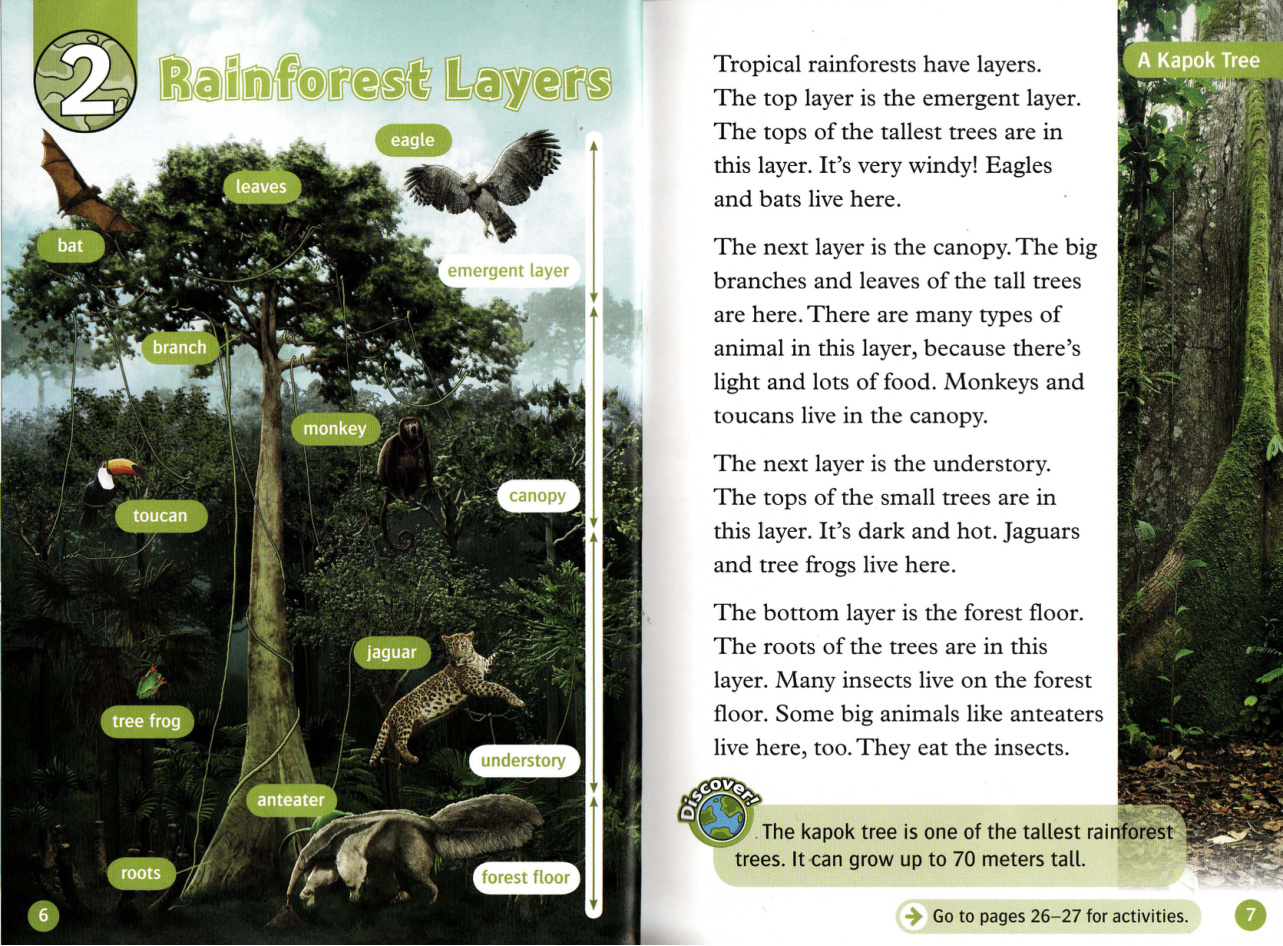
Tropical rainforests have layers.
The top layer is the emergent layer. The tops of the tallest trees are in this layer. It's very windy. Eagles and bats live here.
The next layer is the canopy. The big branches and leaves of the tall trees are here. There are many types of animal in this layer, because there's light and lots of food. Monkeys and toucans live in the canopy.
The next layer is the understory. The tops of the small trees are in this layer. It's dark and hot. Jaguars and tree frogs live here.
The bottom layer is the forest floor. The roots of the trees are in this layer. Many insects live on the forest floor. Some big animals like anteaters live here, too. They eat the insects.
The kapok tree is one of the tallest rainforest trees. It can grow up to 70 meters tall.
Từ vựng
3 Xem trang bài tập

4 Bài tập tương tác
1. Write the four rainforest layers shown by numbers 1-4.
2. It's dark and hot in the _____.
3. It's very windy in the _____.
4. There's light and lots of food in the _____.
5. The bottom layer is the _____.
6. The roots of the trees are on the _____.
7. The tops of the tallest trees are in the _____.
8. The tops of the small trees are in the _____.
9. The big branches of the tall trees are in the _____.
10. Classify each animal by rainforest layer.
Plants
1 Đọc trang sách
2 Đọc & Nghe
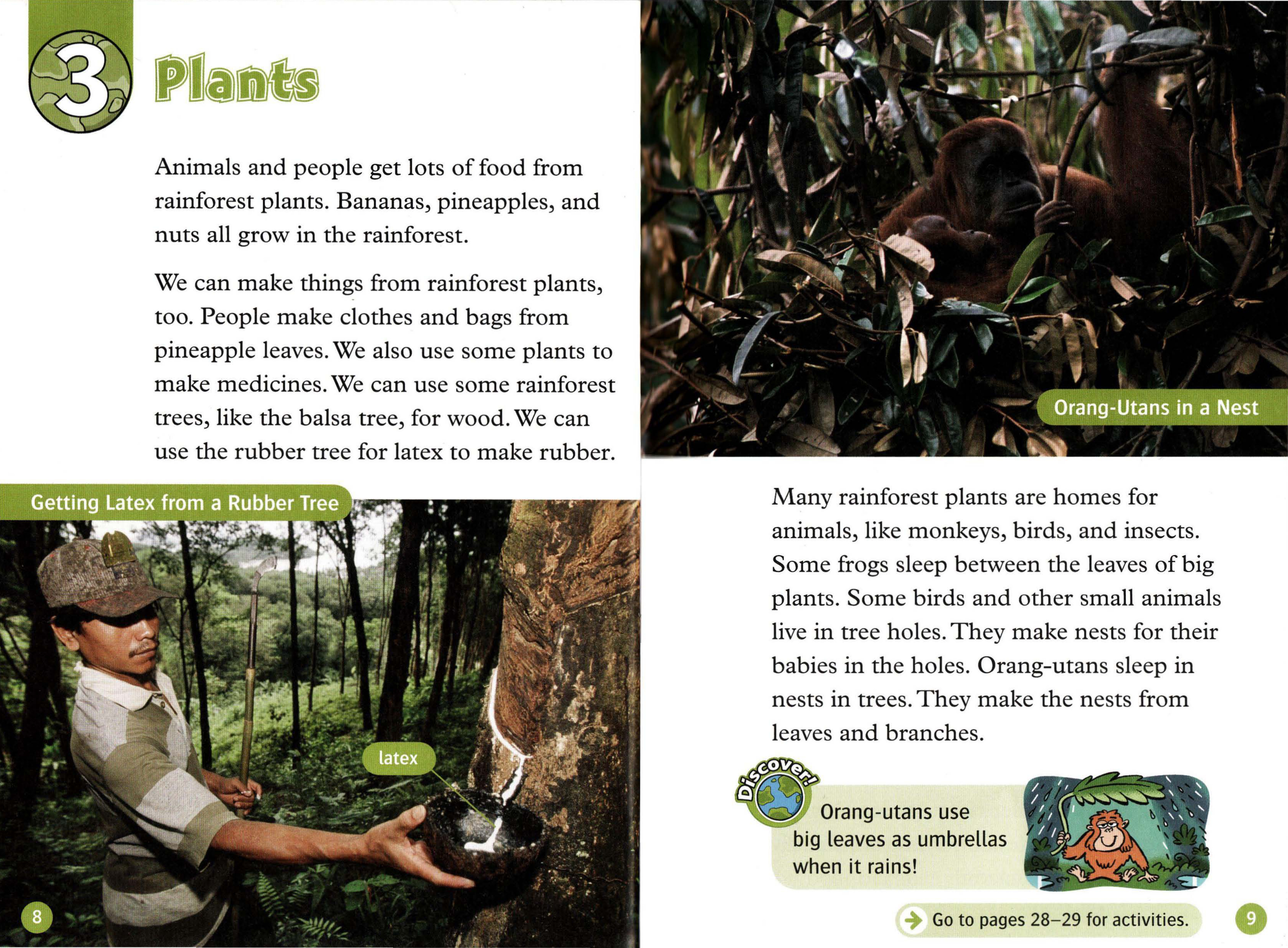
Animals and people get lots of food from rainforest plants. Bananas, pineapples, and nuts all grow in the rainforest.
We can make things from rainforest plants, too. People make clothes and bags from pineapple leaves.
We also use some plants to make medicines. We can use some rainforest trees, like the balsa tree, for wood. We can use the rubber tree for latex to make rubber.
Many rainforest plants are homes for animals, like monkeys, birds, and insects.
Some frogs sleep between the leaves of big plants. Some birds and other small animals live in tree holes. They make nests for their babies in the holes.
Orang-utans sleep in nests in trees. They make the nests from leaves and branches.
Orang-utans use big leaves as umbrellas when it rains.
Từ vựng
3 Xem trang bài tập
4 Bài tập tương tác
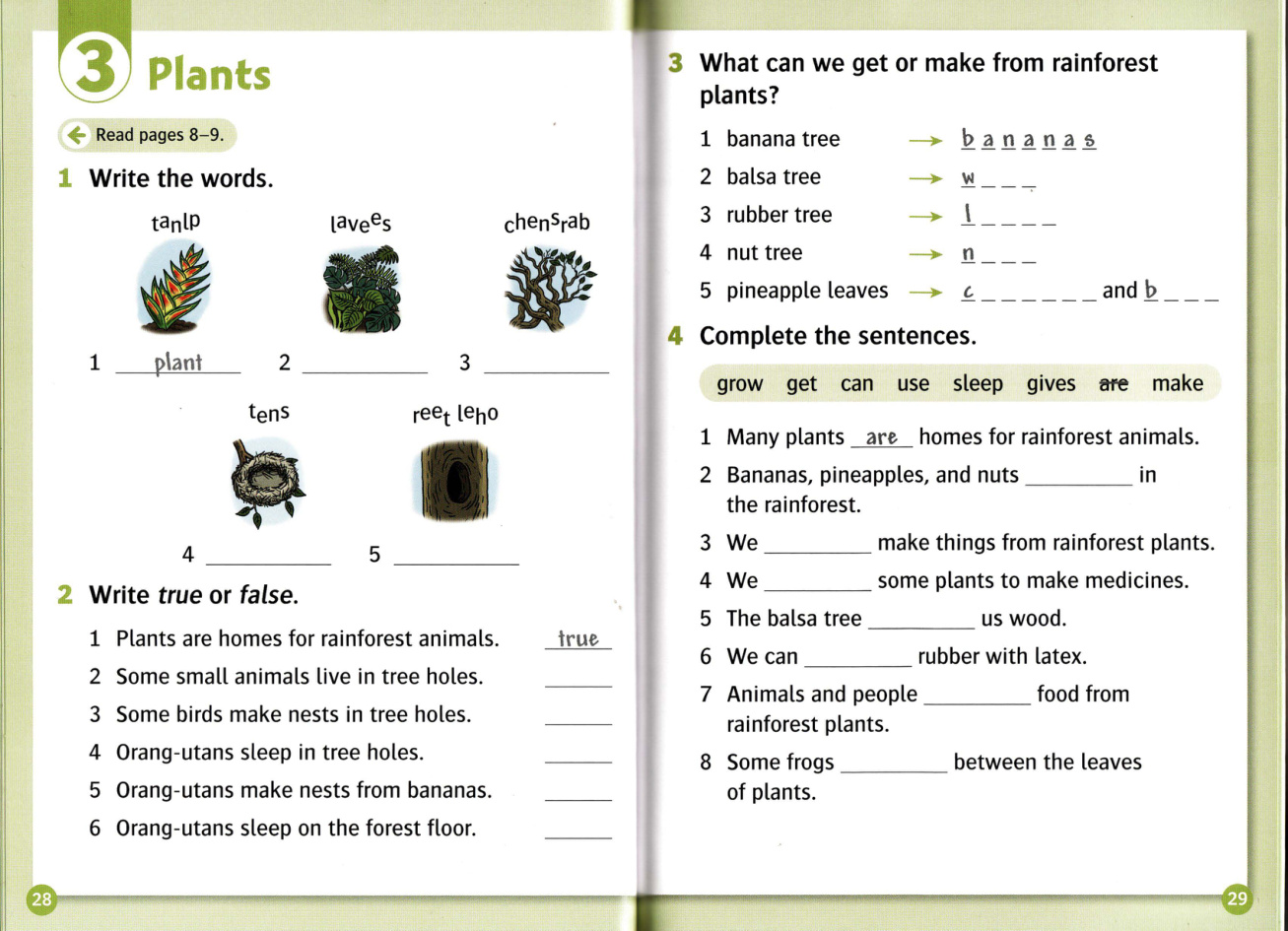
1. Write the five plant-related words shown by numbers 1-5.
2. Plants are homes for rainforest animals.
3. Some small animals live in tree holes.
4. Some birds make nests in tree holes.
5. Orang-utans sleep in tree holes.
6. Orang-utans make nests from bananas.
7. Orang-utans sleep on the forest floor.
8. Match each rainforest plant with what we get or make from it.
9. Many plants _____ homes for rainforest animals.
10. Bananas, pineapples, and nuts _____ in the rainforest.
11. We _____ make things from rainforest plants.
12. We _____ some plants to make medicines.
13. The balsa tree _____ us wood.
14. We can _____ rubber with latex.
15. Animals and people _____ food from rainforest plants.
16. Some frogs _____ between the leaves of plants.
Rivers
1 Đọc trang sách
2 Đọc & Nghe
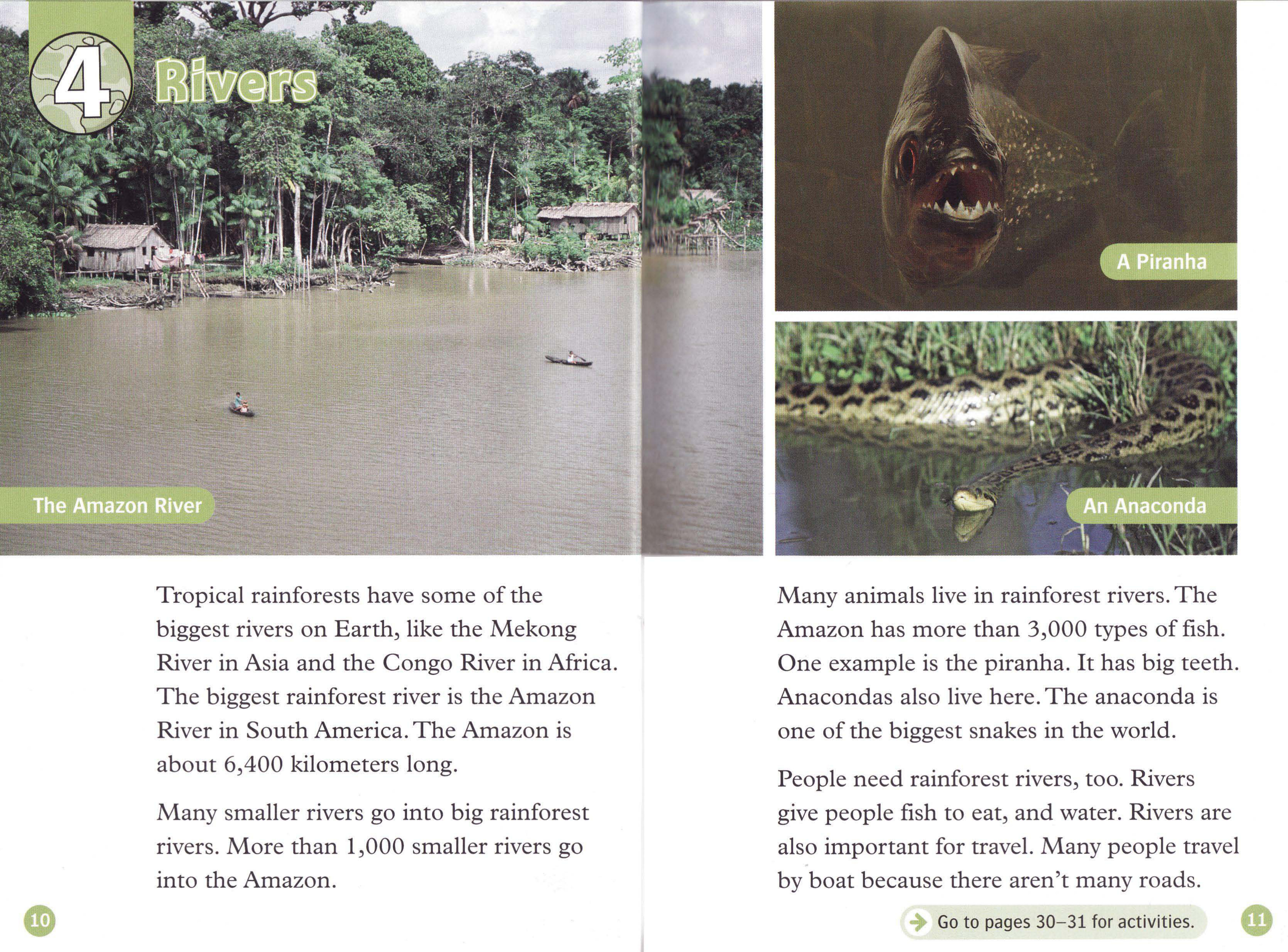
Tropical rainforests have some of the biggest rivers on Earth, like the Mekong River in Asia and the Congo River in Africa.
The biggest rainforest river is the Amazon River in South America. The Amazon is about 6,400 kilometers long.
Many smaller rivers go into big rainforest rivers. More than 1,000 smaller rivers go into the Amazon.
Many animals live in rainforest rivers. The Amazon has more than 3,000 types of fish. One example is the piranha. It has big teeth.
Anacondas also live here. The anaconda is one of the biggest snakes in the world.
People need rainforest rivers, too. Rivers give people fish to eat, and water. Rivers are also important for travel. Many people travel by boat because there aren't many roads.
Từ vựng
3 Xem trang bài tập
4 Bài tập tương tác
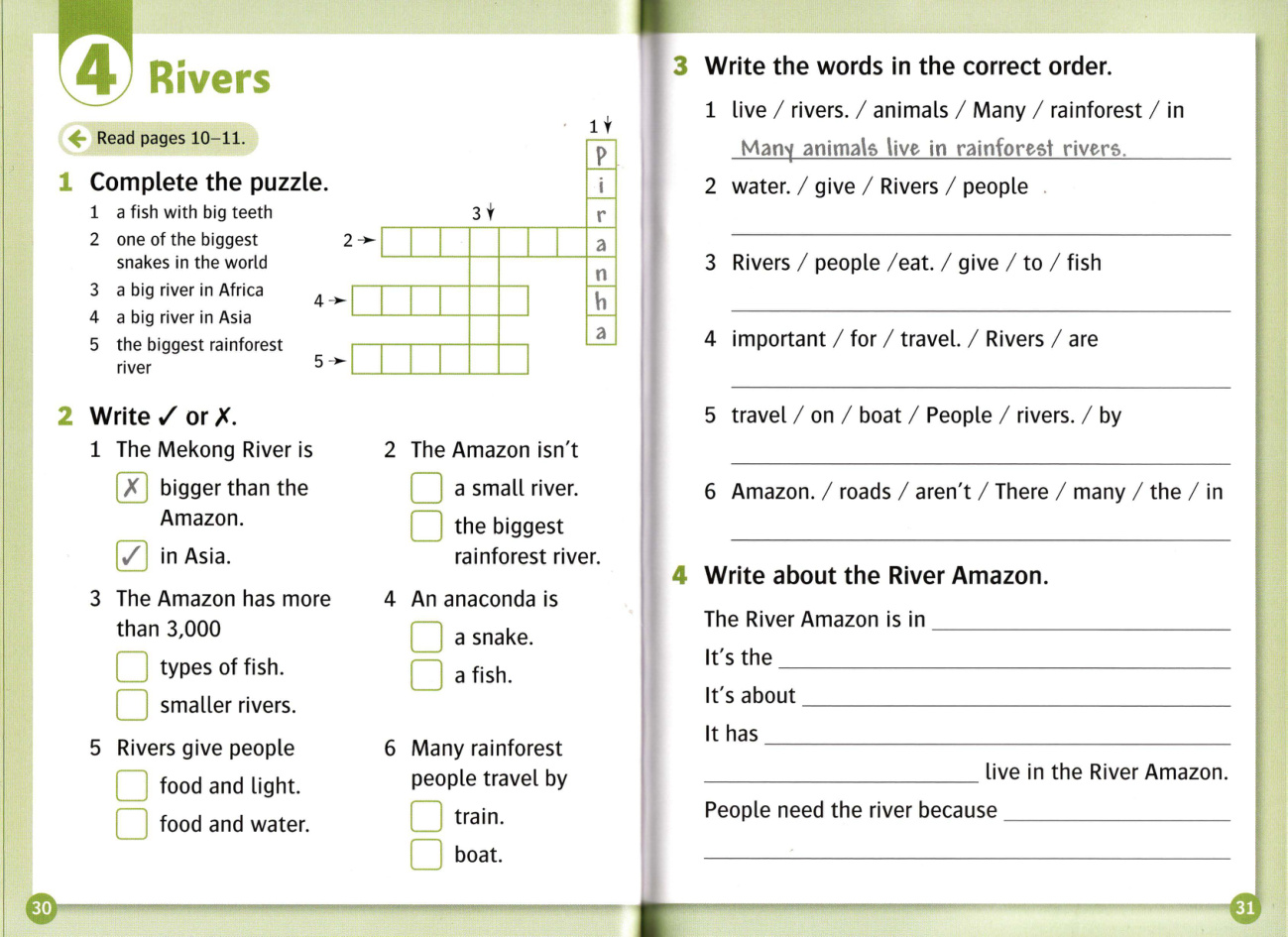
1. Complete the river puzzle.
- 1 Hàng ngang: a fish with big teeth
- 2 Hàng ngang: one of the biggest snakes in the world
- 3 Hàng ngang: a big river in Africa
- 4 Hàng ngang: a big river in Asia
- 5 Hàng ngang: the biggest rainforest river
2. The Mekong River is …
3. The Amazon isn't …
4. The Amazon has more than 3,000 …
5. An anaconda is …
6. Rivers give people …
7. Many rainforest people travel by …
8. Put the words in the correct order.
- live
- rivers.
- animals
- Many
- rainforest
- in
9. Put the words in the correct order.
- water.
- give
- Rivers
- people
10. Put the words in the correct order.
- Rivers
- people
- eat.
- give
- to
- fish
11. Put the words in the correct order.
- important
- for
- travel.
- Rivers
- are
12. Put the words in the correct order.
- travel
- on
- boat
- People
- rivers.
- by
13. Put the words in the correct order.
- Amazon.
- roads
- aren't
- There
- many
- the
- in
14. The River Amazon is in _____.
15. It's the _____.
16. It's about _____ long.
17. It has _____.
18. _____ live in the River Amazon.
19. People need the river because _____.
Mammals
1 Đọc trang sách
2 Đọc & Nghe
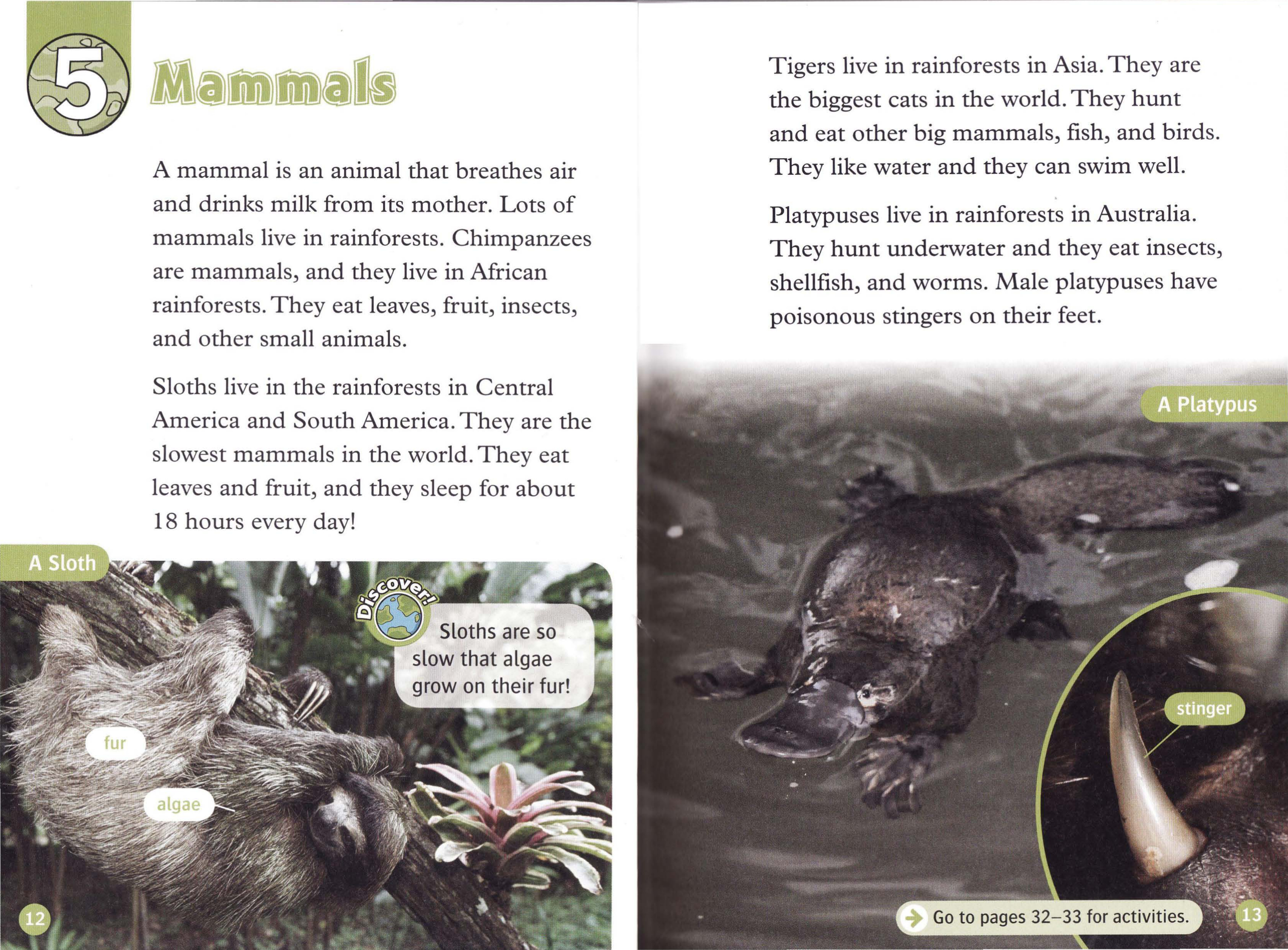
A mammal is an animal that breathes air and drinks milk from its mother. Lots of mammals live in rainforests.
Chimpanzees are mammals, and they live in African rainforests. They eat leaves, fruit, insects, and other small animals.
Sloths live in the rainforests in Central America and South America. They are the slowest mammals in the world. They eat leaves and fruit, and they sleep for about 18 hours every day.
Sloths are so slow that algae grow on their fur.
Tigers live in rainforests in Asia. They are the biggest cats in the world. They hunt and eat other big mammals, fish, and birds. They like water and they can swim well.
Platypuses live in rainforests in Australia. They hunt underwater and they eat insects, shellfish, and worms. Male platypuses have poisonous stingers on their feet.
Từ vựng
3 Xem trang bài tập
4 Bài tập tương tác
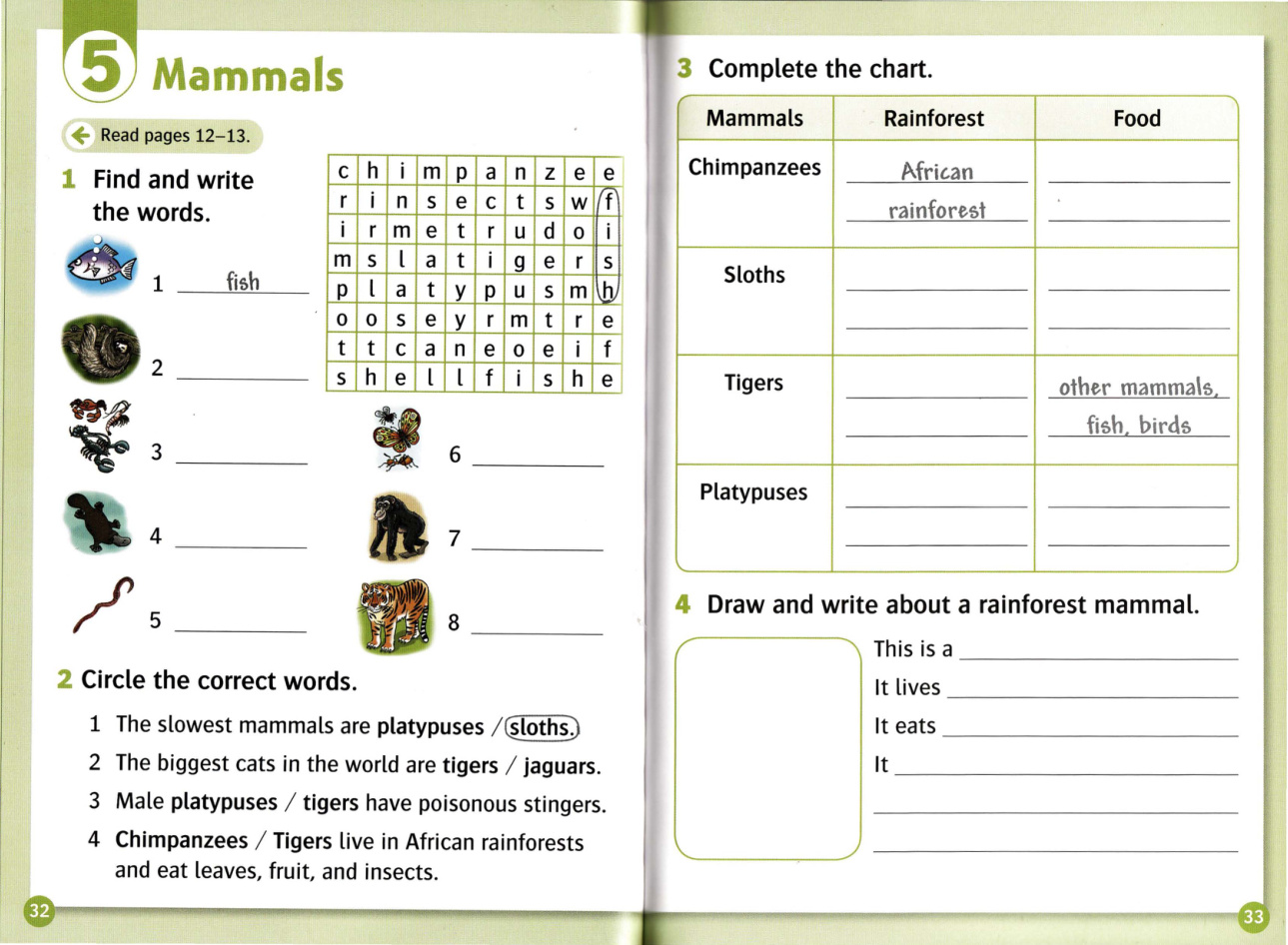
1. Find the eight mammal/food words.
2. The slowest mammals are …
3. The biggest cats in the world are …
4. Male _____ have poisonous stingers.
5. _____ live in African rainforests and eat leaves, fruit, and insects.
6. Classify each mammal by rainforest region.
7. Match each mammal with its food.
8. Draw and write about a rainforest mammal.
Câu trả lời tự do — không tính vào điểm.Minibeasts
1 Đọc trang sách
2 Đọc & Nghe
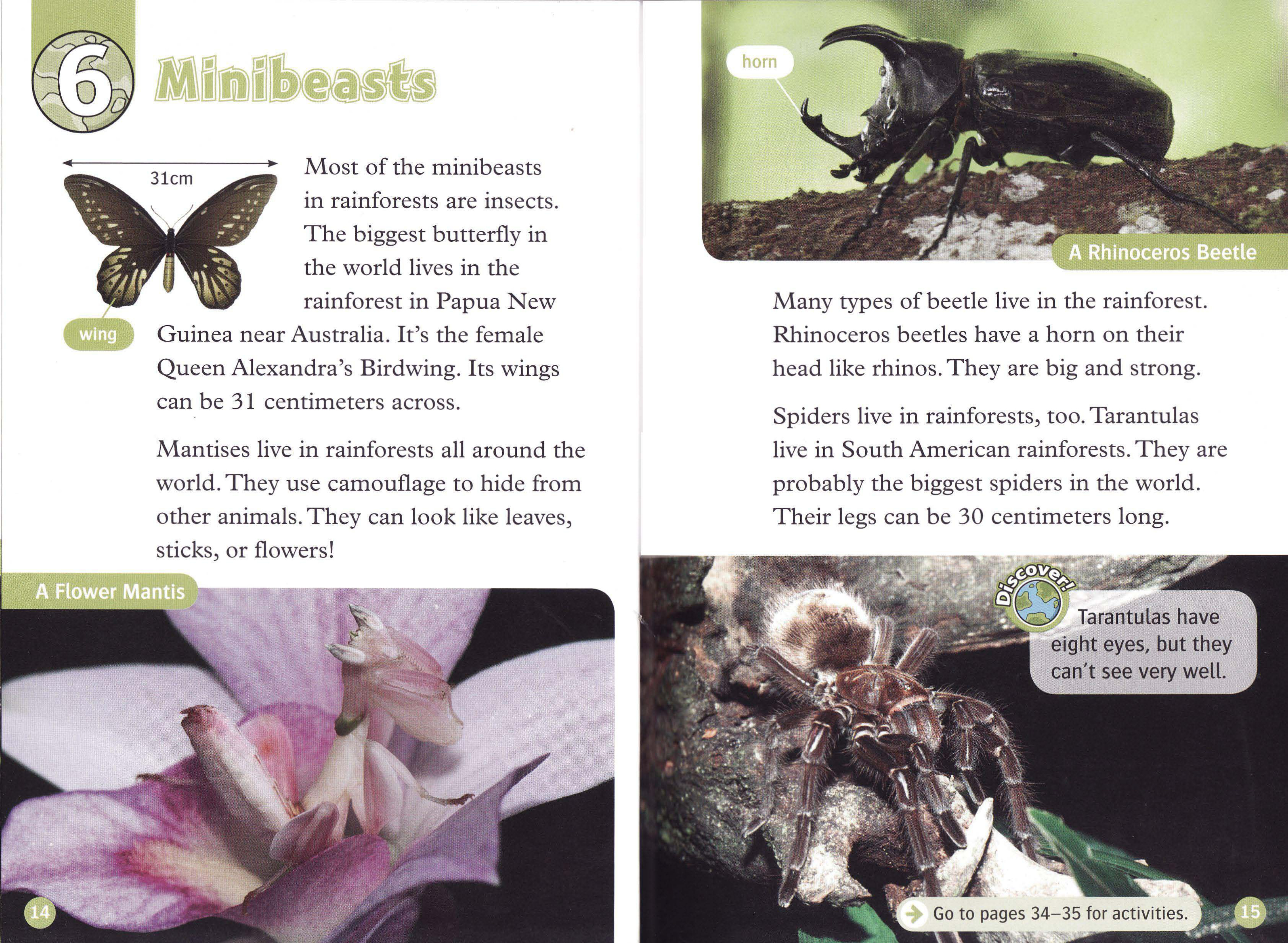
Most of the minibeasts in rainforests are insects.
The biggest butterfly in the world lives in the rainforest in Papua New Guinea near Australia. It's the female Queen Alexandra's Birdwing. Its wings can be 31 centimeters across.
Mantises live in rainforests all around the world. They use camouflage to hide from other animals. They can look like leaves, sticks, or flowers.
Many types of beetle live in the rainforest. Rhinoceros beetles have a horn on their head like rhinos. They are big and strong.
Spiders live in rainforests, too. Tarantulas live in South American rainforests. They are probably the biggest spiders in the world. Their legs can be 30 centimeters long.
Tarantulas have eight eyes, but they can't see very well.
Từ vựng
3 Xem trang bài tập
4 Bài tập tương tác
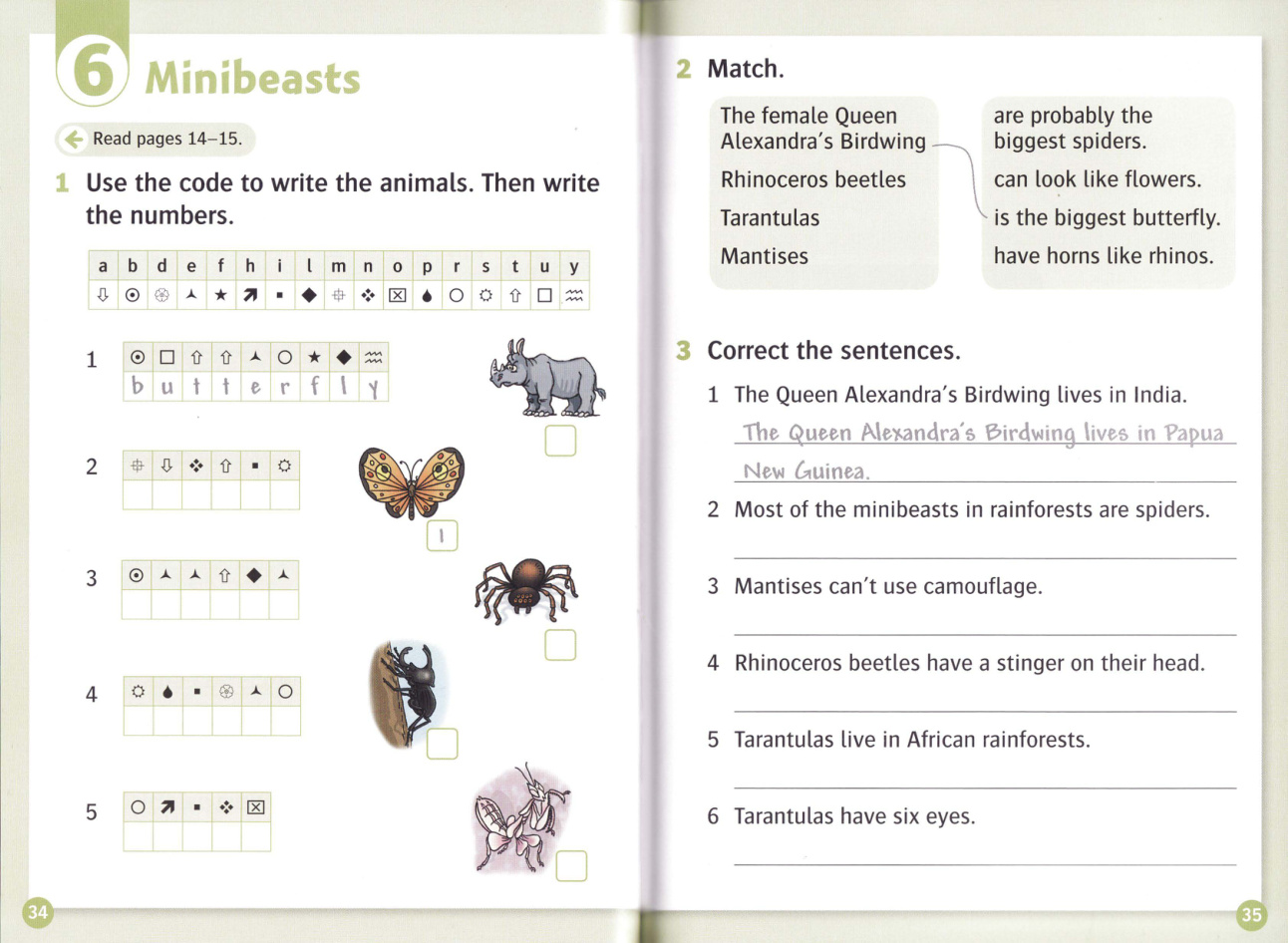
1. Use the source activity image and write the five minibeast names.
2. Match each minibeast with its description.
3. Correct the sentence: The Queen Alexandra's Birdwing lives in India.
4. Correct the sentence: Most of the minibeasts in rainforests are spiders.
5. Correct the sentence: Mantises can't use camouflage.
6. Correct the sentence: Rhinoceros beetles have a stinger on their head.
7. Correct the sentence: Tarantulas live in African rainforests.
8. Correct the sentence: Tarantulas have six eyes.
Birds
1 Đọc trang sách
2 Đọc & Nghe
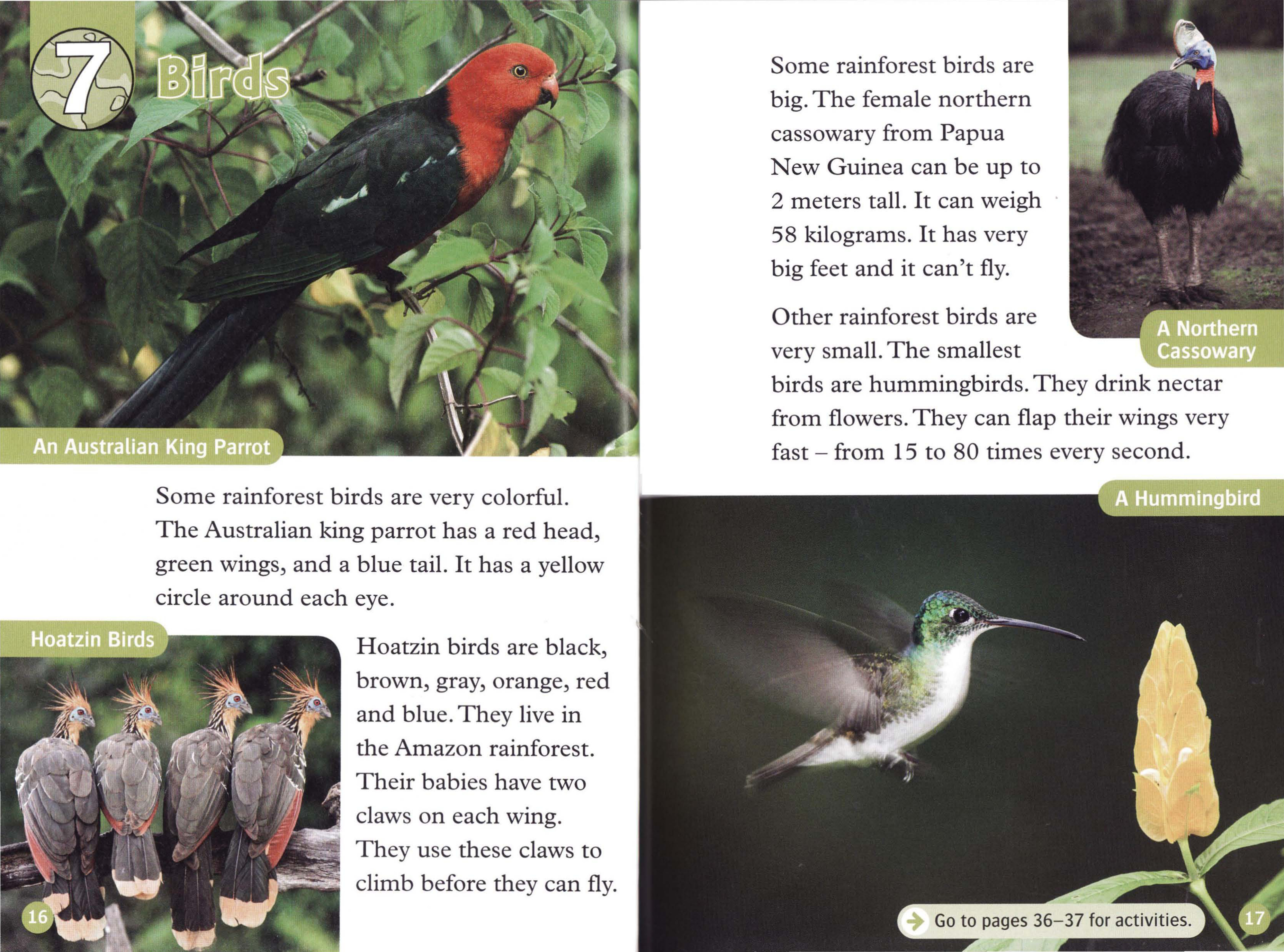
Some rainforest birds are very colorful. The Australian king parrot has a red head, green wings, and a blue tail. It has a yellow circle around each eye.
Hoatzin birds are black, brown, gray, orange, red, and blue. They live in the Amazon rainforest.
Their babies have two claws on each wing. They use these claws to climb before they can fly.
Some rainforest birds are big. The female northern cassowary from Papua New Guinea can be up to 2 meters tall. It can weigh 58 kilograms. It has very big feet and it can't fly.
Other rainforest birds are very small. The smallest birds are hummingbirds.
Hummingbirds drink nectar from flowers. They can flap their wings very fast – from 15 to 80 times every second.
Từ vựng
3 Xem trang bài tập
4 Bài tập tương tác
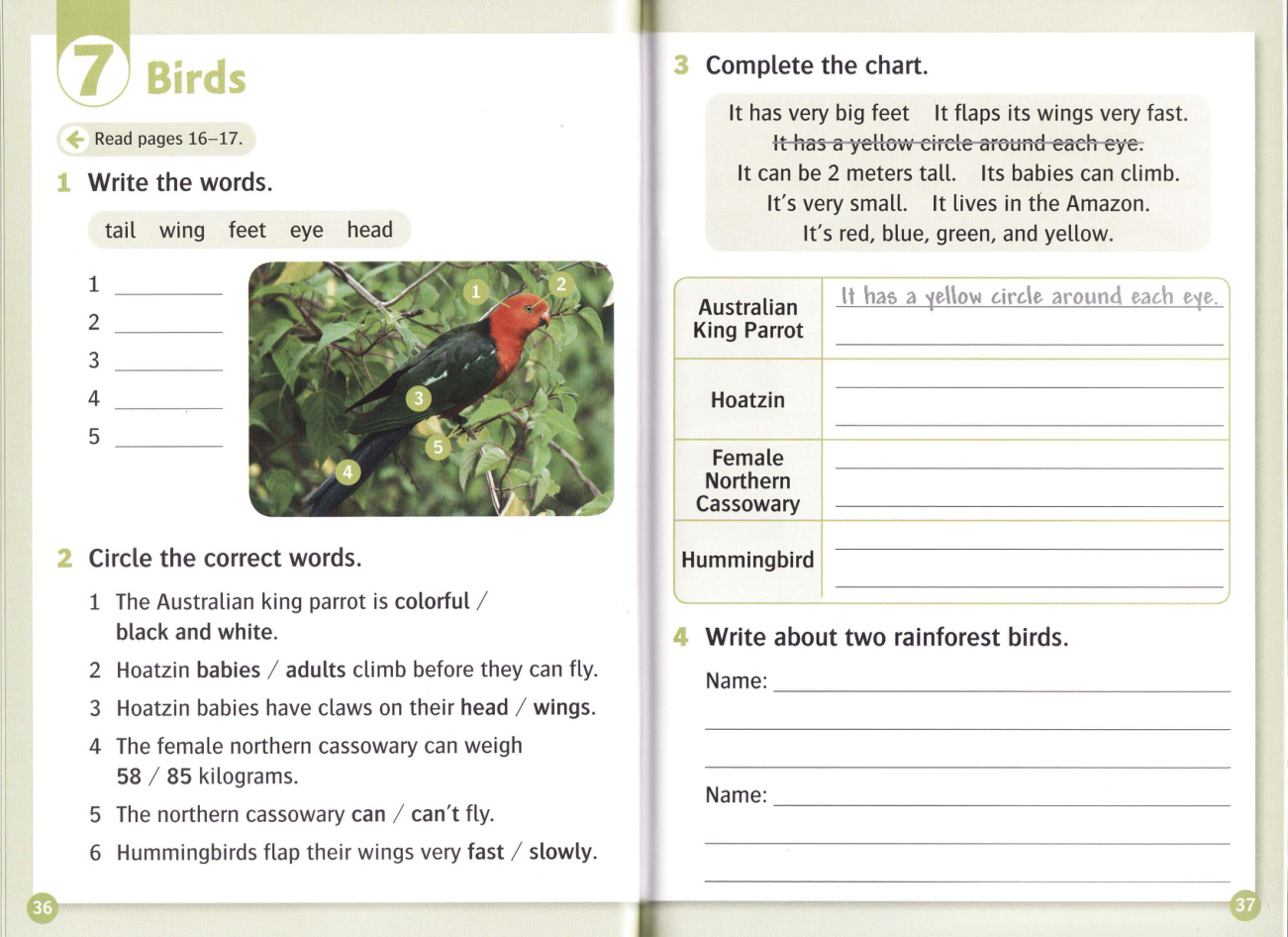
1. Write the five bird-part words shown by numbers 1-5.
2. The Australian king parrot is …
3. Hoatzin _____ climb before they can fly.
4. Hoatzin babies have claws on their …
5. The female northern cassowary can weigh …
6. The northern cassowary … fly.
7. Hummingbirds flap their wings …
8. Classify the bird facts.
9. Write about two rainforest birds.
Câu trả lời tự do — không tính vào điểm.People
1 Đọc trang sách
2 Đọc & Nghe
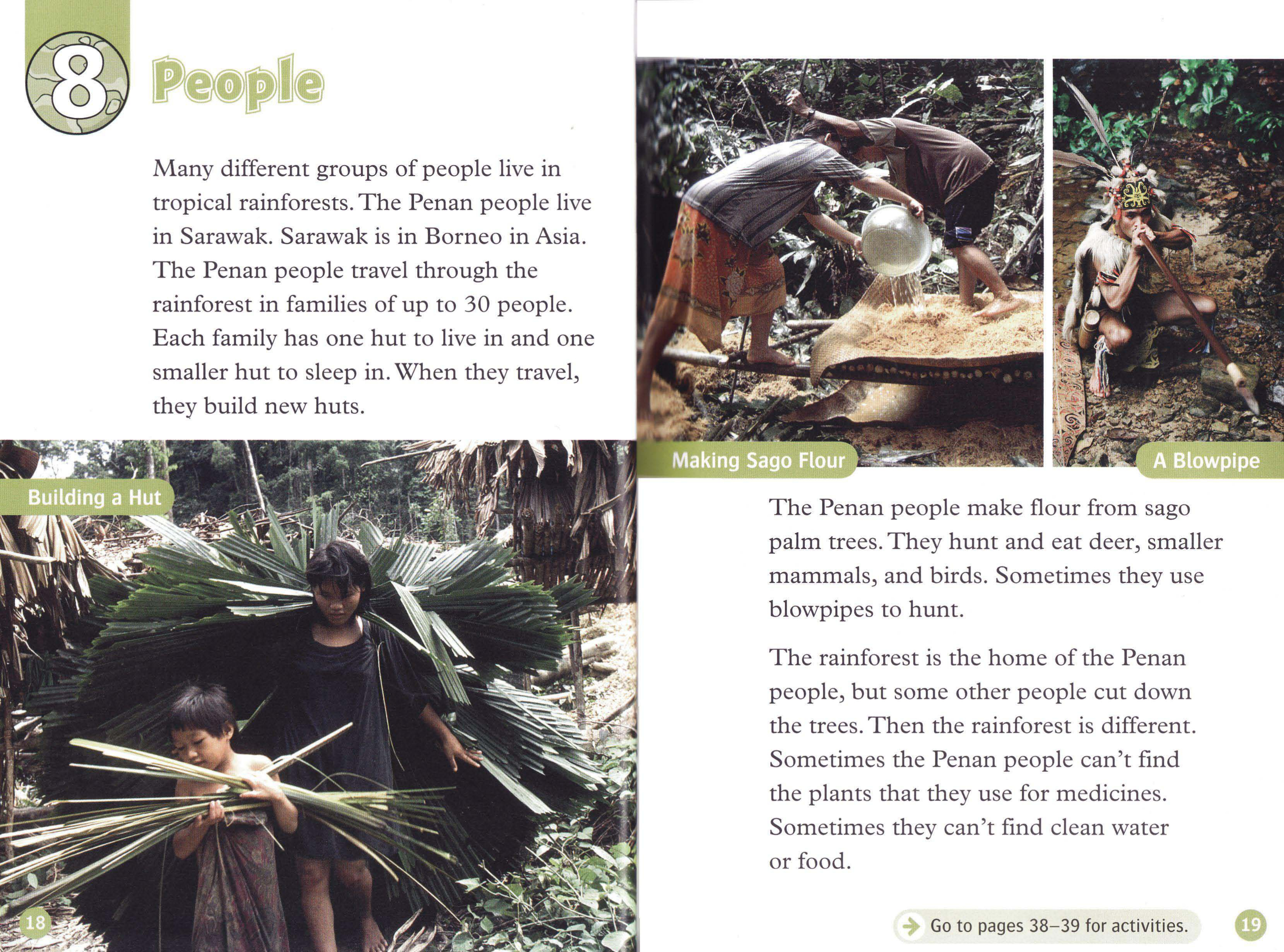
Many different groups of people live in tropical rainforests. The Penan people live in Sarawak. Sarawak is in Borneo in Asia.
The Penan people travel through the rainforest in families of up to 30 people.
Each family has one hut to live in and one smaller hut to sleep in. When they travel, they build new huts.
The Penan people make flour from sago palm trees. They hunt and eat deer, smaller mammals, and birds. Sometimes they use blowpipes to hunt.
The rainforest is the home of the Penan people, but some other people cut down the trees. Then the rainforest is different.
Sometimes the Penan people can't find the plants that they use for medicines. Sometimes they can't find clean water or food.
Từ vựng
3 Xem trang bài tập

4 Bài tập tương tác
1. Complete the Penan people puzzle.
- 1 Hàng ngang: The Penan make this from sago palm.
- 2 Hàng ngang: They sometimes use this to hunt.
- 3 Hàng ngang: Sago is a type of this tree.
- 4 Hàng ngang: One animal the Penan hunt.
- 5 Hàng ngang: Another type of animal the Penan hunt.
- 6 Hàng ngang: A small house in the rainforest.
2. The Penan people hunt _____ and _____.
3. They have a _____ to sleep in.
4. They make and eat sago _____.
5. They make flour from the sago _____.
6. They sometimes use a _____ to hunt.
7. Where do the Penan people live?
8. How many huts does each family have?
9. What do they eat?
10. Why can't the Penan people find the trees that they need?
11. Draw and write about the Penan people.
Câu trả lời tự do — không tính vào điểm.Rainforest Problems
1 Đọc trang sách
2 Đọc & Nghe
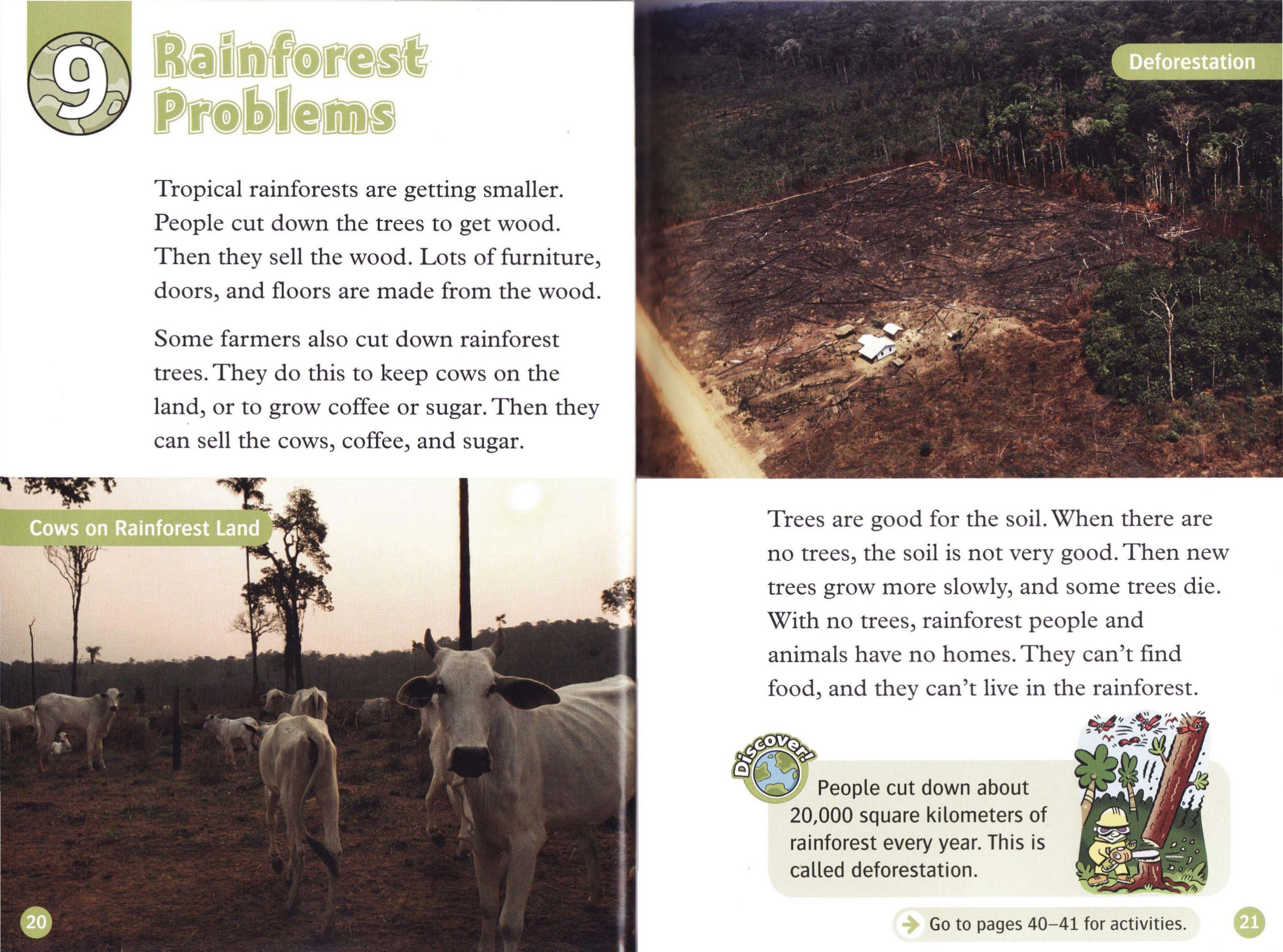
Tropical rainforests are getting smaller. People cut down the trees to get wood. Then they sell the wood. Lots of furniture, doors, and floors are made from the wood.
Some farmers also cut down rainforest trees. They do this to keep cows on the land, or to grow coffee or sugar. Then they can sell the cows, coffee, and sugar.
Trees are good for the soil. When there are no trees, the soil is not very good.
Then new trees grow more slowly, and some trees die.
With no trees, rainforest people and animals have no homes. They can't find food, and they can't live in the rainforest.
People cut down about 20,000 square kilometers of rainforest every year. This is called deforestation.
Từ vựng
3 Xem trang bài tập
4 Bài tập tương tác
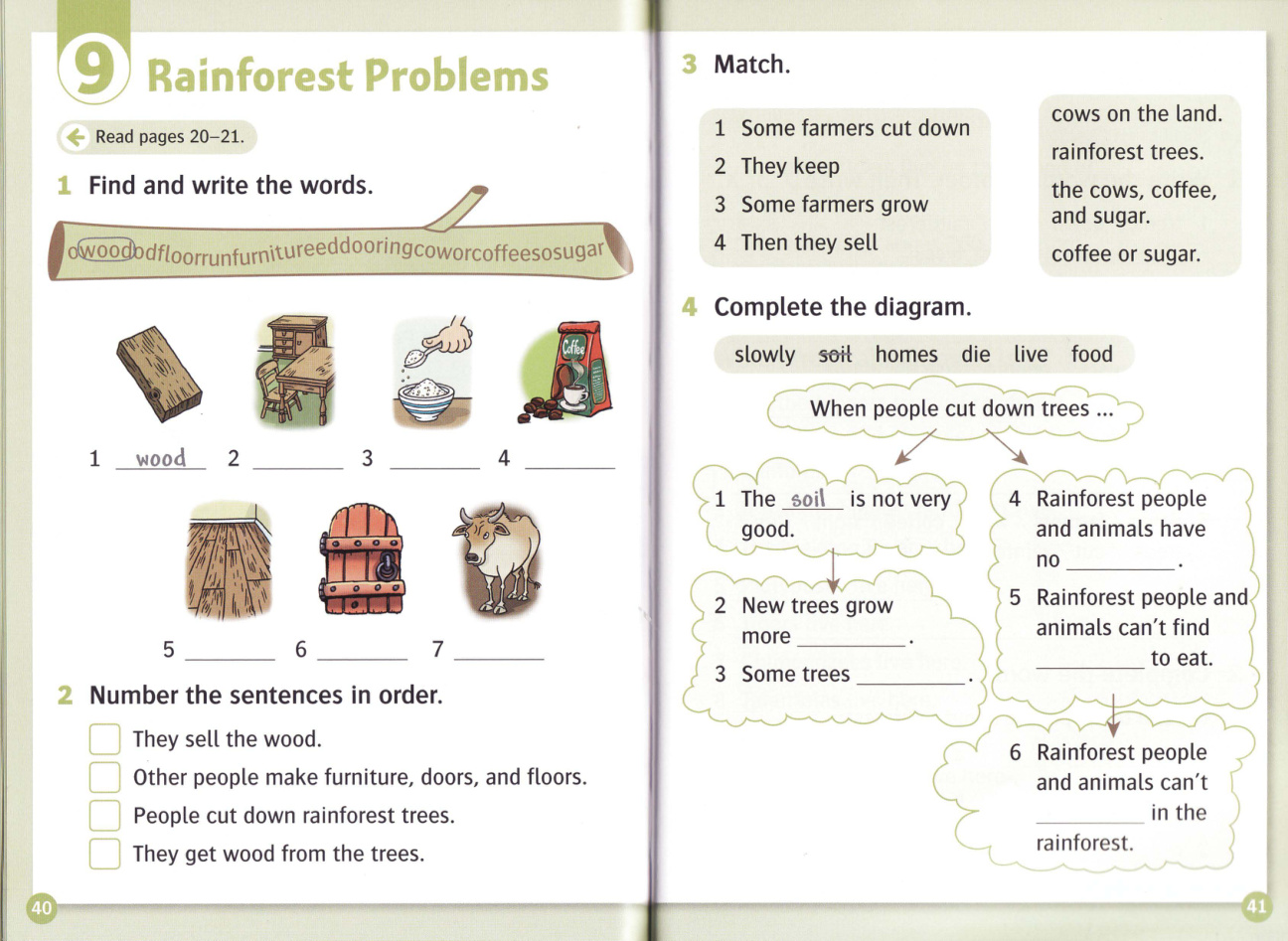
1. Write the seven words shown by pictures in Activity 1.
2. Put the steps in order.
- They sell the wood.
- Other people make furniture, doors, and floors.
- People cut down rainforest trees.
- They get wood from the trees.
3. Match the sentence beginnings and endings.
4. When people cut down trees, the _____ is not very good.
5. New trees grow more _____.
6. Some trees _____.
7. Rainforest people and animals have no _____.
8. Rainforest people and animals can't find _____ to eat.
9. Rainforest people and animals can't _____ in the rainforest.
Save the Rainforests!
1 Đọc trang sách

2 Đọc & Nghe
How can we save the tropical rainforests?
We can buy coffee, sugar, and bananas from farmers who do not cut down rainforest trees. We can buy furniture that is not made from rainforest wood.
We can buy recycled paper. This saves trees because paper is also made from wood.
Sumatran tigers live on the island of Sumatra in Indonesia in Asia. There are only about 250 tigers there. If we save rainforests, we can save tigers.
We can teach other people about rainforests and the people that live there. We can teach them about the amazing rainforest plants and rivers.
We can teach them about the special mammals, birds, and minibeasts that live there, too.
Rainforests are beautiful and important places. Save the rainforests!
Từ vựng
3 Xem trang bài tập
4 Bài tập tương tác
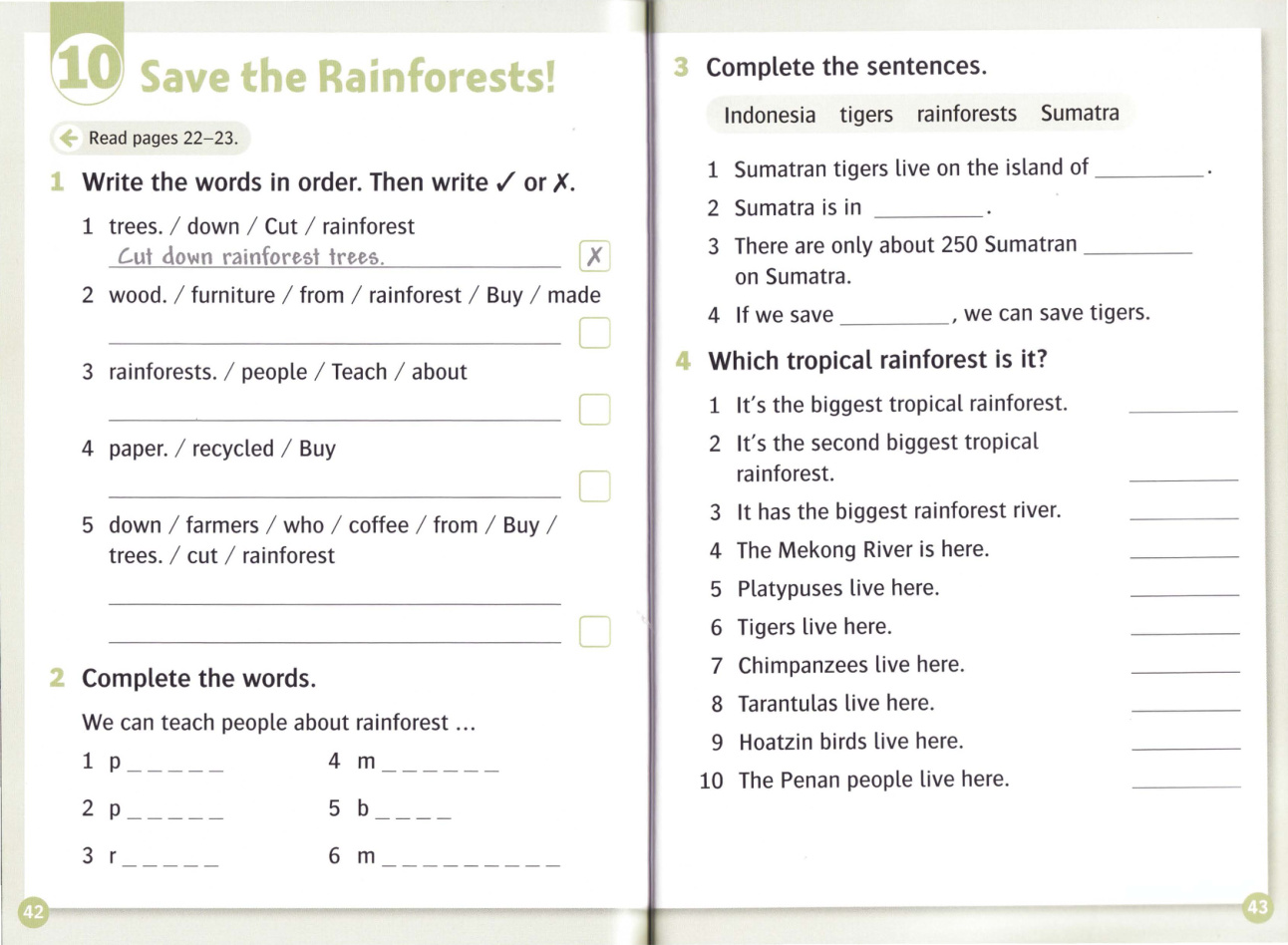
1. Put the words in the correct order.
- trees.
- down
- Cut
- rainforest
2. Put the words in the correct order.
- wood.
- furniture
- from
- rainforest
- Buy
- made
3. Put the words in the correct order.
- rainforests.
- people
- Teach
- about
4. Put the words in the correct order.
- paper.
- recycled
- Buy
5. Put the words in the correct order.
- down
- farmers
- who
- coffee
- from
- Buy
- trees.
- cut
- rainforest
6. Cut down rainforest trees.
7. Buy furniture made from rainforest wood.
8. Teach people about rainforests.
9. Buy recycled paper.
10. Buy coffee from farmers who cut down rainforest trees.
11. We can teach people about rainforest p_____.
12. We can teach people about rainforest p_____.
13. We can teach people about rainforest r_____.
14. We can teach people about rainforest m_____.
15. We can teach people about rainforest b_____.
16. We can teach people about rainforest m_____.
17. Sumatran tigers live on the island of _____.
18. Sumatra is in _____.
19. There are only about 250 Sumatran _____ on Sumatra.
20. If we save _____, we can save tigers.
21. It's the biggest tropical rainforest.
22. It's the second biggest tropical rainforest.
23. It has the biggest rainforest river.
24. The Mekong River is here.
25. Platypuses live here.
26. Tigers live here.
27. Chimpanzees live here.
28. Tarantulas live here.
29. Hoatzin birds live here.
30. The Penan people live here.
Projects
Trang dự án
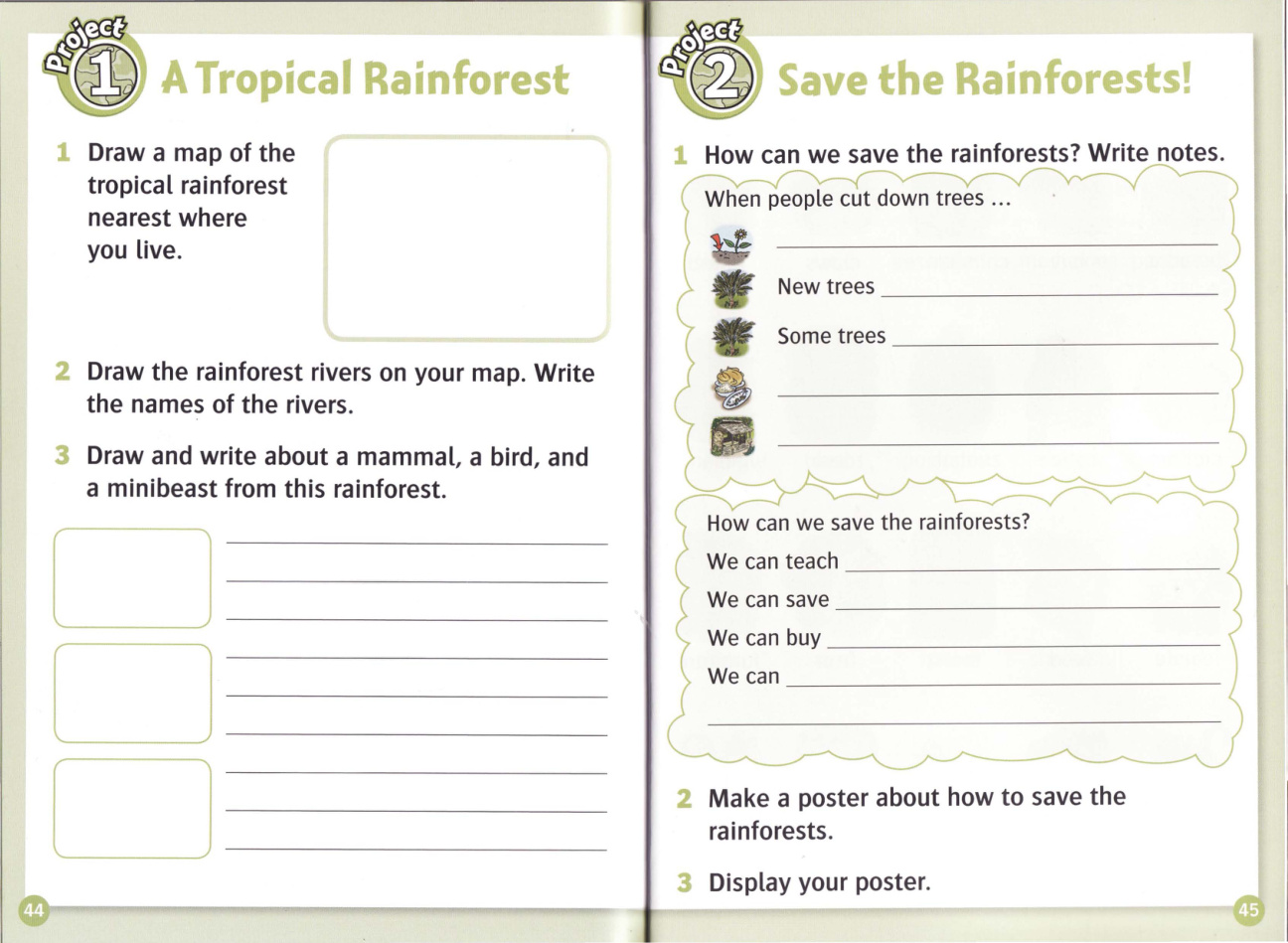
Project 1: A Tropical Rainforest – draw a map of the nearest tropical rainforest, add rivers, and write about a mammal, bird, and minibeast. Project 2: Save the Rainforests! – write notes about the effects of cutting trees and ways to save rainforests, then make a poster.
Từ điển tranh
Từ điển tranh
