Machines Then and Now
Đọc · Nghe · Từ vựng · Bài tập · Dự án · Từ điển tranh
The First Machines
1 Đọc trang sách
2 Đọc & Nghe
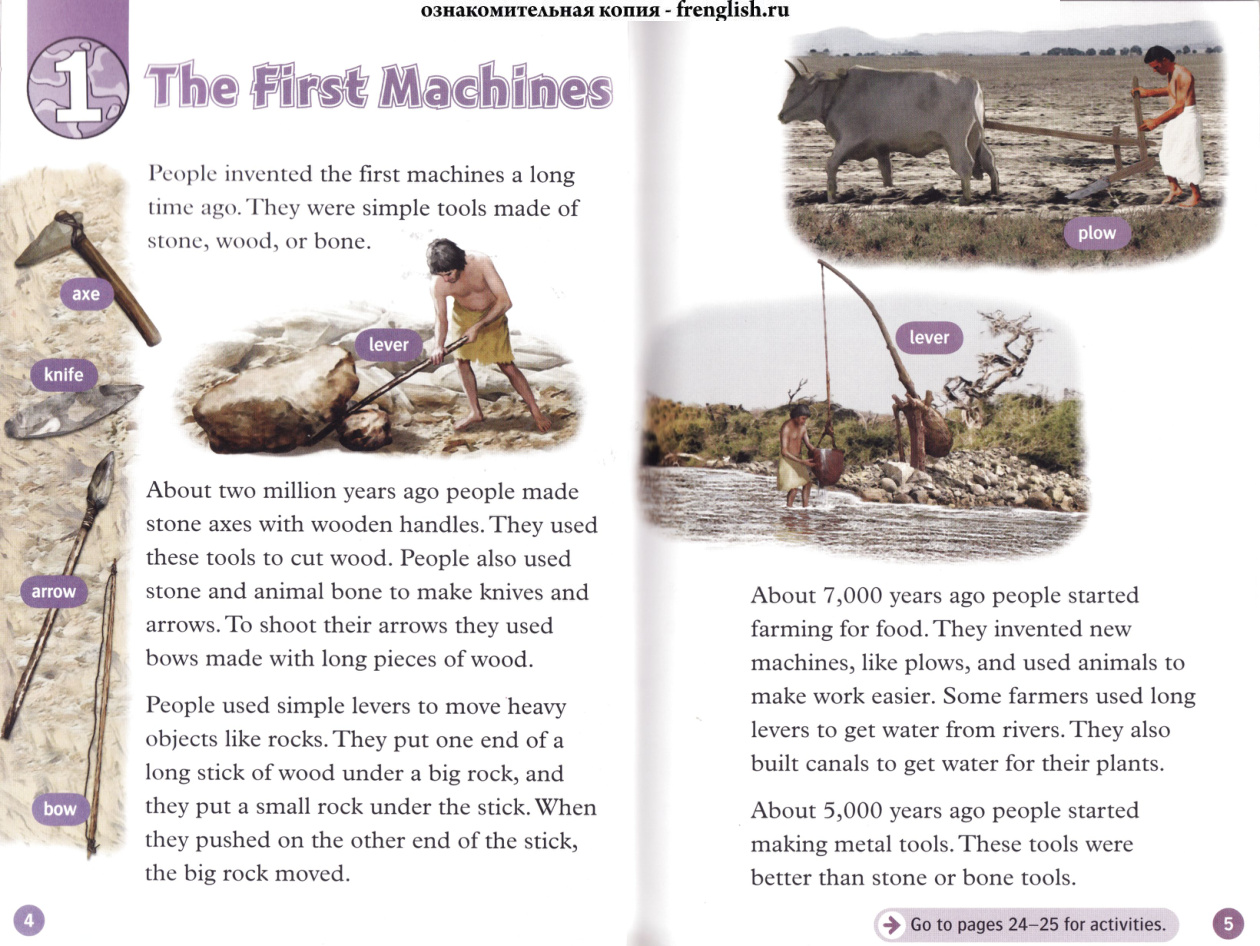
People invented the first machines a long time ago. They were simple tools made of stone, wood, or bone.
About two million years ago people made stone axes with wooden handles. They used these tools to cut wood.
People also used stone and animal bone to make knives and arrows. To shoot their arrows they used bows made with long pieces of wood.
People used simple levers to move heavy objects like rocks. They put one end of a long stick of wood under a big rock, and they put a small rock under the stick. When they pushed on the other end of the stick, the big rock moved.
About 7,000 years ago people started farming for food. They invented new machines, like plows, and used animals to make work easier.
Some farmers used long levers to get water from rivers. They also built canals to get water for their plants.
About 5,000 years ago people started making metal tools. These tools were better than stone or bone tools.
Từ vựng
3 Xem trang bài tập
4 Bài tập tương tác
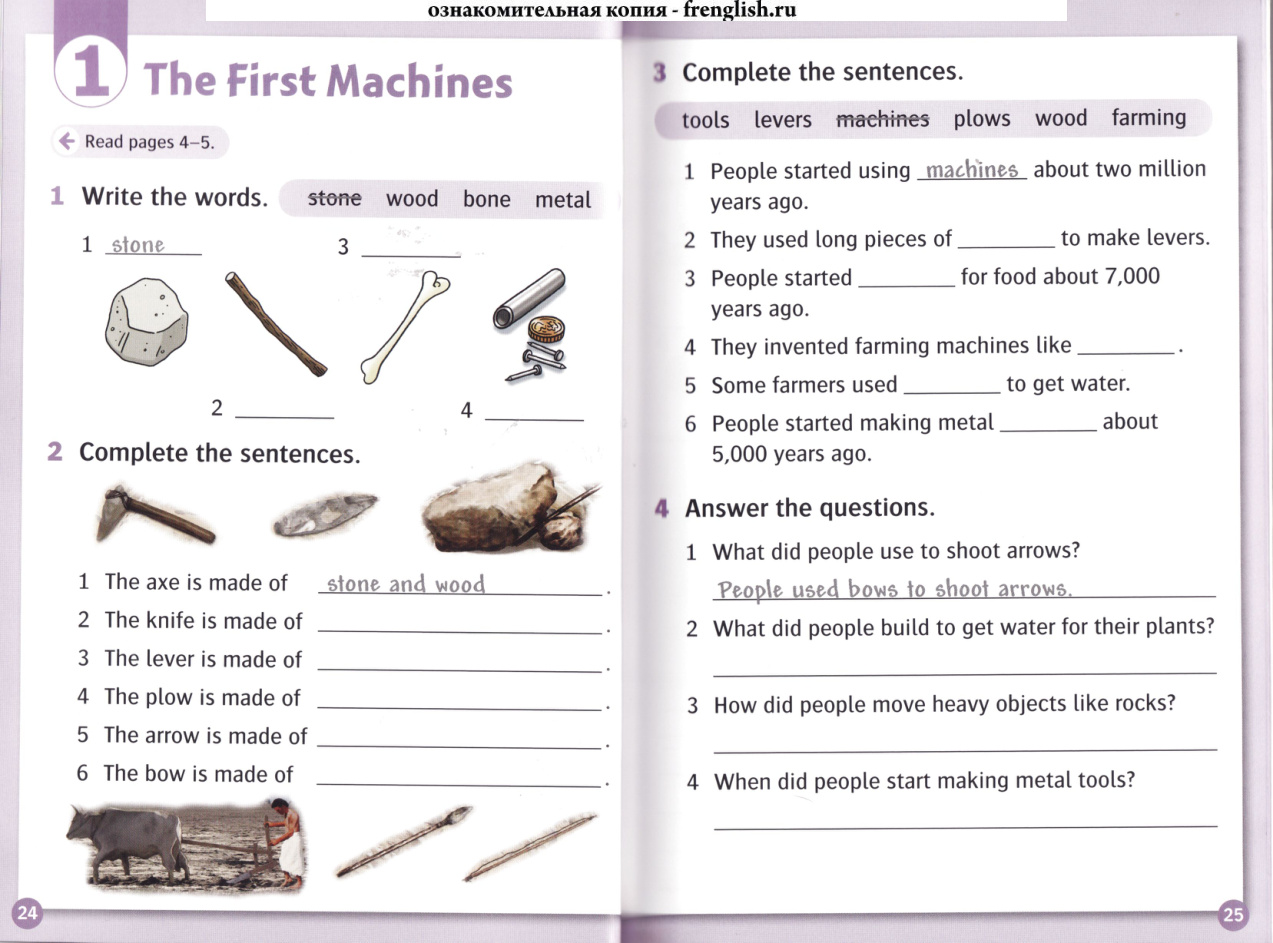
1. Write the four materials shown in Activity 1.
2. The axe is made of _____.
3. The knife is made of _____.
4. The lever is made of _____.
5. The plow is made of _____.
6. The arrow is made of _____.
7. The bow is made of _____.
8. People started using _____ about two million years ago.
9. They used long pieces of _____ to make levers.
10. People started _____ for food about 7,000 years ago.
11. They invented farming machines like _____.
12. Some farmers used _____ to get water.
13. People started making metal _____ about 5,000 years ago.
14. What did people use to shoot arrows?
15. What did people build to get water for their plants?
16. How did people move heavy objects like rocks?
17. When did people start making metal tools?
Round and Round
1 Đọc trang sách
2 Đọc & Nghe
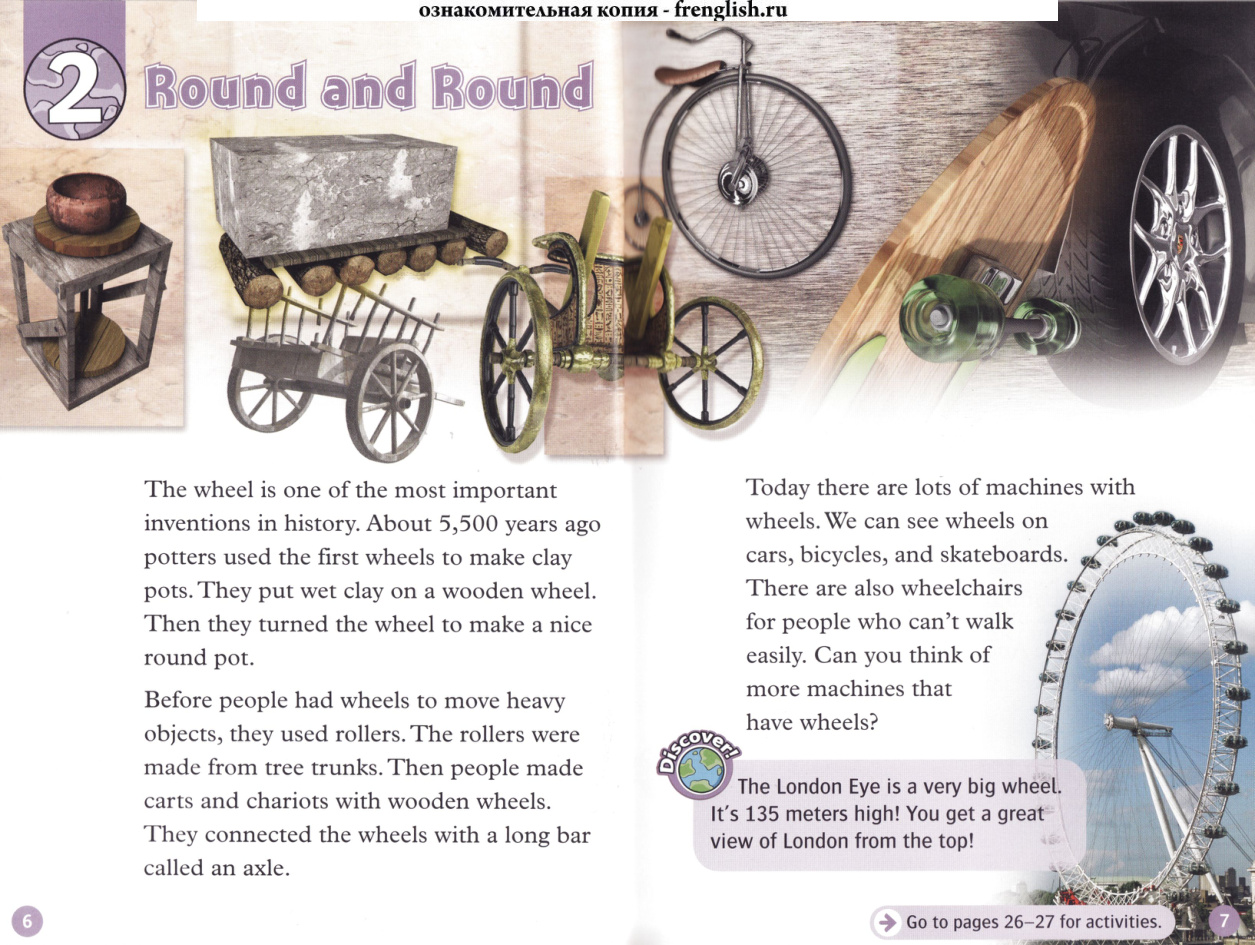
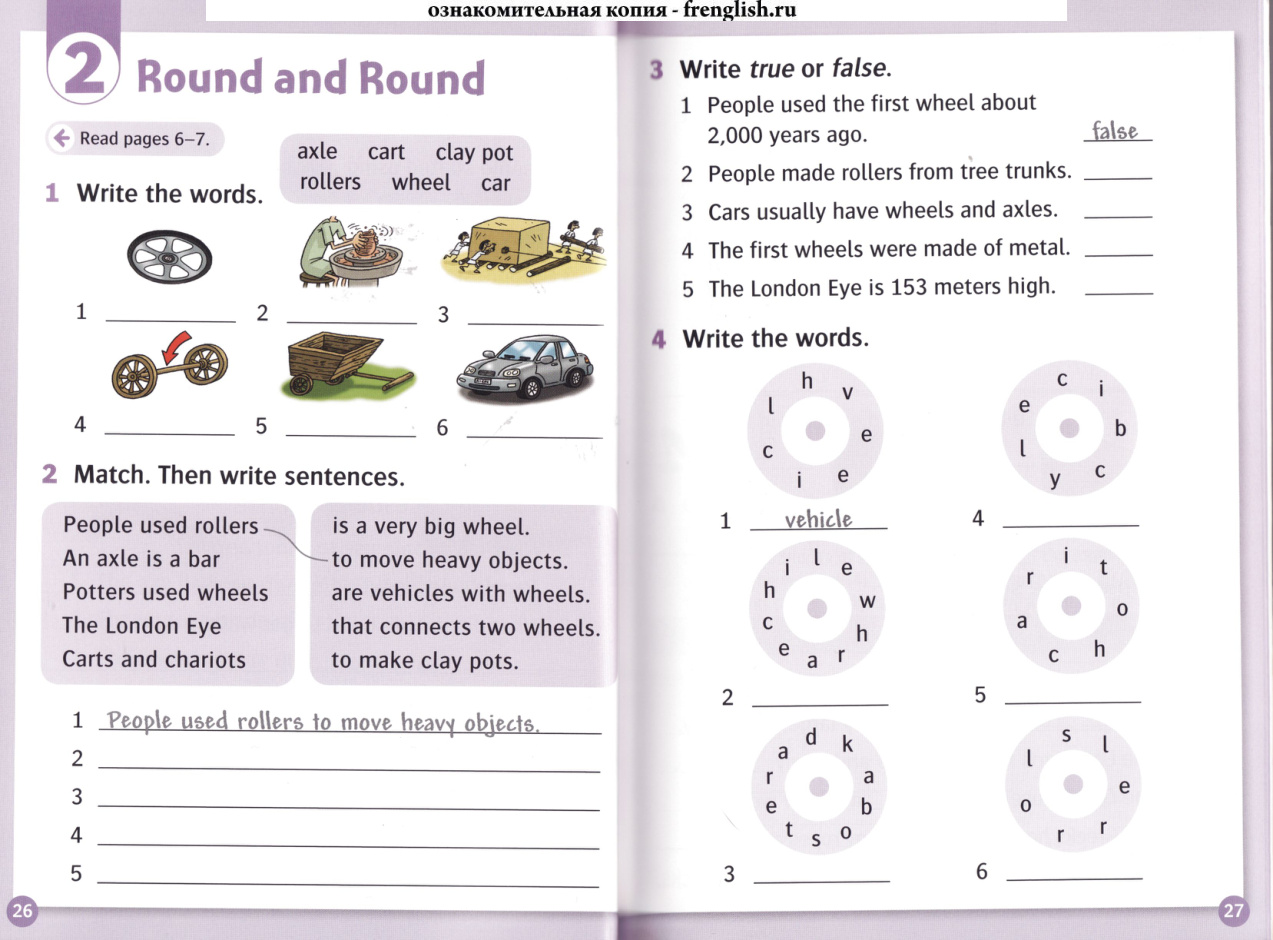
The wheel is one of the most important inventions in history.
About 5,500 years ago potters used the first wheels to make clay pots. They put wet clay on a wooden wheel. Then they turned the wheel to make a nice round pot.
Before people had wheels to move heavy objects, they used rollers. The rollers were made from tree trunks.
Then people made carts and chariots with wooden wheels. They connected the wheels with a long bar called an axle.
Today there are lots of machines with wheels. We can see wheels on cars, bicycles, and skateboards.
There are also wheelchairs for people who can't walk easily.
The London Eye is a very big wheel. It's 135 meters high. You get a great view of London from the top.
Từ vựng
3 Xem trang bài tập
4 Bài tập tương tác
1. Write the six machine words shown by pictures.
2. Match the beginnings and endings.
3. People used the first wheel about 2,000 years ago.
4. People made rollers from tree trunks.
5. Cars usually have wheels and axles.
6. The first wheels were made of metal.
7. The London Eye is 153 meters high.
8. Unscramble the letters.
9. Unscramble the letters.
10. Unscramble the letters.
11. Unscramble the letters.
12. Unscramble the letters.
13. Unscramble the letters.
Ramps and Cranes
1 Đọc trang sách
2 Đọc & Nghe
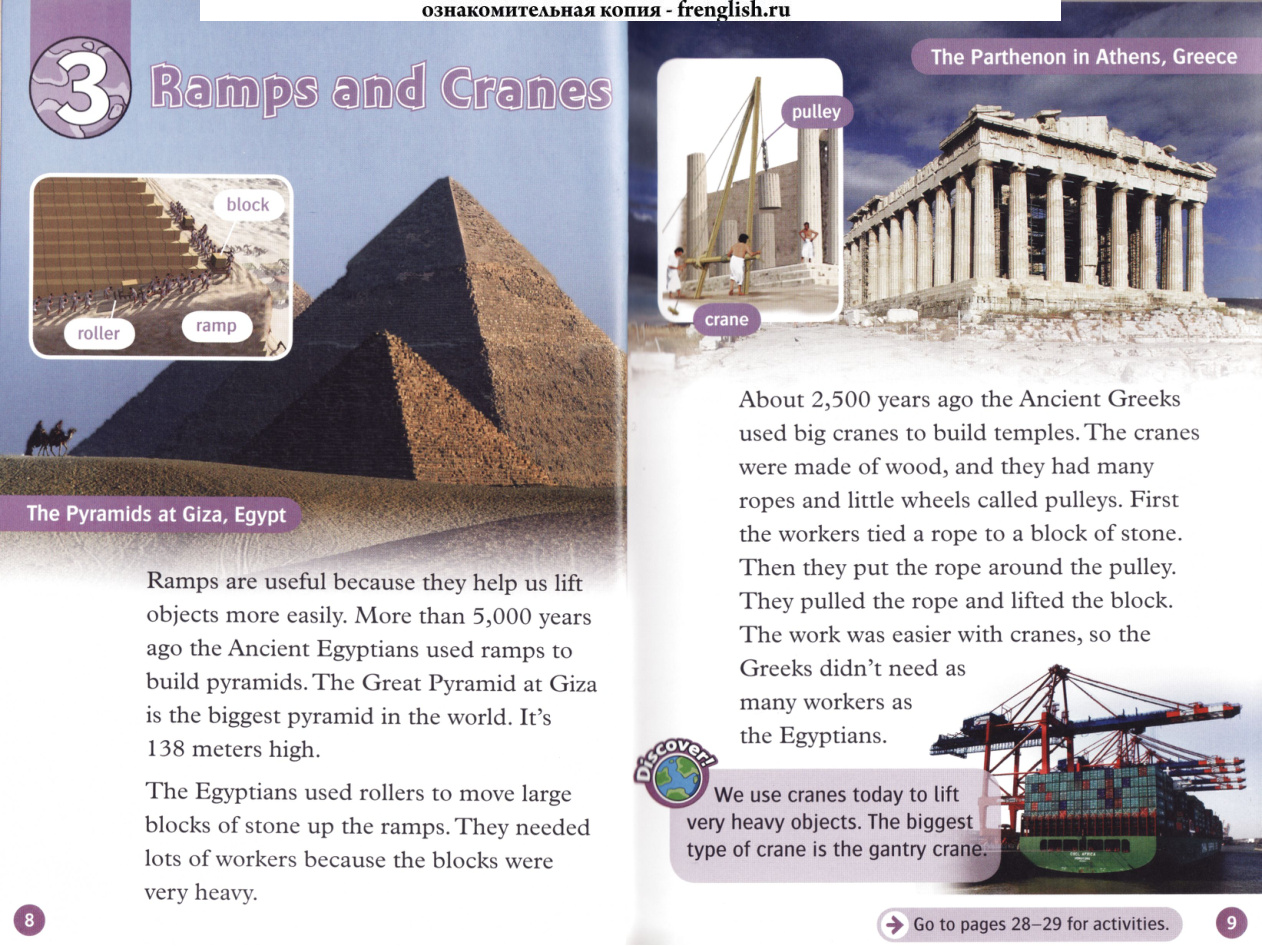
Ramps are useful because they help us lift objects more easily.
More than 5,000 years ago the Ancient Egyptians used ramps to build pyramids. The Great Pyramid at Giza is the biggest pyramid in the world. It's 138 meters high.
The Egyptians used rollers to move large blocks of stone up the ramps. They needed lots of workers because the blocks were very heavy.
About 2,500 years ago the Ancient Greeks used big cranes to build temples.
The cranes were made of wood, and they had many ropes and little wheels called pulleys.
First the workers tied a rope to a block of stone. Then they put the rope around the pulley. They pulled the rope and lifted the block.
The work was easier with cranes, so the Greeks didn't need as many workers as the Egyptians.
We use cranes today to lift very heavy objects. The biggest type of crane is the gantry crane.
Từ vựng
3 Xem trang bài tập
4 Bài tập tương tác
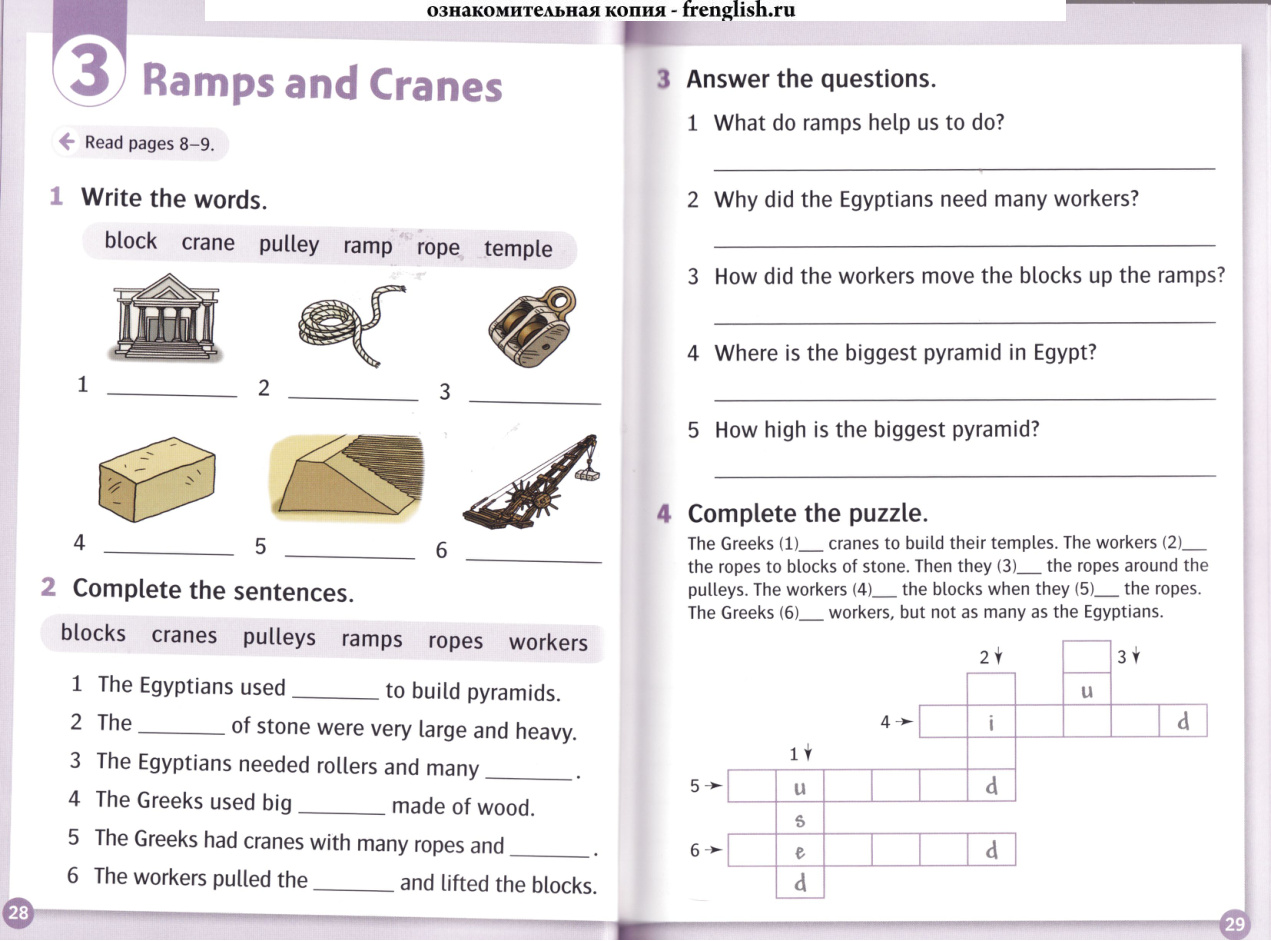
1. Write the six ramps-and-cranes words.
2. The Egyptians used _____ to build pyramids.
3. The _____ of stone were very large and heavy.
4. The Egyptians needed rollers and many _____.
5. The Greeks used big _____ made of wood.
6. The Greeks had cranes with many ropes and _____.
7. The workers pulled the _____ and lifted the blocks.
8. What do ramps help us to do?
9. Why did the Egyptians need many workers?
10. How did the workers move the blocks up the ramps?
11. Where is the biggest pyramid in Egypt?
12. How high is the biggest pyramid?
13. Complete the crane-action puzzle.
- 1 Hàng ngang: The Greeks ___ cranes to build their temples.
- 2 Hàng ngang: The workers ___ the ropes to blocks of stone.
- 3 Hàng ngang: They ___ the ropes around the pulleys.
- 4 Hàng ngang: The workers ___ the blocks.
- 5 Hàng ngang: They ___ the ropes.
- 6 Hàng ngang: The Greeks ___ workers, but fewer than the Egyptians.
Water and Wind
1 Đọc trang sách
2 Đọc & Nghe
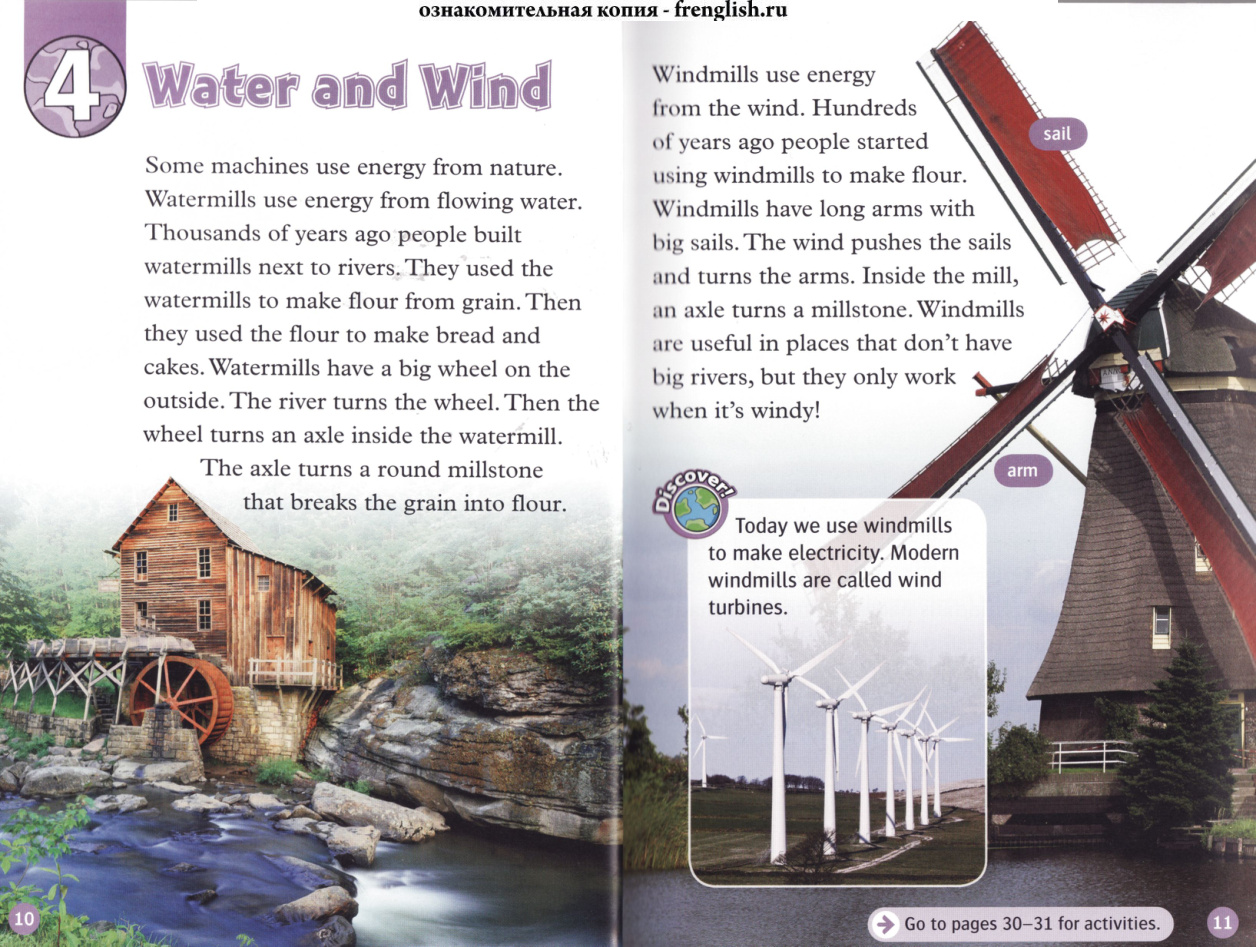
Some machines use energy from nature.
Watermills use energy from flowing water. Thousands of years ago people built watermills next to rivers.
They used the watermills to make flour from grain. Then they used the flour to make bread and cakes.
Watermills have a big wheel on the outside. The river turns the wheel. Then the wheel turns an axle inside the watermill.
The axle turns a round millstone that breaks the grain into flour.
Windmills use energy from the wind. Hundreds of years ago people started using windmills to make flour.
Windmills have long arms with big sails. The wind pushes the sails and turns the arms. Inside the mill, an axle turns a millstone.
Windmills are useful in places that don't have big rivers, but they only work when it's windy.
Today we use windmills to make electricity. Modern windmills are called wind turbines.
Từ vựng
3 Xem trang bài tập
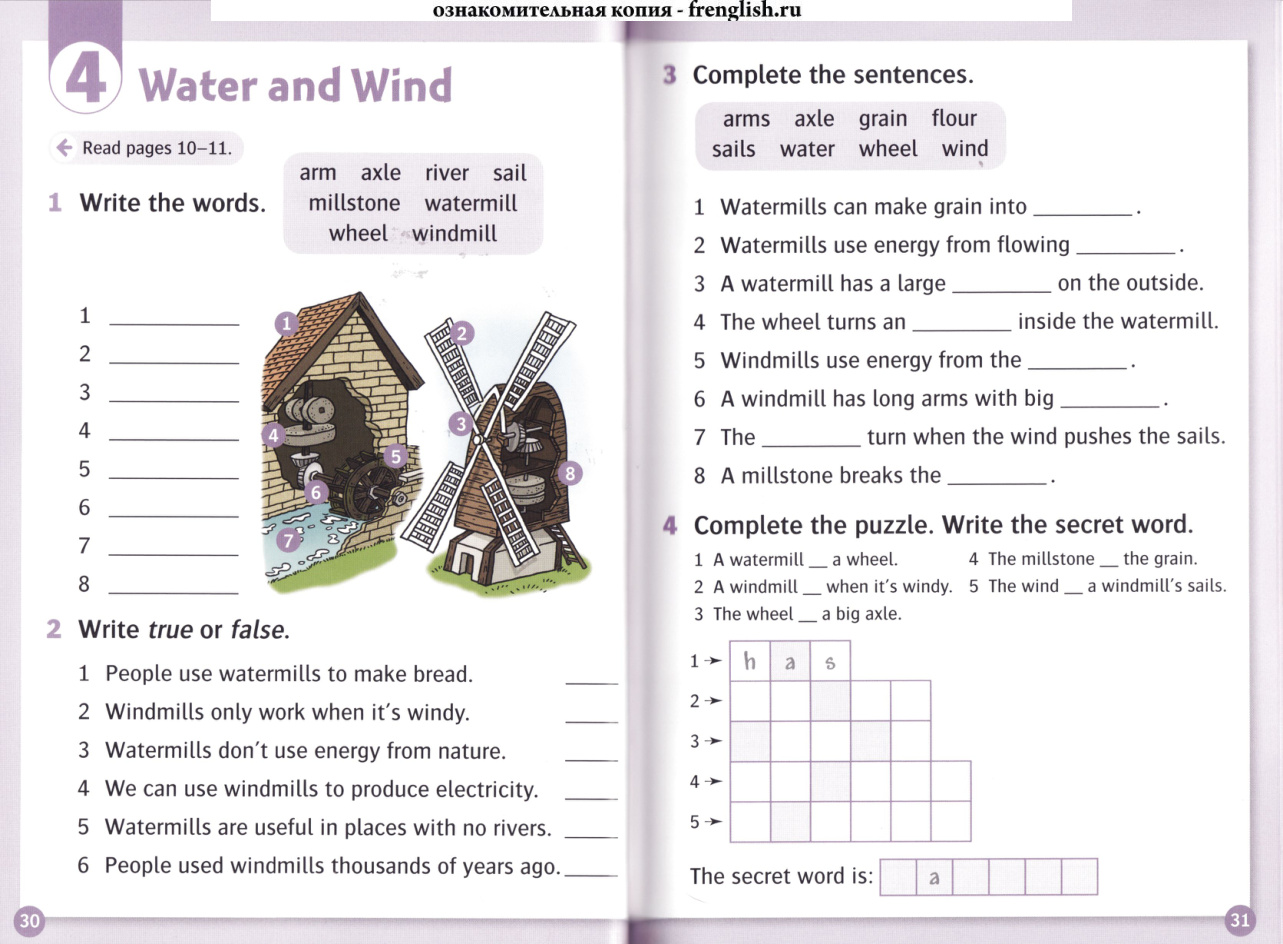
4 Bài tập tương tác
1. Write the eight watermill and windmill words.
2. People use watermills to make bread.
3. Windmills only work when it's windy.
4. Watermills don't use energy from nature.
5. We can use windmills to produce electricity.
6. Watermills are useful in places with no rivers.
7. People used windmills thousands of years ago.
8. Watermills can make grain into _____.
9. Watermills use energy from flowing _____.
10. A watermill has a large _____ on the outside.
11. The wheel turns an _____ inside the watermill.
12. Windmills use energy from the _____.
13. A windmill has long arms with big _____.
14. The _____ turn when the wind pushes the sails.
15. A millstone breaks the _____.
16. Complete the water-and-wind action puzzle.
- 1 Hàng ngang: A watermill ___ a wheel.
- 2 Hàng ngang: A windmill ___ when it's windy.
- 3 Hàng ngang: The wheel ___ a big axle.
- 4 Hàng ngang: The millstone ___ the grain.
- 5 Hàng ngang: The wind ___ a windmill's sails.
Telling the Time
1 Đọc trang sách
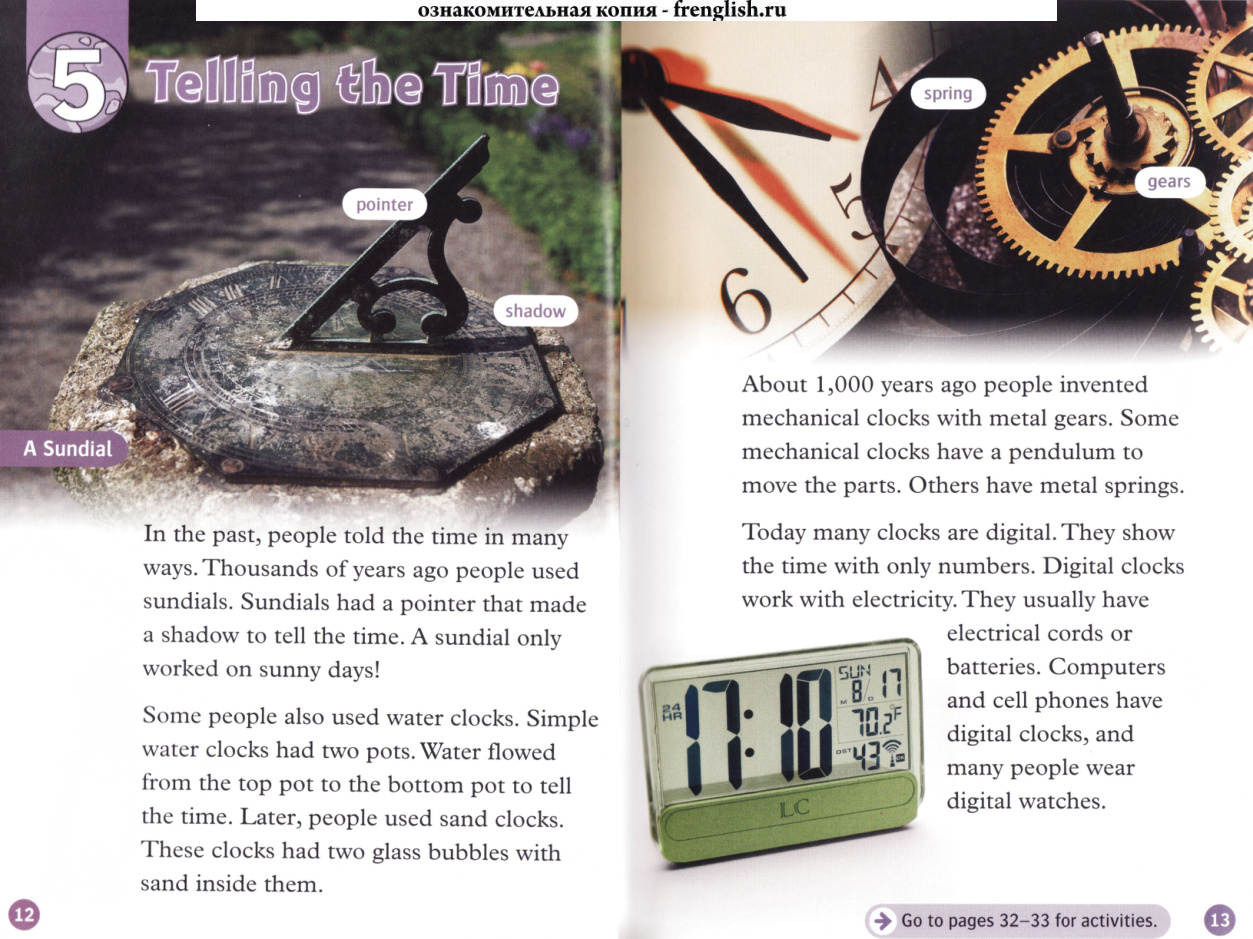
2 Đọc & Nghe
In the past, people told the time in many ways.
Thousands of years ago people used sundials. Sundials had a pointer that made a shadow to tell the time. A sundial only worked on sunny days.
Some people also used water clocks. Simple water clocks had two pots. Water flowed from the top pot to the bottom pot to tell the time.
Later, people used sand clocks. These clocks had two glass bubbles with sand inside them.
About 1,000 years ago people invented mechanical clocks with metal gears. Some mechanical clocks have a pendulum to move the parts. Others have metal springs.
Today many clocks are digital. They show the time with only numbers.
Digital clocks work with electricity. They usually have electrical cords or batteries. Computers and cell phones have digital clocks, and many people wear digital watches.
Từ vựng
3 Xem trang bài tập
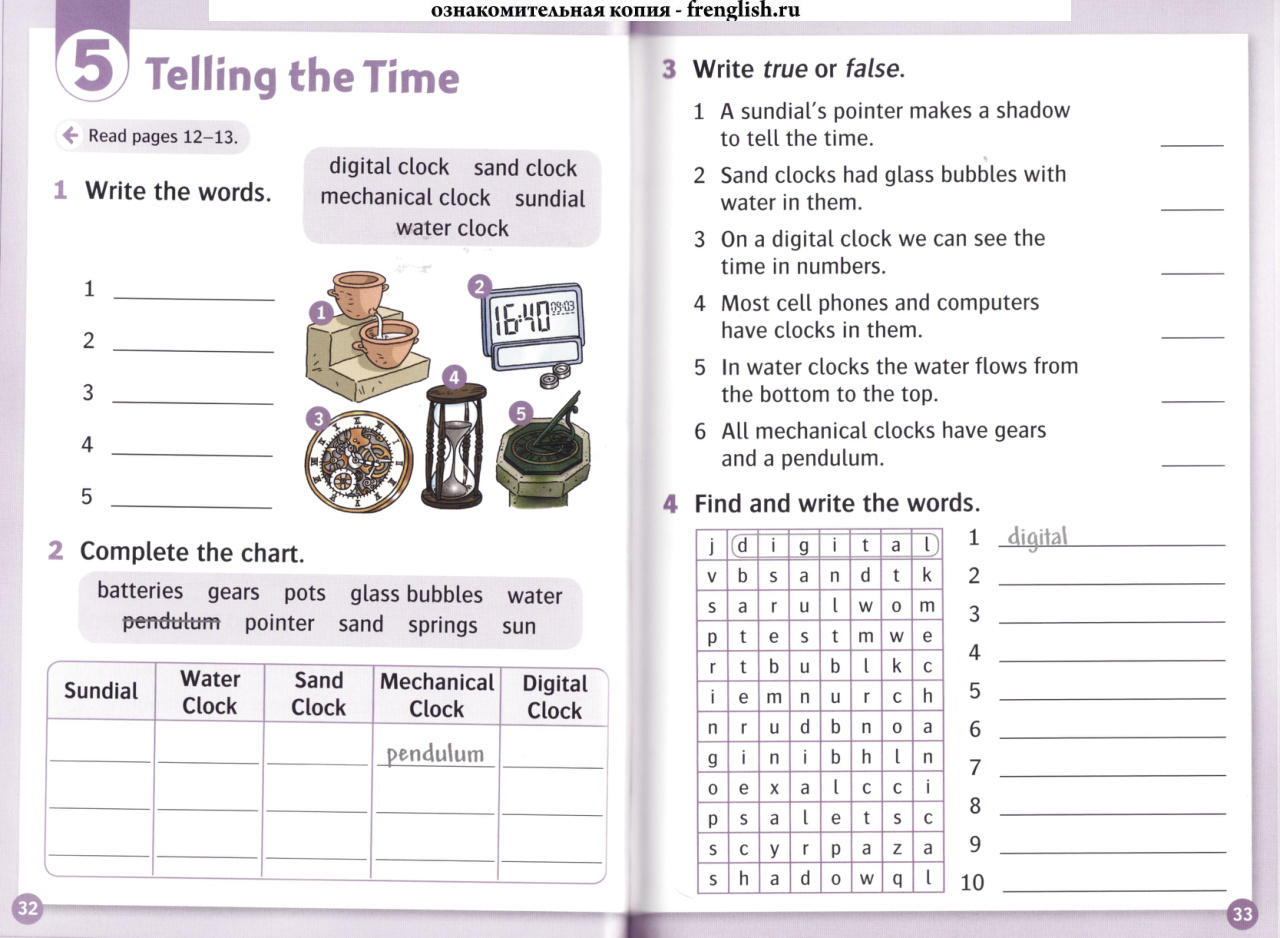
4 Bài tập tương tác
1. Write the five types of clock shown in Activity 1.
2. Classify each clock feature.
3. A sundial's pointer makes a shadow to tell the time.
4. Sand clocks had glass bubbles with water in them.
5. On a digital clock we can see the time in numbers.
6. Most cell phones and computers have clocks in them.
7. In water clocks the water flows from the bottom to the top.
8. All mechanical clocks have gears and a pendulum.
9. Find ten time words.
Tìm các từ trong ô chữ tương tác. Bố trí ô chữ đã được điều chỉnh; ảnh trang gốc vẫn được giữ để đối chiếu.
Engines and Energy
1 Đọc trang sách
2 Đọc & Nghe
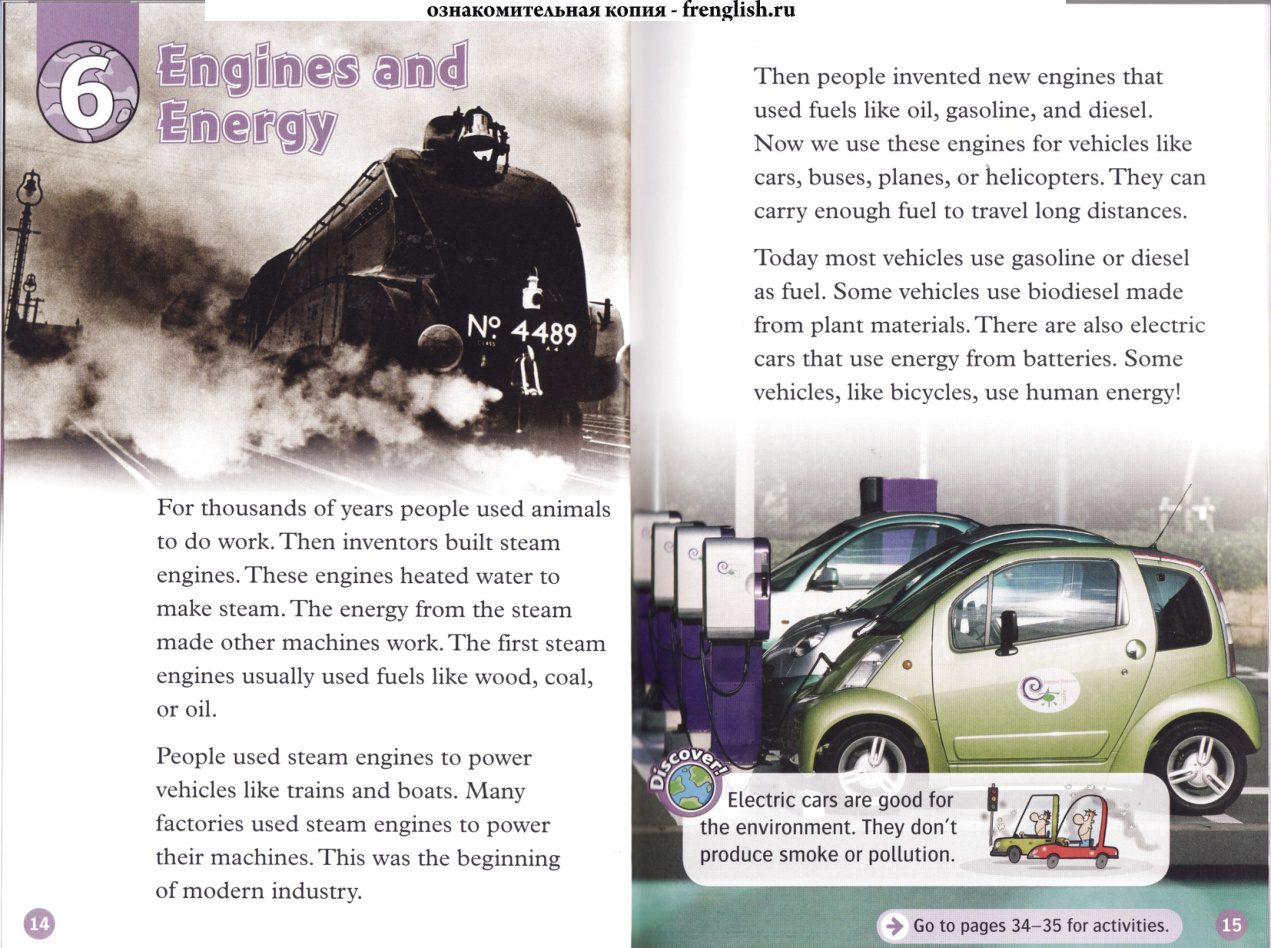
For thousands of years people used animals to do work. Then inventors built steam engines.
These engines heated water to make steam. The energy from the steam made other machines work.
The first steam engines usually used fuels like wood, coal, or oil.
People used steam engines to power vehicles like trains and boats. Many factories used steam engines to power their machines. This was the beginning of modern industry.
Then people invented new engines that used fuels like oil, gasoline, and diesel.
Now we use these engines for vehicles like cars, buses, planes, or helicopters. They can carry enough fuel to travel long distances.
Today most vehicles use gasoline or diesel as fuel. Some vehicles use biodiesel made from plant materials.
There are also electric cars that use energy from batteries. Some vehicles, like bicycles, use human energy.
Electric cars are good for the environment. They don't produce smoke or pollution.
Từ vựng
3 Xem trang bài tập
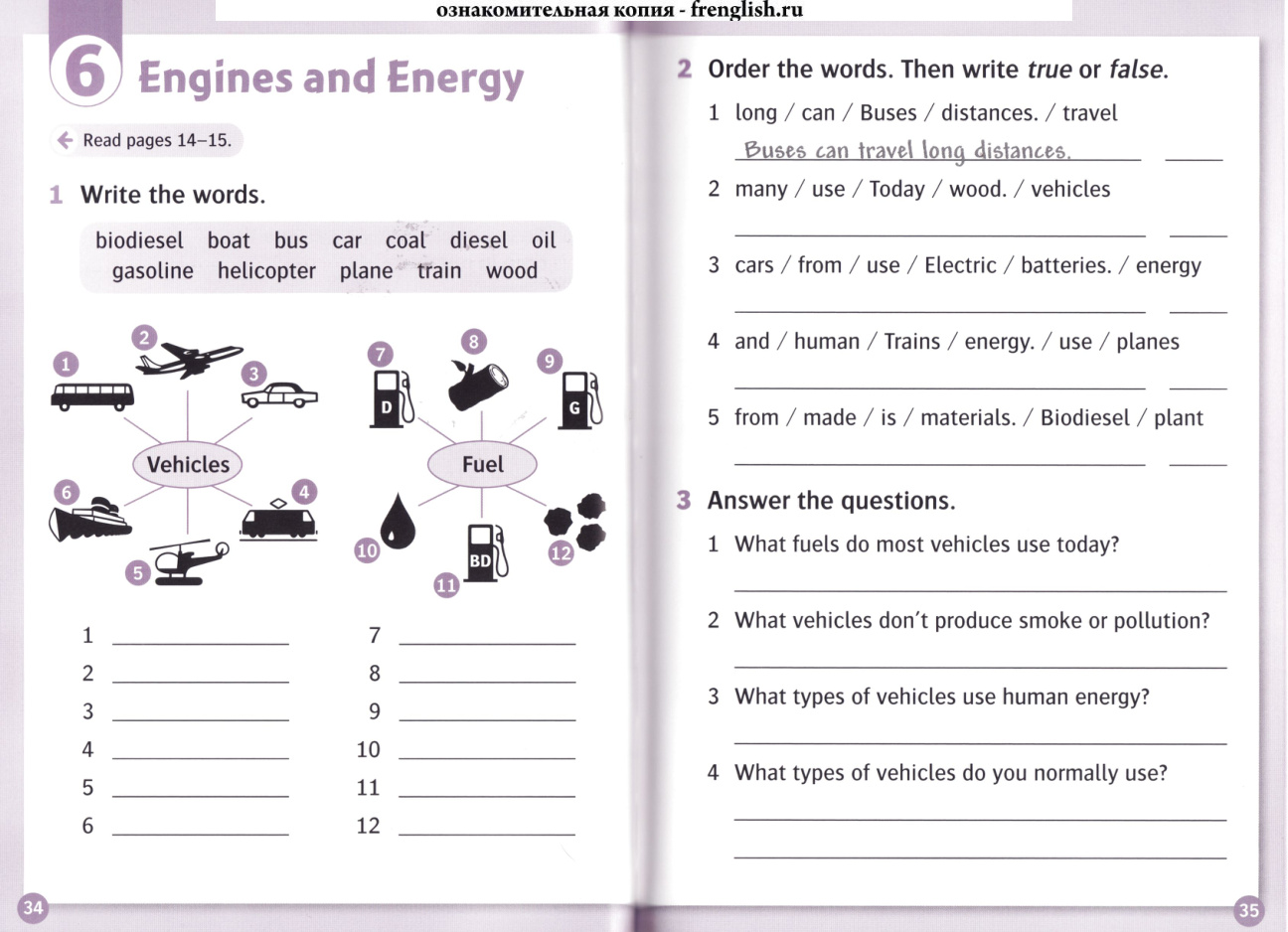
4 Bài tập tương tác
1. Write the twelve vehicle and fuel words.
2. Put the words in the correct order.
- long
- can
- Buses
- distances.
- travel
3. Put the words in the correct order.
- many
- use
- Today
- wood.
- vehicles
4. Put the words in the correct order.
- cars
- from
- use
- Electric
- batteries.
- energy
5. Put the words in the correct order.
- and
- human
- Trains
- energy.
- use
- planes
6. Put the words in the correct order.
- from
- made
- is
- materials.
- Biodiesel
- plant
7. Buses can travel long distances.
8. Today many vehicles use wood.
9. Electric cars use energy from batteries.
10. Trains and planes use human energy.
11. Biodiesel is made from plant materials.
12. What fuels do most vehicles use today?
13. What vehicles don't produce smoke or pollution?
14. What types of vehicles use human energy?
15. What types of vehicles do you normally use?
Câu trả lời tự do — không tính vào điểm.Flying Machines
1 Đọc trang sách
2 Đọc & Nghe
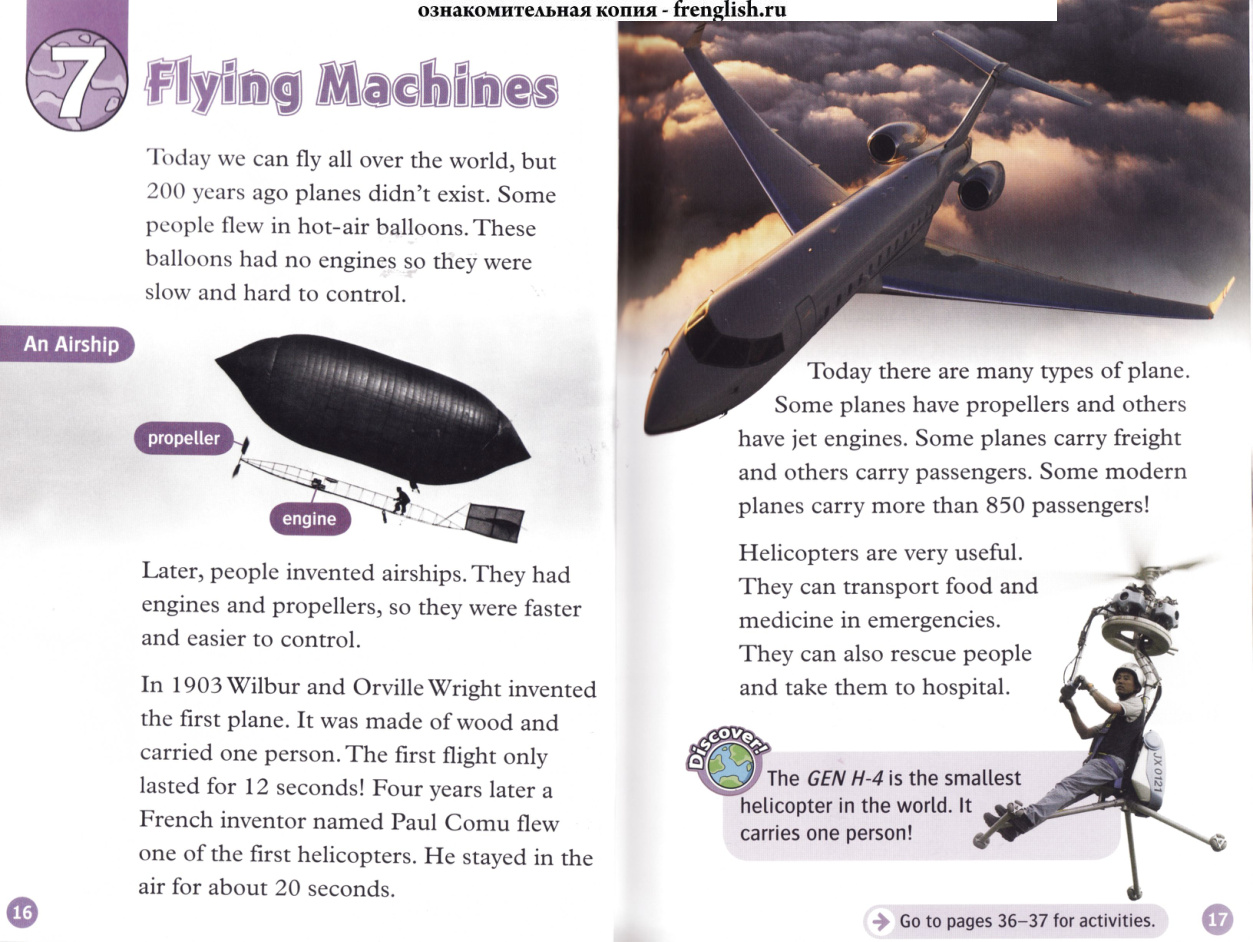
Today we can fly all over the world, but 200 years ago planes didn't exist.
Some people flew in hot-air balloons. These balloons had no engines so they were slow and hard to control.
Later, people invented airships. They had engines and propellers, so they were faster and easier to control.
In 1903 Wilbur and Orville Wright invented the first plane. It was made of wood and carried one person. The first flight only lasted for 12 seconds.
Four years later a French inventor named Paul Cornu flew one of the first helicopters. He stayed in the air for about 20 seconds.
Today there are many types of plane. Some planes have propellers and others have jet engines.
Some planes carry freight and others carry passengers. Some modern planes carry more than 850 passengers.
Helicopters are very useful. They can transport food and medicine in emergencies. They can also rescue people and take them to hospital.
The GEN H-4 is the smallest helicopter in the world. It carries one person.
Từ vựng
3 Xem trang bài tập
4 Bài tập tương tác
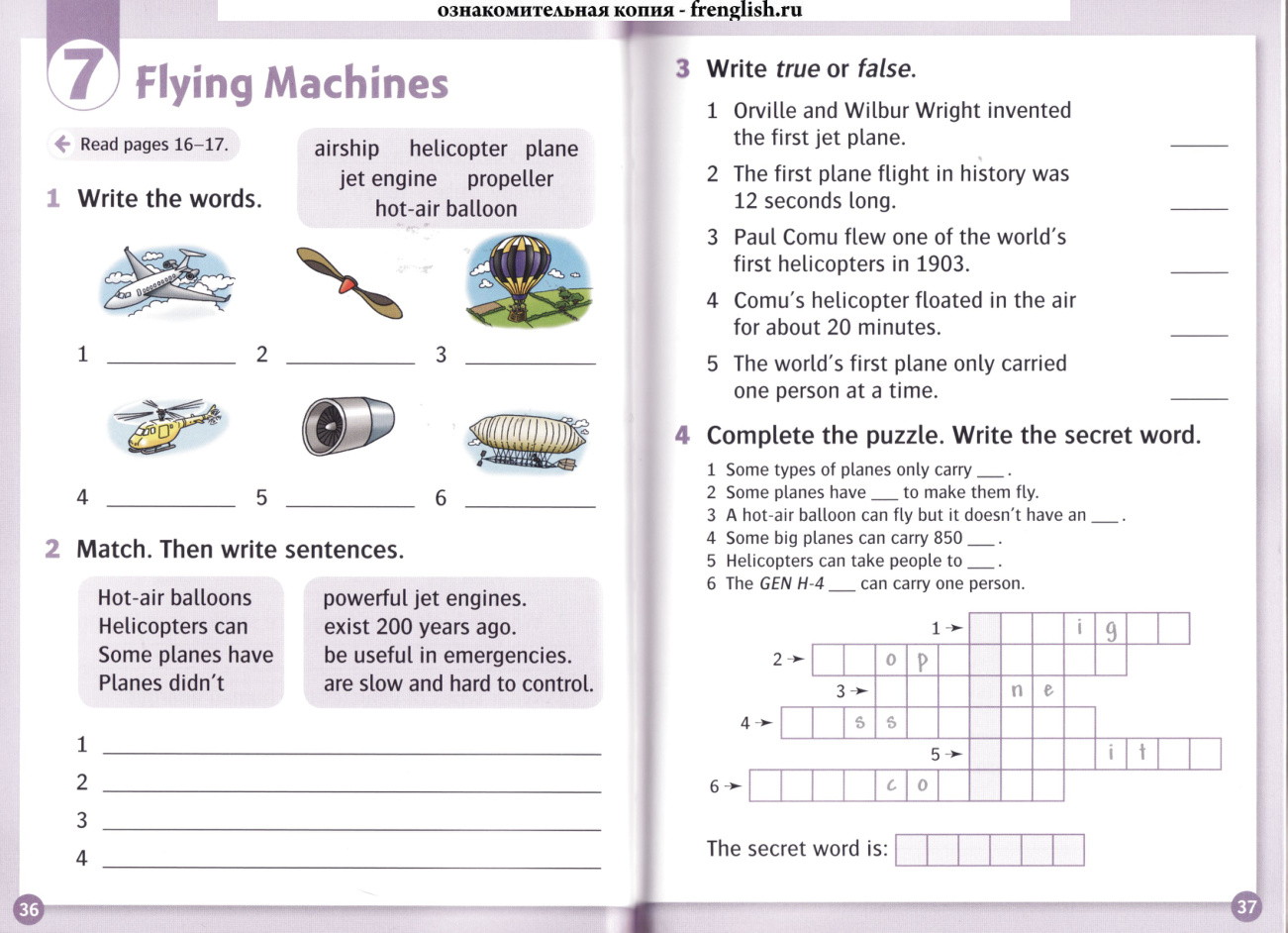
1. Write the six flying-machine words.
2. Match the beginnings and endings.
3. Orville and Wilbur Wright invented the first jet plane.
4. The first plane flight in history was 12 seconds long.
5. Paul Cornu flew one of the world's first helicopters in 1903.
6. Cornu's helicopter floated in the air for about 20 minutes.
7. The world's first plane only carried one person at a time.
8. Complete the flying-machines puzzle.
- 1 Hàng ngang: Some types of planes only carry ___.
- 2 Hàng ngang: Some planes have ___ to make them fly.
- 3 Hàng ngang: A hot-air balloon can fly but it doesn't have an ___.
- 4 Hàng ngang: Some big planes can carry 850 ___.
- 5 Hàng ngang: Helicopters can take people to ___.
- 6 Hàng ngang: The GEN H-4 ___ can carry one person.
Communications
1 Đọc trang sách
2 Đọc & Nghe
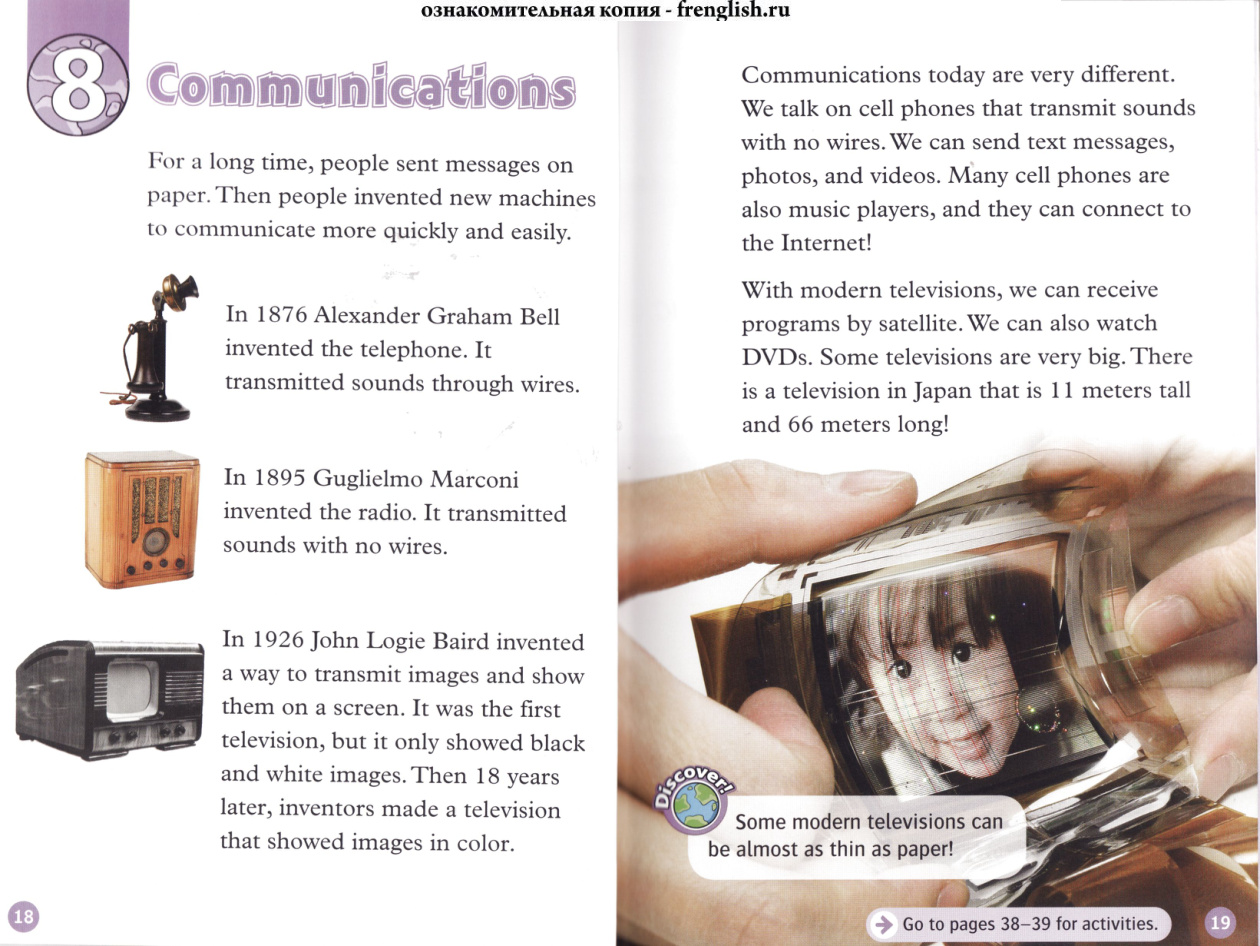
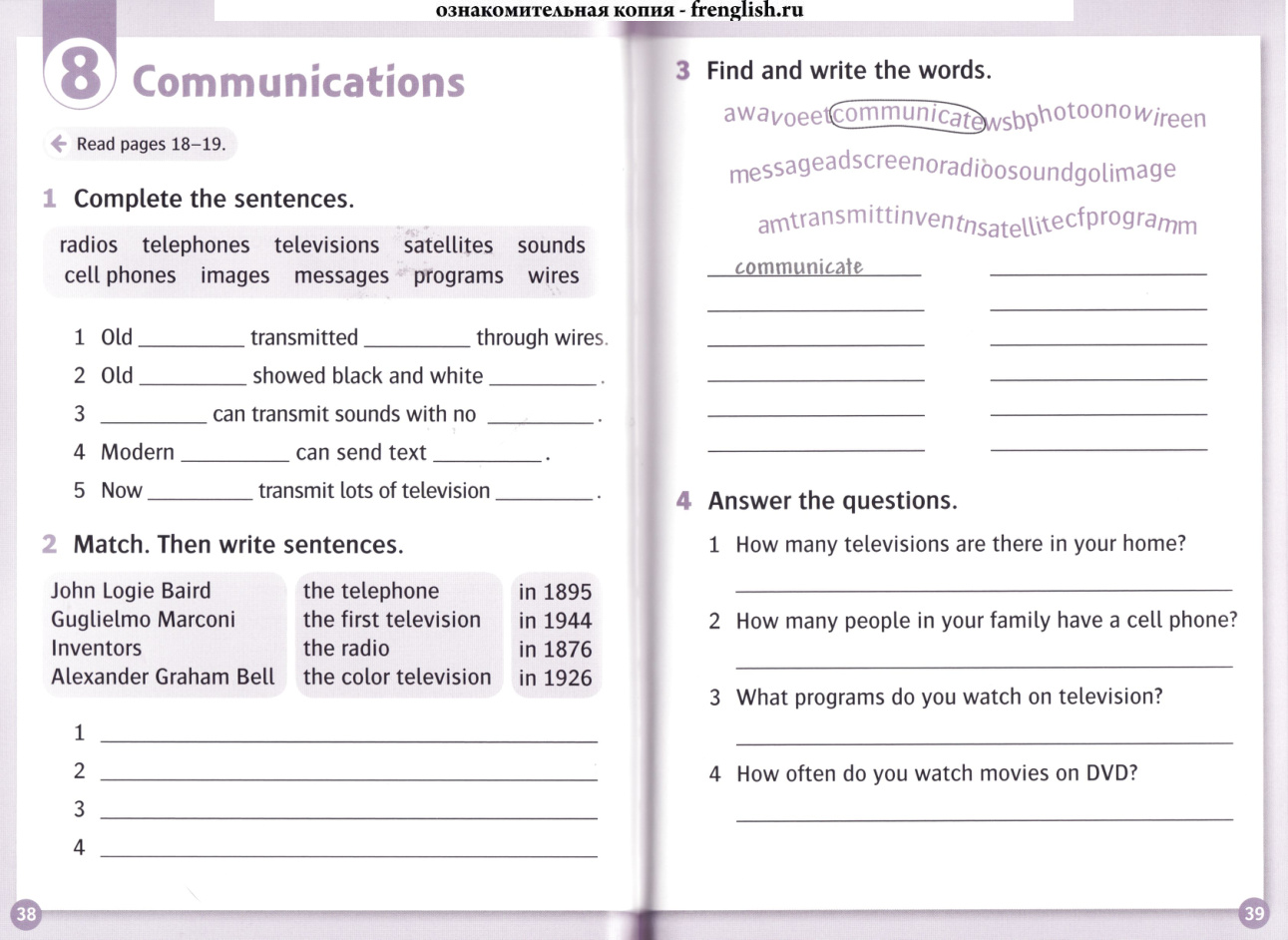
For a long time, people sent messages on paper. Then people invented new machines to communicate more quickly and easily.
In 1876 Alexander Graham Bell invented the telephone. It transmitted sounds through wires.
In 1895 Guglielmo Marconi invented the radio. It transmitted sounds with no wires.
In 1926 John Logie Baird invented a way to transmit images and show them on a screen. It was the first television, but it only showed black and white images.
Then 18 years later, inventors made a television that showed images in color.
Communications today are very different. We talk on cell phones that transmit sounds with no wires.
We can send text messages, photos, and videos. Many cell phones are also music players, and they can connect to the Internet.
With modern televisions, we can receive programs by satellite. We can also watch DVDs.
Some televisions are very big. There is a television in Japan that is 11 meters tall and 66 meters long.
Some modern televisions can be almost as thin as paper.
Từ vựng
3 Xem trang bài tập
4 Bài tập tương tác
1. Old _____ transmitted _____ through wires.
2. Old _____ showed black and white _____.
3. _____ can transmit sounds with no _____.
4. Modern _____ can send text _____.
5. Now _____ transmit lots of television _____.
6. Match inventor, invention, and year.
7. Find the communications words.
Tìm các từ trong ô chữ tương tác. Bố trí ô chữ đã được điều chỉnh; ảnh trang gốc vẫn được giữ để đối chiếu.
8. How many televisions are there in your home?
Câu trả lời tự do — không tính vào điểm.9. How many people in your family have a cell phone?
Câu trả lời tự do — không tính vào điểm.10. What programs do you watch on television?
Câu trả lời tự do — không tính vào điểm.11. How often do you watch movies on DVD?
Câu trả lời tự do — không tính vào điểm.Computers
1 Đọc trang sách
2 Đọc & Nghe
People invented the first computers more than 60 years ago. Those computers were very different from computers today.
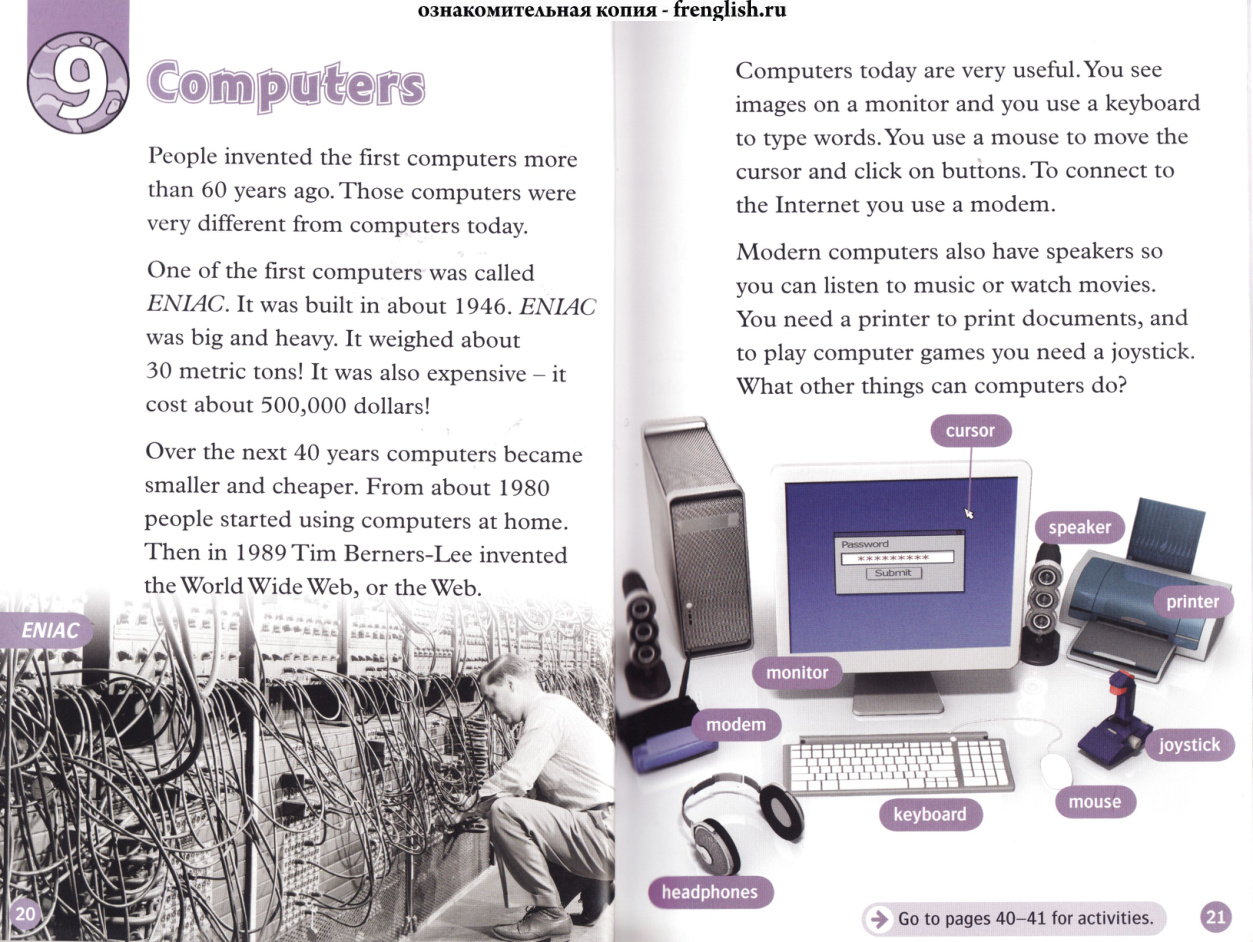
One of the first computers was called ENIAC. It was built in about 1946. ENIAC was big and heavy. It weighed about 30 metric tons.
It was also expensive – it cost about 500,000 dollars.
Over the next 40 years computers became smaller and cheaper. From about 1980 people started using computers at home.
Then in 1989 Tim Berners-Lee invented the World Wide Web, or the Web.
Computers today are very useful. You see images on a monitor and you use a keyboard to type words.
You use a mouse to move the cursor and click on buttons. To connect to the Internet you use a modem.
Modern computers also have speakers so you can listen to music or watch movies.
You need a printer to print documents, and to play computer games you need a joystick.
Từ vựng
3 Xem trang bài tập
4 Bài tập tương tác
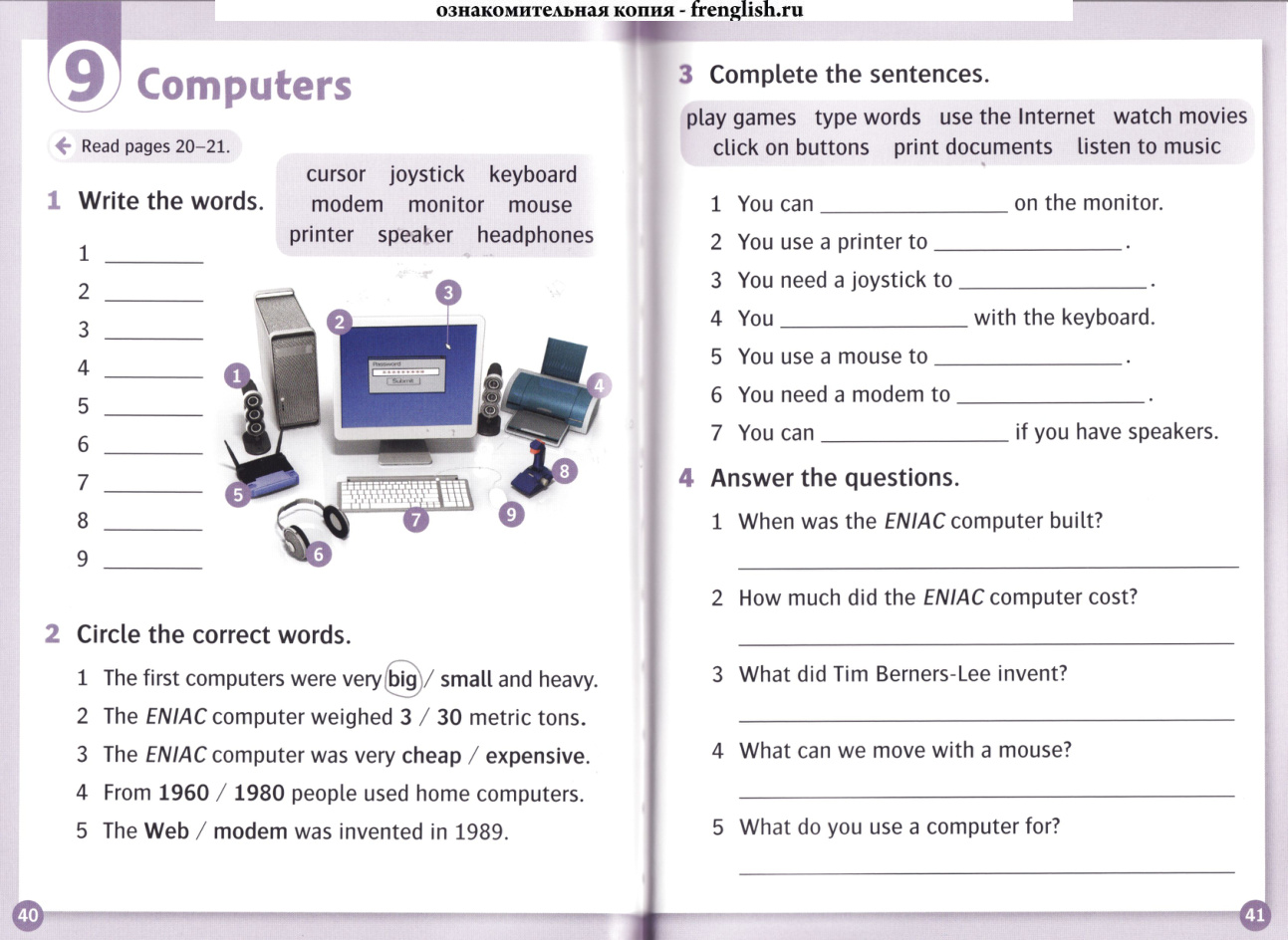
1. Write the nine computer-part words.
2. The first computers were very …
3. The ENIAC computer weighed …
4. The ENIAC computer was very …
5. From about _____ people used home computers.
6. The _____ was invented in 1989.
7. You can _____ on the monitor.
8. You use a printer to _____.
9. You need a joystick to _____.
10. You _____ with the keyboard.
11. You use a mouse to _____.
12. You need a modem to _____.
13. You can _____ if you have speakers.
14. When was the ENIAC computer built?
15. How much did the ENIAC computer cost?
16. What did Tim Berners-Lee invent?
17. What can we move with a mouse?
18. What do you use a computer for?
Câu trả lời tự do — không tính vào điểm.Big and Small
1 Đọc trang sách
2 Đọc & Nghe
With modern technology, we can build machines that are very big or very small.
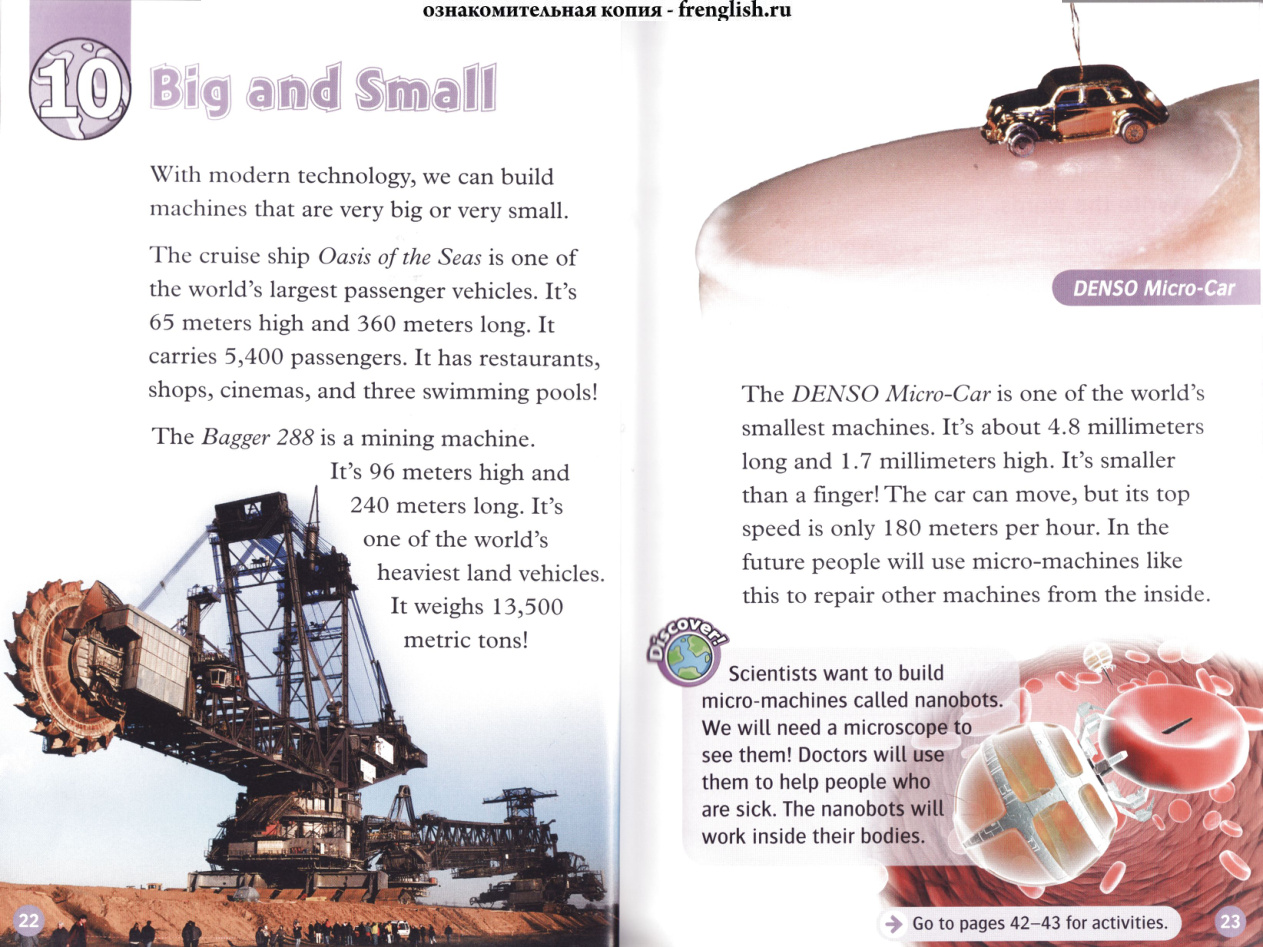
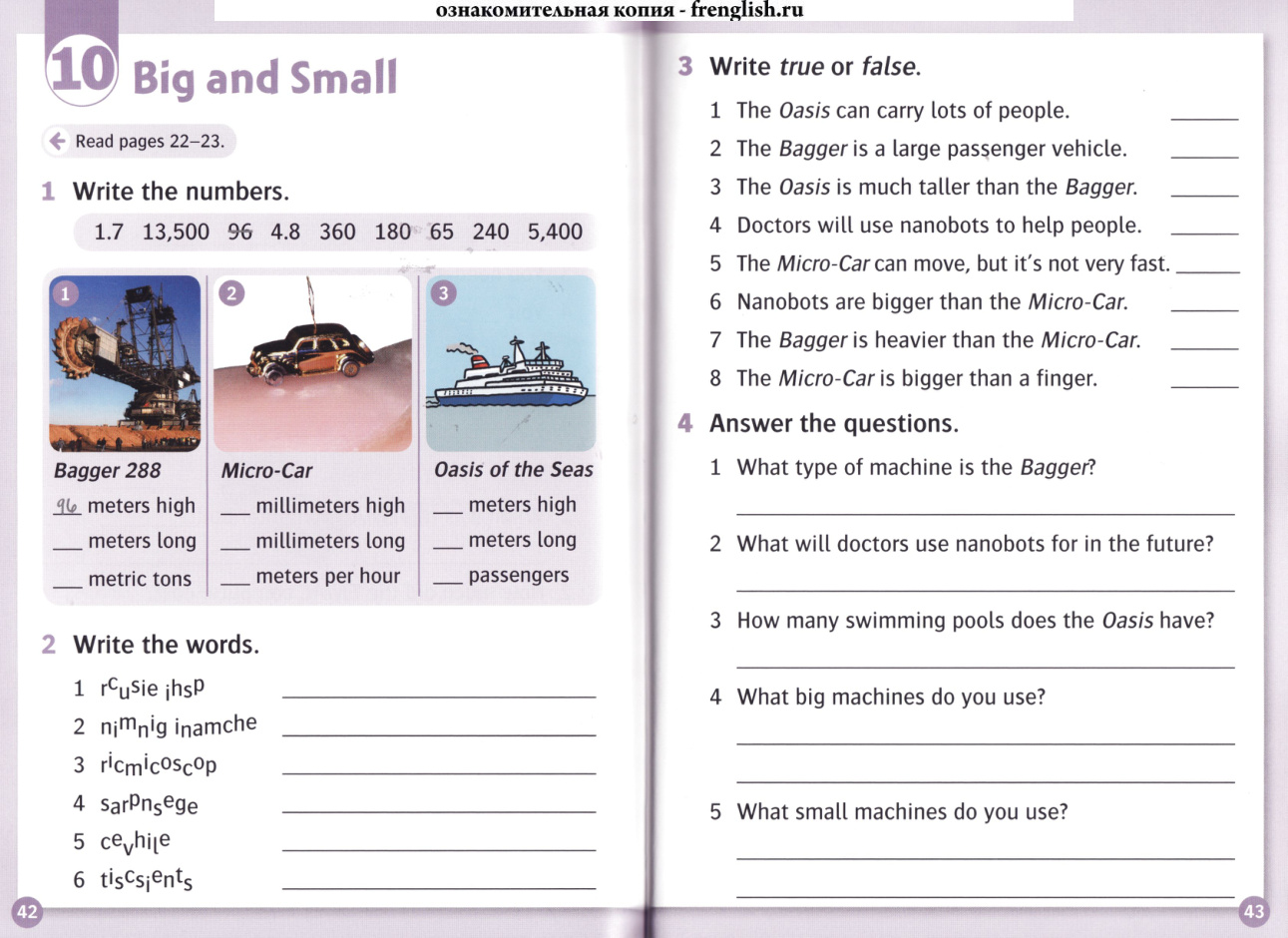
The cruise ship Oasis of the Seas is one of the world's largest passenger vehicles. It's 65 meters high and 360 meters long. It carries 5,400 passengers. It has restaurants, shops, cinemas, and three swimming pools.
The Bagger 288 is a mining machine. It's 96 meters high and 240 meters long. It's one of the world's heaviest land vehicles. It weighs 13,500 metric tons.
The DENSO Micro-Car is one of the world's smallest machines. It's about 4.8 millimeters long and 1.7 millimeters high. It's smaller than a finger.
The car can move, but its top speed is only 180 meters per hour.
In the future people will use micro-machines like this to repair other machines from the inside.
Scientists want to build micro-machines called nanobots. We will need a microscope to see them.
Doctors will use nanobots to help people who are sick. The nanobots will work inside their bodies.
Từ vựng
3 Xem trang bài tập
4 Bài tập tương tác
1. Bagger 288: _____ meters high.
2. Bagger 288: _____ meters long.
3. Bagger 288: _____ metric tons.
4. Micro-Car: _____ millimeters high.
5. Micro-Car: _____ millimeters long.
6. Micro-Car: _____ meters per hour.
7. Oasis of the Seas: _____ meters high.
8. Oasis of the Seas: _____ meters long.
9. Oasis of the Seas: _____ passengers.
10. Unscramble the machine word.
11. Unscramble the machine word.
12. Unscramble the machine word.
13. Unscramble the machine word.
14. Unscramble the machine word.
15. Unscramble the machine word.
16. The Oasis can carry lots of people.
17. The Bagger is a large passenger vehicle.
18. The Oasis is much taller than the Bagger.
19. Doctors will use nanobots to help people.
20. The Micro-Car can move, but it's not very fast.
21. Nanobots are bigger than the Micro-Car.
22. The Bagger is heavier than the Micro-Car.
23. The Micro-Car is bigger than a finger.
24. What type of machine is the Bagger?
25. What will doctors use nanobots for in the future?
26. How many swimming pools does the Oasis have?
27. What big machines do you use?
Câu trả lời tự do — không tính vào điểm.28. What small machines do you use?
Câu trả lời tự do — không tính vào điểm.Projects
Trang dự án
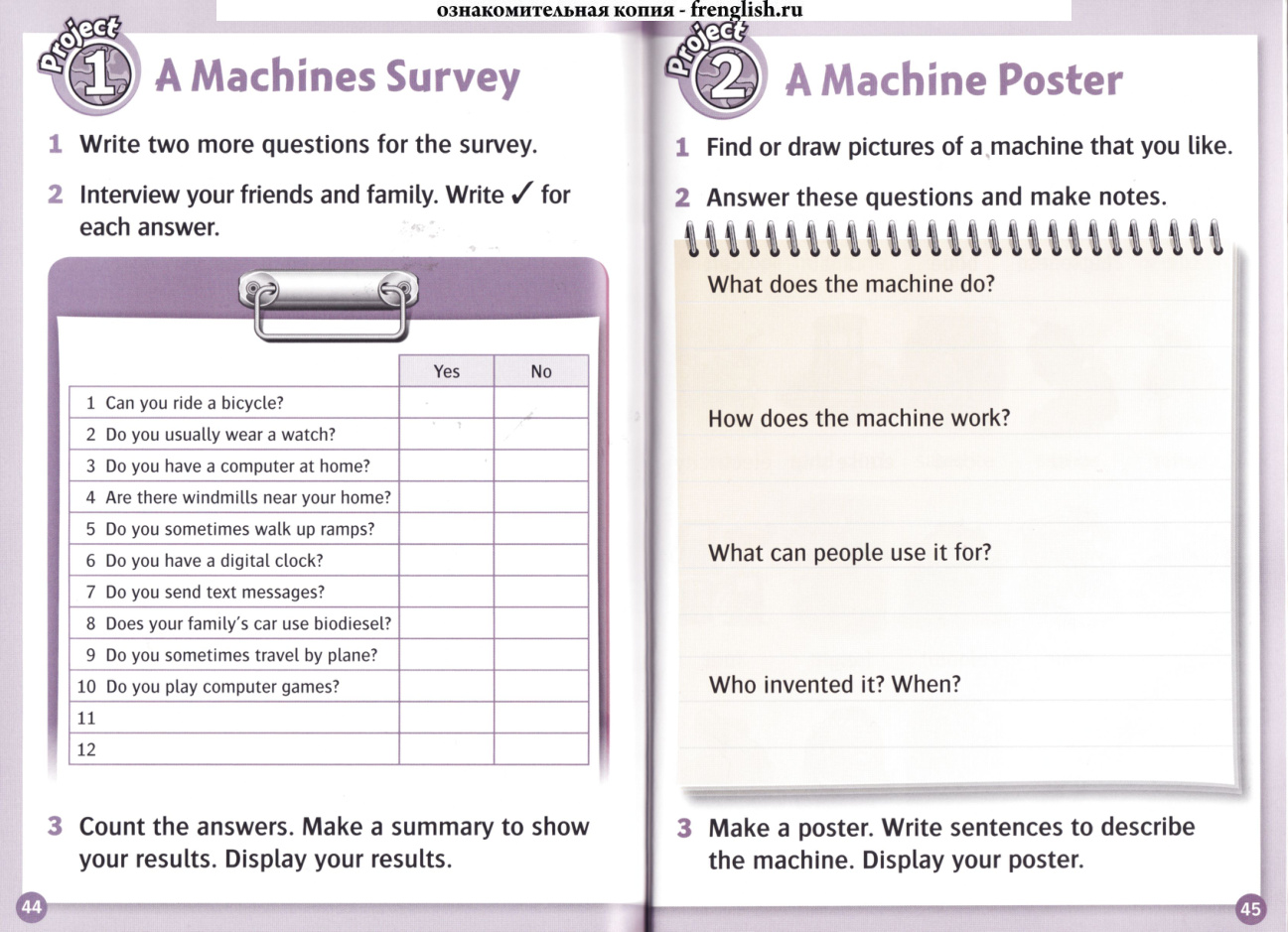
Project 1: A Machines Survey – add two questions, interview friends and family, count the answers, summarize and display the results. Project 2: A Machine Poster – choose a machine, research what it does, how it works, what it is used for, who invented it and when, then make a poster.
Từ điển tranh
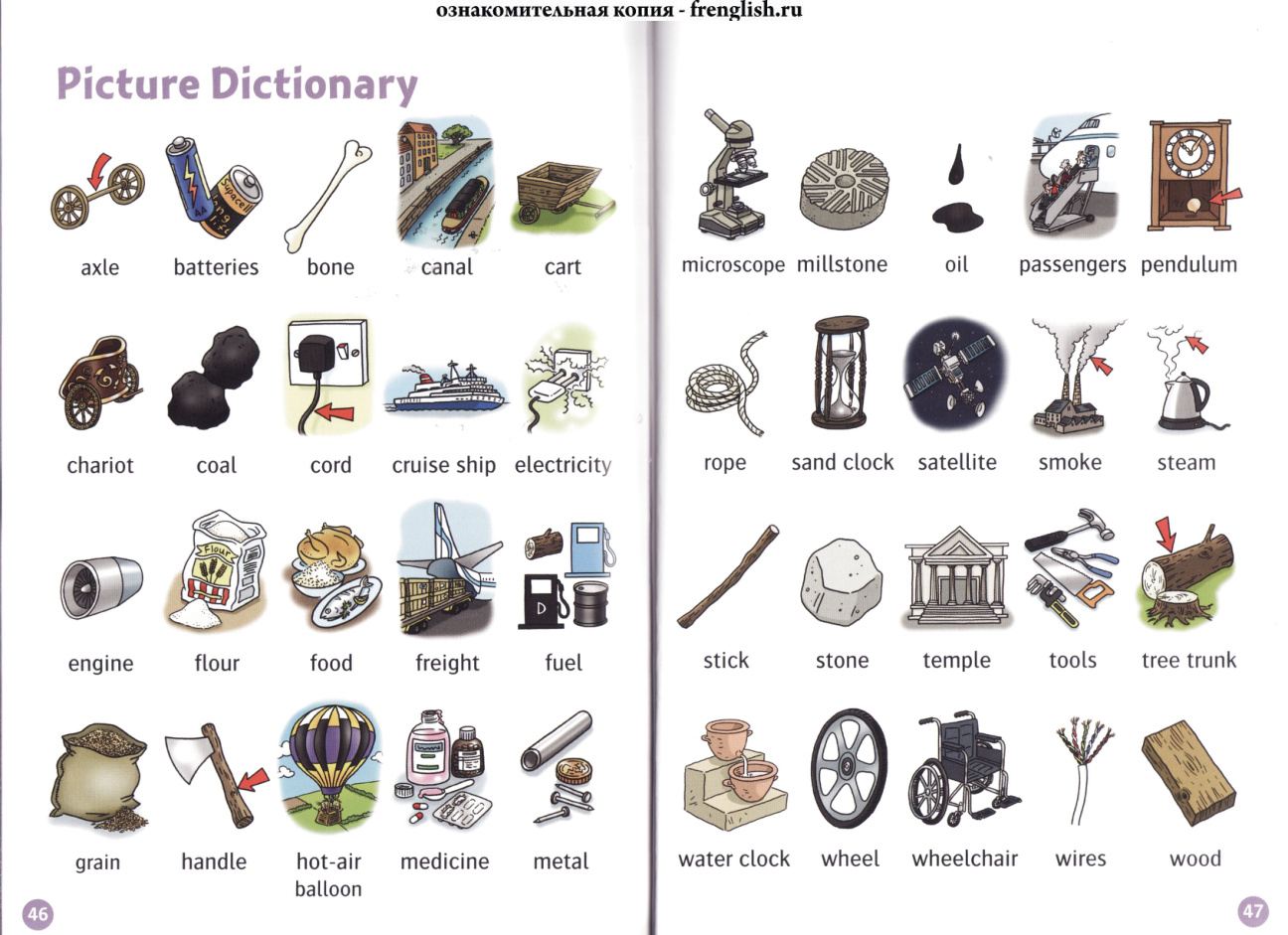
Từ điển tranh