Sound and Music
Đọc · Nghe · Từ vựng · Bài tập · Dự án · Từ điển tranh
How Sound Moves
1 Đọc trang sách
2 Đọc & Nghe
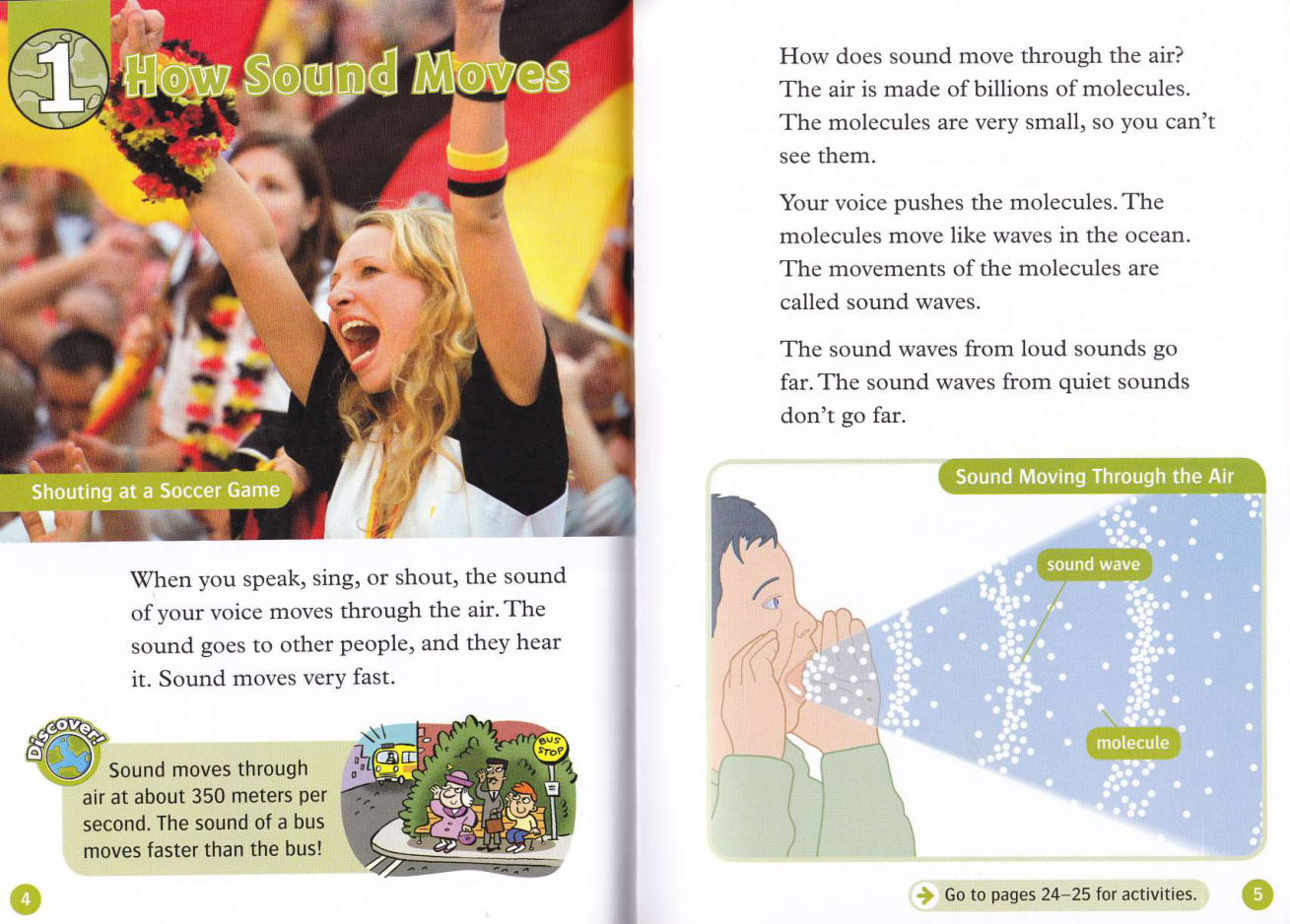
When you speak, sing, or shout, the sound of your voice moves through the air. The sound goes to other people, and they hear it. Sound moves very fast.
How does sound move through the air? The air is made of billions of molecules. The molecules are very small, so you can't see them.
Your voice pushes the molecules. The molecules move like waves in the ocean. The movements of the molecules are called sound waves.
The sound waves from loud sounds go far. The sound waves from quiet sounds don't go far.
Sound moves through air at about 350 meters per second. The sound of a bus moves faster than the bus!
Từ vựng
3 Xem trang bài tập

4 Bài tập tương tác
1. Write the six sound words shown in Activity 1.
2. When you _____, the sound of your voice moves through the air.
3. Other people can hear the sound of your _____.
4. There are billions of _____ in the air.
5. Molecules _____ like waves in the ocean.
6. Sound _____ are movements of molecules.
7. Sound moves very _____.
8. Match the beginnings and endings.
9. Where are you now?
Câu trả lời tự do — không tính vào điểm.10. What sounds can you hear?
Câu trả lời tự do — không tính vào điểm.11. What sounds can you hear when you're in a bus?
Câu trả lời tự do — không tính vào điểm.12. What sounds can you hear when you're in a park?
Câu trả lời tự do — không tính vào điểm.Low Sounds, High Sounds
1 Đọc trang sách
2 Đọc & Nghe
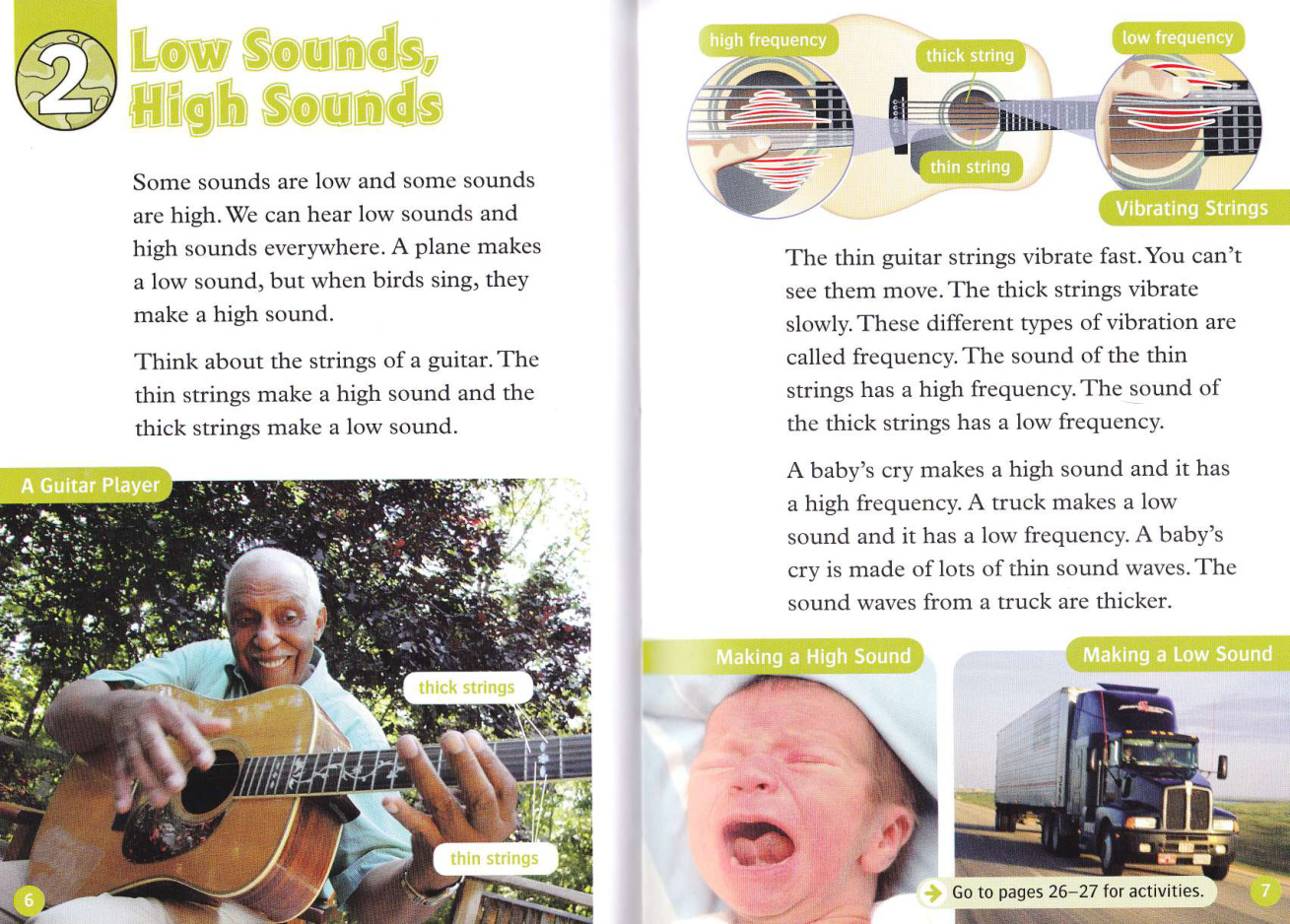
Some sounds are low and some sounds are high. We can hear low sounds and high sounds everywhere. A plane makes a low sound, but when birds sing, they make a high sound.
Think about the strings of a guitar. The thin strings make a high sound and the thick strings make a low sound.
The thin guitar strings vibrate fast. You can't see them move. The thick strings vibrate slowly.
These different types of vibration are called frequency. The sound of the thin strings has a high frequency. The sound of the thick strings has a low frequency.
A baby's cry makes a high sound and it has a high frequency. A truck makes a low sound and it has a low frequency.
A baby's cry is made of lots of thin sound waves. The sound waves from a truck are thicker.
Từ vựng
3 Xem trang bài tập

4 Bài tập tương tác
1. A _____ has thin strings and thick strings.
2. The thin strings make a _____ sound.
3. The thick strings make a _____ sound.
4. The sound of a _____'s cry has a high frequency.
5. The sound of a _____ has a low frequency.
6. When birds sing, they make a low sound.
7. A guitar has thin strings and thick strings.
8. A guitar can make high sounds and low sounds.
9. The thin strings of a guitar make a low sound.
10. The sound of a truck has a high frequency.
11. The sound waves from a truck are thin.
12. Find ten sound words.
13. Classify the examples by pitch.
Your Voice
1 Đọc trang sách
2 Đọc & Nghe
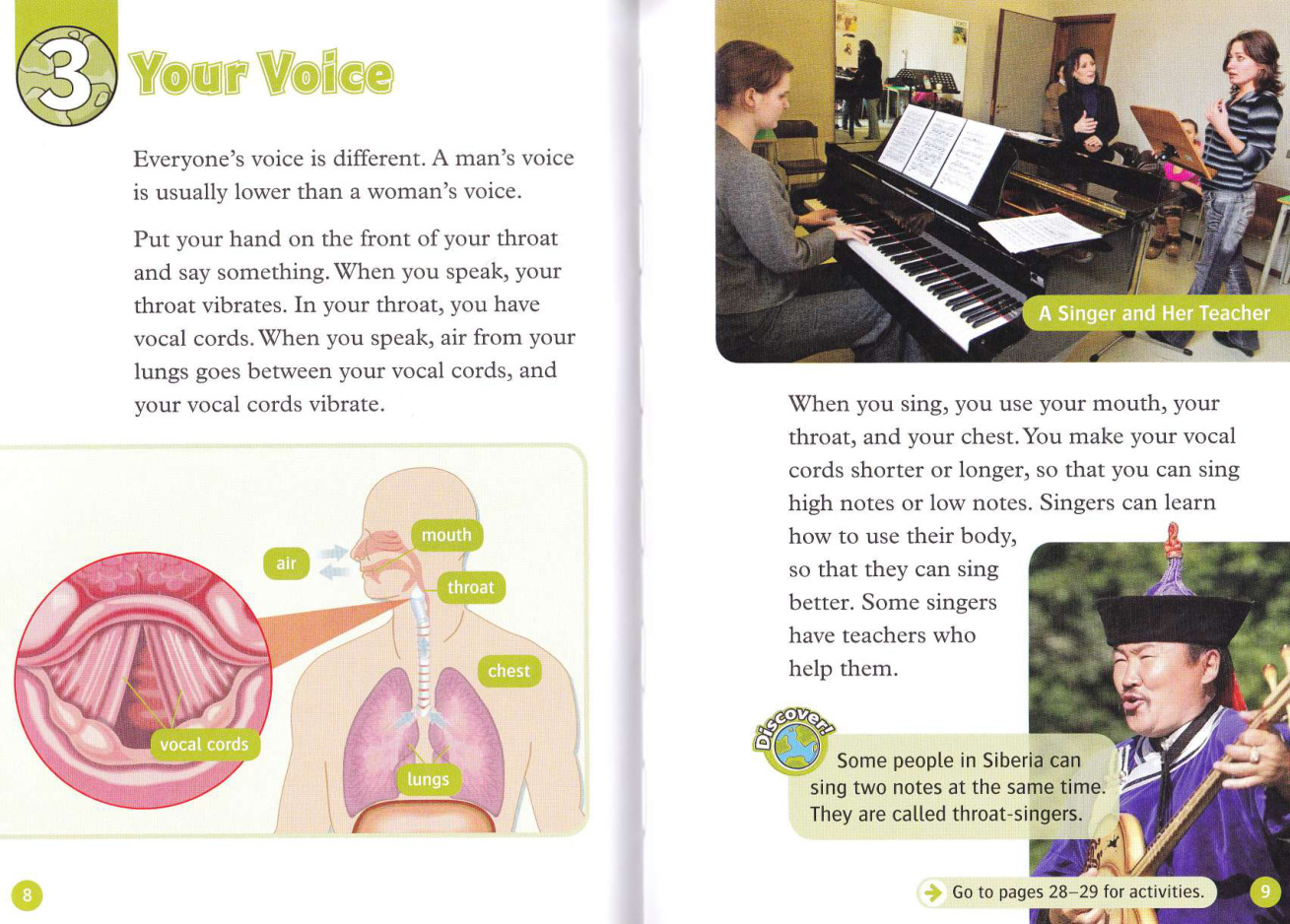
Everyone's voice is different. A man's voice is usually lower than a woman's voice.
Put your hand on the front of your throat and say something. When you speak, your throat vibrates.
In your throat, you have vocal cords. When you speak, air from your lungs goes between your vocal cords, and your vocal cords vibrate.
When you sing, you use your mouth, your throat, and your chest. You make your vocal cords shorter or longer, so that you can sing high notes or low notes.
Singers can learn how to use their body, so that they can sing better. Some singers have teachers who help them.
Some people in Siberia can sing two notes at the same time. They are called throat-singers.
Từ vựng
3 Xem trang bài tập

4 Bài tập tương tác
1. Label the six parts used for the voice.
2. A man's voice is _____ than a woman's voice.
3. A baby's voice is _____ than a man's voice.
4. The sound of a thin guitar string is _____ than the sound of a thick string.
5. The sound of a plane is _____ than a bird's song.
6. A girl's voice is _____ than a man's voice.
7. Your vocal cords are in your _____.
8. When you _____, your vocal cords vibrate.
9. When you sing, you use your _____, your throat, and your chest.
10. You can make your vocal cords shorter or _____.
11. Some people can sing _____ notes and low notes.
12. Some people can sing two _____ at the same time.
13. Where are your vocal cords?
14. What do your vocal cords do when you speak?
15. Which is usually higher – a man's voice or a woman's voice?
16. What can Siberian throat-singers do?
Musical Instruments
1 Đọc trang sách
2 Đọc & Nghe
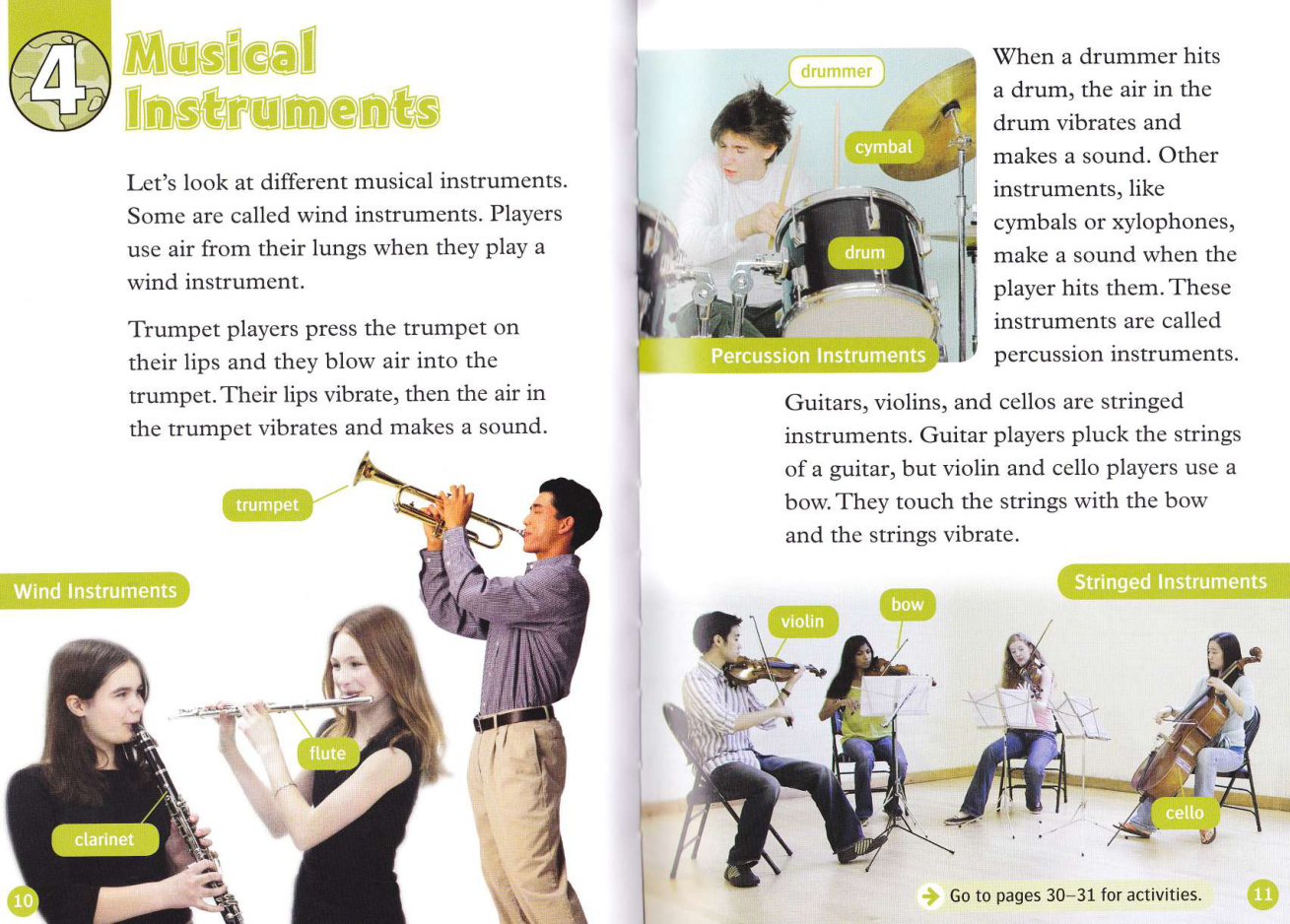
Let's look at different musical instruments. Some are called wind instruments. Players use air from their lungs when they play a wind instrument.
Trumpet players press the trumpet on their lips and they blow air into the trumpet. Their lips vibrate, then the air in the trumpet vibrates and makes a sound.
When a drummer hits a drum, the air in the drum vibrates and makes a sound.
Other instruments, like cymbals or xylophones, make a sound when the player hits them. These instruments are called percussion instruments.
Guitars, violins, and cellos are stringed instruments.
Guitar players pluck the strings of a guitar, but violin and cello players use a bow. They touch the strings with the bow and the strings vibrate.
Từ vựng
3 Xem trang bài tập
4 Bài tập tương tác
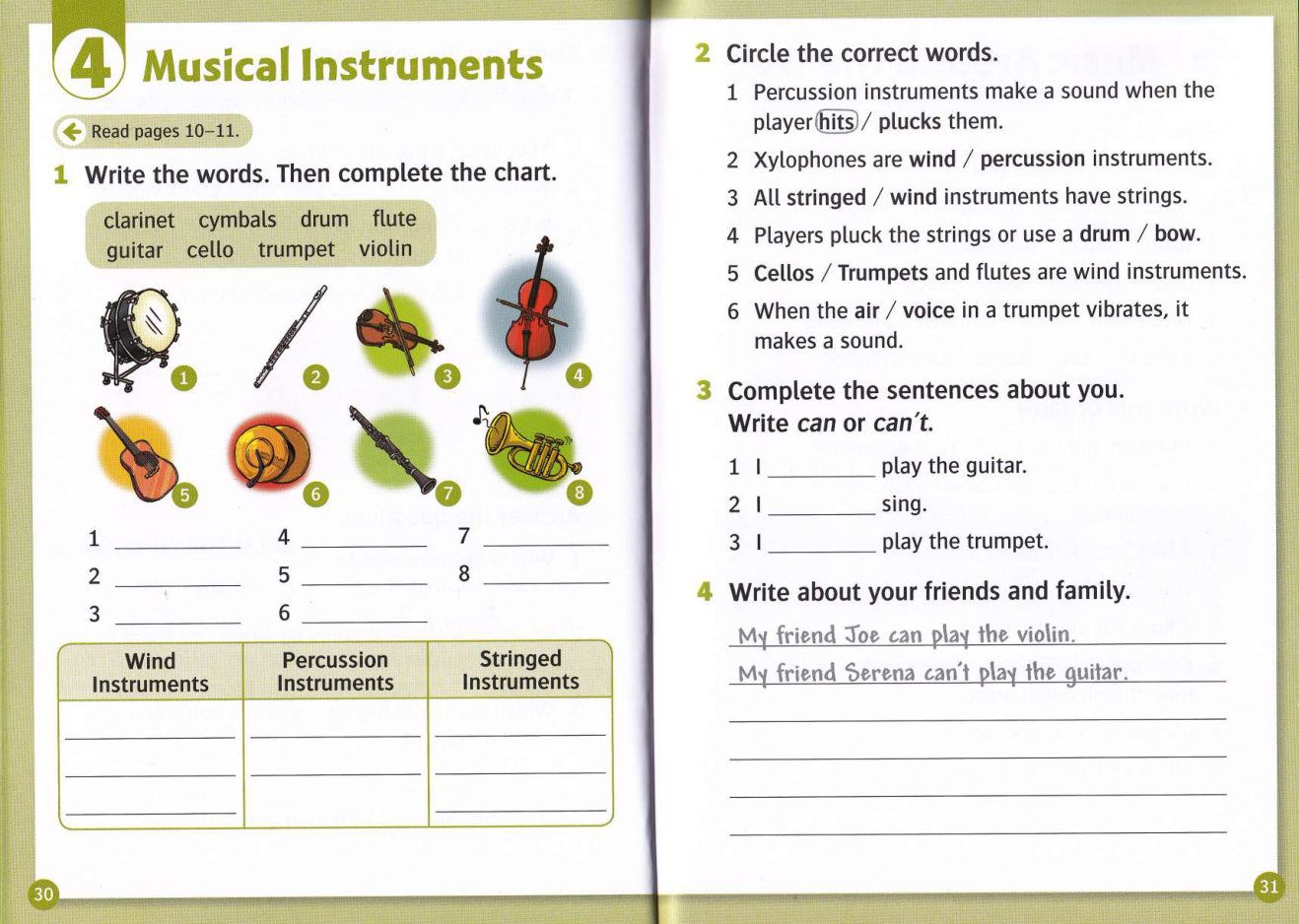
1. Write the eight musical-instrument words.
2. Classify the instruments.
3. Percussion instruments make a sound when the player …
4. Xylophones are … instruments.
5. All … instruments have strings.
6. Players pluck the strings or use a …
7. Trumpets and flutes are … instruments.
8. When the … in a trumpet vibrates, it makes a sound.
9. I can play the guitar.
Câu trả lời tự do — không tính vào điểm.10. I can sing.
Câu trả lời tự do — không tính vào điểm.11. I can play the trumpet.
Câu trả lời tự do — không tính vào điểm.12. Write about musical abilities of your friends or family.
Câu trả lời tự do — không tính vào điểm.Music Around the World
1 Đọc trang sách

2 Đọc & Nghe
Around the world you can find thousands of different musical instruments.
In Bali in Indonesia, there are orchestras called gamelans. In a gamelan there are lots of different percussion instruments. The players in a gamelan usually sit on the floor.
The bandoneon is a type of wind instrument. It's like a box with air inside. You squeeze it and it makes a sound. In Argentina, you can listen to bandoneon players in the streets.
The koto is a stringed instrument from Japan. It has 13 strings.
Koto players pluck the strings with their thumb and two fingers. The players move the small, white bridges to make different notes.
The sitar is a stringed instrument from India. It isn't easy to play. It has lots of strings. Some sitars have 23 strings.
Từ vựng
3 Xem trang bài tập
4 Bài tập tương tác
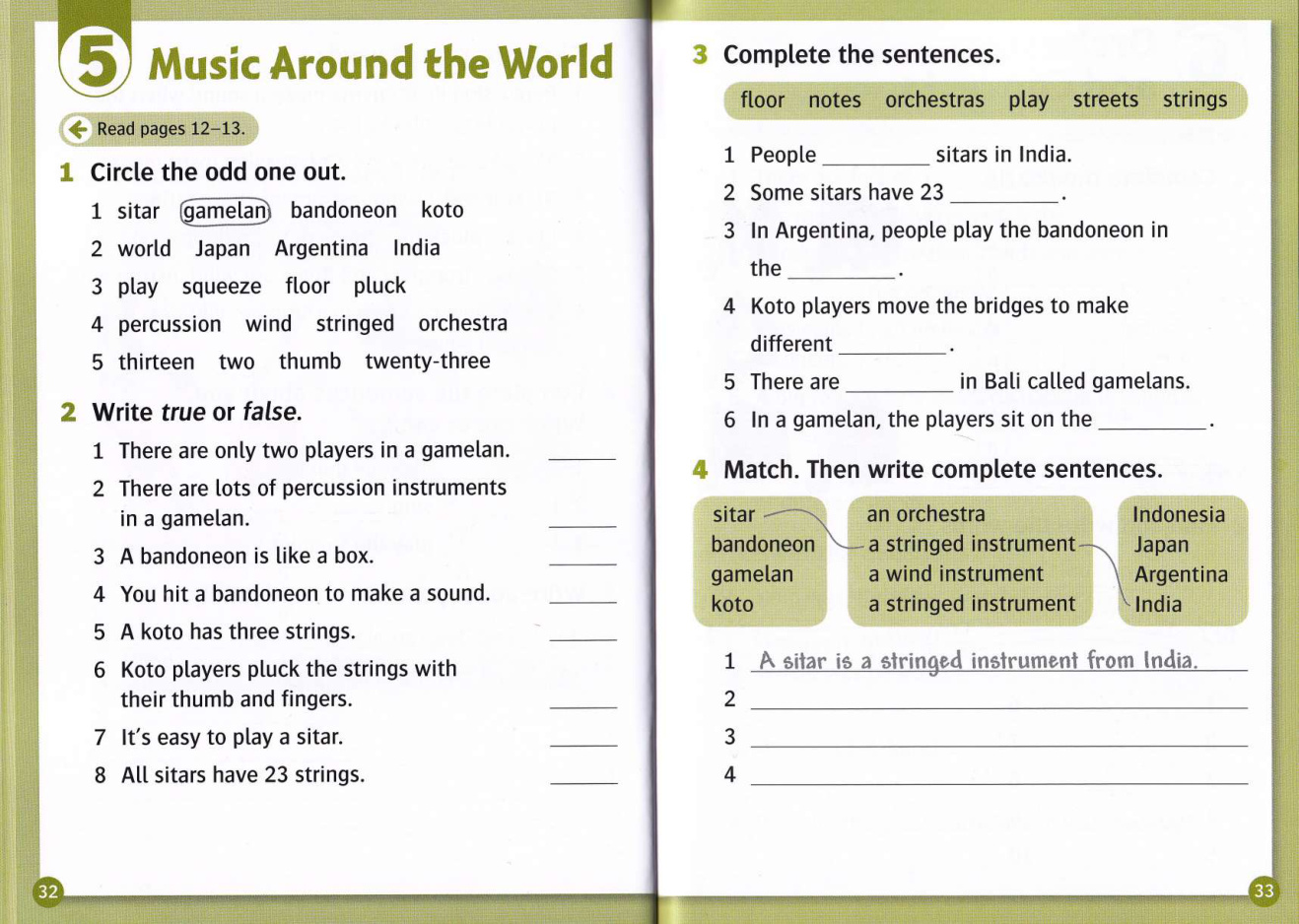
1. sitar / gamelan / bandoneon / koto – choose the odd one out
2. world / Japan / Argentina / India – choose the odd one out
3. play / squeeze / floor / pluck – choose the odd one out
4. percussion / wind / stringed / orchestra – choose the odd one out
5. thirteen / two / thumb / twenty-three – choose the odd one out
6. There are only two players in a gamelan.
7. There are lots of percussion instruments in a gamelan.
8. A bandoneon is like a box.
9. You hit a bandoneon to make a sound.
10. A koto has three strings.
11. Koto players pluck the strings with their thumb and fingers.
12. It's easy to play a sitar.
13. All sitars have 23 strings.
14. People _____ sitars in India.
15. Some sitars have 23 _____.
16. In Argentina, people play the bandoneon in the _____.
17. Koto players move the bridges to make different _____.
18. There are _____ in Bali called gamelans.
19. In a gamelan, the players sit on the _____.
20. Match instrument, type, and country.
Orchestras and Concerts
1 Đọc trang sách
2 Đọc & Nghe
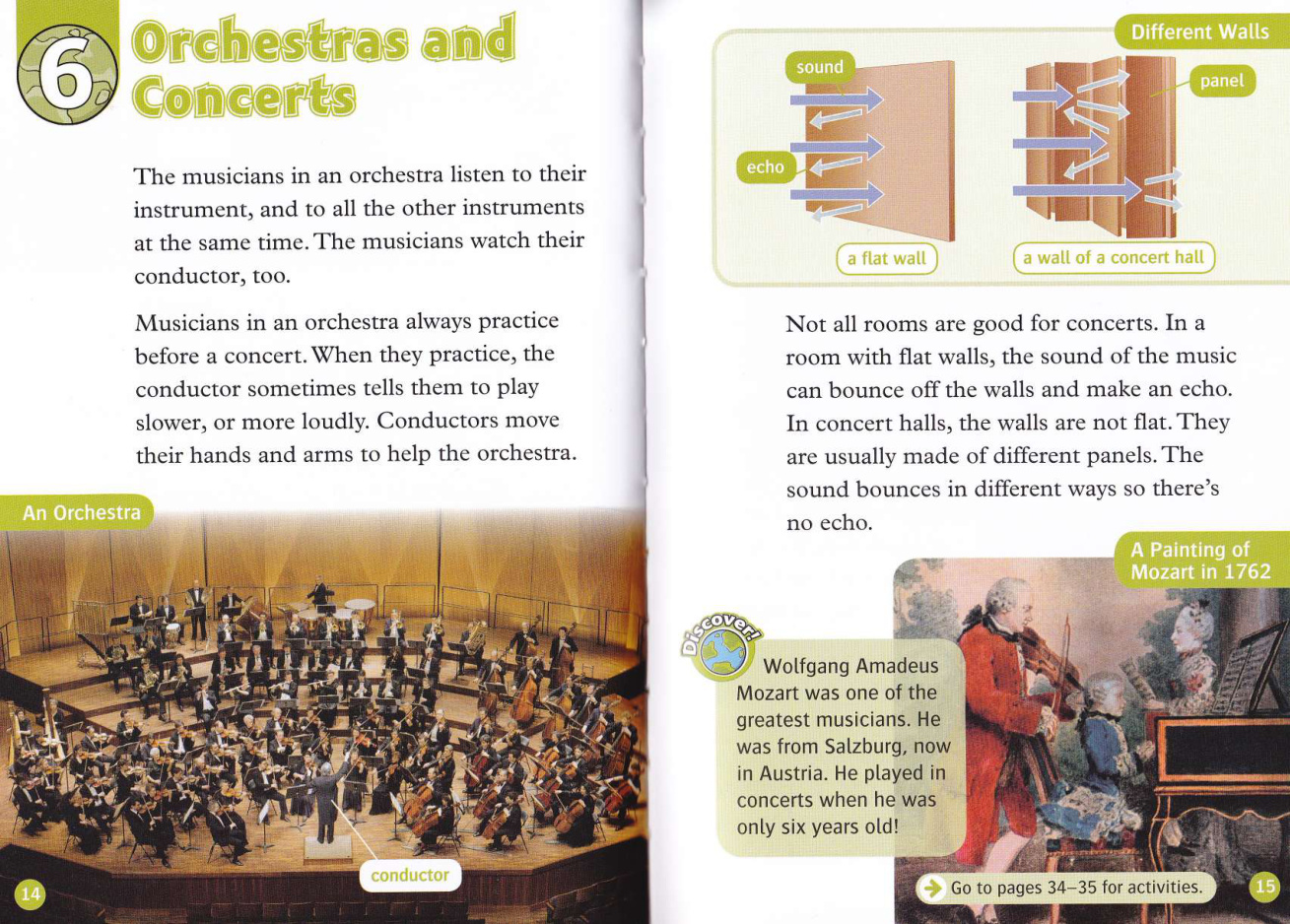
The musicians in an orchestra listen to their instrument, and to all the other instruments at the same time. The musicians watch their conductor, too.
Musicians in an orchestra always practice before a concert. When they practice, the conductor sometimes tells them to play slower, or more loudly.
Conductors move their hands and arms to help the orchestra.
Not all rooms are good for concerts. In a room with flat walls, the sound of the music can bounce off the walls and make an echo.
In concert halls, the walls are not flat. They are usually made of different panels. The sound bounces in different ways so there's no echo.
Wolfgang Amadeus Mozart was one of the greatest musicians. He was from Salzburg, now in Austria. He played in concerts when he was only six years old.
Từ vựng
3 Xem trang bài tập

4 Bài tập tương tác
1. Complete the orchestra picture puzzle.
- 1 Hàng ngang: the person who leads an orchestra
- 2 Hàng ngang: a large group of musicians
- 3 Hàng ngang: a wind instrument shown in the puzzle
- 4 Hàng ngang: a percussion instrument
- 5 Hàng ngang: people who play music
2. Find ten orchestra/concert words.
3. There are lots of _____ in an orchestra.
4. The musicians always watch the _____.
5. Conductors move their hands and arms to _____ the orchestra.
6. Musicians in an orchestra _____ before a concert.
7. A big room where concerts happen is called a concert _____.
8. The _____ of concert halls are usually made of different panels.
9. Who was Wolfgang Amadeus Mozart?
10. Where was he from?
11. Where is Salzburg?
12. Who are the great musicians in your country?
Câu trả lời tự do — không tính vào điểm.Rhythm
1 Đọc trang sách
2 Đọc & Nghe
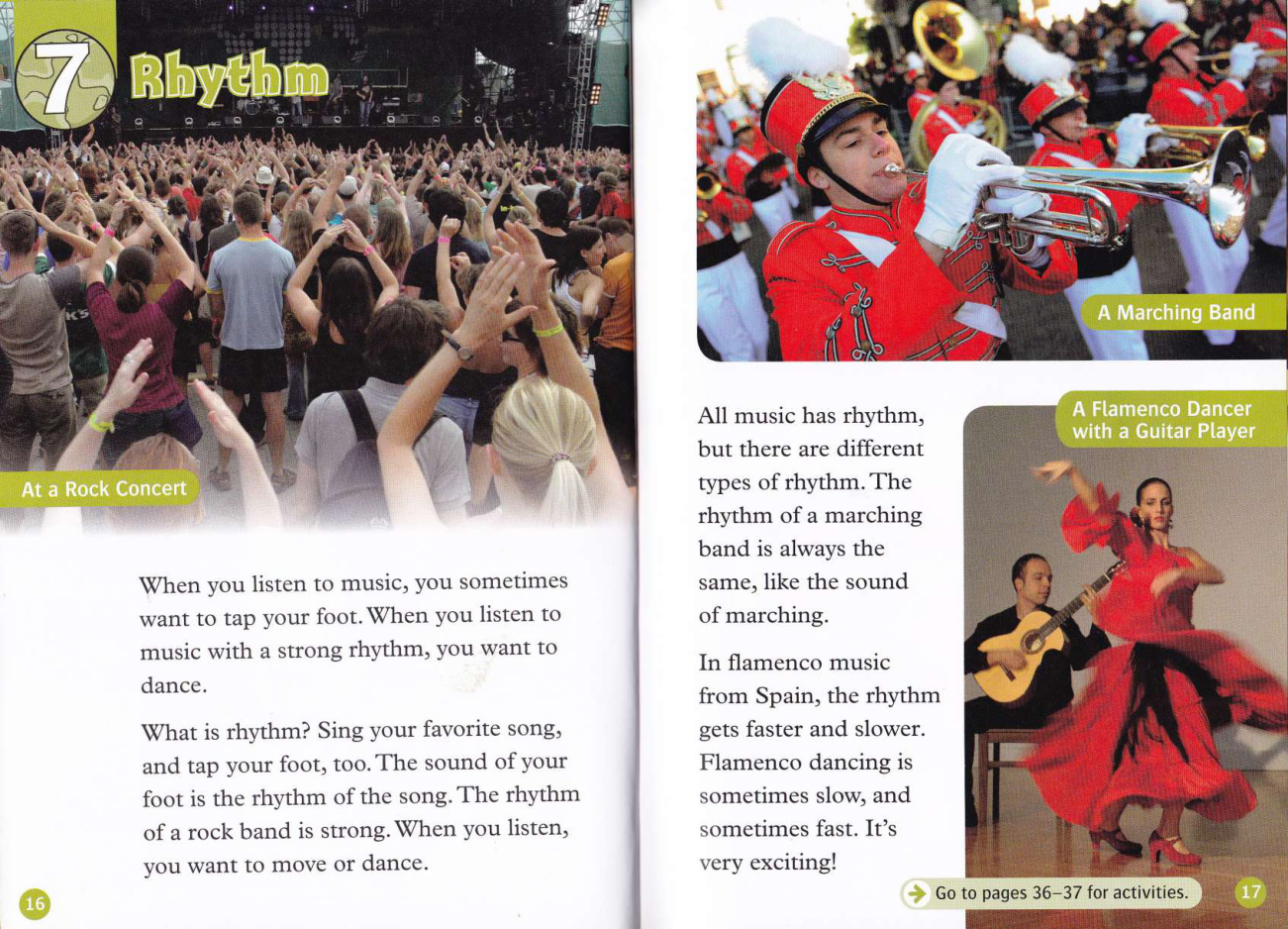
When you listen to music, you sometimes want to tap your foot. When you listen to music with a strong rhythm, you want to dance.
What is rhythm? Sing your favorite song, and tap your foot, too. The sound of your foot is the rhythm of the song.
The rhythm of a rock band is strong. When you listen, you want to move or dance.
All music has rhythm, but there are different types of rhythm.
The rhythm of a marching band is always the same, like the sound of marching.
In flamenco music from Spain, the rhythm gets faster and slower. Flamenco dancing is sometimes slow, and sometimes fast. It's very exciting!
Từ vựng
3 Xem trang bài tập

4 Bài tập tương tác
1. All music has rhythm.
2. All music has the same rhythm.
3. The music at rock concerts has a strong rhythm.
4. The rhythm of a marching band gets faster and slower.
5. Flamenco music is from Spain.
6. Flamenco music is always slow.
7. Match the beginnings and endings.
8. Put the words in the correct order.
- are
- There
- types
- of
- rhythm.
- different
9. Put the words in the correct order.
- is
- strong.
- rock
- band
- The
- rhythm
- of
- a
10. Put the words in the correct order.
- music
- Spain.
- Flamenco
- is
- from
11. Put the words in the correct order.
- exciting.
- very
- is
- Flamenco
- dancing
12. What is your favorite song?
Câu trả lời tự do — không tính vào điểm.13. Can you sing it and tap your foot at the same time?
Câu trả lời tự do — không tính vào điểm.14. Does it have a strong rhythm?
Câu trả lời tự do — không tính vào điểm.15. What music has a fast rhythm?
Câu trả lời tự do — không tính vào điểm.16. What music has a slow rhythm?
Câu trả lời tự do — không tính vào điểm.Recording Music
1 Đọc trang sách

2 Đọc & Nghe
Today there's music everywhere. People listen to music at home or in their car.
With an MP3 player, they can listen to their favorite songs when they are on a train or walking in the streets.
Where does a song come from? First, a songwriter writes a song and musicians play it. They practice, then they play the song in a recording studio in front of a microphone.
In the studio, a sound engineer uses recording equipment and records the song.
Now the song is a lot of digital signals. The sound engineer uses a computer and works with the signals. This makes the sound of the song better.
The first sound recordings were about 130 years ago. The first microphones were like big trumpets.
Từ vựng
3 Xem trang bài tập

4 Bài tập tương tác
1. Write the six recording-music words.
2. Number the steps for recording a song.
- Musicians practice the song.
- The musicians play the song in front of a microphone.
- The musicians go to a recording studio.
- A sound engineer records the song.
- A songwriter writes a song.
3. Correct the sentence: Today, people have MP3 songs.
4. Correct the sentence: They can't listen to their MP3 player in the streets.
5. Correct the sentence: A microphone writes songs.
6. Correct the sentence: A sound engineer works in a store.
7. Correct the sentence: A sound engineer doesn't have a computer.
8. Where do people listen to their MP3 player?
9. Where do musicians record their songs?
10. What does a sound engineer do?
11. Do you have an MP3 player?
Câu trả lời tự do — không tính vào điểm.Buying Music
1 Đọc trang sách

2 Đọc & Nghe
Today, people can buy music on the Internet. The music comes to their computer or phone.
The music is made of thousands of digital signals. These signals stay on the computer or phone, and people can listen to the music when they want.
People can also move the music from their computer to their MP3 player.
In the past, it wasn't so easy to buy music. About 100 years ago, people started to buy records. They played them on record players.
Later, there were big jukeboxes in cafés. In a jukebox there were about 50 records. People put coins in the jukebox and it played their favorite song.
About 40 years ago, there were cassettes. They were good because people played them in their cars.
Then about 30 years ago, there were compact discs, or CDs.
Từ vựng
3 Xem trang bài tập
4 Bài tập tương tác
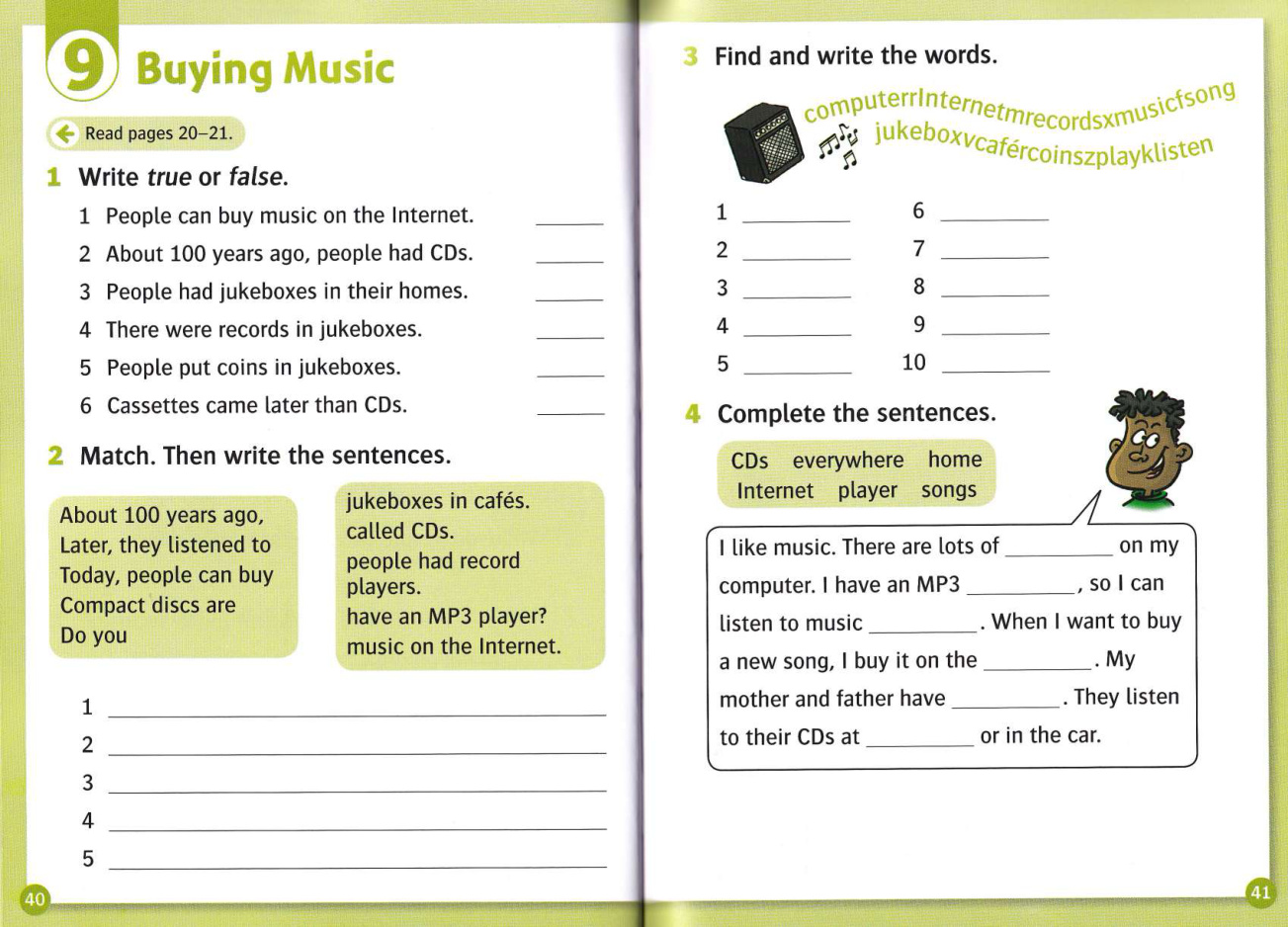
1. People can buy music on the Internet.
2. About 100 years ago, people had CDs.
3. People had jukeboxes in their homes.
4. There were records in jukeboxes.
5. People put coins in jukeboxes.
6. Cassettes came later than CDs.
7. Match the beginnings and endings.
8. Find ten buying-music words.
9. I like music. There are lots of _____ on my computer.
10. I have an MP3 _____, so I can listen to music _____.
11. When I want to buy a new song, I buy it on the _____.
12. My mother and father have _____.
13. They listen to their CDs at _____ or in the car.
Sound and Noise
1 Đọc trang sách

2 Đọc & Nghe
We measure sound in decibels. The sound of a quiet wind is 10 decibels. When people speak, their voices are about 50 decibels.
A jackhammer is about 100 decibels. Sounds of more than 120 decibels can be bad for your ears. A very loud sound or a bad sound is usually called a noise.
Some animals can hear better than people. Your cat can hear more sounds than you.
Don't listen to very loud music with earphones. It can hurt your ears.
Other loud noises can be good, like the sound of a car. It tells you, 'A car is coming. Don't cross the street now.' Always listen carefully before you cross the street.
Listen to music, listen to people's voices, listen to the wind. Use your ears and listen to all the sounds around you!
Từ vựng
3 Xem trang bài tập
4 Bài tập tương tác
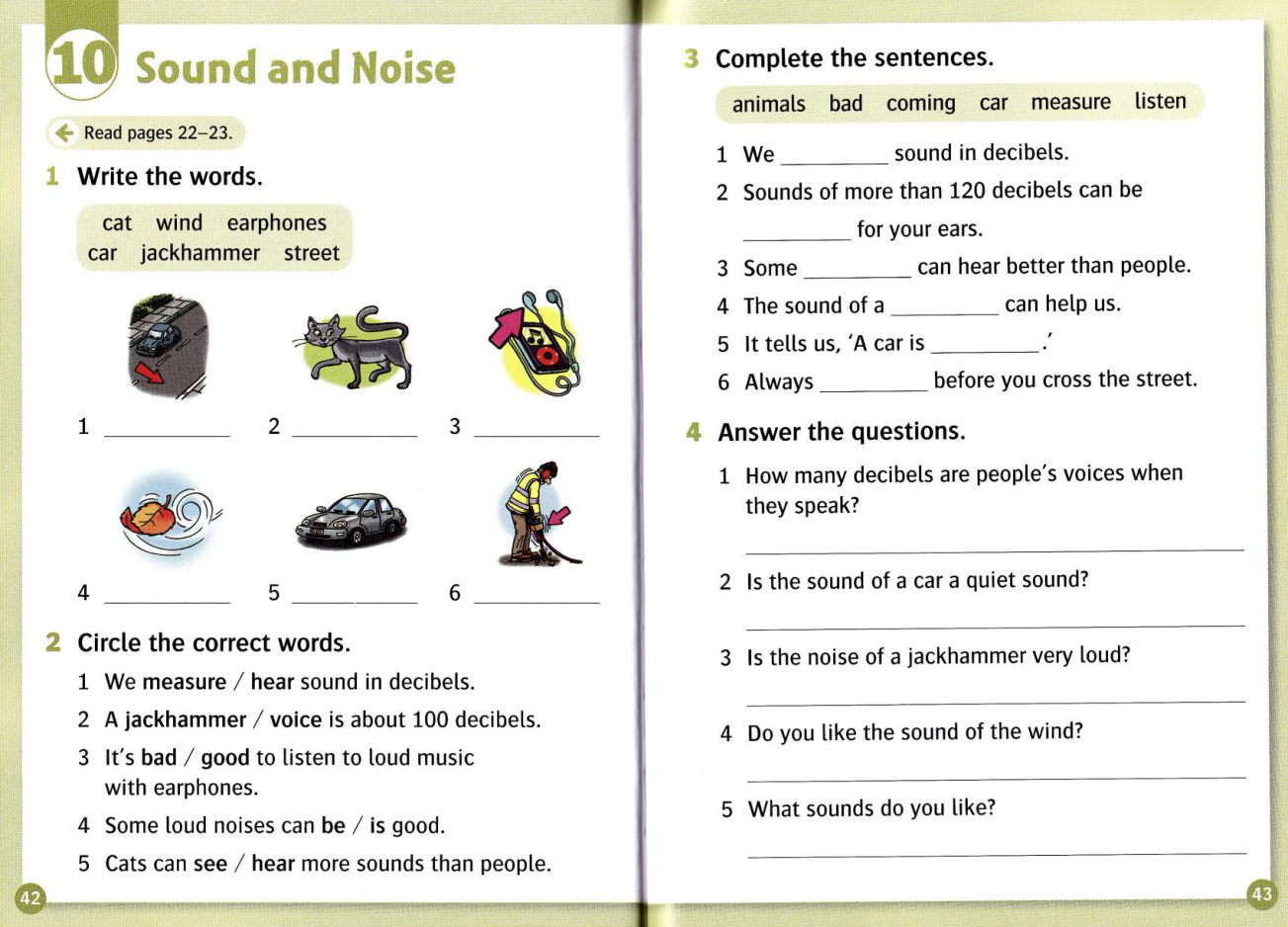
1. Write the six sound-and-noise words.
2. We _____ sound in decibels.
3. A _____ is about 100 decibels.
4. It's _____ to listen to loud music with earphones.
5. Some loud noises can be _____.
6. Cats can _____ more sounds than people.
7. We _____ sound in decibels.
8. Sounds of more than 120 decibels can be _____ for your ears.
9. Some _____ can hear better than people.
10. The sound of a _____ can help us.
11. It tells us, 'A car is _____.''
12. Always _____ before you cross the street.
13. How many decibels are people's voices when they speak?
14. Is the sound of a car a quiet sound?
15. Is the noise of a jackhammer very loud?
16. Do you like the sound of the wind?
Câu trả lời tự do — không tính vào điểm.17. What sounds do you like?
Câu trả lời tự do — không tính vào điểm.Projects
Trang dự án
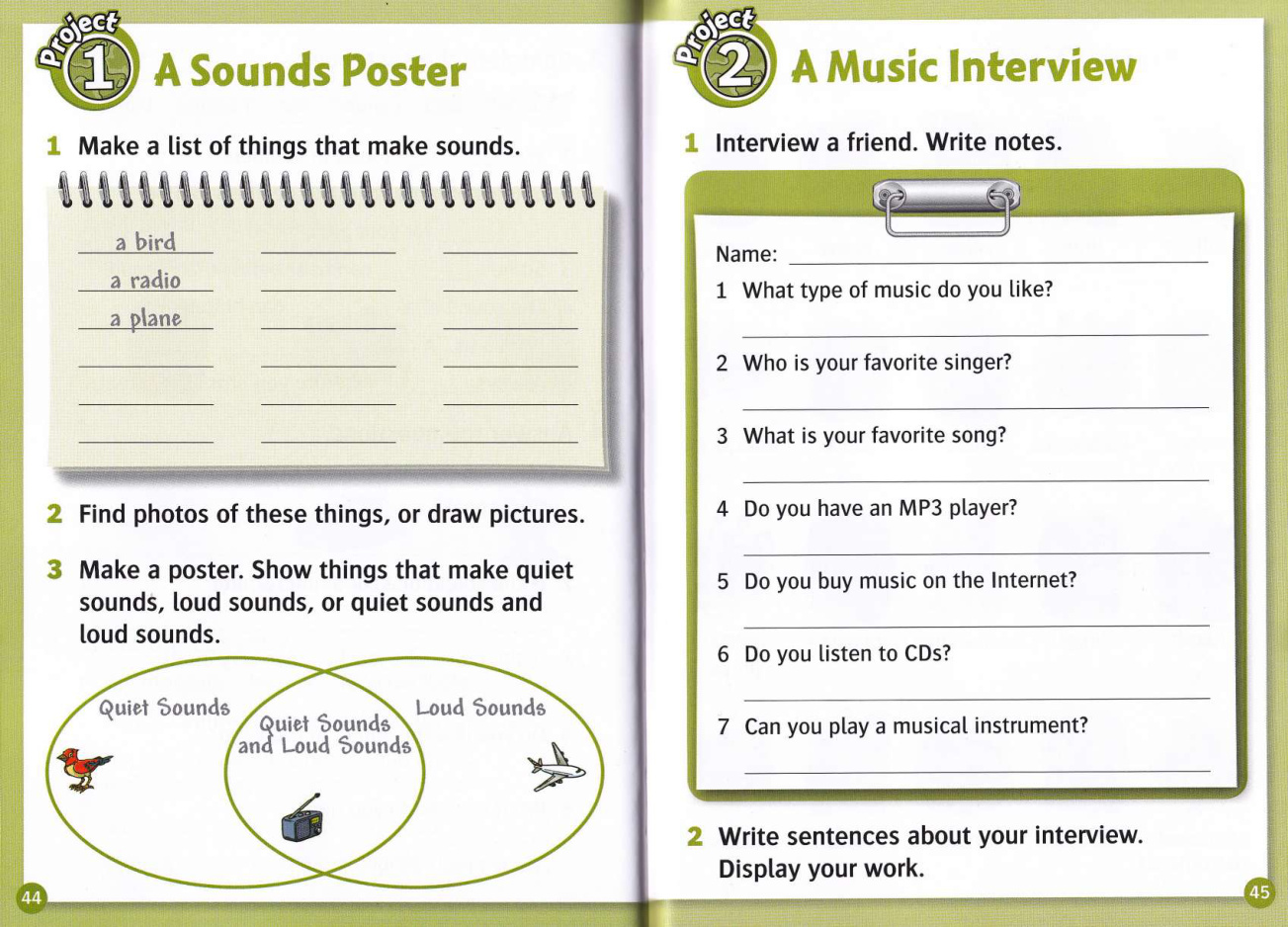
Project 1: A Sounds Poster – list things that make sounds, find or draw pictures, and classify them as quiet sounds, loud sounds, or both. Project 2: A Music Interview – interview a friend about music preferences and habits, write sentences about the interview, and display the work.
Từ điển tranh
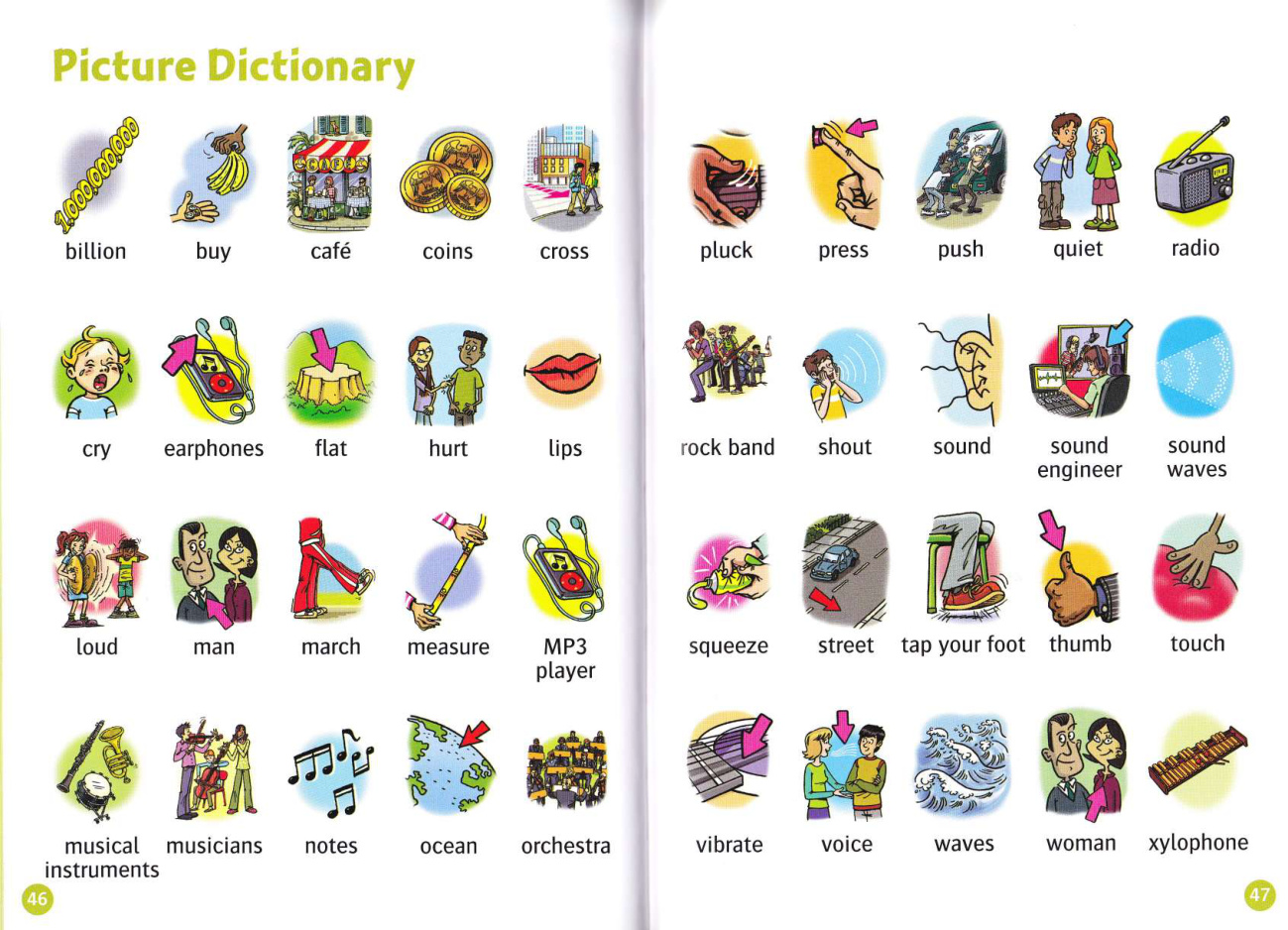
Từ điển tranh