Your Five Senses
Đọc · Nghe · Từ vựng · Bài tập · Dự án · Từ điển tranh
Your Sense of Sight
1 Đọc trang sách
2 Đọc & Nghe
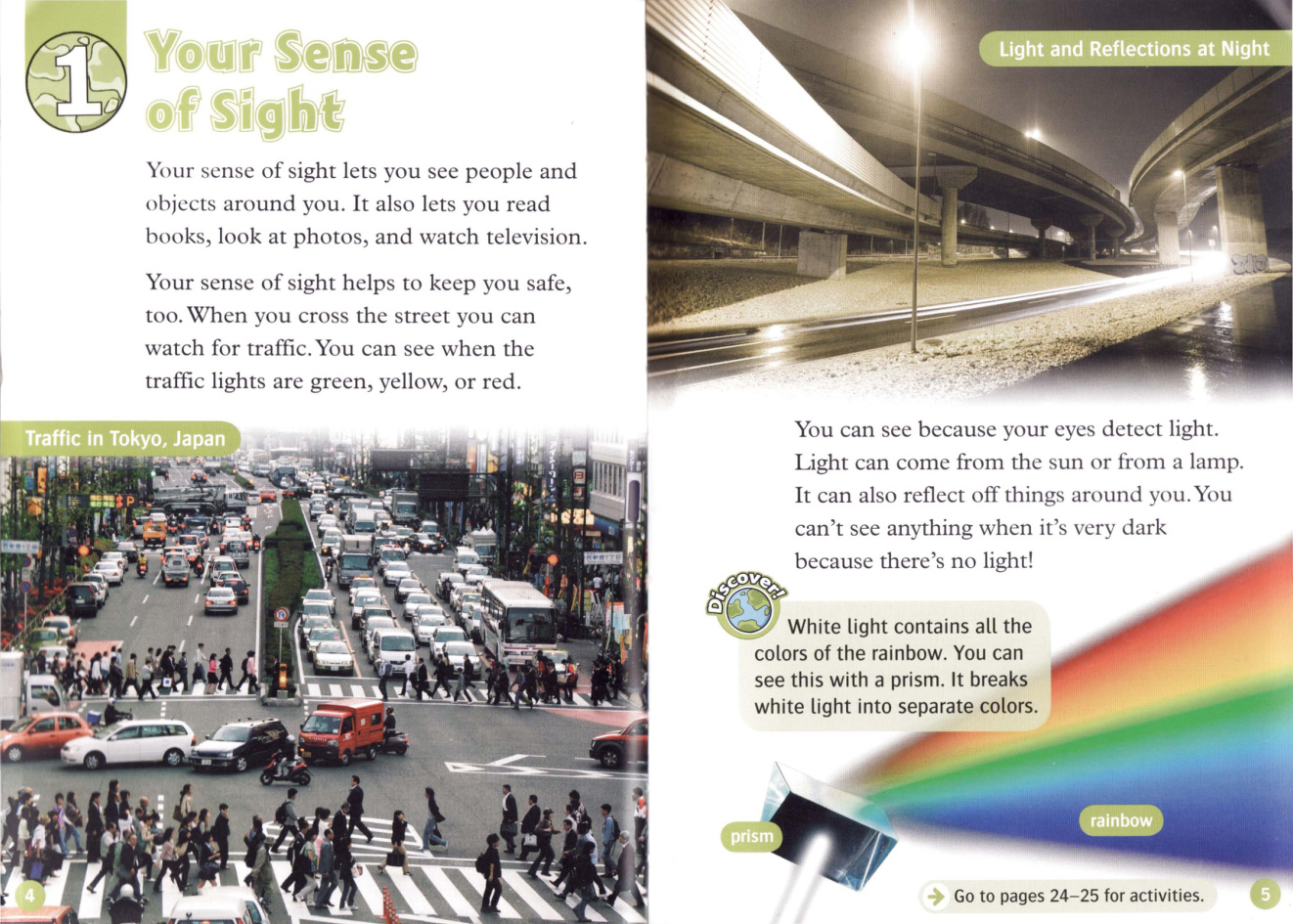
Your sense of sight lets you see people and objects around you. It also lets you read books, look at photos, and watch television.
Your sense of sight helps to keep you safe, too. When you cross the street you can watch for traffic. You can see when the traffic lights are green, yellow, or red.
You can see because your eyes detect light. Light can come from the sun or from a lamp.
Light can also reflect off things around you. You can't see anything when it's very dark because there's no light.
White light contains all the colors of the rainbow. You can see this with a prism. It breaks white light into separate colors.
Từ vựng
3 Xem trang bài tập
4 Bài tập tương tác
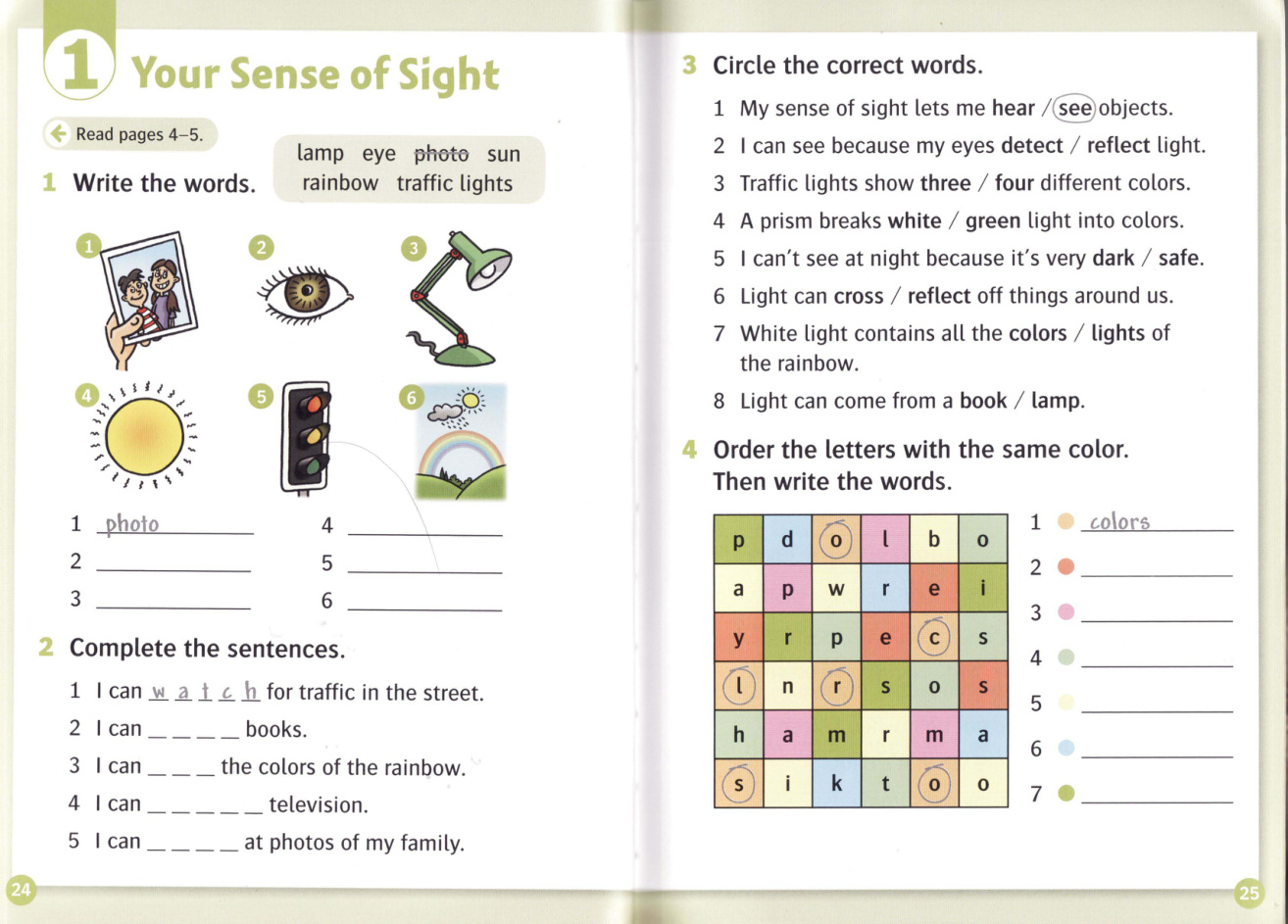
1. Write the six sight words shown in Activity 1.
2. I can _____ for traffic in the street.
3. I can _____ books.
4. I can _____ the colors of the rainbow.
5. I can _____ television.
6. I can _____ at photos of my family.
7. My sense of sight lets me hear / see objects.
8. I can see because my eyes detect / reflect light.
9. Traffic lights show three / four different colors.
10. A prism breaks white / green light into colors.
11. I can't see at night because it's very dark / safe.
12. Light can cross / reflect off things around us.
13. White light contains all the colors / lights of the rainbow.
14. Light can come from a book / lamp.
15. Order the letters to make seven sight words.
A Closer Look
1 Đọc trang sách
2 Đọc & Nghe
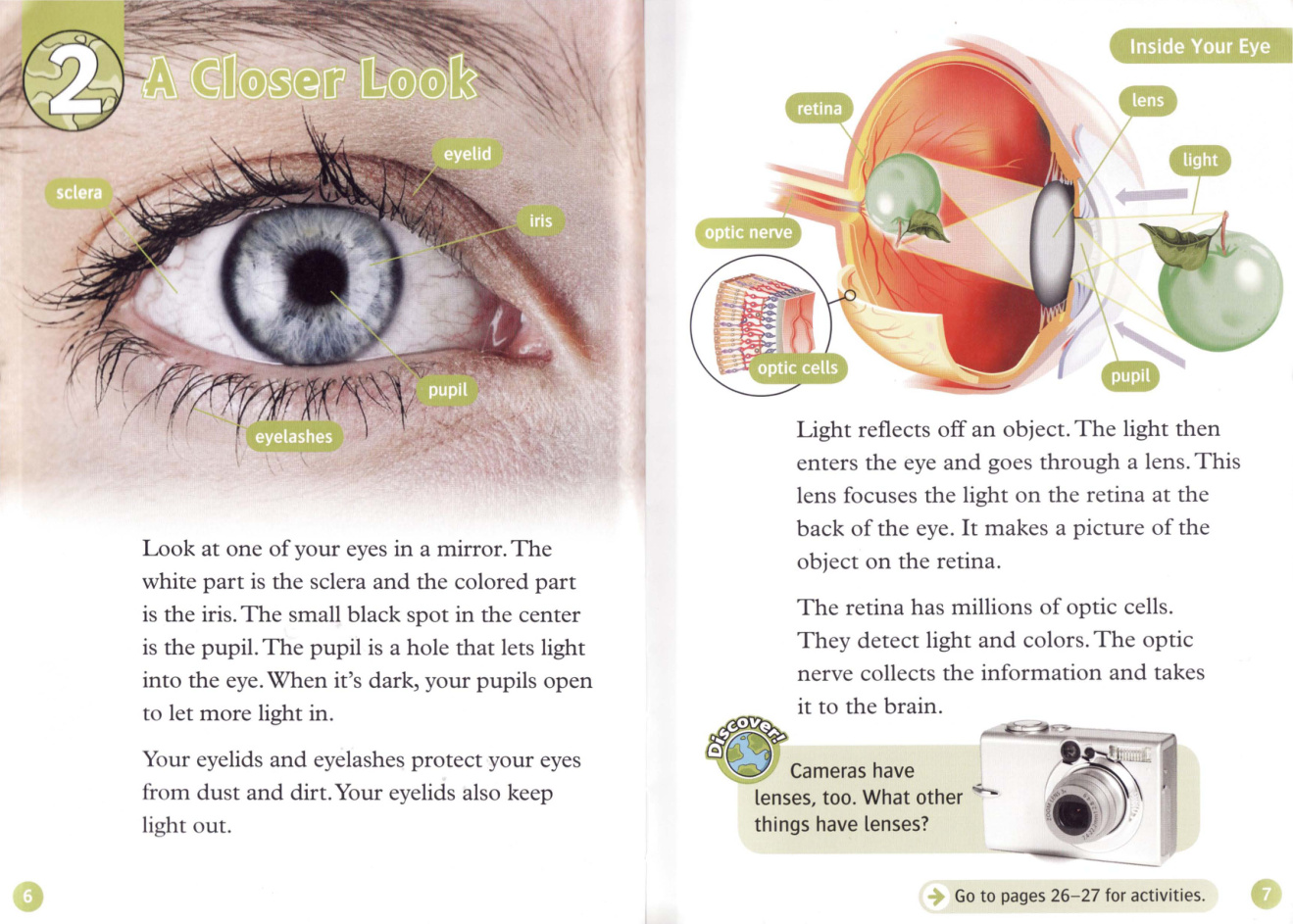
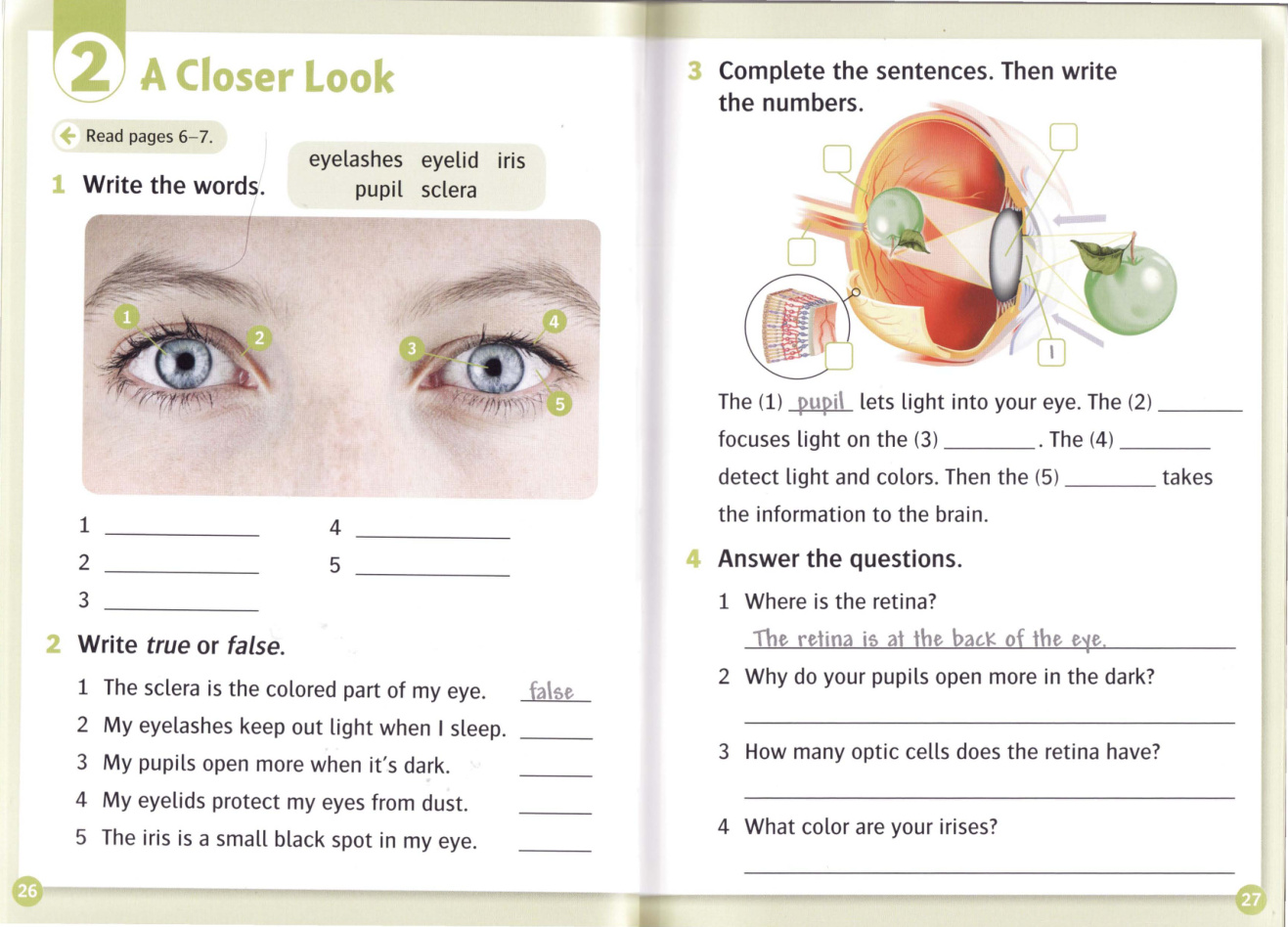
Look at one of your eyes in a mirror. The white part is the sclera and the colored part is the iris.
The small black spot in the center is the pupil. The pupil is a hole that lets light into the eye. When it's dark, your pupils open to let more light in.
Your eyelids and eyelashes protect your eyes from dust and dirt. Your eyelids also keep light out.
Light reflects off an object. The light then enters the eye and goes through a lens.
This lens focuses the light on the retina at the back of the eye. It makes a picture of the object on the retina.
The retina has millions of optic cells. They detect light and colors.
The optic nerve collects the information and takes it to the brain.
Từ vựng
3 Xem trang bài tập
4 Bài tập tương tác
1. Write the five outside-eye words.
2. The sclera is the colored part of my eye.
3. My eyelashes keep out light when I sleep.
4. My pupils open more when it's dark.
5. My eyelids protect my eyes from dust.
6. The iris is a small black spot in my eye.
7. The _____ lets light into your eye.
8. The _____ focuses light on the retina.
9. The _____ is at the back of the eye.
10. The _____ detect light and colors.
11. The _____ takes information to the brain.
12. Where is the retina?
13. Why do your pupils open more in the dark?
14. How many optic cells does the retina have?
15. What color are your irises?
Your Sense of Hearing
1 Đọc trang sách
2 Đọc & Nghe
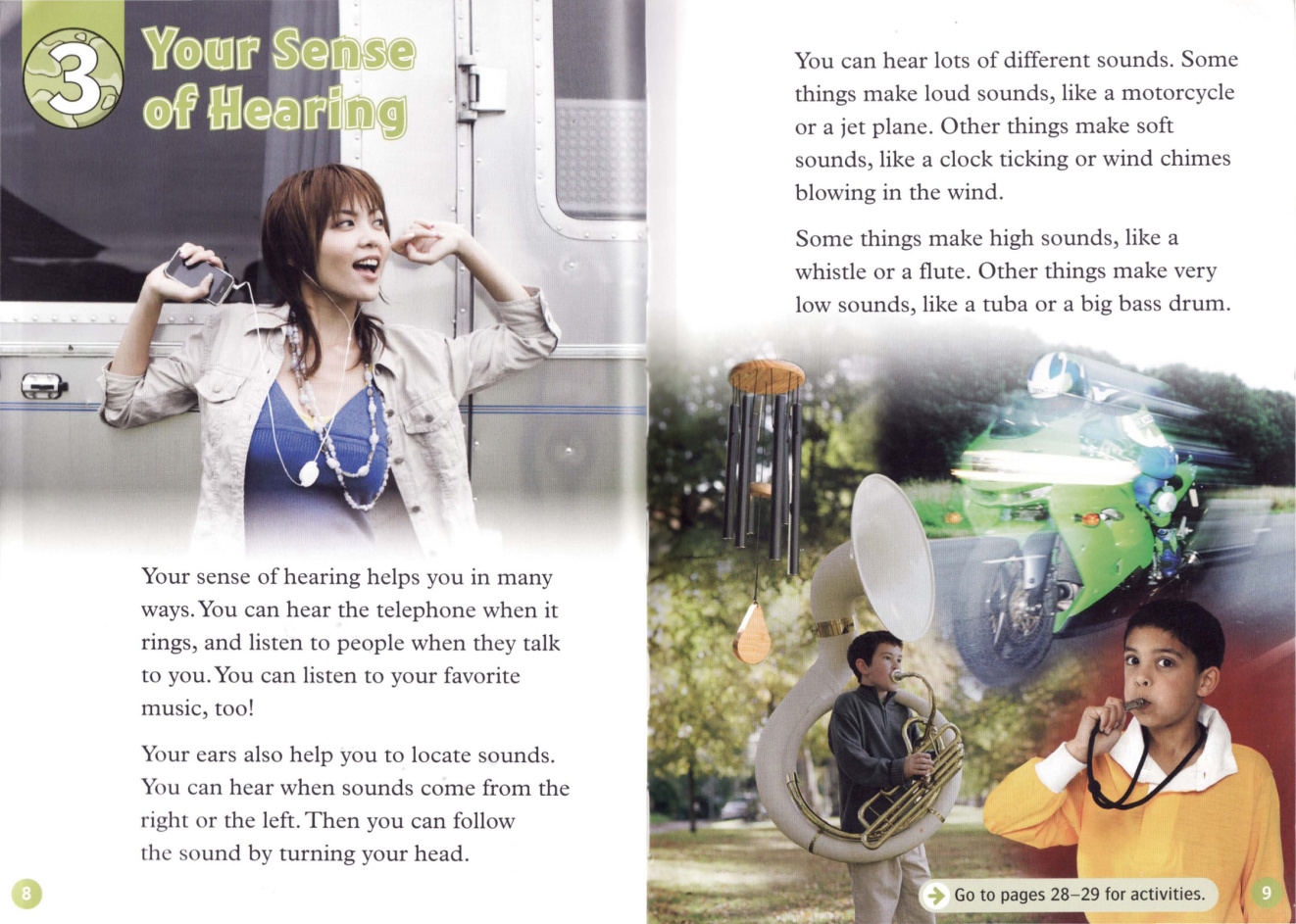
Your sense of hearing helps you in many ways. You can hear the telephone when it rings, and listen to people when they talk to you. You can listen to your favorite music, too.
Your ears also help you to locate sounds. You can hear when sounds come from the right or the left. Then you can follow the sound by turning your head.
You can hear lots of different sounds.
Some things make loud sounds, like a motorcycle or a jet plane. Other things make soft sounds, like a clock ticking or wind chimes blowing in the wind.
Some things make high sounds, like a whistle or a flute. Other things make very low sounds, like a tuba or a big bass drum.
Từ vựng
3 Xem trang bài tập

4 Bài tập tương tác
1. Match the sentence beginnings and endings.
2. Write the eight hearing words.
3. A whistle makes high / low sounds.
4. A jet plane makes very loud / soft sounds.
5. A tuba makes high / low sounds.
6. Wind chimes make loud / soft sounds.
7. A flute makes high / low sounds.
8. A motorcycle makes very loud / soft sounds.
9. Find ten hearing words.
10. I can hear …
Câu trả lời tự do — không tính vào điểm.11. I can listen to …
Câu trả lời tự do — không tính vào điểm.Inside Your Ear
1 Đọc trang sách

2 Đọc & Nghe
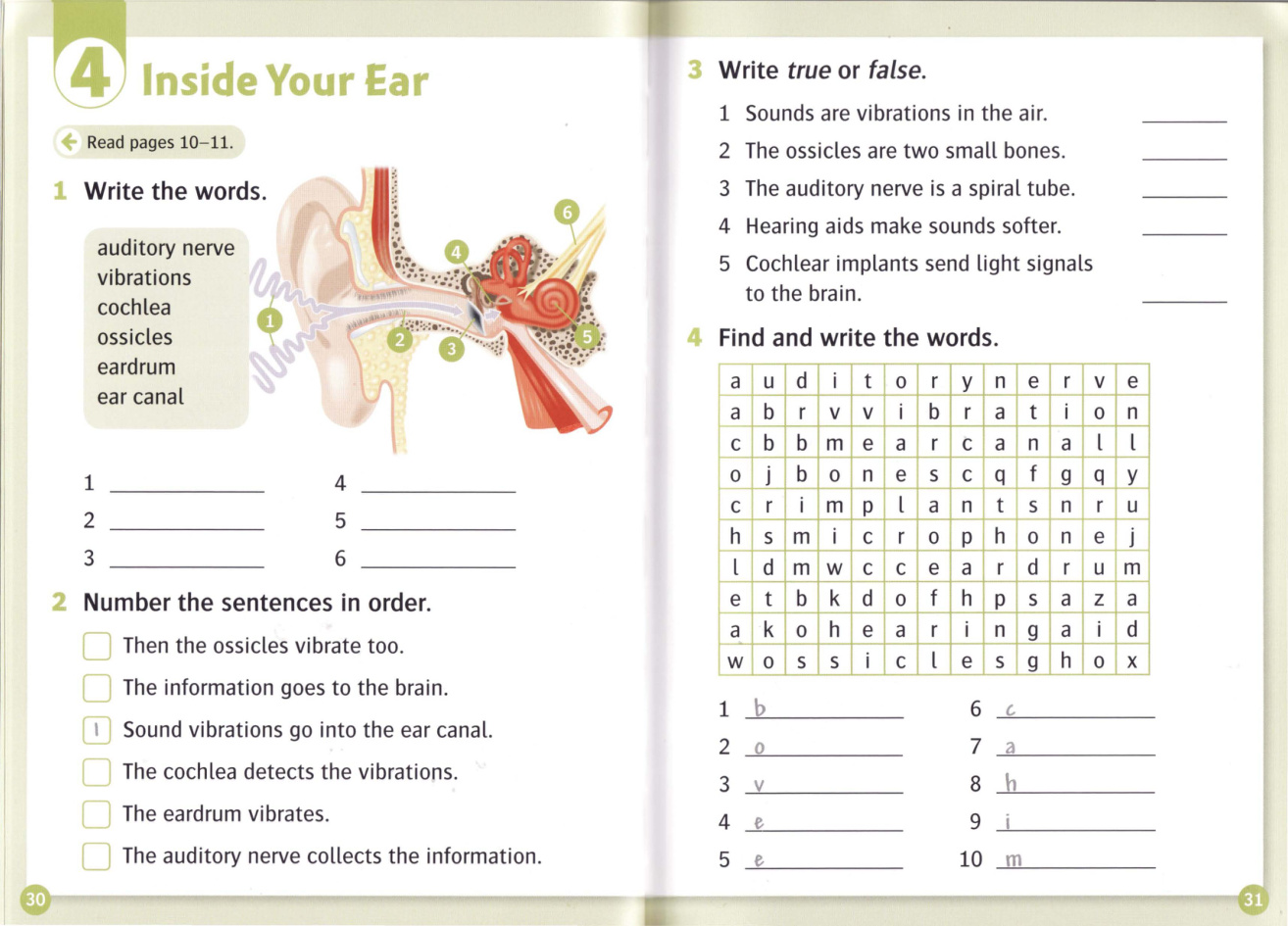
Sounds are vibrations in the air that your ears can detect.
First the vibrations go into your ear canal. Then your eardrum vibrates.
Behind your eardrum there are three small bones called ossicles. They also vibrate.
Next to the ossicles there is a spiral tube called the cochlea. It detects vibrations from the ossicles.
Then the auditory nerve collects the information and takes it to your brain. This is how you hear.
The ossicles are the smallest bones in your body.
Some people don't hear well. Sometimes they wear a hearing aid to make sounds louder.
Other people have a cochlear implant. The implant detects sounds with a microphone. Then it sends electrical signals to the cochlea inside the ear.
Từ vựng
3 Xem trang bài tập
4 Bài tập tương tác
1. Write the six ear-part words.
2. Put the hearing process in order.
- Then the ossicles vibrate too.
- The information goes to the brain.
- Sound vibrations go into the ear canal.
- The cochlea detects the vibrations.
- The eardrum vibrates.
- The auditory nerve collects the information.
3. Sounds are vibrations in the air.
4. The ossicles are two small bones.
5. The auditory nerve is a spiral tube.
6. Hearing aids make sounds softer.
7. Cochlear implants send light signals to the brain.
8. Find ten ear/hearing words.
Your Sense of Smell
1 Đọc trang sách

2 Đọc & Nghe
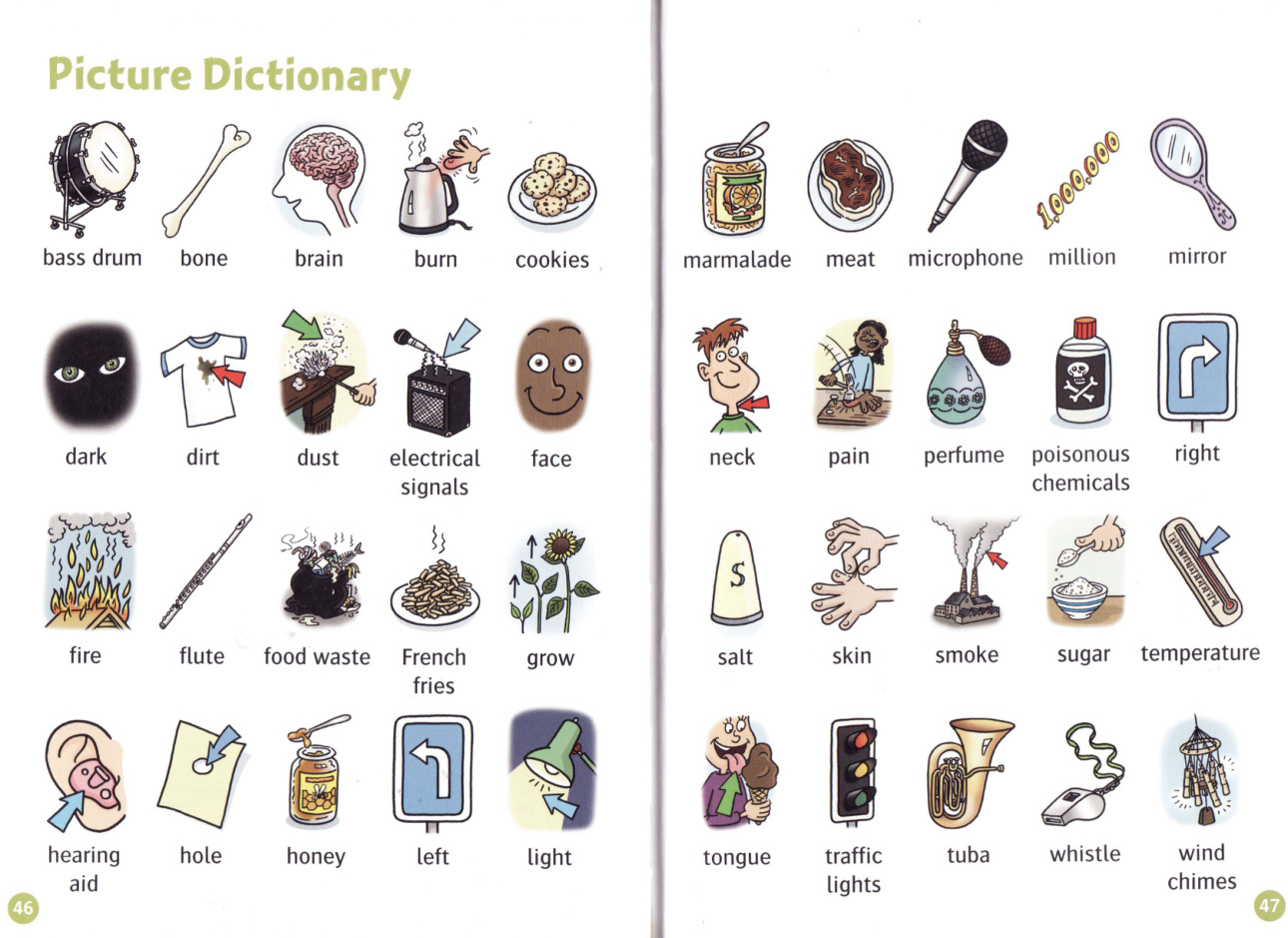
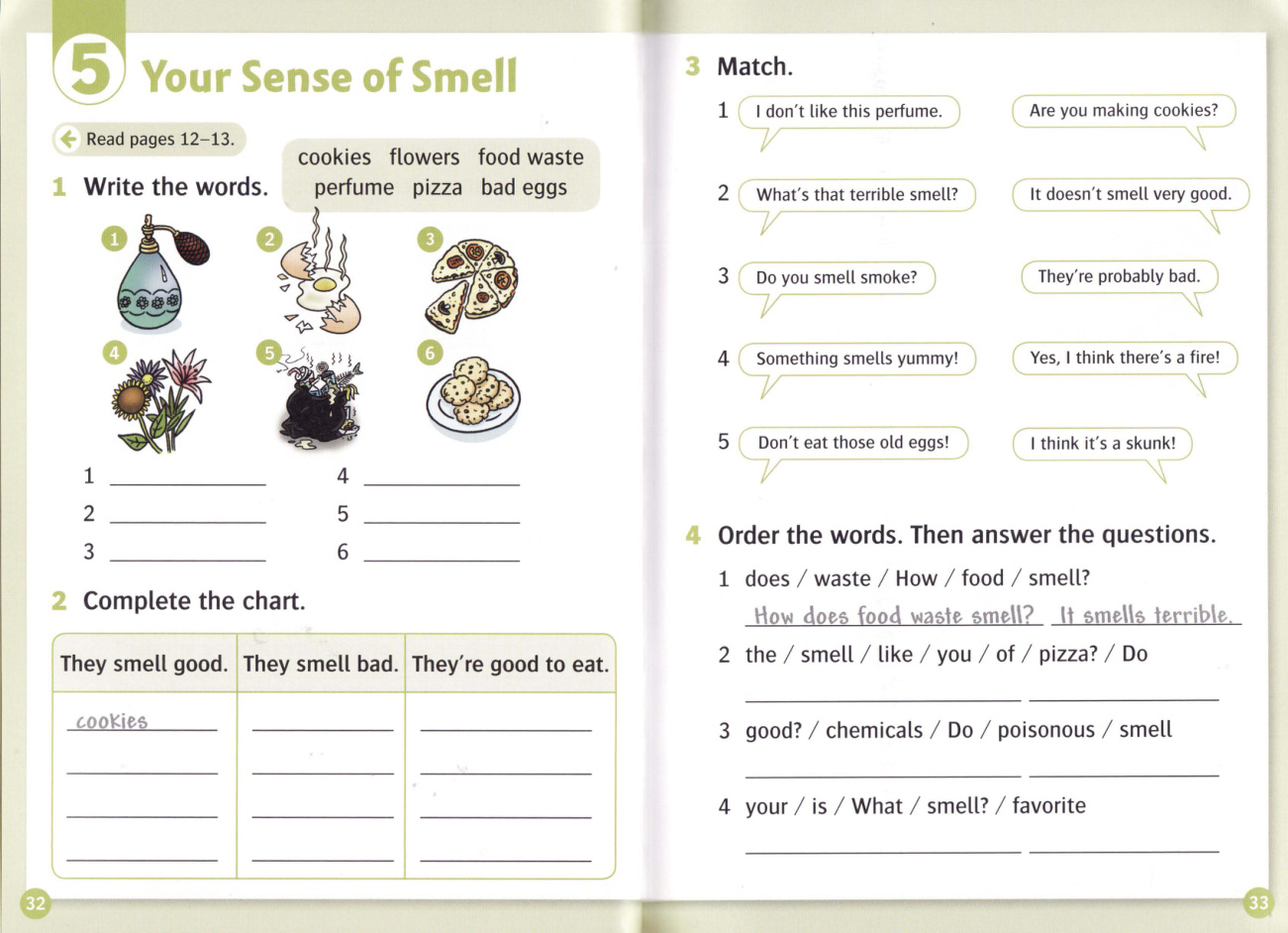
Your nose lets you smell things. Some things smell good, like pizza or fresh cookies. The yummy smells tell you they are probably good to eat.
Flowers and perfume often smell good, too.
Some things smell bad, like food waste or bad eggs. Your nose tells you they aren't good to eat. They can make you very sick.
Your nose tells you about other dangers, too. When there's a fire, you can smell the smoke and call for help.
Poisonous chemicals often smell bad. Your nose tells you they are dangerous.
Skunks can spray a liquid that smells terrible. They use it for protection.
Từ vựng
3 Xem trang bài tập
4 Bài tập tương tác
1. Write the six smell words.
2. Classify the smell examples.
3. Match each comment with the best reply.
4. Put the words in the correct order.
- does
- waste
- How
- food
- smell?
5. Put the words in the correct order.
- the
- smell
- like
- you
- of
- pizza?
- Do
6. Put the words in the correct order.
- good?
- chemicals
- Do
- poisonous
- smell
7. Put the words in the correct order.
- your
- is
- What
- smell?
- favorite
How Your Nose Works
1 Đọc trang sách
2 Đọc & Nghe
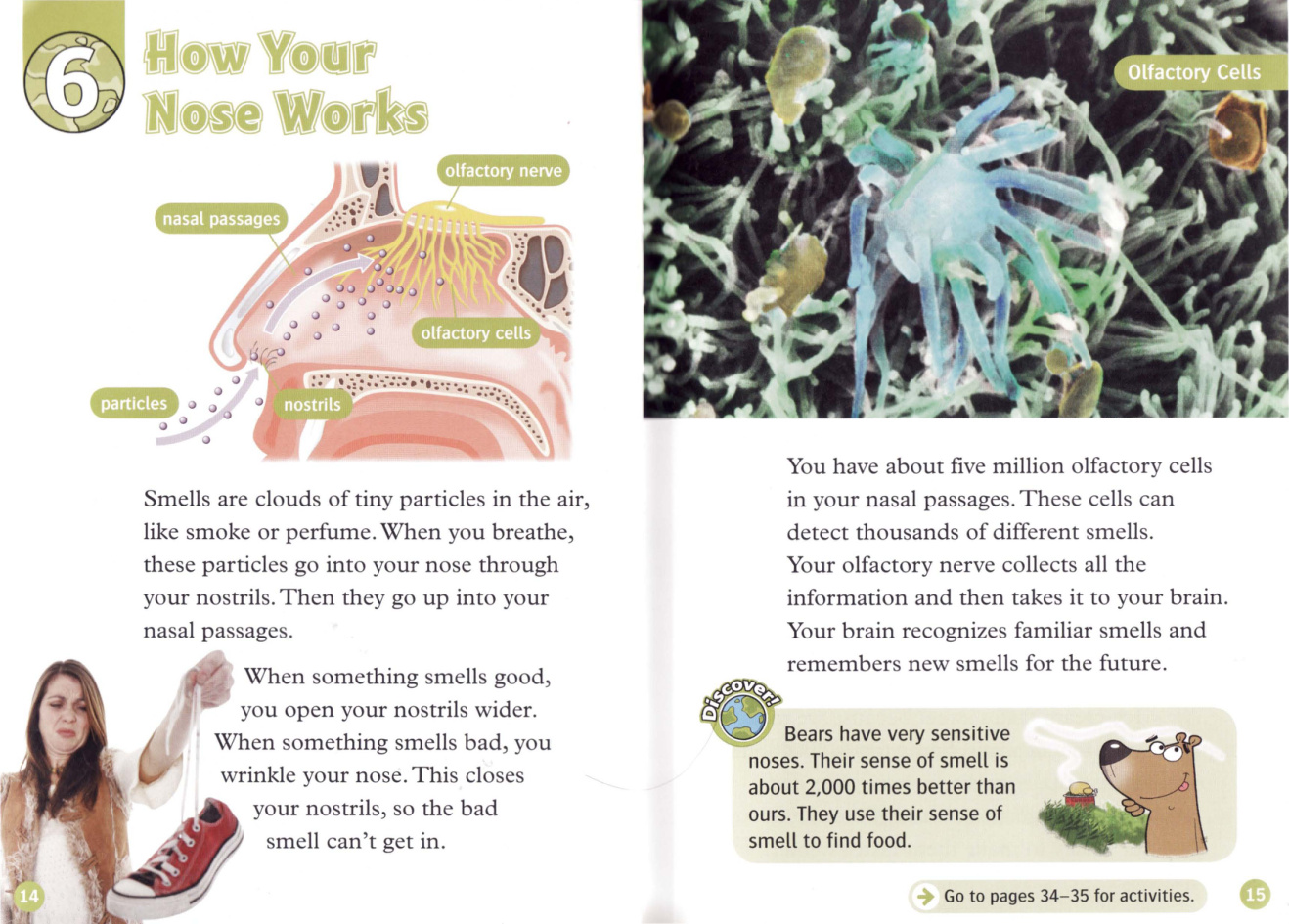
Smells are clouds of tiny particles in the air, like smoke or perfume.
When you breathe, these particles go into your nose through your nostrils. Then they go up into your nasal passages.
When something smells good, you open your nostrils wider.
When something smells bad, you wrinkle your nose. This closes your nostrils, so the bad smell can't get in.
You have about five million olfactory cells in your nasal passages. These cells can detect thousands of different smells.
Your olfactory nerve collects all the information and then takes it to your brain.
Your brain recognizes familiar smells and remembers new smells for the future.
Bears have very sensitive noses. Their sense of smell is about 2,000 times better than ours. They use their sense of smell to find food.
Từ vựng
3 Xem trang bài tập

4 Bài tập tương tác
1. Write the five nose-part words.
2. Smells are _____ of tiny particles in the _____.
3. My _____ let the smell particles into my _____.
4. Then the _____ go up into my _____ passages.
5. My _____ cells detect all the _____ smells.
6. My olfactory _____ takes information to my _____.
7. When do your nostrils open wider?
8. Where are your olfactory cells?
9. How many olfactory cells do you have?
10. What smells does your brain recognize?
11. Unscramble the smell-system words.
Your Sense of Taste
1 Đọc trang sách
2 Đọc & Nghe
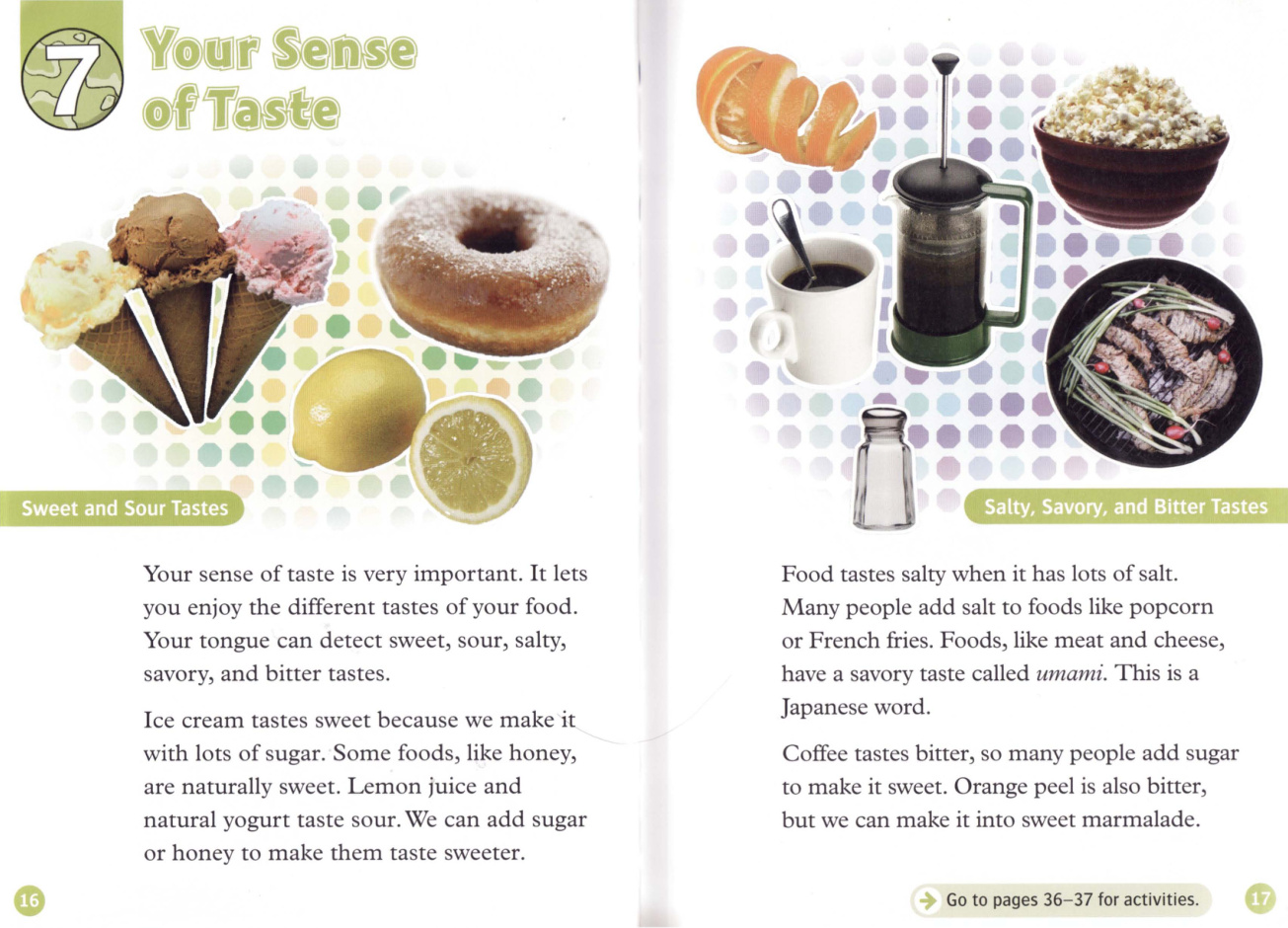
Your sense of taste is very important. It lets you enjoy the different tastes of your food.
Your tongue can detect sweet, sour, salty, savory, and bitter tastes.
Ice cream tastes sweet because we make it with lots of sugar. Some foods, like honey, are naturally sweet.
Lemon juice and natural yogurt taste sour. We can add sugar or honey to make them taste sweeter.
Food tastes salty when it has lots of salt. Many people add salt to foods like popcorn or French fries.
Foods like meat and cheese have a savory taste called umami. This is a Japanese word.
Coffee tastes bitter, so many people add sugar to make it sweet. Orange peel is also bitter, but we can make it into sweet marmalade.
Từ vựng
3 Xem trang bài tập
4 Bài tập tương tác
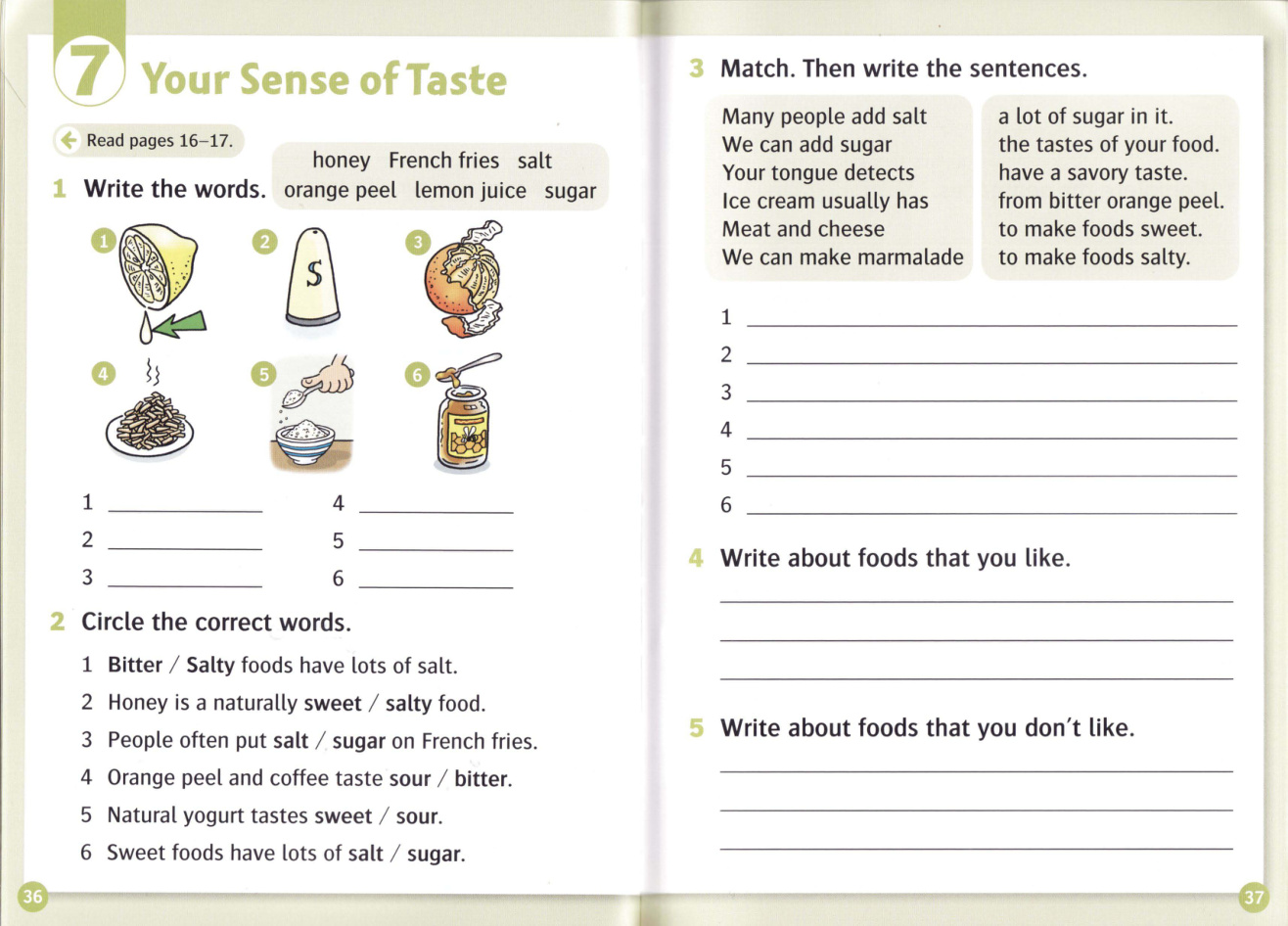
1. Write the six taste words.
2. Bitter / Salty foods have lots of salt.
3. Honey is a naturally sweet / salty food.
4. People often put salt / sugar on French fries.
5. Orange peel and coffee taste sour / bitter.
6. Natural yogurt tastes sweet / sour.
7. Sweet foods have lots of salt / sugar.
8. Match the sentence beginnings and endings.
9. Write about foods that you like.
Câu trả lời tự do — không tính vào điểm.10. Write about foods that you don't like.
Câu trả lời tự do — không tính vào điểm.On Your Tongue
1 Đọc trang sách
2 Đọc & Nghe
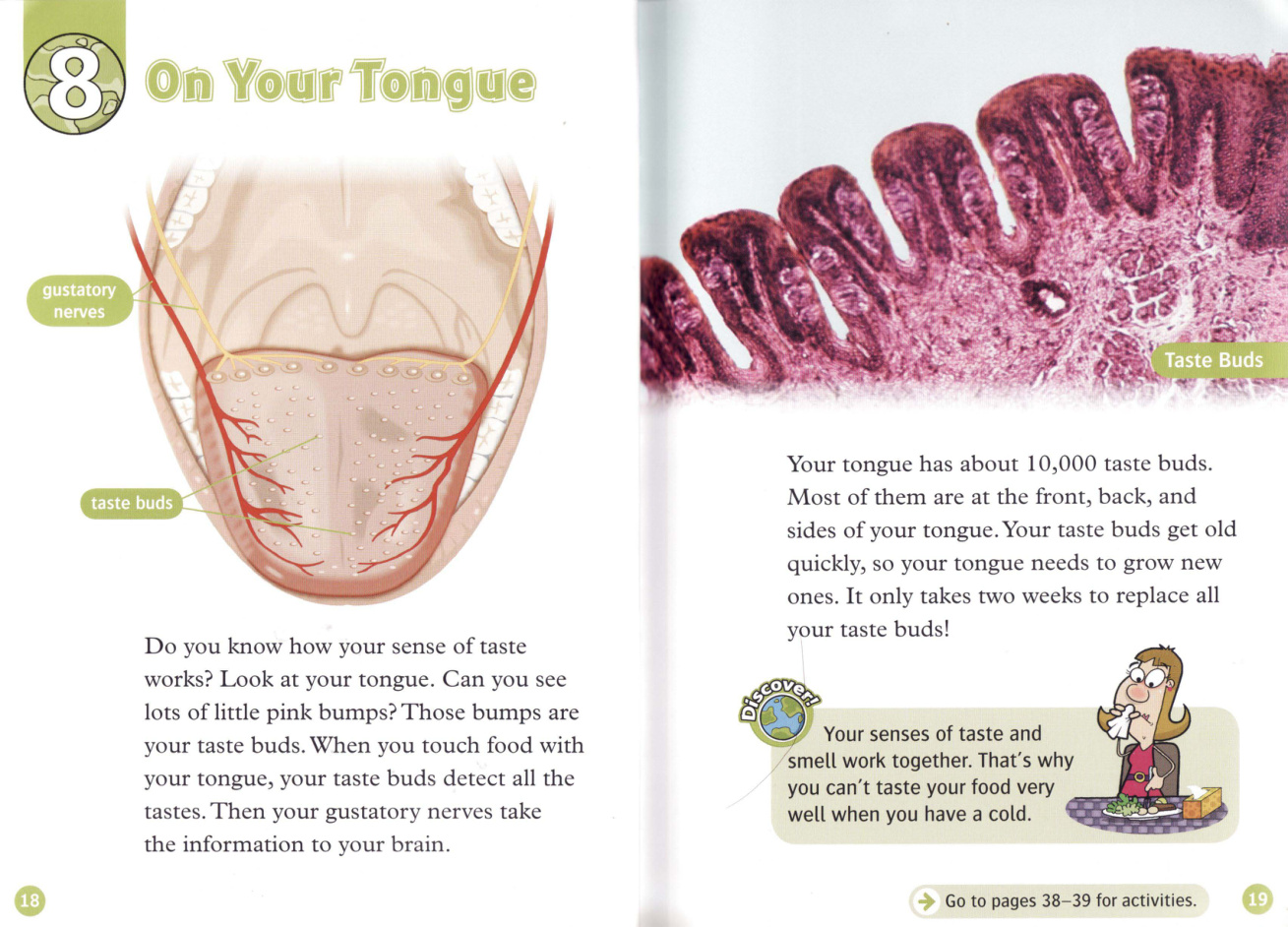
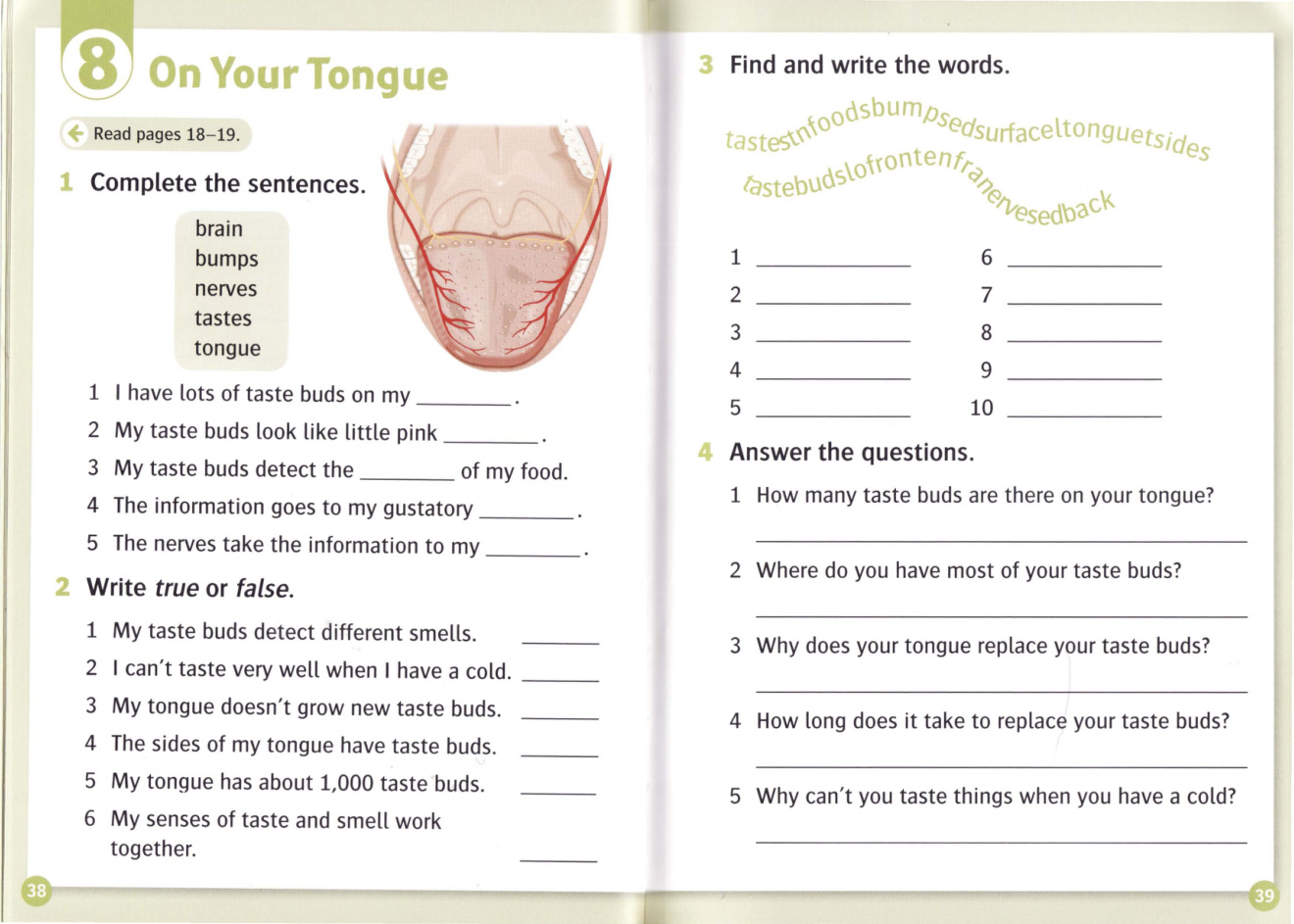
Look at your tongue. Can you see lots of little pink bumps? Those bumps are your taste buds.
When you touch food with your tongue, your taste buds detect all the tastes.
Then your gustatory nerves take the information to your brain.
Your tongue has about 10,000 taste buds.
Most of them are at the front, back, and sides of your tongue.
Your taste buds get old quickly, so your tongue needs to grow new ones.
It only takes two weeks to replace all your taste buds.
Your senses of taste and smell work together. That's why you can't taste your food very well when you have a cold.
Từ vựng
3 Xem trang bài tập
4 Bài tập tương tác
1. I have lots of taste buds on my _____.
2. My taste buds look like little pink _____.
3. My taste buds detect the _____ of my food.
4. The information goes to my gustatory _____.
5. The nerves take the information to my _____.
6. My taste buds detect different smells.
7. I can't taste very well when I have a cold.
8. My tongue doesn't grow new taste buds.
9. The sides of my tongue have taste buds.
10. My tongue has about 1,000 taste buds.
11. My senses of taste and smell work together.
12. Find ten tongue/taste words.
13. How many taste buds are there on your tongue?
14. Where do you have most of your taste buds?
15. Why does your tongue replace your taste buds?
16. How long does it take to replace your taste buds?
17. Why can't you taste things well when you have a cold?
Your Sense of Touch
1 Đọc trang sách
2 Đọc & Nghe
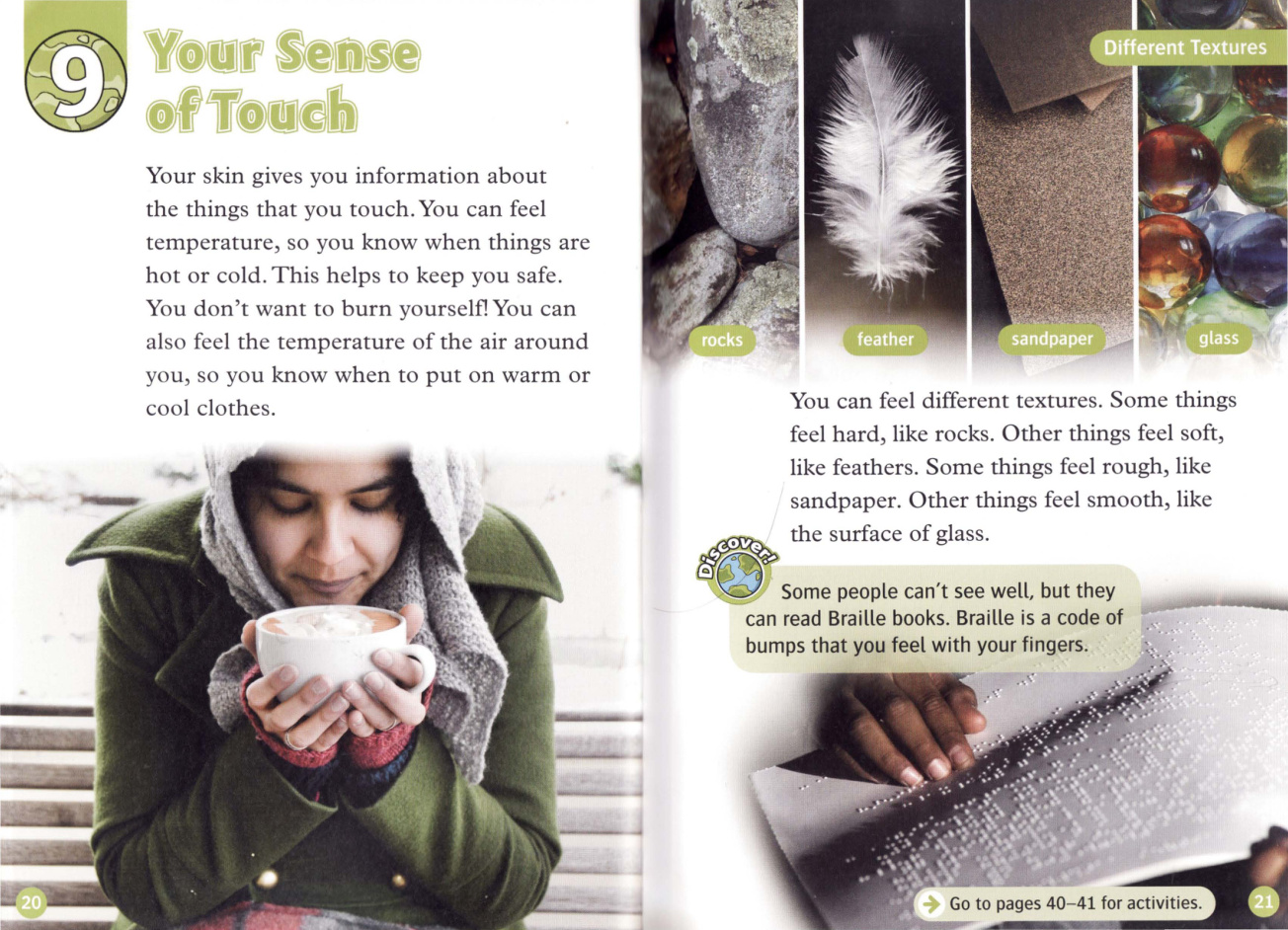
Your skin gives you information about the things that you touch.
You can feel temperature, so you know when things are hot or cold. This helps to keep you safe.
You can also feel the temperature of the air around you, so you know when to put on warm or cool clothes.
You can feel different textures. Some things feel hard, like rocks. Other things feel soft, like feathers.
Some things feel rough, like sandpaper. Other things feel smooth, like the surface of glass.
Some people can't see well, but they can read Braille books. Braille is a code of bumps that you feel with your fingers.
Từ vựng
3 Xem trang bài tập

4 Bài tập tương tác
1. Write the six touch-description words.
2. ice cream / fire / ice – choose the odd one out
3. bumps / sandpaper / glass – choose the odd one out
4. rocks / feathers / glass – choose the odd one out
5. A rock feels hard / soft when you touch it.
6. Ice cream feels hot / cold on my tongue.
7. A cat's tongue feels smooth / rough.
8. Fresh pizza feels hot / cold when I touch it.
9. The surface of a mirror feels rough / smooth.
10. My bed feels soft / hard and comfortable.
11. Find ten touch words.
Under Your Skin
1 Đọc trang sách
2 Đọc & Nghe
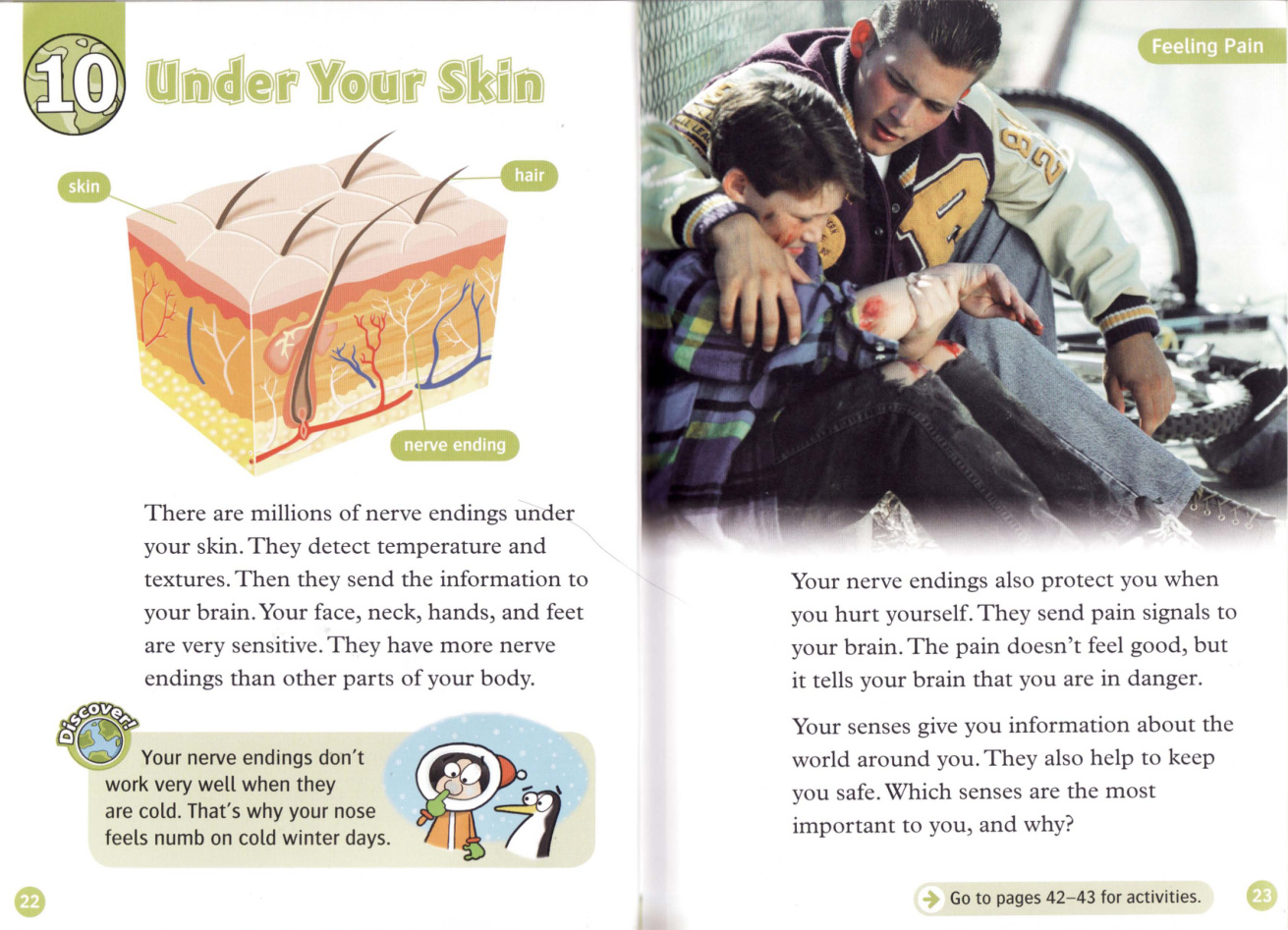
There are millions of nerve endings under your skin. They detect temperature and textures. Then they send the information to your brain.
Your face, neck, hands, and feet are very sensitive. They have more nerve endings than other parts of your body.
Your nerve endings don't work very well when they are cold. That's why your nose feels numb on cold winter days.
Your nerve endings also protect you when you hurt yourself. They send pain signals to your brain.
The pain doesn't feel good, but it tells your brain that you are in danger.
Your senses give you information about the world around you. They also help to keep you safe.
Từ vựng
3 Xem trang bài tập

4 Bài tập tương tác
1. Write the four sensitive body-part words.
2. Match the beginnings and endings.
3. My sense of _____ helps to keep me _____.
4. My nerve _____ are under my _____.
5. Pain _____ tell my brain that I'm in _____.
6. My _____ sometimes feels _____ on cold days.
7. It doesn't _____ good when I _____ myself.
8. Complete the five-senses review puzzle.
- 1 Hàng ngang: I taste with my ___.
- 2 Hàng ngang: I can see with my ___.
- 3 Hàng ngang: Some ___ are loud.
- 4 Hàng ngang: My nose has two ___.
- 5 Hàng ngang: Orange peel tastes ___.
- 6 Hàng ngang: The ___ detects light.
- 7 Hàng ngang: I can feel different ___.
- 8 Hàng ngang: The ___ is a spiral tube.
- 9 Hàng ngang: A mirror feels ___.
- 10 Hàng ngang: ___ smells good.
Projects
Trang dự án
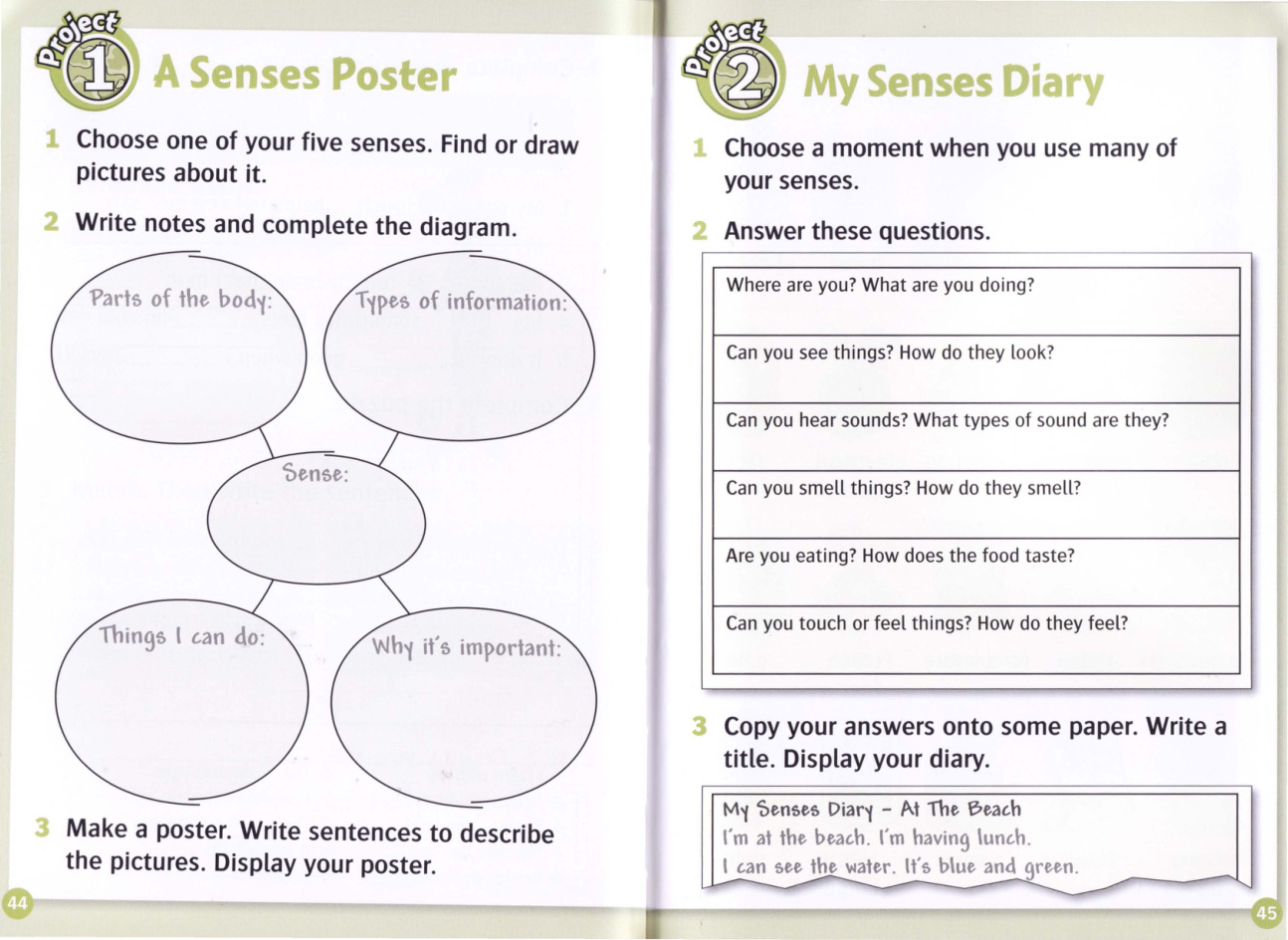
Project 1: A Senses Poster – choose one sense, add pictures, note body parts, types of information, things you can do, and why the sense is important. Project 2: My Senses Diary – choose a moment when you use many senses, answer questions about sight, hearing, smell, taste, and touch, then display the diary.
Từ điển tranh
Từ điển tranh